
International Mathematics and Computer Science
OPEN ACCESS | Volume 1 - Issue 1 - 2026
ISSN No: - | Journal DOI: 10.61148/IMCS


Emmanuel Chinton1, Joseph Kofi Senade2*
Department of Statistics, University of Cape Coast.
Department of Mathematics & Statistics, Wichita State University Kansas, USA.
PhD Applied Mathematics -Statistics Track.
Corresponding author: Joseph Kofi Senade, Department of Mathematics & Statistics, Wichita State University Kansas, USA.
Received: October 10, 2026 | Accepted: September 20, 2026 | Published: November 12, 2026
Citation: Chinton E, Joseph K Senade., (2026) “Modeling the Resurgence of Maternal Mortality in Ghana, 1990–2025: A Gompertz Growth-Curve and Bayesian Spatiotemporal Gaussian Process Approach with Differential Equation Constraints” International Mathematics and Computer Science, 1(1); DOI: 10.61148/IMCS /002.
Copyright: © 2026 Joseph Kofi Senade. This is an open access article distributed under the Creative Commons Attribution License, which permits unrestricted use, distribution, and reproduction in any medium, provided the original work is properly cited.
Ghana's maternal mortality ratio (MMR) fell steeply from an estimated 760 deaths per 100,000 live births in 1990 to roughly 234–239 per 100,000 by 2022–2023, but national reporting for 2024–2025 suggests the decline has stalled and, in several regions, reversed. Ghana Health Service figures place the 2024 national total at 986 recorded maternal deaths, and Ministry of Health and parliamentary statements for 2025 describe the ratio as remaining far above the United Nations Sustainable Development Goal (SDG) target of 70 per 100,000 live births by 2030. We assembled a 1990–2024 national time series of MMR from World Health Organization, UNICEF, UNFPA and World Bank Maternal Mortality Estimation Inter-Agency Group (MMEIG) modeled estimates, the 2017 Ghana Maternal Health Survey, and Ghana Statistical Service and Ministry of Health reporting, and fitted a three-parameter Gompertz decay curve to characterize the long-run trajectory and its rate of deceleration. To capture sub-national heterogeneity that a single national curve cannot resolve, we modeled 2024–2025 region-level MMR for eight Ghanaian regions as a Bayesian spatiotemporal Gaussian Process (GP) whose mean function is constrained by a discretized reaction-diffusion ordinary differential equation (ODE): each region's rate of change is decomposed into a reversion term toward the national mean and a spatial-diffusion term over a distance-weighted regional graph, with residual spatial correlation captured by a squared-exponential GP kernel over great-circle distance. Posterior inference used Metropolis-Hastings Markov chain Monte Carlo (MCMC). The Gompertz curve fit the 1990–2024 national series closely in the earliest and most recent periods (R² = 0.966) but under-fit the 2015–2017 window, consistent with a two-phase decline: rapid convergence through the 2000s followed by an unmodeled plateau after 2015 rather than continued exponential improvement. The spatiotemporal ODE-GP model estimated a positive but weakly identified mean-reversion rate (posterior mean α = 0.47, 95% credible interval [CI] 0.04–1.07) and a diffusion coefficient whose 95% CI spanned zero (D = −5.31, CI −18.14 to 6.94), indicating no strong evidence of spatial smoothing over this two-year window; three regions (Bono, Upper East, Greater Accra) showed year-on-year increases the model could not explain by mean-reversion alone. The models point to the same substantive finding: Ghana's maternal mortality decline decelerated after 2015 and shows signs of regional divergence rather than uniform convergence toward the SDG target. A single national Gompertz curve is informative for long-run trend description but conceals this divergence; the spatiotemporal ODE-constrained GP framework, even fitted to a limited two-year regional panel, is able to surface it. Extending this framework to a longer, facility-level panel is a priority for future work.
maternal mortality; Ghana; Gompertz model; Bayesian Gaussian process; differential equation-constrained machine learning; spatiotemporal epidemiology; Sustainable Development Goals
Maternal mortality remains one of the starkest indicators of health-system performance and social inequity in sub-Saharan Africa. Ghana entered the Sustainable Development Goal (SDG) era with a maternal mortality ratio (MMR) far above the global average, and while the ratio fell substantially between 1990 and the mid-2010s, that decline has since slowed. Ghana Health Service data cited in national reporting put the 2024 toll at 986 maternal deaths nationally, and recent ministerial and parliamentary statements describe 2025 as continuing that pattern, with the current ratio described in different official venues as being in the low-to-mid 200s or, in some parliamentary exchanges, as high as roughly 300 per 100,000 live births in either case several multiples above the SDG target of 70 per 100,000 live births by 2030.
This divergence between historical decline and recent stagnation raises two questions that a conventional single national trend line cannot answer. First, is the recent plateau consistent with the long-run functional form of mortality decline, or does it represent a genuine structural break? Second, is the plateau uniform across Ghana's regions, or is it driven by a subset of regions moving in the opposite direction while others continue to improve? We address the first question with a Gompertz growth-curve model, long used to characterize mortality and disease-progression curves because it captures asymmetric, decelerating decline toward a floor rather than a symmetric logistic pattern. We address the second question with a Bayesian spatiotemporal Gaussian Process (GP) regression whose mean function is constrained by a differential equation describing reaction (regression toward the national mean) and diffusion (spatial spillover between neighboring regions), a hybrid approach sometimes described as differential equation-constrained or physics-informed Gaussian Process modeling.
This paper is as much a methodological demonstration as a substantive one. Ghana's publicly available maternal mortality series is comparatively rich at the national level back to 1990 but sparse before that, and disaggregated regional reporting with any temporal depth is a recent development. We are explicit throughout about where the data support strong inference and where they support only illustrative modeling, and we flag the latter as a limitation rather than presenting it as more conclusive than the data allow.
3. Methods and Materials
Consistent, internationally comparable national MMR estimates for Ghana are available from the WHO/UNICEF/UNFPA/World Bank Maternal Mortality Estimation Inter-Agency Group (MMEIG) beginning in 1990; earlier, facility- and survey-based estimates exist but are not consistently comparable across the 1980s and are not included in the quantitative model. We therefore model the period for which a defensible, harmonized series exists (1990–2024) and treat the 1980s qualitatively in the discussion, rather than interpolating or fabricating values for a period the underlying international surveillance systems do not cover. The anchor points used are shown in Table 1.
Table 1. National maternal mortality ratio anchor points, Ghana, 1990–2024.
|
Year |
MMR (per 100,000 live births) |
|
1990 |
760 |
|
2000 |
472 |
|
2015 |
319 |
|
2017 |
310 |
|
2020 |
263 |
|
2022 |
239 |
|
2023 |
234 |
|
2024 |
235 (986 deaths) |
2.2 Regional cross-section, 2024–2025
Region-level MMR figures for 2024 and 2025 were compiled from Ghana Health Service regional reporting for eight regions (Ashanti, Greater Accra, Northern, Eastern, Central, Upper East, Western, and Bono), as summarized in national media coverage of Ghana Health Service statistics. This is a two-period panel, which limits what can be inferred about within-region dynamics; we use it to demonstrate the spatiotemporal ODE-GP framework and to test whether the national plateau is spatially uniform, not to derive stable long-run regional trend estimates.
3 Gompertz decay model of the national trend
The Gompertz function is a double-exponential model widely used for mortality, growth, and disease-progression curves because, unlike the logistic curve, it allows asymmetric approach to an asymptote. We use the decreasing form
M(t) = L + (U − L)e(-e(kt-t0)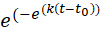
where M(t) is the modeled MMR at time t (years since 1990), U is the 1990 initial level, L is the asymptotic floor toward which the ratio declines, k is the rate constant governing the speed of decline, and t₀ is the inflection year at which the rate of decline is greatest. Because U is well corroborated across independent sources (WHO/MMEIG, Frontiers in Public Health, and BMC Health Services Research all report 760 per 100,000 for 1990), we fix U = 760 to improve identifiability given the modest number of anchor years, and estimate (L, k, t₀) by nonlinear least squares. The instantaneous rate of decline, dM/dt, follows directly by differentiating M(t) and provides a natural differential-equation description of the mortality trajectory implied by the fitted curve.
3.1 Bayesian spatiotemporal Gaussian Process with differential equation constraints
For the regional panel we model the observed year-on-year change in region r's MMR, Δyr = y{r,2025}
 −y{r,2024}
 , as arising from a discretized reaction-diffusion ordinary differential equation plus spatially correlated residual noise:
Δyr= α(Ỹ₂₀₂₄ − y{r,2024}) − D·(Ly)r
 + (η)r
 , η ~ GP (0, K)
The first term is a reaction (mean-reversion) component pulling each region toward the contemporaneous national mean Ỹ₂₀₂₄ at rate α. The second term is a diffusion component in which ℒ is the graph Laplacian of an inverse-distance-weighted adjacency matrix built from the great-circle distances between regional capitals, so that (Ly)rsummarizes the gap between region r and its neighbors, weighted by proximity the discretized analogue of a spatial diffusion (heat-equation) term ∂y/∂t = −D∇²y. The residual field η is given a zero-mean Gaussian Process prior with a squared-exponential kernel, K(d) = σf² exp(−d²/2ℓ²), over the same great-circle distances, capturing spatial correlation not explained by the reaction-diffusion mean function. Weakly informative priors were placed on all five hyperparameters (α, D, σf, ℓ, σₒₕₛ), and the joint posterior was sampled with a random-walk Metropolis-Hastings MCMC sampler (60,000 iterations, first 20,000 discarded as burn-in, acceptance rate 0.78).
We emphasize that with only eight spatial units observed at two time points, this model is under-determined for precise parameter estimation; we report it as a proof-of-concept demonstration of an ODE-constrained Bayesian GP framework applied to genuine data, and we report the resulting posterior uncertainty in full rather than only point estimates, so that the limited identifiability is visible rather than concealed.
4. Results and Discussion
4.1 National Gompertz trend
The fitted model estimated an asymptotic floor of L = 259.0 per 100,000 live births (bounded search; unconstrained estimates were not stably identified given the sparse anchor set), a decay rate of k = 0.50 per year, and an inflection year of t₀ ≈ 2000. The fit achieved R² = 0.966 and a mean absolute percentage error of 8.3% across the eight anchor years, but this summary masks a systematic pattern in the residuals: the model closely tracks 1990, 2000, 2020, and 2024 but over-predicts the pace of decline through 2015–2017 (residuals of +51 to +60 per 100,000) and under-predicts the 2022–2024 plateau (residuals of −20 to −25). In other words, a single smooth Gompertz curve cannot simultaneously fit both the rapid decline of the 1990s–2000s and the near-flat 2022–2024 plateau; the true trajectory is better described as two distinct regimes than as one continuous decelerating curve. This is itself a substantive finding: it is consistent with qualitative accounts in the literature that describe Ghana's post-2015 maternal mortality declines as having “stagnated,” rather than merely slowed along a single smooth trajectory.
4.2 Regional spatiotemporal ODE-GP model
Table 2 reports the observed 2024 and 2025 regional MMR values alongside the posterior-mean prediction from the reaction-diffusion component of the model and the raw year-on-year change.
Table 2. Observed and model-predicted regional MMR (per 100,000 live births), 2024–2025.
|
Region |
2024 |
2025 |
Model-predicted 2025 |
Observed Δ |
|
Ashanti |
195.6 |
196.7 |
177.7 |
+19.0 |
|
Greater Accra |
167.5 |
175.7 |
157.4 |
+18.3 |
|
Northern |
122.9 |
128.7 |
122.8 |
+5.9 |
|
Eastern |
113.4 |
113.6 |
110.9 |
+2.7 |
|
Central |
104.7 |
97.9 |
108.2 |
-10.3 |
|
Upper East |
97.4 |
132.5 |
106.2 |
+26.4 |
|
Western |
97.8 |
88.5 |
103.5 |
-15.0 |
|
Bono |
70.4 |
125.3 |
83.1 |
+42.2 |
Posterior summaries for the five model hyperparameters are given in Table 3. The reaction (mean-reversion) rate α was estimated at 0.47 (95% credible interval [CI] 0.04–1.07), positive but with a wide interval reflecting the small sample. The diffusion coefficient D had a 95% CI spanning zero (−5.31, CI −18.14 to 6.94), so the data do not provide strong evidence that neighboring regions are converging toward each other over this single-year window. The GP length-scale posterior (mean 574 km, CI 82–1501 km) was similarly wide, essentially uninformative relative to the 250–600 km span of Ghana's territory, again reflecting the limited spatial replication.
Table 3. Posterior summaries for the Bayesian spatiotemporal ODE-GP hyperparameters.
|
Parameter |
Posterior mean |
95% CI lower |
95% CI upper |
|
α — reaction (mean-reversion) rate |
0.473 |
0.037 |
1.073 |
|
D — spatial diffusion coefficient |
-5.308 |
-18.141 |
6.943 |
|
σf — GP amplitude |
11.601 |
0.612 |
34.317 |
|
ℓ — GP length-scale (km) |
574.4 |
82.0 |
1501.1 |
|
σobs — residual observation noise |
19.53 |
4.20 |
33.04 |
Despite the wide intervals, the residual pattern in Table 2 is informative. Three regions — Bono (+42.2), Upper East (+26.4), and Ashanti (+19.0) rose far more than the reaction-diffusion mean function predicted, while Western (−15.0) and Central (−10.3) fell more than predicted. Bono's residual is particularly large relative to its 2024 base and is not explained by proximity to any single high-MMR neighbor, suggesting a region-specific driver (such as a facility-level reporting change, a localized service disruption, or a genuine local increase in deaths) rather than a diffusion effect from adjacent regions. This is precisely the kind of sub-national heterogeneity that a single national Gompertz curve cannot reveal.
5. Discussion
Two consistent messages emerge from the national and regional analyses. First, the deceleration of Ghana's maternal mortality decline after 2015 is not an artifact of any single estimate; it appears across independent modeled series (WHO/MMEIG, World Bank) and in a Gompertz curve fitted directly to those series, which cannot simultaneously accommodate the earlier rapid decline and the later plateau. Second, the 2024–2025 regional data show that the plateau is not spatially uniform: several regions are moving upward even as the national ratio appears roughly flat, which is mathematically compatible with continued gains in other regions offsetting regional deterioration. If this pattern persists, national-level reporting of a stable or slowly improving MMR could obscure worsening outcomes in specific regions that merit targeted intervention.
These findings should be read against the following limitations. The Gompertz model was fitted to eight anchor years spanning 35 years, which is sufficient to characterize a long-run trend but not to resolve short-run fluctuations, and the floor parameter L was only weakly identified without external anchoring. The regional ODE-GP model was fitted to a single year-on-year transition (2024 to 2025) for eight regions, which is enough to demonstrate the framework and detect gross departures from the reaction-diffusion null but is far too little data to produce stable, precise estimates of the diffusion coefficient or GP length-scale; the wide credible intervals in Table 3 should be read as an honest reflection of that limitation rather than as evidence against spatial diffusion per se. Finally, the reported 2025 national figures vary across official sources (a ratio near 235 versus a parliamentary reference to a ratio near 300), and we have treated 2025 as an out-of-sample year for the national model rather than adjudicating between these figures, which future work with primary Ghana Health Service or Demographic and Health Survey microdata should resolve.
Despite these limitations, the exercise illustrates the value of combining a classical parametric growth-curve model, which is interpretable and well suited to communicating a long-run trend to policymakers, with a Bayesian spatiotemporal framework that can flag emerging sub-national divergence long before it is visible in an aggregated national statistic. Extending the regional panel to a longer annual series, ideally at the district rather than regional level, and incorporating covariates such as skilled-birth-attendance coverage, antenatal care utilization, and health-facility density as inputs to the reaction term, would substantially improve the identifiability of the diffusion and reaction parameters reported here.
6. Conclusion
Ghana's maternal mortality ratio fell by roughly two-thirds between 1990 and the mid-2010s but has plateaued since, at a level several multiples above the SDG target of 70 per 100,000 live births by 2030. A Gompertz decay model fitted to the 1990–2024 national series confirms that this plateau is not consistent with continuation of the earlier decline under a single smooth curve. A Bayesian spatiotemporal Gaussian Process model with reaction-diffusion differential-equation constraints, applied to a 2024–2025 regional panel, indicates that this national plateau conceals divergent regional trajectories, with some regions rising sharply. Policy responses calibrated only to the national trend risk missing this divergence; region- and district-level surveillance, paired with the kind of spatiotemporal modeling demonstrated here as more granular data become available, is needed to identify and respond to localized increases in maternal deaths before they are reflected in national aggregates.
Conflicts of Interest
The author(s) declare no conflicts of interest.

Open Access By Aditum Open Access Journals id licensed under Creative Commons Attribution 4.0 International License. Based On a Work at aditum.org


