
Ophthalmology and Vision Care
OPEN ACCESS | Volume 6 - Issue 1 - 2026
ISSN No: 2836-2853 | Journal DOI: 10.61148/2836-2853/OVC


Yaghoobi Gholamhossein
Birjand University of Medical Science. Department of ophthalmology, Razi Hospital, Birjand. IRAN.
*Corresponding author: Yaghoobi Gholamhossein, Birjand University of Medical Science. Department of ophthalmology, Razi Hospital, Birjand. IRAN.
Received: January 20, 2026 | Accepted: June 01, 2026 | Published: June 22, 2026
Citation: Gholamhossein Y, (2026). “A Mini Review of Ocular Toxoplasmosis and Report of Two Cases” Ophthalmology and Vision Care, 6(1); DOI: 10.61148/2836-2853/OVC/070.
Copyright: © 2026 Yaghoobi Gholamhossein. Shahsuvaryan. This is an open access article distributed under the Creative Commons Attribution License, which permits unrestricted use, distribution, and reproduction in any medium, provided the original work is properly cited.
Introduction: Toxoplasma gondii (T. gondii) infections affect the population worldwide. This parasite have a spectrum of ocular involvement that some time clinical feature is characteristic but occasionally mimicking any kind of inflammation which result in long-term and often irreversible effects.
Case reports: A 60-year-old man complain of left eye visual impairment. The ophthalmic examination showed retinochoroidal lesion indeed of old scar so,diagnosis of toxoplasmosis retinochoroiditisv suggested. The patient underwent of co-trimoxazol 800 mg twice daily that respond to it. The other case 23 years old man 7 years ago treated with the same without any relapse.
Discussion: This is our goal in concept of prevention beter of treatment. Therefore for this purpose it needed to obtain epidemiology of disease, distribution and clinical assessment in which knows position out breaking, eradication or controlling.Therfore describing of any aspect of disease from diagnostic approach and other specialty of this parasite could be helpful in monitoring programs.
Ocular Toxoplasmosis
Toxoplasma gondii (T. gondii) infections affect approximately 30% of the world's population. uveitis and lesions of eye can be acute or recurrent after infection, leading to long-term and often irreversible effects. A uniform diagnostic approach is found only in articles describing the population of congenital cases resulting from toxoplasmosis surveillance programs. Consistent use of nomenclature, consistent diagnostic testing, and standardized reporting of patient population data by researchers would greatly contribute to understanding the burden of disease experienced.1
Toxoplasmosis is a parasitic infection caused by Toxoplasma gondii, an obligate intracellular protozoan that can infect a wide range of mammals and birds. Although often asymptomatic, this infection can have serious consequences, particularly when it affects the eyes, where it is known as chorioretinal toxoplasmosis. This form of the disease is one of the main causes of retinitis and blindness in developing countries which is a major public health problem, particularly in immunocompromised patients and infants infected in utero.2
A study published by Jitender P. Dubey, entitled "The Prevalence of Clinical Toxoplasmosis in Humans: Five Decades of Personal Experience, Perspectives, and Lessons Learned," hypothesized that clinical disease is more common than reported. The two main sources of postnatal transmission of Toxoplasma gondii are through ingestion of contaminated meat or food and water contaminated with oocysts. The infectious dose and incubation period of Toxoplasma gondii infection are unknown because there are no human volunteer trials. The parasites responsible for three outbreaks (in Brazil, Canada, and India) are suspected to have a genetic predisposition to causing eye disease. As outbreaks that affect some (but not all) of the people who consume a meal of contaminated meat suggest, only a small number of Toxoplasma gondii tissue cysts may be sufficient to cause infection. Therefore, the high frequency of human toxoplasmosis in Brazil is related to environmental pollution, poor hygiene, socioeconomic conditions, or Toxoplasma gondii genotypes, which needs to be investigated.3
Case report:
This case was a recurrent of retinochoroiditis in a 60-year-old man with poor follow-up which attended to eye clinic by reduced vision in right eye without any other problem. Ophthalmological examination revealed a corrected visual acuity of 10/10 for the right eye (OD) and 1/10 for the left eye (OS), the anterior segment and lenses were clear in both eyes. Fundus examination revealed a focus of whitish retino-choroiditis in the left eye, with blurred margins with adjacent old scarring.(Figure 1.)
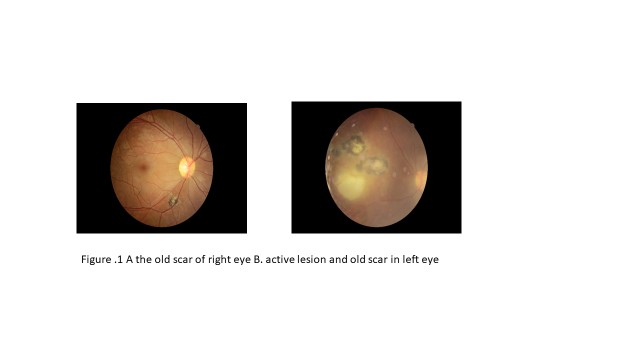
In OS. The right eye fundoscopic finding showed clear vitreous accompany old scar.The characteristic feature of retinochoroiditis confirm toxoplasmic retinochoroiditis.The patient received co trimoxazol 800 mg twice daily four weeks indeed of oral prednisolon therapy (0.5 mg/Kg/day) started 48 hours after initiation of antiparasitic treatment.The steroid gradually taper and discontinued after two weeks.The chorioretinal inflammation regression occurred accompanying improvement of vision.
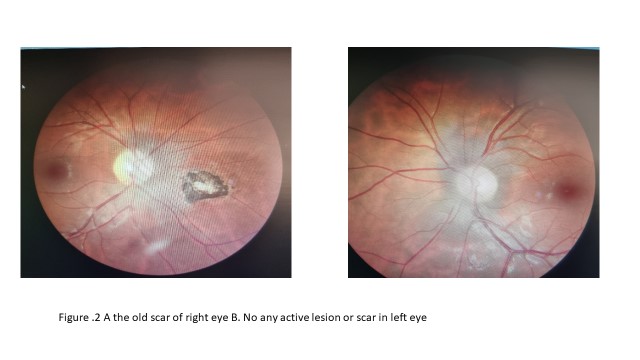
Figure 2 showed the Right eye fundoscopic feature and clear vitreous accompany only old scar and the left eye fundus were normal although seven years ago the scarified lesion of right eye were active retinochoroiditis that had been treated.
Discussion:
Ocular toxoplasmosis is an infectious retinochoroiditis. This is second to our previous publication of three case description that two cases observed during of recent years and the other one were affected many years ago. This case was interesting that in spite of old scare in both retina but the right eye only develop active recurrent retinochoroiditis but the other eye not showed any ocular inflammation or recurrence of retinochoroiditi. So this report is alliance to inquiry about of binocular old scar but recurrence in right eye that may be related to genetic or other influencing causes versus the other case in this report showed that it passed 7 years of treatment but did not have recurrent a similar to this case also Lune, et al reported that it had macula involvement.4
Putera et al. describe Controversy and consensus on the management of ocular toxoplasmosis also. Ocular toxoplasmosis is a leading cause of infectious posterior uveitis worldwide. In spite of progression in diagnostic approach but it have various clinical presentation. Controversies were identified from previous surveys on OT management, Key consensus findings include support for anti parasitic therapy in most active cases, selective use of polymerase chain reaction (PCR) testing for atypical presentations, and prophylactic therapy in high-risk scenarios.5 This two cases report also have awareness on knowledge in prevention strategy, any paper have message from author although it may be a repetition message that not forgotten it but the author opinion who again reported was emphasis on this specific problem to tray cur which is most difficult and prevention protocol employment. .Hence it needed to do a hospital base or epidemiological survey to understand ocular toxoplasmosis is actually decreasing or raising?



Open Access By Aditum Open Access Journals id licensed under Creative Commons Attribution 4.0 International License. Based On a Work at aditum.org


