
Nursing and Healthcare Research
OPEN ACCESS | Volume 3 - Issue 1 - 2026
ISSN No: 3065-7679 | Journal DOI: 10.61148/3065-7679/NHR


Hanan Elzeblawy Hassan1*, Hend Eweis Saad2, Hanan Amin Ali Gaafr3, Amal Ahmed Hassan Omran4
1Professor of Maternal and Newborn Health Nursing, Faculty of Nursing, Beni-Suef University, Egypt.
2Assistant Lecturer of Maternity & Newborn Health Nursing, Faculty of Nursing, Beni-Suef University, Egypt.
3Assistant Professor of Obstetrics & Gynecological Nursing, Faculty of Nursing, Benha University, Egypt.
4Professor of Obstetrics & gynecological Nursing, Faculty of Nursing , Benha University, Egypt.
*Corresponding author: Hanan Elzeblawy Hassan, Professor of Maternal and Newborn Health Nursing, Faculty of Nursing, Beni-Suef University, Egypt.
Received: January 20, 2026 | Accepted: February 21, 2026 | Published: February 23, 2026
Citation: Hanan E Hassan, Hend E Saad, Ali Gaafr HA, Hassan Omran AA., (2026) “First Stage of Normal Labor: Impact of Instructional Package on Nursing performance” Nursing and Healthcare Research, 3(1); DOI: 10.61148/3065-7679/NHR/033.
Copyright: © 2026 Hanan Elzeblawy Hassan. This is an open access article distributed under the Creative Commons Attribution License, which permits unrestricted use, distribution, and reproduction in any medium, provided the original work is properly cited.
Background: Normal labor is a crucial physiological process influenced by cultural, psychological, spiritual, and behavioral factors in a woman's life. It is unique to each individual, necessitating continuous assessment and suitable interventions for positive outcomes during labor. Aim: evaluate the effect of the instructional package on nursing performance regarding the first stage of labor. Subjects and Methods: Design: A quasi-experimental design with a one group pre-posttest was utilized in this study. Setting: The current study was conducted at labor unit at Beni-Suef University Hospital and Beni-Suef Specialist Hospital. Sample: A convenience sample consisting of all 50 maternity nurses was utilized in the current study. Tools: Three tools were utilized for data collection: Tool I, a structured interviewing questionnaire, which includes parts on maternity nurses' knowledge of first-stage normal labor and partograms; Tool II, an observational checklist assessing the practices of maternity nurses; and Tool III, measuring the attitudes of maternity nurses towards nursing care in the first stage of normal labor. Results: 28.0% of them attended training courses regarding the stages of normal labor. Adequate knowledge improved from 10% to 78%, competency of practices improved from 36% to 86%, and positive attitudes improved from 42% to 86% (pre-instruction compared to post-instruction, respectively). Significant correlations among maternity nurses' knowledge, practice, and attitude both pre- and post-instructional package at the 0.01 level (2-tailed). Significant differences in maternity nurses' total knowledge and practice scores post-instructional package related to their attendance in normal labor programs were observed. Conclusion: Instructional package had positive effect on maternity nurse’s performance regarding nursing care of first stage of normal labor and these results support the research hypothesis. Recommendations: Developing periodical sessions to enhance maternity nurses’ knowledge, practices and acquired positive attitudes regarding nursing care of first stage of normal labor.
First Stage of Labor, Instructional Package, Nursing performance
Labor is the series of events by which uterine contractions and abdominal pressure expel the fetus and placenta from the woman’s body [1-3]. Regular contractions cause progressive dilatation of the cervix and sufficient muscular force to allow the baby to be pushed to the outside [4-6]. Regardless of the amount of childbirth preparation and the number of times the women have been through the experience previously, the women need family-focused nursing care, because childbirth marks the beginning of a new family structure [7-10].
Labor starts spontaneously with painful contractions, divided into four stages. The first stage begins with mild and increasingly intense contractions, concluding with a fully dilated cervix. This stage can last from a few hours to several days, influenced by factors such as parity, birth interval, psychological state, fetal position, pelvic dimensions, and contraction characteristics [11-14].
The ongoing education and training of nurses is essential for providing care to pregnant women and improving outcomes for mothers and newborns. An instructional package focusing on obstetrical emergencies is developed to standardize management practices and enhance nurses' competency [15-19]. Various instructional models, such as Merrill’s First Principles of Instruction, emphasize task-centered learning and the importance of engaging nurses with real-world problems [20]. Simulation training is recommended to prevent management failures during labor [21-23]. Effective instructional strategies include establishing high expectations, utilizing multiple grouping methods, creating a safe learning environment, and addressing nurses' misconceptions [24-26]. Moreover, the use of diverse instructional technologies and ensuring nurses take ownership of their learning are vital for successful outcomes [27-20]. Instructional guides should clearly define labor processes and emergency care to support nurses in their crucial role during labor [30-31].
The role of maternity nurses includes assessing women's needs and expectations during labor to empower participation in the childbirth experience. Key identified themes encompass physiologic (nutrition, hygiene, comfort), psychological (empathy, emotional support), informational (understanding labor and policies), communication (interaction with providers), esteem (confidence in decision-making), security (alleviating fears), and medical needs (pain relief) [32-36]. Nursing care during the first stage involves history taking, laboratory tests, physical assessments, identifying estimated due dates, validating the woman's history for fetal risk, conducting examinations, and supporting decisions regarding interventions [37-40].
Nursing roles in the health care system are very important; nurses make up the greatest percentage of health care providers. Instructional packages have become an important subject in nursing and are being integrated into daily practices because of the influences on the capabilities, responsibility, and professional development of nurses. Improving quality of care is essential to ensure women's safety and accelerate reductions in mortality and morbidity [41-45].
AIM OF THE STUDY
The current study aimed to evaluate the effect of the instructional package on nursing performance regarding the first stage of labor.
RESEARCH HYPOTHESIS
Following the implementation of the instructional package, nursing performance (knowledge, practices, and attitude) of the first stage of normal labor will be improved.
SUBJECT AND METHOD
Research design:
A quasi-experimental design with a one group pre-posttest was utilized in this study.
Settings:
The current study was conducted at labor unit at Beni-Suef University Hospital and Beni-Suef Specialist Hospital.
Subjects:
All (50) maternity nurses working in the labor unit at the time of data collection were those 23 nurses from Beni-Suef University Hospital and 27 nurses from Beni-Suef Specialist Hospital.
Tools of data collection:
Three data collection tools were used to carry out the current study.
Tool I: A Structured Interviewing Questionnaire
This tool was developed by a researcher by reviewing current and previous literature and translated into Arabic. It consists of three parts: Part 1 focuses on the general characteristics of maternity nurses, including their training on normal labor stages. Part 2 assesses maternity nurses' knowledge about nursing care during the first stages of normal labor through 11 questions that cover definitions, signs, symptoms, and mechanisms of normal labor.
Knowledge scoring system:
Each item was scored based on responses: complete correct answer (2 points), incomplete correct answer (1 point), and incorrect or "don't know" (0 points). Total scores for each knowledge section were summed and averaged, resulting in a mean score. Knowledge levels were categorized as adequate (≥60%) or inadequate (<60%).
Tool II: Observational checklist
This tool was developed to evaluate maternity nurses' practices during the first stage of normal labor, based on a review of related literature. The assessment includes four parts: Part I consists of an 8-step checklist addressing tasks such as greeting the mother and practicing hygiene. Part II employs an 18-step checklist for Leopold's maneuver, covering aspects such as palpation and auscultation. Part III features a 25-step checklist for vaginal examinations, focusing on procedural explanations and positioning. Part IV utilizes a 14-step checklist for partogram assessment, monitoring fetal and maternal conditions, and labor progress [46].
Practice scoring system:
The scoring for maternity nurses' practice was determined by assigning a value of (1) for completed practices and (0) for incomplete ones. The total score was averaged by dividing the sum of item scores by the number of items, then converted to percentages. A score of 60% or above indicated satisfactory practice, whereas below 60% was considered unsatisfactory.
Tool III: Attitude scale of maternity nurses
A Likert scale assessed maternity nurses' attitudes towards nursing care during the first stage of normal labor. Responses were rated on a 3-point scale: “1 = disagree,” “2 = uncertain,” and “3 = agree.” Scores were summed, averaged into a mean, and converted to percentages, with a positive attitude indicated by ≥60% and a negative attitude by <60%.
Tools validity:
Revision of assessment tools for content validity was performed by five expert professors in obstetrics and gynecological nursing, emphasizing clarity, relevance, comprehensiveness, understanding, and applicability.
Reliability of the tools:
The study tools showed strong internal consistency, indicated by Cronbach’s Alpha values of 0.951 for knowledge, 0.926 for practice, and 0.853 for attitude.
Ethical considerations:
Ethical approval was obtained from Benha University's Research Ethics Committee REC-OBSN-D2, ensuring privacy and confidentiality. Informed consent was secured from nurse participants, who were also informed of their right to withdraw from the study at any time.
Pilot study:
A pilot study involving 5 nurses evaluated the clarity and feasibility of a structured questionnaire. Data analysis indicated that modifications were necessary for specific knowledge-related questions to enhance their effectiveness in terms of correction, omission, and addition.
Field work:
The study took place from October 2024 to June 2025, with the researcher visiting the study site twice a week. She conducted initial interviews with maternity nurses in a private setting, introducing herself and explaining the study's purpose, duration, and activities. The study was organized into four phases.
Assessment and Planning:
The research assessed maternity nurses' comprehension, practices, and attitudes regarding the first stage of normal labor using a self-administered questionnaire and observational checklists. An instructional package in Arabic was subsequently developed, including theoretical knowledge and practical skills, structured into sessions on educational activities, methodology, media design, and evaluation tools.
Implementation:
The instructional package for nursing participants was structured over four weeks, comprising two theoretical and two practical sessions of 45-60 minutes each. Nurses were divided into five small groups of around ten members. The first session introduced the package, followed by sessions concentrating on feedback and motivation techniques. Various teaching methods, including lectures, discussions, and practical demonstrations, were utilized, alongside a booklet on nursing care for early normal labor to improve understanding and skills.
The theoretical and practical sessions:
In a series of instructional sessions, a researcher covered topics related to labor onset, influential factors, and differentiating true from false labor. Subsequent sessions focused on nursing care in early labor, involving discussions on uterine contractions and nursing methods, followed by implementation talks on abdominal and vaginal examinations. The final session included feedback and re-demonstrations of these procedures, featuring a partogram demonstration.
Evaluation
The evaluation phase, considered a post-test, uses identical tools from the pretest to measure the influence of an instructional package on maternity nurses' knowledge, practices, and attitudes regarding nursing care in the first stage of normal labor. The researcher employed Tool I for knowledge assessment, Tool II for practices, and Tool III for attitudes.
Administrative approval:
Approval for the study was granted by the Dean of the Faculty of Nursing at Benha University, alongside an official request to the directors of Beni-Suef University Hospital and Beni-Suef Specialist Hospital to conduct the study and obtain informed consent prior to data collection.
Statistical item:
The study employed SPSS version 26 for data analysis, using descriptive statistics such as frequencies, percentages, means, and standard deviations. Statistical significance was evaluated through chi-square tests, paired sample t-tests, and Pearson correlation coefficients, with significance levels defined as: P-value >0.05 (Not Significant), P-value ≤0.05 (Statistically Significant), and P-value ≤0.01 (Highly Statistically Significant).
RESULTS
Table (1): Illustrates that 28.0% of them attended training courses regarding the stages of normal labor, 71.4% attended training programs only once or twice, and 57.1% of them attended courses two years ago.
Figure (1): Party's maternity nurses' total knowledge level regarding nursing care of the first stage of normal labor at pre- and post-instructional package; it reveals improvement of adequate knowledge from 10% pre-instruction to 78% post-instruction, with a highly statistically significant difference; p = 0.000.
Figure (2): Presents the studied maternity nurses’ total practice level regarding nursing care of the first stage of normal labor at pre- and post-instructional package. It shows that competency of practices improved from 36% pre-instruction to 86% post-instruction.
Figure (3): shows the studied maternity nurses' total attitude level regarding nursing care of first stage of normal labor at pre and post-instructional package. It clear that nurses’ positive attitudes improved from 42% pre-instruction to 86% post-instruction.
Table (2): indicates significant correlations among maternity nurses' knowledge, practice, and attitude both pre- and post-instructional package, highlighting the effectiveness of the educational intervention.
Table 3 indicates statistically significant differences in the total knowledge scores of maternity nurses’ post-instructional package related to their attendance in normal labor programs. Additionally, significant differences were found in their reported practices before and after the instructional package (P≤0.05). In contrast, no significant differences were noted in their reported attitudes concerning their attendance in normal labor programs.
Table (1): Percentage distribution of attending training courses regarding the stages of normal labor of the studied maternity nurses (n=50).
|
Attending training courses regarding the stages of normal labor (50) |
No. |
% |
|
Yes |
14 |
28.0 |
|
No |
36 |
72.0 |
|
If yes, Number of training times (n=14) |
||
|
1-2 |
10 |
71.4 |
|
≥ 3 |
4 |
28.6 |
|
If yes, How long has the training been (n=14) |
||
|
1-3 years |
8 |
57.1 |
|
≥ 4 years |
6 |
42.9 |
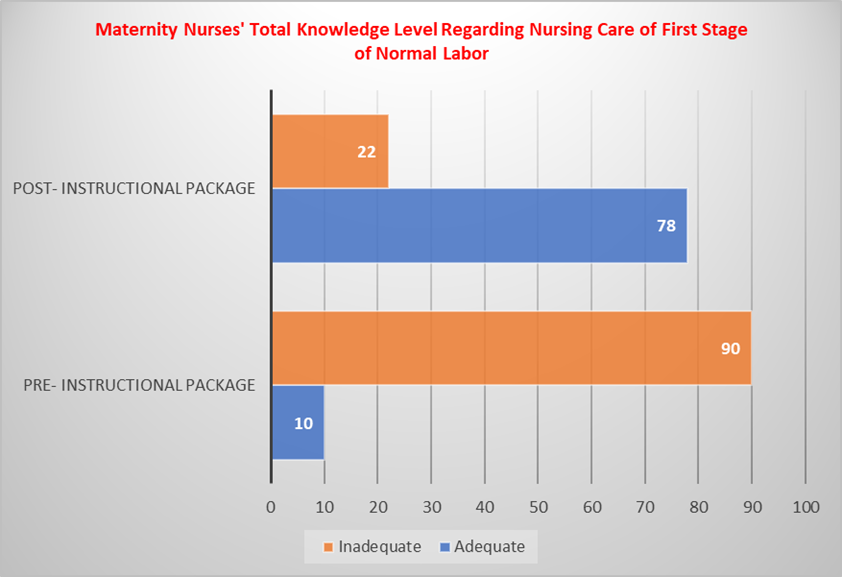
Figure (1): Percentage Distribution of The Studied Maternity Nurses' Total Knowledge Level Regarding Nursing Care of First Stage of Normal Labor at Pre and Post-Instructional Package; X 2 =46.916, P =0.000HS

Figure (2): Percentage Distribution of The Studied Maternity Nurses’ Total Practices Level Regarding Nursing Care of First Stage of Normal Labor at Pre and Post-Instructional Package

Figure (3): Percentage Distribution of The Studied Maternity Nurses' Total Attitude Level Regarding Nursing Care of First Stage of Normal Labor at Pre and Post-Instructional Package
Table (11): Correlation matrix among study variables at pre and post-instructional package
|
Variables |
Total Knowledge |
Total practice |
Total attitude |
||
|
Pre- instructional package |
Total Knowledge |
r |
1 |
0.948 |
0.929 |
|
P-value |
|
0.000** |
0.000** |
||
|
Total practice |
r |
0.948 |
1 |
0.930 |
|
|
P-value |
0.000** |
|
0.000** |
||
|
Total attitude |
r |
0.929 |
0.930 |
1 |
|
|
P-value |
0.000** |
0.000** |
|
||
|
Post- instructional package |
Total Knowledge |
r |
1 |
0.962 |
0.953 |
|
P-value |
|
0.000** |
0.000** |
||
|
Total practice |
r |
0.962 |
1 |
0.952 |
|
|
P-value |
0.000** |
|
0.000** |
||
|
Total attitude |
r |
0.952 |
0.952 |
1 |
|
|
P-value |
0.000** |
0.000** |
|
||
|
** Correlation is significant at the 0.01 level (2-tailed). |
|||||
Table (3): Relation between the studied nurses' total knowledge, practices, and attitude level and their attendance of educational programs of normal labor at pre and post-instructional package
|
Attendance of programs of normal labor |
Pre- instructional package |
P- value |
Post- instructional package |
P- value |
|||||||||
|
????±SD |
test |
????±SD |
test |
||||||||||
|
Knowledge |
Yes |
16.91±6.54 |
t= 0.298 |
0.767 |
50.44±7.41 |
t= 2.754 |
0.008** |
||||||
|
No |
16.35±3.93 |
47.92±8.55 |
|||||||||||
|
Practices |
|
Competent |
Incompetent |
X2/ FET 6.752 |
0.009* |
Competent |
Incompetent |
X2/ FET 7.615 |
0.014* |
||||
|
No |
% |
No |
% |
No |
% |
No |
% |
||||||
|
Yes |
9 |
50.0 |
27 |
84.4 |
34 |
79.1 |
2 |
28.6 |
|||||
|
No |
9 |
50.0 |
5 |
15.6 |
9 |
20.9 |
5 |
71.4 |
|||||
|
Attitude |
|
Positive |
Negative |
X2/ FET 1.439 |
0.230 |
Positive |
Negative |
X2/ FET 3.429 |
0.085 |
||||
|
No |
% |
No |
% |
No |
% |
No |
% |
||||||
|
Yes |
17 |
81.0 |
19 |
65.5 |
33 |
76.7 |
3 |
42.9 |
|||||
|
No |
4 |
19.0 |
10 |
34.5 |
10 |
23.3 |
4 |
57.1 |
|||||
* A statistically significant difference P ≤ 0.05 **A highly statistically significant difference P ≤ 0. 001
DISCUSSION
Labor encompasses various preparatory steps leading to the active phase and is a significant experience for many women. Nurses play a crucial role in supporting women during childbirth by facilitating discussions, providing companionship, listening to concerns, addressing emotional needs, and offering informative assistance throughout the labor stages [47-50].
The current study aimed to evaluate the effect of the instructional package on maternity nurses’ performance regarding nursing care of the first stage of normal labor. The study found that over 75% of nurses had adequate knowledge of nursing care for the first stage of labor after an instructional package. This aligns with findings from Sayed et al. (2023) and Hashem et al. (2023), which also reported similar improvements in knowledge levels post-guideline and training program interventions, respectively [51-52]. The current research revealed a statistically significant difference in knowledge among nurses (P=0.0000), corroborating the results from Ali et al. (2024), which showed a significant increase in knowledge post-intervention, with three-quarters of the nurses demonstrating adequate understanding of the first stage of labor [53].
In the study on nursing care during the first stage of labor, it was found that approximately 75% of nurses exhibited unsatisfactory practices in the pretest phase, whereas over 75% demonstrated satisfactory practices in the posttest. This aligns with findings from Said & Gaafar (2020), which indicated similar trends after supportive nursing instructions regarding electronic fetal monitoring [54]. The current research revealed a highly statistically significant improvement in nursing practices related to the first stage of normal labor (P<0.0000), corroborating Ali et al. (2024), who noted significant enhancements in maternity nurses' performance post-competency-based education (p-value <0.001) [53]. Overall, a notable percentage of nurses achieved satisfactory practices following the interventions.
In a study on nursing care during the first stage of labor, it was found that over three-quarters of nurses exhibited a positive attitude after participating in a post-instructional program. This aligns with findings from Ibrahim et al. (2024) and Hashem et al. (2023) both reporting similar positive attitudes among nurses and care providers towards labor pain management techniques [52, 55]. Melesse et al. (2022) also noted positive attitudes in health care providers regarding labor analgesia, reinforcing the trend observed in the current study [56].
Briefly, the results of the current study declared that the studied nurses’ total knowledge, practices, and attitudes were improved after the implementation of the instructional package; the results indicated that there is progression in nurses’ adequate knowledge, competent practices, and positive attitudes and regression in poor, incompetent, and negative ones. This improvement could be attributed to attending the instructional package; the results indicated that there is progression in nurses’ adequate knowledge, competent practices, and the lecture and positive reinforcement or the long-term retention of knowledge, as well as a wide variety of educational methods used [57-64]. Additionally, the distributed Arabic booklets also played a crucial role in attaining and retaining knowledge. Booklets are best used when they are brief, written in plain language, and full of good pictures and when they are used to back up other forms of education. This is in accordance with Edgar Dale’s or the NTL’s Pyramid of Learning as cited by Masters, as the pyramid illustrated that individuals can retain 10.0% of what they read and 20.0% of what they see and hear (audiovisual). The same author added that one can retain 50.0% of what he learned by a discussion [65-75].
The study reveals a highly significant positive correlation between total knowledge scores, practices scores, and attitudes before and after an instructional package, with a p-value of <0.001. This aligns with findings from Luo et al. (2025), which indicated a similar positive correlation among midwives regarding birth position management (p-value 0.001) [76]. It is further supported by Shahin et al. (2021), who reported a strong positive correlation between nurses’ knowledge and practices in preventing postpartum hemorrhage during labor and the immediate postpartum period.
Current research aligns with findings by Sethi et al. (2019), which showed a positive correlation between nurses' knowledge and practices in maternal and newborn care [77]. This is further supported by Mohamady & Addelfattah (2024), who found a statistically significant positive correlation between nurses' knowledge and their practices following a competency-based education model [78]. Abdelhameed et al. (2025) also indicated a significant positive correlation between knowledge scores and practice scores after an educational program on CTG [79]. The researcher concludes that enhancing nurse knowledge positively influences their practices in normal labor care.
CONCLUSION
Based on the findings of the present study, it can be concluded that instructional package had positive effect on maternity nurse’s performance regarding nursing care of first stage of normal labor, hence, these results support the research hypothesis.
RECOMMENDATION

Open Access By Aditum Open Access Journals id licensed under Creative Commons Attribution 4.0 International License. Based On a Work at aditum.org


