
Nursing and Healthcare Research
OPEN ACCESS | Volume 3 - Issue 1 - 2026
ISSN No: 3065-7679 | Journal DOI: 10.61148/3065-7679/NHR


Fourogh Talaie1*, Rahmatollah Azimi2
1Master of Educational Psychology, Tehran. Iran.
2Child and Adolescent Therapist, Iranian Psychological System Organization No. 2180. Tehran. Iran.
*Corresponding author: Fourogh Talaie, Master of Educational Psychology, Tehran. Iran.
Received: January 25, 2026 | Accepted: February 01, 2026 | Published: February 10, 2026
Citation: Talaie F and Azimi R., (2026) “Predicting Academic Enthusiasm Based on Sports and Critical Thinking in Girl Students” Nursing and Healthcare Research, 3(1); DOI: 10.61148/3065-7679/NHR/031.
Copyright: © 2026 Fourogh Talaie. This is an open access article distributed under the Creative Commons Attribution License, which permits unrestricted use, distribution, and reproduction in any medium, provided the original work is properly cited.
The aim of the present study was to determine academic enthusiasm based on sports and critical thinking in girl students. In terms of its applied purpose and in terms of its data collection method, it is a descriptive correlational research. The statistical population of this study consisted of all second-year high school students in Tehran in the academic year 2024-2025, and the sample size of 140 students was calculated using the Tabachnig and Fidel formula (2008) and selected using the convenience sampling method. In this study, Fredericks and Bluemanfield's Academic Enthusiasm Questionnaire (2004), Scanlan et al.'s Sports Questionnaire (1993), and Ritex Critical Thinking Questionnaire (2010) were used to collect data. The data were analyzed using correlation and regression tests. The results of the analysis of the findings showed that there is a significant correlation between sports and critical thinking with academic enthusiasm (p < 0.05, r = 0.282), and according to F equal to 5.905 with a level of (p < 0.05), it has become significant, meaning that the variables of sports and critical thinking well explain the changes in the academic enthusiasm variable of girl students in the second secondary school. The beta of sports (0.175) and the beta of critical thinking (0.196) have been obtained, which is significant at the level of (p < 0.01), meaning that it is possible to predict the academic enthusiasm variable in girl students in the second secondary school based on sports and critical thinking as independent predictor variables and also consider it effective.
Academic enthusiasm, sports, critical thinking
Students, as the fundamental pillar of the education system of any country, have a special role and position in achieving the goals of the education system. Paying attention to this segment of society in terms of education and training will lead to the greater fertility and prosperity of the education and training system of the society (Liu, Gao, and Ping, 2019). The academic achievement of students, especially female students, is one of the important indicators of the development of societies and a fundamental component of the evaluation of education and training (Starberdoff Norton and Marcus, 2016, Clawson, 2017). In most societies, education and training have been prominent aspects of human life and there has always been an effort to ensure that this is done effectively. For example, in school education and training, efforts have been made to ensure that students find interest and enthusiasm for academic subjects in order to have better academic performance. (Nik Sirat and Khademi Eskandari, 2022). Academic engagement is one of the psychological constructs that has been studied in the field of achievement (Morton, 2018). Academic engagement refers to the amount of energy a student expends on academic matters (Morgan, 1991). Academic engagement generally refers to liking the educational environment and being interested in academic matters (Liang, Chen, & Lam, 2010). Academic enthusiasm refers to the quality of effort that students expend on purposeful educational activities to directly contribute to achieving desired outcomes (Abotab, 2010). Academic enthusiasm includes behavioral, cognitive, and motivational dimensions. The behavioral dimension refers to observable academic behaviors such as effort and persistence when faced with problems while completing homework and requesting help from teachers and peers in order to learn and understand the course material (Gharibi, Fazli, & Gharibi, 2010). The emotional dimension refers to the student's emotional and behavioral reactions in the classroom and school. In fact, academic enthusiasm includes an intrinsic interest in the course material and assignments, valuing the material, the presence of positive affect, and the absence of negative affect such as frustration, anxiety, and anger when completing homework and learning (Memarian, 2010). Cognitive engagement includes a variety of processing processes that students use to learn and consists of cognitive strategies, actions that prepare new information for linking and combining with previously learned information and storing it in long-term memory, and includes three general categories: review, elaboration or expansion, and organization. Metacognitive strategies are a form of cognition that monitors applied cognitive processes (Kocak and Bayik, 2010). In this regard, another dimension called agency has recently been added to the concept of academic engagement, which refers to the learner's constructive participation in the educational process he receives. In this engagement, the emphasis is on the process during which learners intentionally and to some extent actively try to personalize and enrich what they learn as well as the conditions and situations of learning (Rivey and Tseng, 2011). One of the variables that seems to be related to academic enthusiasm is sports. Sports and physical activity play a very fundamental role in the health and development of children and adolescents. Health during childhood and adolescence is the foundation for health in adulthood. Sports, as a powerful tool, can improve the quality of life, increase self-confidence, improve cognitive and academic performance, and academic enthusiasm (Ross et al., 2015). Sports training can keep the brain young and active by growing nerve cells and expanding intercellular connections that are necessary for learning and memory. The connection between physical fitness and learning increases discipline, adaptation to the environment, the development of social traits, and academic enthusiasm in students. According to the results of recent research on exercise on learning, exercise increases blood flow in the brain and the number of brain cells in the hippocampus and the secretion of protective molecules, and as a result, the combination of these processes can improve learning and, as a result, academic enthusiasm (Salehi and Amiri Haftadar, 2016). Research shows that students who participate in exercise and physical activities, both inside and outside the classroom, have a positive impact on their academic performance and efficiency and have higher self-esteem. In fact, most of them are bolder than others. Because exercise can give them more recognition and credibility among their friends. All these factors increase the motivation and academic enthusiasm for studying in students (Zortashtian, Gholami, and Farzi, 2017). Participating in sports and physical activity provides students with new opportunities to interact with each other. Promoting strong friendships is one of the benefits of participating in group sports. When you do something together, the efficiency of that work increases significantly. In this way, you can both do better sports and establish new friendships. Group study and study is one of the best ways to learn. On the other hand, a positive atmosphere is created in the classroom due to the intimacy and cheerfulness between people. Students who participate in physical activities in and outside the curriculum are more willing and enthusiastic about school (Wallenberg, Shriver, Gash, 2015). J. Rathi (2022) in his research examines the connection between the brain and exercise and provides strong evidence; This evidence shows that exercise, especially those that require more oxygen, such as aerobic exercise, puts the brain in a high state of readiness for its performance, and as a result, strengthens and improves three main parts: 1- It prepares the human mind to increase attention, concentration, and motivation. 2- It prepares the cells necessary for the entry of new information. And 3- It helps the brain to prepare to retain information and learn new materials. Exercise can also improve the mental and emotional health of students. Exercise is also the best weapon against many issues and problems surrounding the mental health of students. Students may face severe stress in the classroom and in their personal lives. These stresses can be factors such as not having the right friends, being overweight, academic failure, family problems, psychological problems, and economic and financial problems. Exercise can control these stresses and reduce them over time so that a person can create a balance between their life and their studies. Studies by Woodman et al. (2021) show that people who include physical activity and exercise in their daily lives are more socially active and have more self-confidence. When a person engages in sports, the oxygen entering the brain increases, which increases the person's ability to concentrate, learn, and remember previously learned information. If we want to examine this issue scientifically, we should say that increasing brain oxygenation keeps neurons alive in areas of the brain that are responsible for learning, memory, and thinking. Critical thinking is another variable that has a positive and reciprocal relationship with academic enthusiasm. Critical thinking is the ability to think clearly and logically and understand the connections between ideas that has existed and continues to exist since the time of early Greek philosophers such as Plato and Socrates to the modern era. Critical thinking has been defined as the ability to explore an issue, problem, or situation in order to integrate all available information about the subject under consideration and arrive at a solution or hypothesis to justify one's orientation (Pirooz, Jalili, and Sassani, 2023). Dewey is considered the father of modern critical thinking, describing critical thinking as reflective or deep thinking based on careful, sustained, and active attention to a belief, and considering achieving it as one of the fundamental goals of education (Afraz and Hajj Hosseini, 2022). Shion (2015) identifies seven characteristics of people with critical thinking, including: 1- Analytical (the tendency of people to make conscious analysis based on logical principles and criteria); 2- Truth-seeking (searching for reality even if it does not support previous beliefs); 3- Maturity in judgment (a developed tendency to make thoughtful and comprehensive evaluations); 4- Broad-mindedness (flexibility in the face of opposition and readiness to listen to others and respect the opposing opinion); 5- Systematic (tendency to organize when examining and searching for the truth); 6- Confidence in one's ability to think critically (high self-confidence of the individual when having an inquisitive and critical attitude); and 7- Curiosity (inquiry and a desire to gain more knowledge and gather information). People with critical thinking have the characteristics of being receptive to new ideas, flexible, willing to change, innovative, creative, analytical, bold, tireless, enthusiastic, energetic, risk-taking, knowledgeable, resourceful, observant, and thoughtful (Popil, 2010). Critical thinking skills are mainly domain-specific, meaning that an individual’s ability to be enthusiastic about doing them is strongly related to their knowledge and attitude or specific application area (Hanson, 2019). The results of the study by Gharibi et al. (2022) have confirmed the relationship between academic enthusiasm and family functioning and resilience in students. Also, the study by Afraz and Hajhosseini (2022) indicates the relationship between adaptive thinking and resilience and academic achievement in students. Afshin and Afrasiabi (2022) also reported in their study that academic burnout has an effect on academic enthusiasm. According to the study (Pirouz, Jalili, and Sasani, 2023), they also reported the effect of critical thinking training on psychological capital. Zardashtian et al. (2018) concluded in their study that self-esteem and sports self-efficacy have a positive and significant relationship among wrestlers participating in the International Cup. Considering the purpose of this study to investigate the relationship between academic enthusiasm, sports, and critical thinking, the researcher is trying to answer this question: How can sports and critical thinking predict academic enthusiasm of girl high school students in Tehran?
Conceptual research model
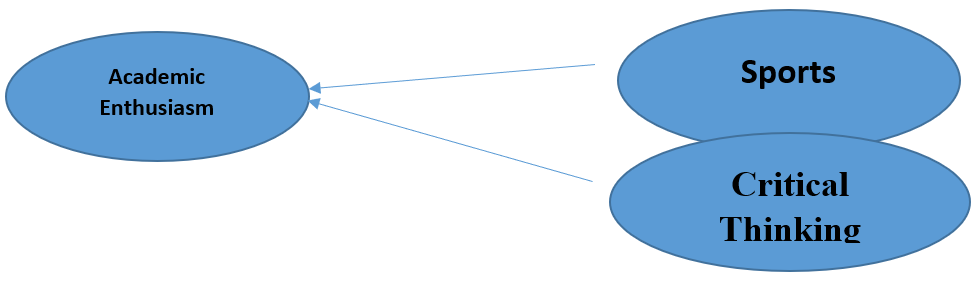
Method:
In terms of the applied purpose and the method of data collection, the descriptive research is of the correlation type. The statistical population of this study consisted of all second-high school students in Tehran in the academic year 2024-2025, and the sample size was 140 girls second high school students. The sample size was the formula (8M + 50≤ N) proposed by Tabachnig and Fidel (2007). Based on this formula, the sample size is used to calculate the sample size in multiple regression, considering the number of predictor variables. In this formula, N is the sample size and M is the number of predictor variables. Therefore, in the present study, two predictor variables are named sports, which has five subscales, and critical thinking, which has three subscales. Therefore, a total of 10 variables are predicted. According to the above formula, 8 multiplied by 10 plus 50 is 130, which according to the formula, the research sample should be more than 130 people. Therefore, to ensure accuracy in selecting the sample size and increase the external validity of the research in order to generalize the results, 140 students were selected and convenience sampling was used to collect data.
Measuring Tools:
A) Fredericks and Bluemanfield Academic Enthusiasm Questionnaire (2004): This questionnaire measures academic activities in 15 questions. This questionnaire examines three subscales (behavioral, emotional, and cognitive) for the research. Scoring for this questionnaire is a five-point Likert scale, with the options “very low score 1”, “low score 2”, “average score 3”, “high score 4”, and “very high score 5”. The total academic enthusiasm score is obtained by summing all the items of the questionnaire, which has a range from 1 to 75. To determine the reliability of this scale, the academic enthusiasm scale was first distributed and completed among 200 students from different medical sciences. After calculating the Cronbach’s alpha reliability coefficient, it was obtained as 0.66. Fredericks and colleagues reported the reliability coefficient of this scale as 0.86 (Fredericks et al., 2004). The reliability of the questionnaire in the study of Abbasi et al. (2015) was obtained as 0.66 using Cronbach's alpha method. Also, in the present study, the reliability of the entire questionnaire was obtained as 0.86 using Cronbach's alpha method.
B) Scanlan et al. (1993) Exercise Questionnaire: The above questionnaire has 26 questions and five subscales (exercise commitment and enjoyment, social pressure, alternative occupation, participation opportunities, and personal investment). Scoring for this questionnaire is based on a five-point Likert scale, ranging from (strongly disagree, score 1, to strongly agree, score 5). The range of scores is 1 to 130. Scanlan et al. reported a Cronbach's alpha of 0.89 for the entire questionnaire. In this study, Cronbach's alpha was 0.76, indicating the high validity of this questionnaire.
C) Ritex Critical Thinking Questionnaire (2010): This questionnaire contains 33 questions. The questionnaire has three subscales (creativity, growth, and commitment). Scoring for this questionnaire is measured using a five-point Likert scale (strongly disagree score 1, disagree score 2, undecided score 3, agree score 4, and strongly agree score 5). To obtain validity in his research, Biyabangard (2008) found that the correlation coefficients between the subjects' scores in two occasions, namely the test and retest, for all subjects, female subjects, and male subjects were (r=0.77), (r=0.88), and (r=0.67), respectively, which is satisfactory. As a result, it has good validity. The reliability of this questionnaire was reported by Izadi Fard and Sepasi Ashtiani (2009) using Cronbach's alpha coefficient as 0.94 for the whole sample, 0.95 for female subjects, and 0.92 for male subjects.
Findings:
Table (1): Descriptive statistics related to the variables
|
Variables Number Minimum Maximum Mean Standard.D |
|
Academic enthusiasm 140 54 71 62.31 4.45 |
|
Sports 140 89 118 103.63 6.18 |
|
Critical thinking 140 99 135 116.93 8.41 |
According to Table (1), the descriptive information shows that the mean and standard deviation of the academic enthusiasm variable are 62.31 and 4.45, respectively. The mean and standard deviation of the sports variable are 103.63 and 6.18, respectively. The mean and standard deviation of critical thinking are 116.93 and 8.41, respectively.
Table (2): Pearson correlation coefficient matrix between variables
|
Variables |
Academic procrastination |
Academic self-concept |
Excitement seeking |
|
Academic enthusiasm |
1 |
|
|
|
Sports |
0.204* |
1 |
|
|
Critical thinking |
0.222** |
0.150* |
1 |
According to the information in Table (2), the Pearson correlation coefficient shows a significant positive correlation between the variables of academic enthusiasm and sports (p<0.05, r = 0.204) and between the variables of academic enthusiasm and critical thinking, there is a significant positive correlation (p<0.01, r = 0.222).
Table (3) Statistical characteristics of multivariate regression of academic procrastination, academic self-concept, and excitement seeking
|
Variables R R2 df F B Beta t P |
|
Sports 0.282 0.079 (2.137) 5.905 0.126 0.175 2.110 0.03 Critical thinking 0.104 0.196 2.366 0.01 |
As can be seen in Table (4), there is a significant correlation (p<0.05, r = 0.282). And the adjusted coefficient of determination is = 0.079, which means that the variables of sport and critical thinking predicted 0.079 percent of the variance (changes) of academic enthusiasm in female high school students. And considering F equal to 5.905 with a level of significance (p < 0.05), we conclude that our model is significant, meaning that the variables of exercise and critical thinking well explain the changes in the variable of academic enthusiasm in female students of the second secondary school. And the beta of exercise (0.175) and beta of critical thinking (0.196) were obtained, which is significant at the level of (p < 0.01), meaning that it is possible to predict the variable of academic enthusiasm in female students of the second secondary school based on exercise and critical thinking as independent predictor variables and also consider it effective.
Discussion and Conclusion:
The aim of the present study was to investigate the prediction of academic enthusiasm based on sports and critical thinking in female high school students. The results of correlation analysis and multivariate regression showed that there is a significant relationship between academic enthusiasm score and sports and critical thinking, and the sports and critical thinking variables well explain the changes in the academic enthusiasm variable in female high school students. This means that sports and critical thinking as predictors (independent) variables have been effective on academic enthusiasm in female high school students. The results obtained are consistent with the findings of Zaratshtian et al. (2017). Wallenberg et al. (2015), Jay Ratti (2022), Woodman et al. (2021), the results of the research of Gharibi et al. (2022), the study of Afraz and Hajhosseini (2022), Afshin and Afrasiabi (2022) and (Pirooz, Jalili, and Sasani, 2023). In explaining these findings, it can be stated that academic enthusiasm includes a variety of processing processes that students use to learn and consists of cognitive strategies that prepare new information for linking and combining with previously learned information and storing it in long-term memory. Therefore, students who include physical activity and exercise in their daily lives are more socially active and have more self-confidence. When a person engages in sports, the oxygen entering the brain increases, and the increase in brain oxygen causes the survival of neurons in areas of the brain that are responsible for learning, memory, and thinking, which increases the person's ability to concentrate, learn, and remember previously learned information, and as a result, increases academic enthusiasm in students. Critical thinking also has a positive and reciprocal relationship with academic enthusiasm. Critical thinking is the ability to think clearly and logically and understand the connections between ideas. Critical thinking is defined as the ability to explore an issue, problem, or situation in order to integrate all available information about the subject under study and arrive at a solution or hypothesis to justify the student's orientation. Students with critical thinking have the characteristics of being receptive to new ideas, flexibility, willingness to change, innovation, creativity, analyticalness, boldness, tirelessness, enthusiasm, energy, risk-taking, knowledge, resourcefulness, observation, and thinking. Critical thinking skills are mainly domain-specific, meaning that they increase the student's ability to be enthusiastic about academics and their performance is strongly related to his knowledge and attitude or a specific field of application. Therefore, exercise and critical thinking, as a powerful tool, can improve the quality of life, increase self-confidence, improve cognitive and academic performance, and academic enthusiasm in students. Finally, it is suggested that counselors and psychologists include educational meetings and workshops in their work schedules to increase academic enthusiasm, critical thinking, and exercise, based on the results of this study. It is also recommended to researchers that in future research, this study be conducted on students in other cities of the country.

Open Access By Aditum Open Access Journals id licensed under Creative Commons Attribution 4.0 International License. Based On a Work at aditum.org


