
Journal of Veterinary Medicine And Science
OPEN ACCESS | Volume 3 - Issue 1 - 2026
ISSN No: 3065-7075 | Journal DOI: 10.61148/3065-7075/JVMS


Abinet Elias1, Assegid Altaye2
1Hobicha district agricultural office, Animal Health expert, Wolaita Ethiopia.
2Damot Sore Woreda agricultural office, Animal Health expert, Wolaita Ethiopia.
*Corresponding author: Abinet Elias, Hobicha district agricultural office, Animal Health expert, Wolaita Ethiopia.
Received: September 20, 2026 | Accepted: September 30, 2026 | Published: October 06, 2026
Citation: Elias A, Altaye A, (2026). “Assessment Of Major Health Problems And Welfare Of Working Donkeys In Hobicha Woreda, Wolaita Zone Southern Ethiopia”. Journal of Veterinary Medicine and Science, 3(2); DOI: 10.61148/3065-7075/JVMS/057.
Copyright: © 2026 Abinet Elias. This is an open access article distributed aunder the Creative Commons Attribution License, which permits unrestricted use, distribution, and reproduction in any medium, provided the original work is properly cited.
Working donkeys are important animals to the resource-poor communities in rural and urban areas of Ethiopia, providing traction power and transport services at low cost. A cross-sectional study was carried out from August 2025 to November 2025 to investigate the welfare constraints and health problems of working equines found in the selected kebeles of Hobicha woreda in Wolaita zone, southern Ethiopia. About 384 donkeys were randomly selected and thoroughly observed for their welfare and health status. Similarly a semi structured questionnaire was prepared and collected from donkey owners to assess common factors compromising welfare of working donkeys. This study showed about 48.69% of assessed animals had one or more major health problems in working donkey population in study area. Among identified health and welfare problems, wounds of different origin account the high percentage 28.87% followed by External parasites and other skin infections (21.9%), musculoskeletal problems (20.8%), Infectious diseases of different causes (17.1%), dental problems 6.95% and 4.27% eye problems. The major welfare and production constraints identified in the study area were Shortage of feed and water, Health problems, Overloading and over working, poor attitude/lack of awareness and lack of adequate veterinary services. Finally comprehensive awareness creation on equine welfare issues should be promoted through short training, extension service by the government and different non-governmental organizations.
Welfare, Donkey, Health status, Constraints, Hobicha
1. Introduction:
The equine population of the world was reported to be 122.4 million with 40 million donkeys, 15 million mules, and 43.3 million horses. The number of equines in Africa was in the range of 17.6 million comprising 11.6 million donkeys, 2.3 mullion mules, and 3.7 million horses (Geiger et al., 2021). According to central statistical report of 2021/22, Ethiopia possess about an estimated 2.1 million horses, 8.9 million donkeys, 0.4 million mules harboring the largest population of donkeys in Africa and the second largest donkey population in the world. The country possesses approximately half of Africa’s equine population with 37%, 58%, and 46% of all African donkeys, horses, and mules, respectively (Atirihun et al., 2019).
In many developing countries around the world, working equids contribute to family livelihoods and perform a wide variety of economic, social, and labor-reducing functions especially in mountainous areas, where motorized vehicles have limited access (Romero et al., 2022). In Africa, the equid is a very essential animal for people’s daily work. They are utilized for pack, draught, agricultural work, and riding, and their owners are often from poor communities with incomes below the international poverty line (Adam et al., 2023). Working animals provide more than 50% of the world′s agricultural energy for traction, while the internal combustion engines provide less than 30%, with the remaining percentage provided by men or women. In many developing countries rising fuel prices are causing a significant number of urban workers to switch from motorized vehicles to equine powered carts (Gelaye, and Fesseha, 2020).
Equines are vital animals to the resource-poor communities in rural and urban parts of Ethiopia, providing traction power and transport services at low cost. The usage of equines in door-to-door delivery service also gives urban inhabitants with the option of money generating (Dembelo, 2012). Horses, donkeys, and mules are extensively used, particularly in the rural socio-economic activities. Horses are transport animals, utilized for riding as well as for rural and urban transport. They occupy an important function in the agricultural and transport sectors of Ethiopia, particularly as draft power, pack and riding animals. Carts powered by horses are a common mode of transportation in urban and peri-urban settings when electromotive power is either nonexistent or insufficient to meet transportation needs (Asmare and Yayeh, 2017).
Donkeys are mainly used for transportation of farm products from farmstead to home, to and from market, grain to and from grinding mill houses, fire wood and charcoal for household use or sale, stone and blocks for construction, water for manual-irrigation like growing cash crops including chat, fertilizers, seedlings, aid-supplies, for ploughing and as cash income for the family (Tiruneh et al., 2016).
Animal welfare refers to the physical and emotional state that is impacted by the environment in which the animal lives and works human attitudes and practices, and resources available to it. Welfare is an ever-changing state in which all of these factors can and will cause welfare to fluctuate between good, bad, and somewhere in between on a near constant basis (Arega et al., 2023). The status of animal welfare keeping is variable between developed and developing world. The source of differences arises due to there is a difference in the interest of policy makers between developed and developing nations in driving up of consumers to demand products passing animal welfare standards (Asebe et al ., 2016).
The animal welfare is being compromised internationally due to several constraints such as poverty and lack of knowledge (Herago et al., 2015). Working horses' welfare is poor despite their uses, due to insufficient management and care, particularly in nations like Sudan, where they are susceptible to poor welfare. Mistreatment, cruelty, and a lack of veterinary care for equids have all led to premature death; and at present, a working life of only 4–6 years (Adam et al., 2023). Some methods of hobbling to restrain cause discomfort and inflict wounds and poorly designed harnesses or yokes that may be heavy and ragged have an effect on the animals health and safety (Amante et al., 2014). Diseases of working equids are linked to their working conditions and environment and span from infectious diseases including zoonoses to non-infectious conditions like lameness and colic. If untreated, they cause severe effects on animal health and welfare, frequently leading to death. Diseases also affect the equid’s working efficiency and their income-generating capacity, which is particularly detrimental to households that own only one equid (Bonsi et al., 2023).
Although smaller in total numbers than food production animals, working donkeys are the backbone of household and national economies in numerous countries, contributing to a number of industries which would come to a standstill without them. The challenges faced by individuals and their working equids vary across communities and geographic locations; consequently, a broad brush, one-size-fits-all approach to addressing welfare issues is unlikely to work even within the same country (Geiger et al., 2021). Despite the large numbers of donkeys population and their invaluable contributions as an engine that power rural as well as urban economic development of the nation, donkeys in Ethiopia are the most neglected animals and little attention is given to study their health status (Abdela et al., 2017). Though Donkeys provide invaluable support for the livelihoods of communities in the Hobicha woreda; however, there is still scarcity of updated information regarding donkey welfare issues and health status.
Therefore the objectives the current studies were:
The study was conducted in the Hobicha woreda, which is one of the 22 woredas located in Wolaita Zone. The woreda is located between 06042ʹ11ʹʹN to 06049ʹ20ʹʹN latitude and 37045ʹ56.4ʹʹE to 38005ʹ16Eʹʹ longitudes. According to Wolaita zone agricultural department report, the administrative center of Hobicha woreda, Bada town, is located at a distance of 18km away to the direction of North from Abela Abaya, 22 km away to the direction of South from Damot woyde, 27 km away to the direction of Northwest from Sidama zone (specially Loka Abaya woreda), 18Km away to the direction of Southeast from Sodo Zuria woreda, 21 Km South east from Humbo woreda (WZAD, 2018).
Study animals for this study were working donkeys selected from the district regardless of sex, work type, body condition and age. The age of the selected working donkeys was determined according to owner’s information and the dentition pattern as described by Crane and Svendsen (1997); hence classified as young, adult and old. The body condition of animals also characterized according to Svendsen (2008) as good, medium and poor body condition scores.
A cross-sectional study was carried out from August 2025 to November 2025 to investigate the welfare status and health conditions of working donkeys found in the selected kebeles of Hobicha district Wolaita zone in southern Ethiopia.
2.4. Sample Size and Sampling Method:
Simple random sampling technique was conducted to select required donkeys sample from the study area. The sample size for this study was determined by the formula described by Thrusfield (2005). Accordingly, at 95% confidence level and precision of 5% the total sample size was determined to be 384 since there was no research carried out on the title previously in the study area. So, for this particular study the sample size was as following
n = (1.96)2 Pexp (1-Pexp)d2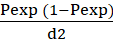
n= (1.96)2 0.5(1-0.5)(0.05)2  = 384
= 384
Where n= sample size required; 1.96=the value of Z at 95% confidence interval; Pexp= expected prevalence; d= desired absolute precision
Hence, 384 donkeys were sampled using simple random sampling method from the study area.
2.5. Method of Data Collection
Data collection format for direct assessment was developed and data were collected by direct physical examination of the equine Prior to the assessment, consent was obtained from animal’s owners by introducing the objective of the study. Information regarding general body condition such as wound type, dermatological disease, musculo-skeletal disease, other disease signs and behavior, age categories, body condition score, work type and condition of harnessing were properly recorded on data collection format according to Pritchard et al (2005).
A semi-structured questionnaire was designed and validated to be subjected to the randomly selected animal owners and interviewed so that relevant information was collected about the uses of their equine, size of animals ownership at a household level, the magnitude of workload of their animal, management practices (feeding, watering, housing) and health care.
The data collated according to species, age, sex and work type and will be recorded by hand and results will be inserted in to MS- excel spread sheet program to create a data base and will be transferred to the SPSS software version 26 program and analyzed by using descriptive statistical. The results of the study was interpreted and reported in tables, percentages, and figures.
In the study area from a total of 384 donkeys included in the study, the majority 291 (75.8%) were males whereas 93 (24.2%) were females. High number donkeys observed were 45.3% were categorized under adult age category; about 38.5% were old donkeys and the rest 16.4% were categorized under young age. Among the observed animals 112(29.2%) were having good body condition, 176 (45.8%) were of Medium body condition and 96 (25%) showed poor body condition. From the total animals observed the majority 2246 (64%) donkeys has been used for pack services, and 138 (35.9%) equines has been used for cart purpose Table 1.
Tabe-1 Description of work types, body condition score, sex and age groups of the observed Donkeys
|
Variables |
Categories |
No. Animals observed |
Percentage |
|
Sex |
Male |
291 |
75.8% |
|
Female |
93 |
24.2% |
|
|
Age |
Young |
62 |
16.4% |
|
Adult |
174 |
45.3% |
|
|
Old |
148 |
38.5% |
|
|
BCS |
Good |
112 |
29.2% |
|
Medium |
176 |
45.8% |
|
|
Poor |
96 |
25% |
|
|
Work type |
Pack |
246 |
64% |
|
Cart |
138 |
35.9% |
3.2. Major health problems identified in the study area
As stated in Table-2 from the total 384 donkeys included in this study during this study period; 187 (48.69%) equines shown different health problems. Among the identified health problems wounds of different origin account the high percentage 28.87% followed by External parasites and other skin infections (21.9%), Musculoskeletal problems (20.8%), Infectious diseases of different causes (17.1%) and 6.95% were having dental problems and 4.27% were having eye problems.
Table-2: Major health problems identified in the study area
|
No |
Major health problems |
No. Affected |
Percentage |
|
1 |
Wounds |
54 |
28.87 |
|
2 |
Musculoskeletal problems |
39 |
20.8 |
|
3 |
Infectious diseases |
32 |
17.1 |
|
4 |
Eye problems |
8 |
4.27 |
|
5 |
External parasites and other skin infections |
41 |
21.9 |
|
6 |
Dental problems |
13 |
6.95 |
|
|
Total |
187 |
48.69 |
3.3. Major constraints comprising donkey welfare in the study area
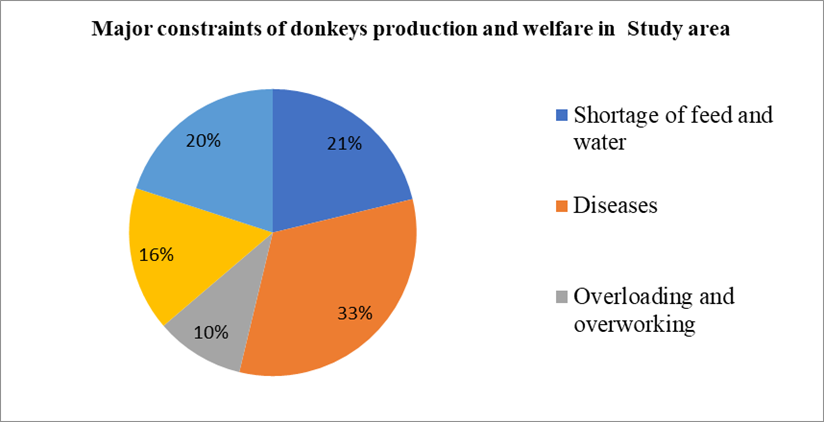
There are various problems or constraints faced by the respondent owners, health workers in the utilization and production of equines. The semi structured questionnaire was prepared and distributed to donkey owners and animal health workers. The major welfare constraints in the study area were Shortage of feed and water, Health problems, Overloading and overworking and Poor attitude/lack of awareness. Among them health problems take the higher percentage (32.5%), shortage of feed and water take 21.25%, poor attitude and lack of awareness towards management and care of equines also account 16.25%, overloading and overworking take (17.5%),and Lack of adequate health care and veterinary services took 20% which is indicated in figure 1.
Ethiopia has a huge equine population that is essential to the country's transportation and agricultural infrastructure. Working equids, particularly donkeys, are part of the critical infrastructure of Ethiopia e.g., essential for the functioning of a society and the economy (Asteraye et al., 2024). The current study demonstrated that Donkeys were prominently used by the farmers in the study region for packing purposes (64%). This finding is consistent with assessments conducted across the country (Amante et al., 2014; Atirihun et al., 2019; Gelaye and Fesseha, 2020). This is because it's possible that the majority of these animals belonged to highland and arid regions with poor or nonexistent transportation connections, as well as places with rough terrain that are unsuitable for vehicle transportations.
The study revealed a wide spectrum of welfare issues and health problems on study animals. The study showed that about 48.69% donkeys examined have at least one health problems on assessed donkeys in study area. This assessment agrees with Hailu et al. (2016); Chaburte et al. (2019). Among the identified health problems; Wounds are one of the most significant health issues that have been recognized. Animals with various types of wounds of various origins were observed in higher proportions (28.87%). This higher prevalence of wound in the study area agrees with the findings of Morka Amante et al. (2014) in and around Nekemte town, Moltumo et al., (2020) in Hosaena District, Hadiya Zone, Southern Ethiopia; Fsahaye et al. (2018) in and around Rama town, Tigray, Ethiopia and Arega et al. (2023) in Sebeta Town and Suburbs, Central Ethiopia. This similarity may be explained by Ethiopia's rough terrain and uneven roads in the majority of its rural communities, as well as the prevalence of overwork, overload, and inappropriate harness in many rural locations. The most common cause of these wounds in working equine are over loading, improper position of load predisposing to falling, beating of donkeys, hyena bites, donkey bites, injuries inflicted by horned Zebu (Temesgen and Sitota, 2019; Chaburte et al., 2017).
In present study 20.8% of animals were seen with different musculoskeletal problems such as gait abnormalities, tendon and joint swellings, deformities in legs, overgrown hoof, fractures and different degrees of lameness seen. This assessment agrees with the finding of Herago et al. (2015) and Chaburte et al., (2019). This is likely due to many reasons such as overloading, lack of hoof care and continuous movement in various landscapes and on rough roads were the main reasons for the occurrences of musculoskeletal problems. This implies that any type of interaction between limb abnormalities in these animals may have serious welfare and health problems (Moltumo et al., 2020).
This study also revealed that Eye problems such as lacrimation, eye inflammation traumatic damage, opacity and unilateral blindness were also among the major health problems (4.27%) in the study area. It is in agreement with report of Girmay (2017) who reported 3.9% in and around Axum Districts, Tigray Regional State Northern Ethiopia; and Hassen et al. (2022) who reported 3.5% in Godey Town, Somali Regional State. This revealed that eye problems as among the prevalent health problems of equines. The eye problem might due to arise from improper health management, treating with traditional (Some medicinal plants), using illegal drugs purchased from local market and provided insufficient feed at homes only before or after work (Hailu et al., 2016).
During the study period 21.9% of animals were observed with skin problems such as skin infections, external parasites, warts, sarcoids and other form of lesions. The finding agree with Moltumo et al. (2020) reported 21.1% in Hosaena District, Hadiya Zone, Southern Ethiopia. This is attributed to the use of ill-fitting and ragged harness and a bit (which is used for steering and braking animals) in draught animals which are not usually used in pack animals (Dembelo, 2012)
In the present study, it is observed that the main welfare constraints raised by respondents and on observation were Shortage of feed and water, Health problems, Overloading and overworking and Poor attitude/lack of awareness. Among them health problems take the higher percentage, shortage of feed and water take, poor attitude and lack of awareness towards management and care of equines also account, overloading and overworking take and Lack of adequate health care and veterinary services. This assessment agree with (Gelaye and Fesseha, 2020); (Hassen et al., 2022) in Godey town Somali Regional State, Ethiopia.
Feed shortage was one of the major constraints to productivity and work performance of equines in the area. This assessment agrees with the findings of (Dembelo, 2015) in Hosanna, Southern Ethiopia. Shortage of feed during dry season might be due to expansion of crop land and decreased feed or fodder production, which can be used for feeding of animals (Gelaye and Fesseha, 2020).
Lack of veterinary services and health care also a major production and welfare constraint in study area. This finding agree with findings in different areas of country (Fsahaye et al., 2018) in in and around Rama town, Tigray, Ethiopia; (Medhin, 2017) in and around Axum Districts, Tigray Regional State; (Julia, 2016) in Addis Ababa and Ambo, Ethiopia. Additionally Overloading and overworking are one of the major production and welfare constraints in the study area; which were considered as the predisposing factors for the occurrence of wound which was also reported by (Julia, 2016) in Addis Ababa and Ambo as major causes of external injuries.
According to the current study, most owners did not have the same perception for equines as compare to other animals. This finding is in agreement with the reports of (Fasil and, Yenewhunegnaw, 2017) in Wogera District, Northern Ethiopia. This similarity might be due to unlike other animals low priority is given to donkeys and horses in feeding allocation. Besides, these animals are often engaged in work for long hours and when they get free, they are left to browse and feed on garbage which has a potentially negative effect on their welfare and quality of life (Gelaye and Fesseha, 2020).
5. Conclusion And Recommendations
Working donkeys provide a critical resource for some of the poorest and most marginalized people, enabling them to travel to access resources such as schools and health care and to generate income to support themselves and their dependents. In this study higher prevalence welfare and health problems in working donkeys population in Hobicha woreda was identified. Wounds of different origin, External parasites and other skin infections, Musculoskeletal problems, Infectious diseases of different causes and other health problems like eye and dental problems were major health problems identified in the study area. The major welfare and production constraints in the study area were Shortage of feed and water, Health problems, Overloading, over working, poor attitude/lack of awareness and lack of adequate veterinary services.
In order to address the above problems identified in the study, the following recommendations forwarded:



Open Access By Aditum Open Access Journals id licensed under Creative Commons Attribution 4.0 International License. Based On a Work at aditum.org


