
Journal of International Research and Reviews
OPEN ACCESS | Volume 2 - Issue 2 - 2026
ISSN No: 3068-370X | Journal DOI: 10.61148/3068-370X/JIRR


Victorine HIEN1*, Silué NAKPALO2, Ouemela Venance Allais BAN3, Karamoko OUATTARA4
1Université Polytechnique de San Pedro, department of agriculture and new technologies, Côte d’Ivoire.
2Université Polytechnique de San Pedro, department of agriculture and new technologies, Côte d’Ivoire.
3Université Polytechnique de San Pedro, department of agriculture and new technologies, Côte d’Ivoire.
4Université Polytechnique de San Pedro, department of agriculture and new technologies, Côte d’Ivoire.
*Corresponding author: Victorine HIEN, Université Polytechnique de San Pedro, department of agriculture and new technologies, Côte d’Ivoire.
Received: September 05, 2026 | Accepted: September 15, 2026 | Published: September 17, 2026
Citation: HIEN V, NAKPALO S, Allais BAN OV, OUATTARA K. (2026) “‘Influence of Local Organic Substrates on the Growth of Eudrilus Eugeniae for Vermicomposting in San Pedro, Côte d’Ivoire”, Journal of International Research and Reviews, 2(2); DOI: 10.61148/3068-370X/JIRR/023.
Copyright: © 2026. Victorine HIEN. This is an open access article distributed under the Creative Commons Attribution License, which permits unrestricted use, distribution, and reproduction in any medium, provided the original work is properly cited.
This study evaluated the influence of organic substrates to identify the most suitable substrate for the reproduction of Eudrilus eugeniae for vermicomposting in San Pedro, Côte d’Ivoire. A randomized complete block design comprising four treatments was used: T1 (cocoa pod husks), T2 (fern), T3 (sawdust), and T4 (a mixture containing one-third of each substrate), with three replicates per treatment. Each replicate contained 1 kg of shredded organic matter and 0.5 kg of composted soil. After two weeks of pre-composting, five adult E. eugeniae were introduced into each replicate. In the first month, the fern recorded the highest population (66.67 ± 0.58 individuals), followed by the mixture (45.33 ± 0.58), cocoa pod husks (16.33 ± 0.58), and sawdust (3.00 ± 0.58). In the second month, populations decreased to 1.66 ± 0.06, 0.66 ± 0.06, 0.33 ± 0.02, and 0 ± 0 individuals, respectively. ANOVA revealed significant differences among treatments in both months (p = 0.001 < 0.05), and Tukey’s test confirmed differences among treatment groups. The fern also showed the highest volumetric reduction (65.8%), followed by the mixture (51.23%), indicating greater substrate decomposition. Tukey’s test showed that T1 and T4 belonge.
Eudrilus eugeniae; fern; vermicomposting; organic residues; substrates, Côte d’Ivoire
Soil degradation leads to a decrease in soil fertility and agricultural productivity, notably due to the reduction of organic matter (FAO, 2021). Vermicomposting is a sustainable option to valorize organic residues and produce a nutrient-rich amendment (Pandit et al., 2020). Among the earthworm species used, Eudrilus eugeniae shows strong potential for transforming organic matter (Balachandar et al., 2020). However, its multiplication depends on substrate characteristics, notably the C/N ratio, moisture, pH, temperature and the availability of nutrients (Vasanthi et al., 2013). In San Pedro, local organic substrates favorable to its development remain poorly documented. With this in mind, the present study was conducted to assess the suitability of different local organic residues to promote the development of Eudrilus eugeniae and their degradation during vermicomposting. The overall objective was to identify the substrate most favorable to the development and multiplication of Eudrilus eugeniae with a view to vermicompost production.
Specifically, it involved:
I/ Material and Methods
1.1 Presentation of the study site
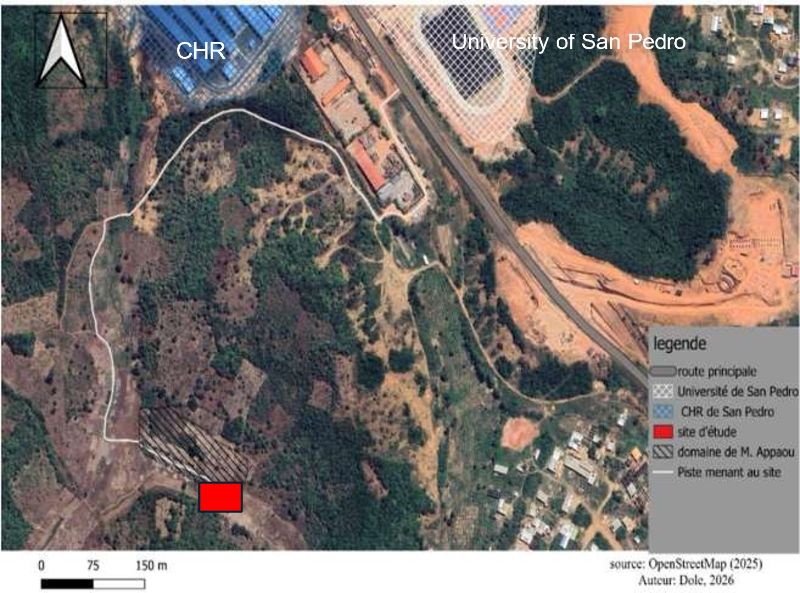
The experiment was carried out in San Pedro, a port city located in the south-west of Côte d'Ivoire. Within it is the study site, with an area of 5 hectares, and for geographical coordinates: latitude 4°44' N and longitude 6°38' W. It is occupied by market gardeners from the DAFCI association, which is favorable for market-gardening crops.
 1.2 Materials
The biological material consisted of Eudrilus eugeniae, the fern, cacao pod husks and wood sawdust.
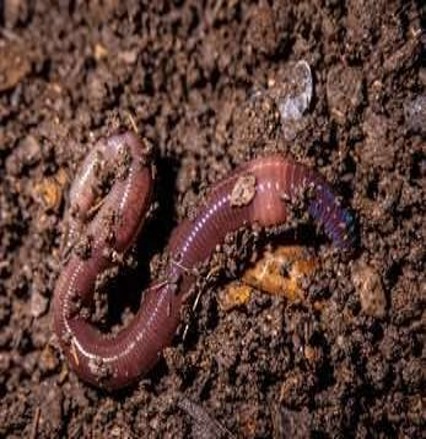
Figure 2: Eudrilus eugeniae
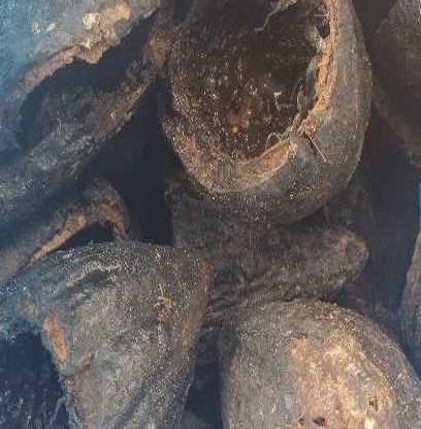
Figure 3: Cacao pod husks (Author 2026)
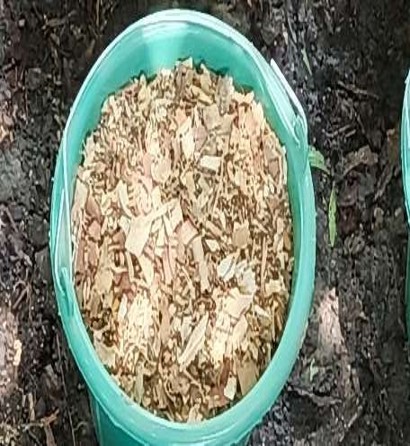
Figure 4: Wood sawdust
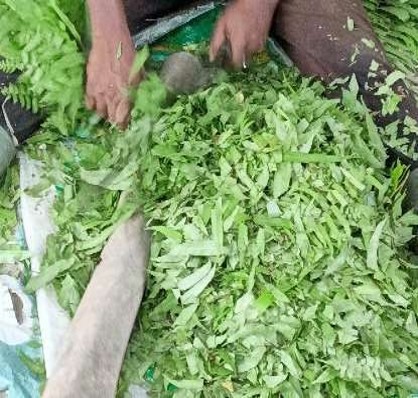
Figure 5: Fern
The technical equipment included:
12 plastic 4 L buckets used as composters, a mosquito net to protect the device from earthworm predators, a watering can for humidification, a scale for weighing, and gloves and masks for handling the substrates, etc.
1.3 Methods
1.3.1 Setup of the experimental device
It was installed under natural shading with the president of market gardeners according to a randomized complete block design (RCBD) according to Montgomery (2017), including four treatments such as T1 (cocoa pod husks), T2 (fern), T3 (wood shavings) and T4 (1/3 mix of each substrate), with three replicates per treatment used. Each replicate contained 1 kg of shredded organic matter and 0.5 kg of potting soil.
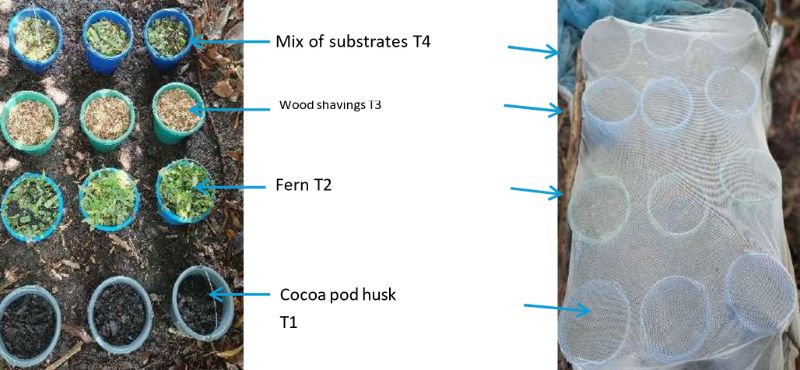
Figure 6: Experimental setup
1.3.2 Determination of C/N ratios of the substrates
The C/N ratios of the different substrates were determined from values reported in the literature. They were 35 for cocoa pod husks, 25.67 for fern, 100 for wood shavings, and 40 for the mix. A C/N ratio between 25 and 30 is generally favorable to microorganism activity and organic matter decomposition, thus creating favorable conditions for earthworm development (Pandit et al., 2020).
1.3.3 Substrate pre-composting
Before the introduction of Eudrilus eugeniae, the substrates were precomposted for two weeks. During this period, they were watered once a week (1 L of water per replicate) and turned over twice per week to favor the activity of decomposer microorganisms, notably bacteria and fungi. This step helped to initiate the decomposition of organic matter and reducing the substrate temperature to about 25 °C, a temperature favorable for the development of Eudrilus eugeniae (Coulibaly et al., 2019).
1.3.4 Identification, collection and seeding of the worms
Adult worms have a reddish to dark red coloration and measure about 15 to 25 cm in length. The clitellum, a structure specialized in reproduction, is located between the 14th and 18th segments, starting from the anterior end. The body segments are clearly visible to the naked eye. In total, 60 adult worms were collected. Five adult worms were then introduced into each repetition of each of the experimental substrates (Byambas et al., 2017).
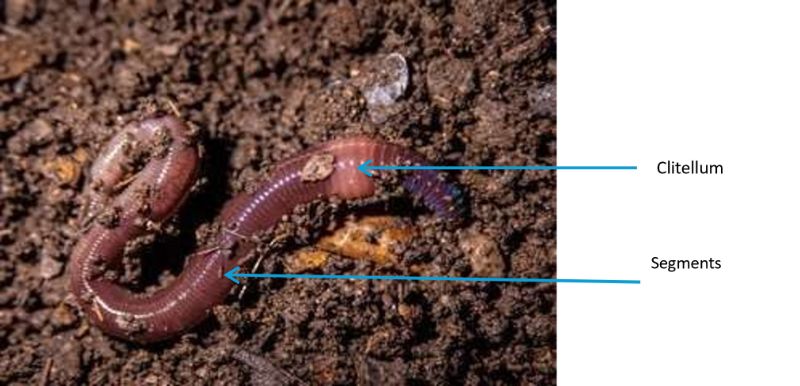
Figure 7: Eudrilus eugeniae
1.3.5 Counting of worms and measurement of the substrate volume of the treatments
The counting of worms was done manually in a progressive manner for each repetition on a plastic tray. The attached formula was used for the total number of worms counted
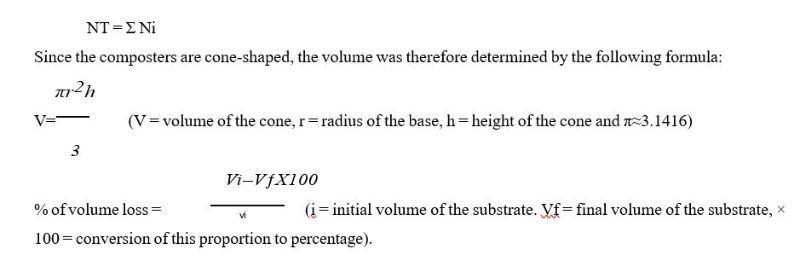
1.3.6 Statistical analysis
The means were calculated and the graphical representations were made using Microsoft Excel. The analysis of variance (ANOVA) was performed with SPSS software to determine if the differences observed between treatments were statistically significant. When ANOVA revealed a significant difference, Tukey's multiple comparison test, at a 5% significance level, was applied to identify treatments showing significant differences among themselves (Montgomery, 2017).
II/ Results and Discussion
2.1 Results
2.1.1 Variation in the number of Eudrilus eugniae per substrate
The analysis of variance (ANOVA) revealed a highly significant difference between treatments over the two months of observation (p = 0.001 < 0.05). The treatment T2 (fern), had the highest earthworm count (66.67 ± 0.58; 1.66 ± 0.06 individuals), followed by T4, mixture (45.33 ± 0.58; 0.66 ± 0.06 individuals), T1, cacao pod shell (16.33 ± 0.58; 0.33 ± 0.02 individuals) and T3, wood sawdust (3.00 ± 0.58; 0±0 individuals). The multiple comparison test at the 5% level showed that the four treatments were significantly different from each other, each belonging to a different statistical group (a, b, c and d) over the two months.
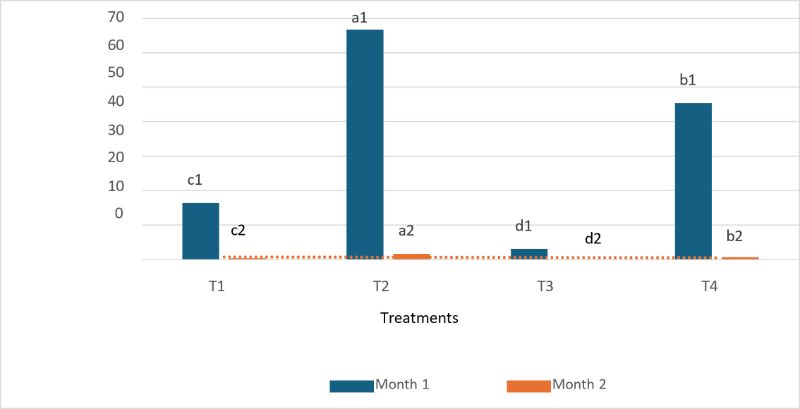
T1: cacao pod shell, T2: fern, T3: wood sawdust, and T4: mixture Figure
Figure 8: variation in earthworm number by treatment
2.1.2 Variation in treatment volume during the experiment
The loss of substrate volume varied by treatment. The most significant reduction was recorded with T2 (fern), at 65.84%, followed by T4 (mixture) at 51.23%, T1 (cocoa bean shell) at 28.16%, and T3 (wood sawdust) at 15.20%. Thus, the T2 substrate showed the highest volume loss, while T3 recorded the lowest. Analysis of variance (ANOVA) revealed a significant difference between treatments at months 1 and 2 (p = 0.001 < 0.05). Tukey multiple comparison test at the 5% threshold showed that in the first month, T1 and T4 belonged to the same statistical group (c1), indicating no significant difference between these two treatments. In the second month, the four treatments belonged to different statistical groups (a, b, c and d), indicating significant differences among them.
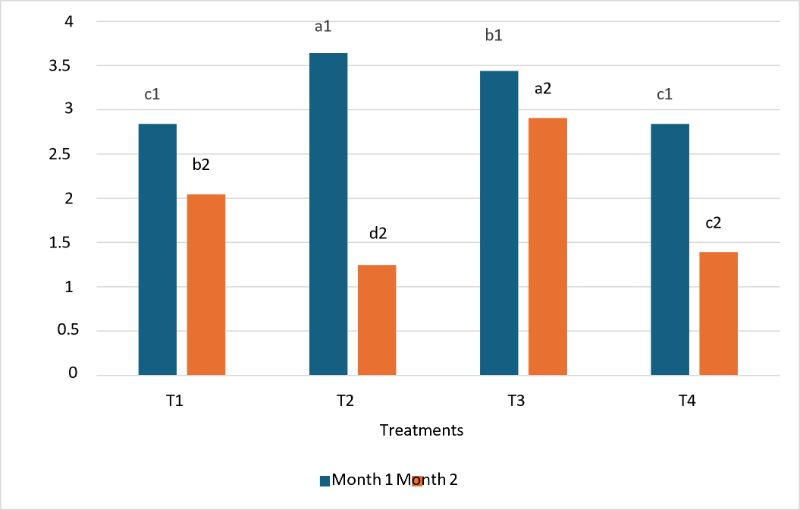 T1: Cocoa pod husk, T2: fern, T3: wood sawdust, and T4: mixture
Figure 9: variation in treatment volume
1.3 Discussion
1.3.1 Variation in the number of Eudrilus eugniae per substrate
The highest observed number of Eudrilus eugeniae in the fern could be explained, in part, by its C/N ratio of 25.67, close to the range generally favorable to microbial activity and the decomposition of organic matter. A balanced C/N ratio indeed favors the activity of microorganisms involved in the degradation of organic substrates (Zhang et al., 2022). This gradual decomposition can improve the availability of the food resources needed for the development of earthworms. In addition, the presence of lignocellulosic fractions such as cellulose and hemicellulose can influence the availability of carbon during vermicomposting. The work of Martin et al. (2020) showed that the quality and availability of carbon in the substrates significantly influence the biomass and fecundity of Eudrilus eugeniae. The gradual degradation of organically accessible fractions could thus promote the growth and reproduction of earthworms. The high multiplication observed in the fern could also be related to the biological characteristics of Eudrilus eugeniae. Vasanthi et al. (2013) showed that the growth and reproduction of this earthworm species are strongly influenced by environmental conditions, particularly temperature, with particularly favorable performance around 26° C. Under the favorable conditions of the experiment, the quality of the substrate and the rearing conditions could therefore have contributed jointly to the observed multiplication. Thus, these results show that the composition of the substrate, in particular its C/N ratio and its physical and chemical characteristics, is an important factor for the growth and reproduction of Eudrilus eugeniae.
1.3.2 Variation in the volume of substrates during the experiment
The fern showed the greatest decrease in volume compared with cocoa pod husks, sawdust, and the mixture. This reduction could be explained by a greater degradation of its organic matter, encouraged by the availability of carbon fractions that are easily degradable. The work of Martin et al. (2020) showed in fact that the quality of carbon in the substrates influences the biomass and reproductive activity of Eudrilus eugeniae, whereas the more recalcitrant fractions, especially lignin, are degraded more difficultly. The mixture of substrates also recorded a volume reduction of more than 50%. This decrease could result from the successive degradation of the different components of the mixture, whose decomposition rate varies according to their lignocellulosic composition. The work of Balachandar et al. (2020) showed that vermicomposting with Eudrilus eugeniae can lead to a reduction in the fractions of cellulose, hemicellulose, and lignin of the substrates, reflecting their progressive transformation during the process. In contrast, sawdust and cocoa pod husks, which have relatively high C/N ratios and a significant proportion of lignified compounds, showed the smallest reductions in volume. Lignocellulosic materials lignin-rich materials are generally more resistant to biological degradation, which can slow their breakdown during composting (Karthäuser et al., 2021; Zhang et al., 2021). Thus, the observed volume loss during vermicomposting constitutes an important parameter to consider when estimating the initial masses of substrates needed to obtain a sufficient amount of vermicompost intended for fertilizing crops.
Conclusion
The valorization of organic residues through vermicomposting provides a sustainable approach that both reduces organic waste and produces an amendment that can contribute to improving soil fertility. This study showed that the nature of the substrate strongly influences the multiplication of Eudrilus eugeniae as well as the degradation of organic matter during vermicomposting. Among the substrates studied, the fern (T2) proved the most favorable for the multiplication of Eudrilus eugeniae, with the highest worm count and the greatest volume reduction. The substrate mixture (T4) also showed interesting performance, with a volume reduction greater than 50%, indicating significant degradation of organic matter. Conversely, wood shavings (T3) and cocoa husks (T1) showed the smallest volume reductions, probably due to their more lignified composition and high C/N ratio. These results thus show that the choice and combination of organic residues are determining factors for optimizing vermicompost production based on Eudrilus eugeniae. The fern appears to be the most promising substrate under the conditions of this study, while the mixture represents an interesting alternative to valorize several local organic resources simultaneously. Accounting for biomass losses during the process also allows estimating the initial quantities of substrates needed to produce sufficient volumes of vermicompost for fertilizing crops. In conclusion, the valorization of these local residues by vermicomposting represents a relevant agroecological solution to promote recycling of organic matter, reduce dependence on external inputs, and contribute to more sustainable soil fertility management in Côte d’Ivoire. Further work, particularly on the physico-chemical quality and the fertilizing value of the produced vermicompost, would help confirm its agronomic potential.
Acknowledgements
Mr. YAO Appaou Dominique, president of DAFCI market gardeners, San Pedro. Declaration of conflicts of interest
Disclaimer (Artificial Intelligence)
Author(s) hereby declare that NO generative AI technologies such as Large Language Models (ChatGPT,COPILOT, etc.) and text-to-image generators have been used during writing or editing of this manuscript
The authors declare that they have no conflicts of interest to declare. Authors' contributions
Study design and execution: VH; data collection: VH and SN; analysis and interpretation of results: VH and OVAB; manuscript drafting: VH. All authors have reviewed and approved the final version of the
manuscript. Supervision: Ok.

Open Access By Aditum Open Access Journals id licensed under Creative Commons Attribution 4.0 International License. Based On a Work at aditum.org


