
Journal of International Research and Reviews
OPEN ACCESS | Volume 2 - Issue 2 - 2026
ISSN No: 3068-370X | Journal DOI: 10.61148/3068-370X/JIRR


Oluwatoyin Abayomi Amuda
Department of Accounting and Finance, Robert Gordon University, Scotland, United Kingdom.
Corresponding author: Oluwatoyin Abayomi Amuda, Department of Accounting and Finance, Robert Gordon University, Scotland, United Kingdom.
Received: August 02, 2026 | Accepted: August 10, 2026 | Published: August 13, 2026
Citation: Oluwatoyin A Amuda. (2026) “Explainable Artificial Intelligence Adoption and Credit Risk Optimization in Selected African Financial Institutions: The Role of Transparency, Accountability and Regulatory Governance”, Journal of International Research and Reviews, 2(1); DOI: 10.61148/3068-370X/JIRR/021.
Copyright: © 2026. Oluwatoyin Abayomi Amuda. This is an open access article distributed under the Creative Commons Attribution License, which permits unrestricted use, distribution, and reproduction in any medium, provided the original work is properly cited.
Purpose: This study examines the role of Explainable Artificial Intelligence (XAI) in credit risk optimization within African financial institutions, with particular emphasis on transparency, accountability, and regulatory governance. Although AI-driven credit assessment can improve predictive capability and operational efficiency, the opacity of complex machine learning models, limited transparency in algorithmic decision-making, accountability concerns, and evolving regulatory requirements may constrain their effective application within African financial institutions. The study therefore investigates whether XAI adoption enhances credit risk optimization and whether regulatory governance strengthens this relationship.
Design: The study adopted a quantitative explanatory design using secondary panel data from selected African financial institutions covering 2020–2025. Multiple regression analysis was used to examine the direct effects of Explainable Artificial Intelligence, Transparency, Accountability, and Regulatory Governance on Credit Risk Optimization, while Partial Least Squares Structural Equation Modelling (PLS-SEM) was used to assess the structural relationships and the moderating effect of Regulatory Governance.
Findings: The findings show that XAI adoption has a significant positive effect on credit risk optimization and contributes to enhanced transparency and accountability in AI-driven credit evaluation. The results further indicate that regulatory governance positively moderates the relationship between XAI adoption and credit risk optimization, suggesting that stronger regulatory and institutional frameworks can enhance the effectiveness of explainable AI in financial decision-making.
Originality: The study contributes to the emerging literature on responsible AI in finance by integrating XAI adoption with transparency, accountability, and regulatory governance within a unified framework for credit risk optimization in African financial institutions. In particular, it extends existing research beyond the predictive and technical performance of AI models by demonstrating the importance of institutional and regulatory conditions in shaping the effectiveness of explainable AI in emerging financial markets.
Explainable Artificial Intelligence (XAI); Credit Risk Optimization; AI Governance; Transparency; Accountability; Regulatory Governance; African Financial Institutions
1. INTRODUCTION
1.1 Background of the Study
In the world of finance, Artificial Intelligence (AI) stands out as one of the most zeitgeist-defining technologies, reshaping the way financial services institutions manage risk, detect and prevent fraud rather than merely respond to it, comprehend customers, and drive strategic choices. One of the most transformative technologies in the global financial services industry, Artificial Intelligence (AI) transforms how financial services institutions interact with customers, understand them, mitigate risk, and prevent fraud. With the rapid growth of big data, the development of large-scale financial information, the development of machine learning algorithms, and the rise of computational power, banks and other financial institutions can increasingly replace traditional credit-risk rate prediction methods based on rules with data-driven prediction methods that can uncover non-linear patterns in borrower behaviour (Chen & Guestrin, 2016; Lessmann et al., 2015). In contrast to approaches that determine models using a static and linear model definition, AI models constantly learn from past and updated information, leading to more accurate credit predictions, loss reduction, and better credit portfolio performance (Varian, 2014; Wang et al., 2021). Therefore, AI has proven to be a strategic tool in the hands of financial institutions aiming to make the most of their operational efficiency and stay competitive in the rapidly digitizing financial markets.
One area where AI technologies have had a significant impact is credit risk optimization. Gone are the days of relying on manual or rule-based methods for credit risk optimization—AI has changed the game. Credit risk is one of the most important risks that financial institutions have to deal with, as misjudging the credit risk of loans impacts profitability, capital adequacy, liquidity, and the long-term stability of financial institutions (Thomas et al., 2017). Typically, credit evaluation has been based on statistical models like logistic regression, linear discriminant analysis, and judgment, which were simple to implement and interpretable but were not always able to deal with the nonlinear interactions between borrowers' modern behaviours (Hand & Henley, 1997; Lessmann et al., 2015). Several empirical analyses published recently show that machine learning techniques (random forests, gradient boosting, or deep learning) are much more effective than traditional models at predicting default and making optimal credit allocation decisions ( Chen & Guestrin, 2016; Fuster et al., 2022). The breakthroughs have propelled the adoption of AI in commercial banking, digital banks, microfinance institutions, and fintech businesses, especially where speed and accuracy in credit decisions are crucial.
While these benefits in performance have come, complex challenges of governance have emerged as the complexity of AI models has grown. Some of the most successful machine learning algorithms are "black-box" models that have complex internal workings that are not easily demystified and understood by humans (Guidotti et al., 2018; Rudin, 2019). These models frequently yield better predictive accuracy, though their lack of transparency is anxiety-provoking for issues of fairness, accountability, transparency, explainability, and regulatory control for use in high-stakes contexts like credit approval and loan pricing (Arrieta et al., 2020; Adadi & Berrada, 2018). Ordinance, as well as consumers and investors, is imposing new stresses on financial institutions, requiring that AI systems not only make correct predictions, but that they be explainable, challengeable, verifiable, and auditable. That means there has been a subtle shift in banking AI adoption from the mere pursuit of predictive performance to implementing AI systems that are both accurate and responsible, focusing on explainability and governance.
As a result, Explainable Artificial Intelligence (XAI) has come to the fore, aiming to increase the transparency and interpretability of complex AI models while maintaining their predictive power (Arrieta et al., 2020). Explainable AI utilizes methods such as SHAP (Shapley Additive Explanations), LIME (Local Interpretable Model-Agnostic Explanations), and inherently interpretable learning models, which help stakeholders grasp the impact of individual factors on predictions made by AI systems (Lundberg & Lee, 2017; Ribeiro et al., 2016). Further, deploying XAI can enhance corporate governance by offering risk managers, regulators, auditors, and customers a means to ensure that lending decisions are fair, bias-free, and ethical, and adhere to regulatory requirements (Bussmann et al., 2021). AI is becoming a more integral part of financial decision-making, and explainability has become a governance tool that fuels institutional trust, accountability, and regulatory acceptance.
1.2 Problem Statement
While machine learning models have shown superior predictive power of credit default risk, their presence in financial institutions in emerging African markets has been limited due to uncertainty about their regulation and interpretability issues (Wang et al., 2021; Rudin, 2019). Traditional risk scoring methods, though transparent, are inadequate both at capturing alternative data signals and nonlinear borrower behavior, and at having high predictive power, especially in informal economies (Hand & Henley, 1997; Lessmann et al., 2015). While AI has revolutionized credit risk forecasting, the majority of machine learning models used in practice are still opaque, making it difficult for lenders to offer transparency, accountability, and regulatory oversight. In the existing literature, the amount of research placed in the context of governance structures and how they shape institutional trust and regulatory acceptance is limited and focuses more on predictive detection. There is a lack of empirical evidence on the impact of the integration of Explainable AI models, transparency mechanisms, Accountability practices, and Compliance with regulatory standards together on Credit Risk optimization in the context of African Financial Institutions (AFIs), where regulations are still evolving. Thus, financial institutions are challenged to find a balance between predictive performance, explainability, and governance. The impact of XAI, transparency mechanisms, accountability practices, and regulatory governance on enhancing credit risk optimization in the context of African financial institutions is thus the subject of this study.
1.3 Research Aim and Objectives
This research aims to evaluate the influence of Explainable Artificial Intelligence adoption on credit risk optimization in African financial institutions, with particular focus on transparency, accountability, and regulatory governance.
The specific objectives are:
i. To examine the influence of Explainable Artificial Intelligence on credit risk optimization in African financial institutions.
ii. To assess the influence of transparency mechanisms associated with Explainable Artificial Intelligence adoption on credit risk optimization in African financial institutions.
iii. To evaluate the influence of accountability practices associated with Explainable Artificial Intelligence on credit risk optimization in African financial institutions.
iv. To determine the moderating effect of regulatory governance on the relationship between Explainable Artificial Intelligence and credit risk optimization in African financial institutions.
1.4 Research Questions
i. How does Explainable Artificial Intelligence influence credit risk optimization in African financial institutions?
ii. To what extent do transparency mechanisms associated with Explainable Artificial Intelligence influence credit risk optimization in African financial institutions?
iii. How do accountability practices associated with Explainable Artificial Intelligence influence credit risk optimization in African financial institutions?
iv. How does regulatory governance moderate the relationship between Explainable Artificial Intelligence and credit risk optimization in African financial institutions?
1.5 Significance of the Study
The study builds on existing research on using AI in financial services, offering important insights into the integration of predictive machine learning models with interpretability frameworks. It builds on previous work on credit scoring (Lessmann et al., 2015; Hand & Henley, 1997) by incorporating explainability as an integral analytical element, which has implications for the governance of AI systems, the innovation of fintech, and the financial study of emerging markets (Arrieta et al., 2020; Jobin et al., 2019). The study offers financial institutions guidance on the potential benefits of using explainable AI for accurate risk assessment while complying with regulations. It helps fintech companies to build trustworthy and transparent lending systems that can be scaled in low-credit data environments. The insights gained are valuable for regulators and policymakers, including in the African financial landscape, which is rapidly evolving, to strike the right balance between fostering innovation and ensuring responsible regulation of AI systems (Bussmann et al., 2021; Fuster et al., 2022).
1.6 The Scope of the Study
This study focuses on selected African financial institutions that have adopted or disclosed the use of Artificial Intelligence in credit risk assessment. The geographical scope covers selected financial institutions in Kenya, Nigeria, Ghana, and South Africa, comprising commercial banks, digital banks, microfinance institutions, and regulated fintech lenders. The study covers the period 2020–2025, reflecting the increasing adoption of AI-driven credit assessment, the growing application of explainable AI techniques, and the evolving regulatory and governance requirements for responsible AI use in financial services. The study specifically examines the relationship between Explainable Artificial Intelligence adoption, transparency, accountability, regulatory governance, and credit risk optimization within these institutions.
2. LITERATURE REVIEW
2.1 Theoretical Review
This study is underpinned by four complementary theories: Technology Acceptance Model (TAM), Resource-Based View (RBV), Institutional Theory, and Stakeholder Theory. TAM explains AI acceptance; RBV views XAI as a strategic organizational capability; Institutional Theory explains regulatory and governance pressures; and Stakeholder Theory explains the importance of transparency, accountability, and stakeholder confidence.
2.1.1 Technology Acceptance Model (TAM)
The Technology Acceptance Model (TAM) proposes that perceived usefulness and perceived ease of use influence the acceptance and use of new technologies (Davis, 1989). In AI-based credit risk management, financial institutions are more likely to adopt AI when it is perceived as useful, effective and understandable.
Research shows that predictive accuracy alone may not ensure AI acceptance, as interpretability influences trust and confidence (Adadi & Berrada, 2018; Arrieta et al., 2020). Explainability is therefore important in credit assessment, particularly in emerging African markets where trust and transparency remain important concerns (Bussmann et al., 2021; Fuster et al., 2022). Rudin (2019) further argued that high predictive accuracy does not necessarily justify the use of opaque models in high-stakes decisions. TAM therefore supports the role of trust in explainability in the acceptance of XAI for credit risk management.
2.1.2 Resource-Based View (RBV)
The Resource-Based View (RBV) argues that competitive advantage can arise from resources that are valuable, rare, difficult to imitate, and non-substitutable (Barney, 1991). AI can represent a valuable intangible resource that strengthens analytical and decision-making capabilities in financial institutions.
However, the strategic value of AI depends on how effectively it is integrated with organizational resources and governance capabilities. Explainability can enhance the value of AI by improving transparency, regulatory governance, customer trust, and risk management (Arrieta et al., 2020; Bussmann et al., 2021). Fuster et al. (2022) also demonstrate the potential of machine-learning-based lending to improve credit assessment. RBV therefore supports the view that effective XAI deployment can strengthen credit risk management and provide operational and competitive advantages.
2.1.3 Institutional Theory
Institutional Theory explains how organizational practices are influenced by regulatory, normative, and institutional pressures (Meyer & Rowan, 1977; DiMaggio & Powell, 1983). This is relevant to XAI because financial institutions operate within highly regulated environments where transparency, accountability, and responsible AI governance are increasingly expected.
Explainable AI can strengthen institutional legitimacy by making automated credit decisions more transparent and auditable (Adadi & Berrada, 2018; Arrieta et al., 2020). Accountability, monitoring, and auditing are also important elements of responsible AI governance (Floridi & Cowls, 2019; Jobin et al., 2019; Raji et al., 2020). Mökander and Floridi (2021) further emphasized the importance of governance mechanisms in implementing responsible AI.
Institutional Theory therefore provides the basis for the moderating role of regulatory governance, as stronger regulatory and governance structures may enhance the effectiveness of XAI in credit risk optimization.
2.1.4 Stakeholder Theory
Stakeholder Theory, associated with Freeman (1984), proposes that organizations should consider the interests of stakeholders affected by their activities. In AI-supported credit decisions, these include customers, regulators, investors, management, and society.
XAI can address stakeholder expectations by making automated decisions more transparent, understandable, and accountable (Adadi & Berrada, 2018; Arrieta et al., 2020). Guidotti et al. (2018) similarly emphasized the role of explainability in improving understanding of machine-learning outcomes. Transparency can strengthen customer trust and regulatory oversight, while accountability ensures that AI-supported decisions remain subject to appropriate human and institutional responsibility (Floridi & Cowls, 2019; Jobin et al., 2019; Raji et al., 2020).
Stakeholder Theory therefore supports the expected relationships between transparency, accountability, and credit risk optimization.
2.1.5 Integration of the Underpinning Theories
The four theories provide complementary explanations of the study. TAM explains acceptance of XAI; RBV explains its strategic value; Institutional Theory explains regulatory and governance influences; and Stakeholder Theory explains the importance of transparency and accountability. Together, they support the proposition that XAI can improve credit risk optimization, with its effectiveness influenced by user acceptance, organizational capabilities, institutional governance and stakeholder confidence.
2.2 Conceptual Review
2.2.1 Artificial Intelligence in Banking
In the banking sector, AI has emerged as a powerful tool for credit underwriting, fraud prevention, and risk management, among other applications. The predictive accuracy of machine learning algorithms, like gradient boosting machines and neural networks, is better than traditional econometric models (Chen & Guestrin, 2016; Lessmann et al., 2015).
While AI systems can enhance performance, they also present governance issues that must be addressed, particularly in regulated environments where explainability is needed for compliance and auditability (Bussmann et al., 2021; Rudin, 2019). The challenge of accuracy vs interpretability is a modern issue in the deployment of AI in banking systems. Governance frameworks are not yet developed, and the growth of digital banking and mobile money in African financial ecosystems is driving the increased uptake of AI (Fuster et al., 2022).
2.2.2 Credit Risk Management
The task associated with credit risk management is to evaluate the likelihood of a borrower's default. Traditional models are based on financial data (structured) and statistical techniques like logistic regression (Hand & Henley, 1997). These models can be interpreted but fail to model the nonlinearity of today's financial systems (Lessmann et al., 2015).
Nonlinear interactions and alternative data can be used to significantly enhance the predictive accuracy of machine learning models (Wang et al., 2021). However, they become more complex and make it harder to be transparent, which causes issues in risk governance and regulatory compliance (Rudin, 2019). To this end, hybrid solutions combining accuracy with interpretability via Explainable AI frameworks (Arrieta et al., 2020) are becoming more and more necessary in modern credit risk management.
2.2.3 Explainable Artificial Intelligence
Explainable Artificial Intelligence (XAI) refers to methods and techniques that enable users to understand and interpret the outputs and decision-making processes of AI models (Adadi & Berrada, 2018; Arrieta et al., 2020). In high-stakes applications such as credit scoring, explainability is particularly important for transparency, accountability, and regulatory oversight. Some key XAI techniques are:
• SHAP (Shapley Additive Explanations): Generates feature importance explanations in a consistent way using cooperative game theory, which is commonly adopted in the field of interpretability in credit scoring (Lundberg & Lee, 2017).
• LIME (Local Interpretable Model-Agnostic Explanations): Approximates complex models locally by simpler interpretable models to explain individual predictions (Ribeiro et al., 2016).
• Explainable Boosting Machines (EBM): Captures high accuracy and has built-in explainability via additive models (Lou et al., 2013).
Empirical results show that SHAP-based models are more stable and consistent in financial applications than the local approximations in the LIME model (Guidotti et al., 2018; Bussmann et al., 2021).
Figure 1: Conceptual Model Illustrating the Relationship between Explainable Artificial Intelligence Adoption, Governance Mechanisms and Credit Risk Optimization
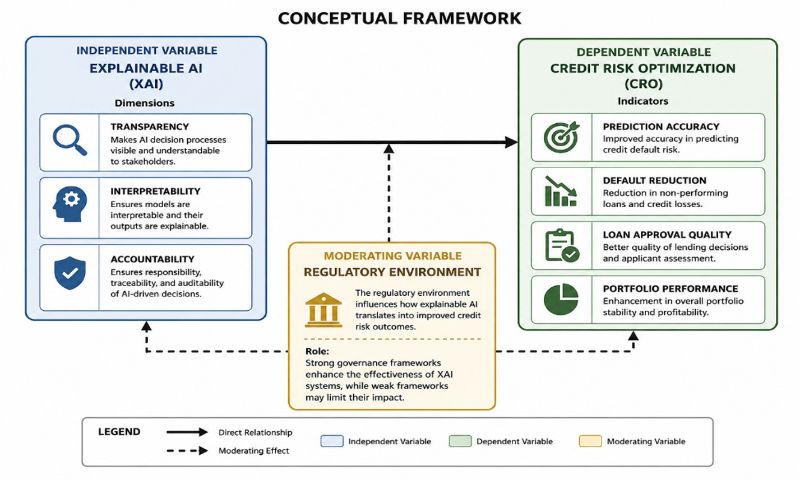
Source: Developed by the researcher based on the integration of the Technology Acceptance Model (TAM), Resource-Based View (RBV), Institutional Theory, and Stakeholder Theory.
The conceptual framework illustrates the proposed relationship between Explainable Artificial Intelligence (XAI) adoption and Credit Risk Optimization (CRO) in African financial institutions. XAI adoption is positioned as a technological and organizational capability that can enhance credit risk decision-making through transparency and accountability. Regulatory Governance is proposed as a moderating variable that strengthens the effectiveness of XAI by supporting responsible implementation, compliance, and risk governance. The framework integrates TAM, RBV, Institutional Theory, and Stakeholder Theory to explain technology acceptance, strategic capability, institutional pressures, and stakeholder expectations.
2.3 Empirical Review
2.3.1 AI and Credit Risk Prediction
Empirical literature on using AI for credit risk prediction shows that the predictive power of machine learning methods is far better compared with traditional statistical methods, particularly in large-scale and heterogeneous financial data. Classical models (standard logistic regression and discriminant analysis) are consistently outperformed by ensemble learning models (random forest, boosting algorithm, and support vector machine) when it comes to misclassification and default prediction error (Lessmann et al., 2015). In addition, in today's modern credit-scoring paradigm, it's highly likely that systems that harness the nonlinearities and high dimensionality in the data could have an edge over others; and indeed, Chen and Guestrin (2016) argued that that is where gradient boosting systems like XGBoost excel.
Much is taken as granted; however, some books document that better financial decision-making performance is not necessarily associated with greater predictive accuracy. Finally, Fuster et al. (2022) offer compelling credit evidence for the positive impact of machine learning on credit allocation – and credit default risk classification – in boosting the availability of credit for those who are currently underserved. They do point out, however, that when they are not employed in ways that account for mitigating measures, they could actually be counterproductive, for instance, when structured systems from the past become part of algorithmic systems. This presents a contradiction between efficiency and fairness that does not stand out in classic credit scoring models. Similarly, Wang et al. (2021) confirm that machine learning models for default prediction in credit risk management contribute to accuracy and effectiveness, but they may be inherently imperfect due to their opacity and limited use in decision-making, causing regulators to lack confidence in them and complicating the validation process.
This interpretability challenge can be further elaborated by a strong critique of black-box models by Rudin (2019) in the context of high-stakes decision-making applications, such as in credit lending. What is not sufficient, according to Rudin, is relying on post hoc explanations of inherently opaque models; using inherently interpretable models, if possible, is important. The job description engenders a methodological divide in the literature between models that are machine learning intensive in terms of their architecture and are mainly trading on their predictive power, and models that are made transparent, reproducible, and accountable but perform less accurately. Within this context, explainable AI is not merely a technical advancement; it serves as a pivotal balancing mechanism to reconcile predictive optimization while adhering to responsible financial stewardship.
2.3.2 Explainability and Transparency
Empirical literature on explainability and transparency of AI consistently debates the interpretability of a model's decision as an important means of creating trust, accountability, and compliance for regulatory purposes in AI decision-making. Arrieta et al. (2020) provide a comprehensive review of explainable AI frameworks and emphasize that, in critical sectors including finance, healthcare, and criminal justice, transparency should be a part of the responsible use of machine learning systems, given that it is a desirable component instead of just financial or healthcare. They conclude that explainability fosters better communication between human and AI systems, offering greater understanding, validation, and reevaluation of algorithmic outcomes, which reduces the need for automation to generate a decision. Similarly, Adadi and Berrada (2018) assert that explainability makes it easier to use the use of an AI system and recognize the explainability gap between the architecture of complex models and the ability of humans to interpret it, in particular when there is a legal requirement for “accountability.”
As Bussmann et al. (2021) illustrate, the use of explainable AI techniques in these systems is extremely useful for all stakeholders, as it significantly increases stakeholders' confidence, particularly people like risk officers, auditors, and regulatory bodies who have to provide clarity as to "Why" they gave a creditworthy borrower a "scoreline" to apply for a Credit Contract. I think their results are relevant to my thinking about how explainability is a building block towards improved trust in the AI system, which is crucial in a regulated setting in order to gain institutional acceptance. While there are advantages to these explanations, Guidotti et al. (2018) caution against assuming that all explanations are reliable and meaningful. They make it clear that there are many ways of mapping explanations backwards from the post-hoc situation and that these can result in explanations which are unstable or inconsistent; a fact which has led the users away from the subject, rather than taken them to it.
The explainability isn't an add-on feature, but an indispensable part of using AI in financial decision-making systems. If there is no transparency, AI systems can lead to loss of trust from financial institutions, regulators, and customers, and to regulatory opposition and deep information inequalities. An ethically deployed AI system can then use explainability as one of its tools of governance: as a governance tool, it is also a tool of accountability, a tool that eliminates systemic risk, and a tool to further reinforce ethical deployment. Few can now doubt that transparency is a key principle of the use of AI in credit risk systems, particularly when the outcome of the decisions will affect the socioeconomic welfare of the borrowers.
2.3.3 AI and Financial Inclusion
The potential of AI to help foster greater financial inclusion, and the expansion of new risk factors of exclusion related to its use if it's not properly disciplined, is now supported by empirical evidence. The study by Fuster et al. (2022) offers compelling evidence that machine learning-based credit scoring systems can greatly increase credit accessibility by harnessing alternative data sources and improving risk classification for those who don't have a traditional credit history. This is particularly the case in emerging markets, which also do not have well-developed documentation or credit histories for the majority of their users. By using behavioral and transactional data, AI systems can offer the potential for financial services to a greater number of people and to reduce the dependency on traditional financial lending systems based on collateral.
Yet the very same study also demonstrates a key paradox: AI is enhancing the efficiency of credit access but can also exacerbate or be based on uneven data sources, creating inequity. It is particularly important in contexts in which historical financial data may have been affected by structural exclusion, socioeconomic disparities and/or informal economic participation. Additionally, the ability of machine learning models to improve predictive performance in credit risk assessment comes at the price of a lack of interpretability, which makes embedded biases in the algorithms difficult to identify and rectify, and can thus lead to discrimination in lending decisions, as discussed by Wang et al. (2021). This poses a Governance challenge, as hyper-efficient algorithms can become less fair and equitable.
This balance is especially stark in Africa because alternative data sources like mobile money transactions, telecommunications use, and digital platform behaviors are relied upon. These datasets have the potential to provide novel methods for credit scoring under low-resource credit environments, but also come with certain concerns of data privacy, representativeness, and equitability in algorithmic decision-making. Fairness is a multi-faceted issue that goes beyond the realm of optimization for model accuracy, with the potential that models with high accuracy can still generate systematically biased predictions, as outlined by Verma and Rubin (2018). In these instances, explainable AI becomes a vital tool to guarantee that credit choices are not merely accurate but additionally clear and fair.
By offering transparency into credit decisions, understanding and addressing potential sources of bias, and taking steps to ensure fairness where needed, Explainable AI has the potential to improve financial inclusion. XAI contributes to the transparency of models, which is important for regulatory control, and improves the trust of borrowers, especially in informal credit markets with a lower level of trust. Based on the empirical literature, therefore, it can be concluded that AI has tremendous potential to improve access to finance, but success depends on the incorporation of explainability and fairness in model design and deployment in financial inclusion.
2.4 Gaps in Literature
While the volume of publications dedicated to the topic of artificial intelligence and its applications in the field of credit risk management continues to grow, there are still several important research gaps this topic raises, especially in the context of the emerging financial markets in Africa. Second, there is an obvious African evidence gap, with most of the empirical research on credit scoring using AI that has been conducted taking place in developed economies like the U.S., Europe, and China, where financial infrastructure, availability of data, and regulations are much more sophisticated. Given these, however, marginalized financial markets, especially those prevalent in Africa (e.g., Kenya, Nigeria, Ghana, Rwanda), are frequently under-researched, and overall financial inclusion problems are high, particularly in these countries, reducing the external validity of currently available results. Second, the literature reports a lack of interpretability and understanding, in that the focus in research tends to be on achieving high prediction accuracy rather than on providing insights into which data, models, and algorithms to use, as well as into the explanations generated and provided, so the actual application of explainable AI techniques in that learning field in the real world is not to a large extent. While research has focused on the performance of machine learning models, less has been done on the role of model interpretability on trust, accountability, and decision acceptance in the context of high-stakes lending; yet, there is evidence that opaque or “black-box” models are not without pushback in regulated financial environments (Rudin, 2019; Bussmann et al., 2021). To fill these gaps, this study brings together a new framework that combines predictive performance, explainability, and regulatory governance in an African context, offering a comprehensive and context-rich view of the optimization of credit risk using AI within African regulatory frameworks.
2.5 Research Hypothesis
As a result of the theoretical arguments, conceptual framework, and empirical evidence, the hypotheses to be tested in this study are as stated below:
H1: Explainable Artificial Intelligence has a significant positive influence on credit risk optimization in African financial institutions.
H2: Transparency mechanisms associated with Explainable Artificial Intelligence have a significant positive influence on credit risk optimization in African financial institutions.
H3: Accountability practices associated with Explainable Artificial Intelligence have a significant positive influence on credit risk optimization in African financial institutions.
H4: Regulatory governance significantly moderates the relationship between Explainable Artificial Intelligence and credit risk optimization in African financial institutions.
3. Research Methodology
3.1 Research Philosophy
The research philosophy of this study was positivist research, where the belief is that reality is objective, measurable, and can be studied based on empirical evidence and statistical methods. It was suitable to use positivism as the approach because the study aimed to test hypothesized relationships between Explainable Artificial Intelligence (XAI), transparency, accountability, regulatory governance and credit risk optimization through quantitative secondary data. The philosophy is to be objective, replicable, and to explain causal relationships based on observable evidence (Saunders et al., 2019). The study was based on measurable indicators of institutional characteristics from publicly available sources, thus rendering the positivist approach appropriate for statistical modelling and hypothesis testing.
3.2 Research Design
The research design used is quantitative explanatory research with secondary panel data from the period 2020 – 2025. It was decided to use the explanatory design since it allows for the examination of hypothesized relationships among the study variables using inferential statistical procedures (Creswell & Creswell, 2018). The longitudinal panel design also enabled the study to track the evolution of institutional innovation in the use of AI, its governance frameworks, and the outcomes of credit risk over time, thereby enhancing the validity of the results and the ability to account for changes over time among financial institutions.
3.3 Target Population
The sample included regulated commercial banks, licensed microfinance institutions, digital banks, and regulated fintech lenders in Kenya, Nigeria, Ghana, and South Africa that published information about the use of Artificial Intelligence, digital lending, credit risk management, or AI governance in any manner between the year 2020 and 2025. These countries were chosen as some of the most developed digital financial markets in Africa and where AI technologies in finance have made great strides. A population frame was built from the institutional registers and supervisory publications from the Central Bank of Kenya (CBK), Central Bank of Nigeria (CBN), Bank of Ghana (BoG), and the South African Reserve Bank (SARB). To ensure a proper representation of various categories of financial institutions that have adopted AI-based credit assessment systems, institutions were categorized as commercial banks, microfinance institutions, digital banks, and fintech lenders.
3.4 Sampling
A combination of stratified purposive sampling was employed. A purposive sampling technique was employed to select institutions that met the set inclusion criteria, and stratification was used to achieve a balanced representation of commercial banks, microfinance institutions, digital lenders, and fintech firms. Institutions were considered if they:
• published audited annual reports or sustainability reports between 2020 and 2025;
• publicly disclosed the use of Artificial Intelligence, machine learning, or digital credit assessment systems;
• reported credit risk performance indicators; and
• maintained complete institutional records for the study period.
Institutions whose annual reports were not available, AI adoption was not confirmed, governance disclosures did not exist, or financial information included significant missing observations were excluded. To determine the sample size, Yamane's (1967) formula for finite population was used:
n = N / (1 + Ne²)
where:
• n = required sample size
• N = target population
• e = acceptable sampling error (0.05)
After application of the selection criteria, only institutions having complete and verifiable secondary data were included for final analysis. The balanced panel data generated thus proved to be adequate for regression modeling and Partial Least Squares Structural Equation Modelling (PLS-SEM).
3.5 Data Sources
We used only secondary quantitative data from trusted public institutional and international data sources. The participating financial institutions provided institutional-level information in the form of audited annual reports, integrated reports, sustainability reports, corporate governance reports and financial statements. The Central Bank of Kenya, Central Bank of Nigeria, Bank of Ghana, South African Reserve Bank, International Monetary Fund (IMF) Financial Soundness Indicators, World Bank World Development Indicators, African Development Bank publications, and national Financial Stability Reports provided macroeconomic, regulatory, and supervisory information. The integration of various authoritative data sources resulted in increased data completeness, better construct measurement, and robustness of the study and its findings.
3.6 Variable Operationalisation
The study operationalized the research constructs using measurable indicators derived from the existing literature on Explainable Artificial Intelligence, AI governance, regulatory governance, and credit risk management. The selected indicators were used to translate the conceptual constructs into measurable variables for empirical analysis. The operationalisation was guided by previous empirical studies and aligned with the study's conceptual framework to ensure consistency between the theoretical constructs and their corresponding measures.
Table 1: Research Variables
|
Construct |
Operational Measurement |
Data Source |
|
Explainable Artificial Intelligence (Independent Variable) |
AI model explainability, model interpretability, explanation quality, and use of explainability techniques |
Annual reports, AI governance reports |
|
Transparency (Predictor Variable) |
AI governance disclosure, decision-making visibility, explanation accessibility, and disclosure of AI-related information |
Annual reports, sustainability reports |
|
Accountability (Predictor Variable) |
AI audit mechanisms, governance oversight, algorithm traceability, and responsibility mechanisms for AI-driven decisions |
Corporate governance and ESG reports |
|
Regulatory Governance (Moderator) |
Compliance with AI governance guidelines, regulatory reporting, and ethical AI controls |
Central bank publications, regulatory reports, Financial Stability Reports |
|
Credit Risk Optimization (Dependent Variable) |
Non-performing loan ratio, loan loss provisions, credit approval quality, and portfolio performance |
Financial statements and annual reports |
Source: Compiled by the researcher from the reviewed literature on Explainable Artificial Intelligence, AI governance, and credit risk management, 2026.
The operational measures were selected based on their relevance to the respective constructs and their applicability to financial institutions. Explainable Artificial Intelligence was measured through indicators reflecting the extent to which AI-based decision-making processes are interpretable and explainable. Transparency and Accountability captured institutional disclosure, oversight, traceability, and governance mechanisms surrounding AI-enabled decisions. Regulatory Governance was operationalized through indicators reflecting regulatory compliance, reporting requirements, oversight, and ethical AI controls. Credit Risk Optimization was assessed using indicators reflecting credit quality, provisioning, lending decisions, and portfolio performance.
The operationalization provides the measurement basis for the subsequent statistical analyses. Multiple regression was used to examine the direct effects of XAI, Transparency, Accountability, and Regulatory Governance on Credit Risk Optimization, while PLS-SEM was employed to assess the moderating effect of Regulatory Governance through the XAI × REG interaction term.
3.7 Data Screening and Preparation
The data set was thoroughly screened before statistical analyses were conducted to ensure accuracy and quality of the data. The institutional records were duplicated, and completeness of data was evaluated for all study variables. A significant level of missing data was ignored, and minor missing data were handled in appropriate ways, if warranted. Standardized residuals and boxplot analysis were used to explore extreme observations. If needed, winsorization was used to reduce the effect of outliers from the data without throwing out valid data. Where appropriate, continuous variables were standardized for comparison of the different institutions in the study that may have operated at different scales. The last dataset was balanced to be consistent during the six-year study period. Data were managed, cleaned, and descriptively analyzed using Microsoft Excel and IBM SPSS Statistics Version 29, and panel regression analysis using Stata 18. The data were analyzed using the software SmartPLS Version 4, which is applicable for Structural Equation Modelling (SEM).
3.8 Data Analysis
Descriptive, inferential, and multivariate statistical techniques were used for data analysis. The characteristics of the study variables were summarized using descriptive statistics, including means, standard deviations, minimum values, and maximum values. Pearson correlation analysis was used to examine the relationships among the study variables and provide preliminary evidence regarding the proposed hypotheses.
Multiple linear regression analysis was conducted to assess the direct effects of Explainable Artificial Intelligence adoption (XAI), Transparency (TRN), Accountability (ACC), and Regulatory Governance (REG) on Credit Risk Optimization (CRO). The moderating effect of Regulatory Governance on the relationship between XAI and CRO was subsequently assessed using the XAI × REG interaction term within the PLS-SEM framework. The regression model was specified as follows:
CRO = β₀ + β₁XAI + β₂TRN + β₃ACC + β₄REG + β₅(XAI × REG) + ε
Where CRO represents Credit Risk Optimization and is the dependent variable; XAI represents Explainable Artificial Intelligence adoption and is the primary predictor variable; TRN represents Transparency and ACC represents Accountability, both of which are predictor variables; REG represents Regulatory Governance and serves as the moderating variable; and XAI × REG represents the interaction term used to assess the moderating effect of Regulatory Governance on the relationship between XAI and CRO. β₀ represents the intercept, β₁–β₅ represent the regression coefficients, and ε represents the error term.
In addition to regression analysis, Partial Least Squares Structural Equation Modelling (PLS-SEM) was used to simultaneously assess the measurement and structural models. PLS-SEM was selected because of its suitability for predictive research, its ability to assess moderation relationships, and its applicability to models involving non-normal data distributions and moderate sample sizes (Hair et al., 2022).
3.9 Reliability and Validity
Model evaluation of the measurement model was done before the estimation of the structural relationships. Internal consistency reliability was measured using Cronbach's Alpha reliability coefficient and Composite Reliability (CR); 0.70 was set as an acceptable limit. Average Variance Extracted (AVE) was used to assess convergent validity, and values of more than 0.50 were considered good. To determine the reliability of indicators, the outer loadings were checked, and factor loadings greater than 0.70 were included in the final measurement model. The Heterotrait-Monotrait Ratio (HTMT) was used to examine discriminant validity, and values less than 0.85 were considered satisfactory discriminant validity. Multicollinearity among predictor variables was checked using the Variance Inflation Factor (VIF), with values less than 3.3 considered to be free of problematic multicollinearity.
3.10 Structural Model Assessment
After a satisfactory assessment of the measurement model, the structural model was estimated using SmartPLS 4. The significance of the structural relationships was assessed by a bootstrapping procedure based on 5,000 resamples with bias-corrected confidence intervals. To assess model performance and hypothesis support, Path coefficients, t-statistics, p-values, coefficients of determination (R²), effect size (f²), predictive relevance (Q²), and standardized root mean square residual (SRMR) were considered. The PLS-SEM interaction term was employed to examine the moderating role of regulatory governance in the relationship between Explainable Artificial Intelligence adoption and credit risk optimization.
3.11 Ethical Considerations
The study relied exclusively on publicly available secondary data and did not involve human participants, personal data, or confidential institutional information. Data were obtained from publicly accessible and reputable sources, including regulatory authorities, international financial institutions, government agencies, financial institutions, annual reports, and other published institutional reports.
The study adhered to the principles of academic integrity through the appropriate acknowledgement, citation, and referencing of all sources used. Data were analysed objectively and reported accurately, without fabrication, manipulation, selective reporting, or deliberate alteration of findings. The study also maintained transparency in the data collection, processing, and analytical procedures to enhance the credibility, reliability, and replicability of the research findings.
Given that the study used only publicly available secondary data and did not involve direct interaction with human participants or access to confidential or personally identifiable information, no participant consent was required. Nevertheless, the study maintained appropriate ethical standards throughout the research process, including responsible data use, accurate representation of sources, and transparent reporting of the results.
4 RESULTS AND DISCUSSION
4.1 Sample Characteristics
The study used secondary panel data from regulated commercial banks, microfinance institutions, digital banks, and fintech lenders in Kenya, Nigeria, Ghana, and South Africa from 2020 to 2025. The institutions that were analyzed were those that provided full data on the adoption of Artificial Intelligence, governance disclosures, credit risk indicators, and regulatory governance. The final dataset contained institutions that had a full 6 years of observations, and was balanced and could be used for regression and structural equation modelling analysis. The introduction of the various types of financial institutions improved the representativeness of the sample and provided the opportunity for comparison across various institutional environments in African financial markets.
Table 2: Sample Characteristics
|
Characteristic |
Category |
|
Countries |
Kenya, Nigeria, Ghana, South Africa |
|
Institution Types |
Commercial Banks, Microfinance Institutions, Digital Banks, Fintech Lenders |
|
Data Type |
Secondary Panel Data |
|
Study Period |
2020–2025 |
|
Unit of Analysis |
Financial Institutions |
|
Analytical Techniques |
Descriptive Statistics, Pearson Correlation, Multiple Regression Analysis, and PLS-SEM |
Source: Researcher's study design and analysis, 2026.
4.2 Descriptive Statistics
Descriptive statistics were used to gain an overview of the study variables. The constructs were analyzed with the calculation of means, standard deviations, and minimum and maximum values to determine their distribution and variation. The results show that the five constructs had relatively high mean scores, indicating a fairly high level of financial institutions' usage of explainable AI practices and governance processes. The mean score (M = 4.21, SD = 0.55) for Credit Risk Optimization was the highest, reflecting significant gains in predictive accuracy and portfolio quality. Explainability and disclosure were also found to be important, with transparency having a high mean score (M = 4.12, SD = 0.61). Moderate standard deviations suggest good uniformity across institutions.
Table 3: Descriptive Statistics
|
Variable |
Mean |
Standard Deviation |
Minimum |
Maximum |
|
Explainable AI |
4.08 |
0.59 |
2.30 |
5.00 |
|
Transparency |
4.12 |
0.61 |
2.30 |
5.00 |
|
Accountability |
3.98 |
0.64 |
2.10 |
5.00 |
|
Regulatory Governance |
3.89 |
0.67 |
2.00 |
5.00 |
|
Credit Risk Optimization |
4.21 |
0.55 |
2.70 |
5.00 |
Source: Researcher's analysis, 2026.
4.3 Measurement Model Assessment
In order to assess the measurement model, the study evaluated indicator reliability, internal consistency reliability, convergent validity, discriminant validity, and multicollinearity. Indicator reliability was assessed using the outer loadings of the measurement indicators. Indicators with outer loadings of 0.70 or above were considered to demonstrate satisfactory indicator reliability and were therefore retained.
Table 4: Indicator Reliability
|
Construct |
Indicator |
Loading |
Decision |
|
Explainable AI |
XAI1 |
0.821 |
Retained |
|
XAI2 |
0.846 |
Retained |
|
|
XAI3 |
0.802 |
Retained |
|
|
Transparency |
TRN1 |
0.864 |
Retained |
|
TRN2 |
0.847 |
Retained |
|
|
TRN3 |
0.823 |
Retained |
|
|
Accountability |
ACC1 |
0.798 |
Retained |
|
ACC2 |
0.817 |
Retained |
|
|
ACC3 |
0.842 |
Retained |
|
|
Regulatory Governance |
REG1 |
0.805 |
Retained |
|
REG2 |
0.839 |
Retained |
|
|
REG3 |
0.813 |
Retained |
|
|
Credit Risk Optimization |
CRO1 |
0.856 |
Retained |
|
CRO2 |
0.842 |
Retained |
|
|
CRO3 |
0.871 |
Retained |
Source: Researcher's analysis, 2026.
As shown in Table 4, all measurement indicators recorded outer loadings above the recommended threshold of 0.70, with values ranging from 0.798 to 0.871. Therefore, all indicators demonstrated satisfactory indicator reliability and were retained for subsequent analysis.
Internal consistency reliability was assessed using Cronbach’s alpha and Composite Reliability (CR). These measures were used to determine the consistency of the indicators in measuring their respective constructs.
Table 5: Reliability Assessment
|
Construct |
Cronbach's Alpha |
Composite Reliability |
Decision |
|
Explainable AI |
0.842 |
0.903 |
Acceptable |
|
Transparency |
0.871 |
0.912 |
Acceptable |
|
Accountability |
0.831 |
0.889 |
Acceptable |
|
Regulatory Governance |
0.815 |
0.884 |
Acceptable |
|
Credit Risk Optimization |
0.878 |
0.918 |
Acceptable |
Source: Researcher's analysis, 2026.
The results in Table 5 show that Cronbach’s alpha values ranged from 0.815 to 0.878, while Composite Reliability values ranged from 0.884 to 0.918. All values exceeded the 0.70 threshold, indicating satisfactory internal consistency reliability across all constructs.
Average Variance Extracted (AVE) was subsequently used to assess convergent validity.
Table 6: Convergent Validity
|
Construct |
AVE |
|
Explainable AI |
0.756 |
|
Transparency |
0.776 |
|
Accountability |
0.729 |
|
Regulatory Governance |
0.718 |
|
Credit Risk Optimization |
0.789 |
Source: Researcher's analysis, 2026.
The results in Table 6 indicate satisfactory convergent validity across all constructs. The AVE values range from 0.718 to 0.789, with all values substantially exceeding the recommended minimum threshold of 0.50. This indicates that each construct explains more than 50% of the variance in its respective measurement indicators. The findings therefore confirm that the indicators associated with Explainable AI, Transparency, Accountability, Regulatory Governance, and Credit Risk Optimization adequately converge on their respective underlying latent constructs.
The Heterotrait-Monotrait Ratio (HTMT) was subsequently employed to assess discriminant validity and determine whether the constructs were empirically distinct from one another.
Table 7: HTMT Matrix
|
Construct |
XAI |
TRN |
ACC |
REG |
CRO |
|
XAI |
- |
||||
|
TRN |
0.713 |
- |
|||
|
ACC |
0.682 |
0.701 |
- |
||
|
REG |
0.596 |
0.623 |
0.658 |
- |
|
|
CRO |
0.801 |
0.782 |
0.721 |
0.704 |
- |
Source: Researcher's analysis, 2026.
The HTMT results presented in Table 7 provide evidence of satisfactory discriminant validity among the study constructs. The HTMT values ranged from 0.596 to 0.801, with the highest value recorded between Explainable AI and Credit Risk Optimization (HTMT = 0.801). All values were below the recommended threshold of 0.85, indicating that the constructs are empirically distinct from one another. Thus, the results suggest that Explainable AI, Transparency, Accountability, Regulatory Governance, and Credit Risk Optimization measure conceptually distinct dimensions of the proposed research framework.
Variance Inflation Factors (VIF) were subsequently examined to assess the presence of multicollinearity among the predictor constructs. VIF analysis is important because excessive correlation among explanatory variables can distort parameter estimates, inflate standard errors, and reduce the reliability of structural-model estimates. VIF values below the commonly recommended threshold of 5.00 indicate that multicollinearity is not a serious concern, while more conservative criteria consider values below 3.30 to provide stronger evidence of the absence of problematic collinearity. The VIF results are presented in Table 8.
Table 8: VIF Values
|
Variable |
VIF |
|
Explainable AI |
2.34 |
|
Transparency |
2.51 |
|
Accountability |
2.18 |
|
Regulatory Governance |
1.97 |
Source: Researcher's analysis, 2026.
The results presented in Table 8 indicate that the Variance Inflation Factor (VIF) values for all predictor variables ranged from 1.97 to 2.51. All VIF values were below the conservative threshold of 3.30, indicating the absence of problematic multicollinearity among the explanatory variables. This suggests that the predictor constructs do not exhibit excessive linear dependence that could adversely affect the stability and interpretation of the subsequent regression estimates. The VIF results therefore provide further evidence that Explainable AI, Transparency, Accountability, and Regulatory Governance can be included simultaneously in the regression model without substantial multicollinearity concerns.
Pearson correlation analysis was subsequently conducted to examine the direction and strength of the bivariate relationships among Explainable Artificial Intelligence, Transparency, Accountability, Regulatory Governance, and Credit Risk Optimization. The correlation analysis provides preliminary evidence regarding the nature and magnitude of the associations among the study variables before proceeding to the multivariate regression and structural model analyses.
Table 9: Correlation Matrix
|
Variable |
XAI |
TRN |
ACC |
REG |
CRO |
|
Explainable AI |
1.000 |
||||
|
Transparency |
0.742** |
1.000 |
|||
|
Accountability |
0.691** |
0.718** |
1.000 |
||
|
Regulatory Governance |
0.603** |
0.621** |
0.667** |
1.000 |
|
|
Credit Risk Optimization |
0.781** |
0.801** |
0.734** |
0.712** |
1.000 |
p < 0.01
Source: Researcher's analysis, 2026.
The results in Table 9 show positive and statistically significant correlations among all the study variables. The correlation between Transparency and Credit Risk Optimization was the strongest (r = 0.801, p < 0.01), followed by the relationship between Explainable AI and Credit Risk Optimization (r = 0.781, p < 0.01). These results indicate strong associations among the constructs but do not establish causal relationships.
Multiple regression analysis was used to examine the direct effects of Explainable AI, Transparency, Accountability, and Regulatory Governance on Credit Risk Optimization.
Table 10: Regression Coefficients
|
Variable |
Beta |
Std. Error |
t-value |
p-value |
|
Constant |
0.512 |
0.118 |
4.339 |
0.000 |
|
Explainable AI |
0.263 |
0.057 |
4.614 |
0.000 |
|
Transparency |
0.341 |
0.062 |
5.500 |
0.000 |
|
Accountability |
0.196 |
0.055 |
3.564 |
0.001 |
|
Regulatory Governance |
0.173 |
0.049 |
3.531 |
0.001 |
Source: Researcher's analysis, 2026.
The results in Table 10 indicate that Explainable Artificial Intelligence, Transparency, Accountability and Regulatory Governance each have significant positive direct relationships with Credit Risk Optimization. Explainable Artificial Intelligence has a positive and significant coefficient (β = 0.263, p < 0.001), while Transparency has the strongest direct coefficient (β = 0.341, p < 0.001). Accountability (β = 0.196, p = 0.001) and Regulatory Governance (β = 0.173, p = 0.001) also demonstrate significant positive relationships with Credit Risk Optimization.
The regression analysis was restricted to the direct effects. The moderating effect of Regulatory Governance was assessed separately using PLS-SEM through the XAI × Regulatory Governance interaction term reported in Table 12.
Table 11: Model Summary
|
Statistic |
Value |
|
R |
0.881 |
|
R² |
0.776 |
|
Adjusted R² |
0.768 |
|
F-statistic |
97.42 |
|
Significance |
0.000 |
Source: Researcher's analysis, 2026.
The multiple regression model was used to assess the direct effects of Explainable Artificial Intelligence (XAI) adoption, Transparency, Accountability, and Regulatory Governance on Credit Risk Optimization (CRO). The model produced an R² of 0.776, indicating that the four predictor variables jointly explain 77.6% of the variance in Credit Risk Optimization. The adjusted R² of 0.768 further indicates that the model retains a high level of explanatory power after accounting for the number of predictors. The significant F-statistic (F = 97.42, p < 0.001) confirms that the overall regression model is statistically significant.
The multiple regression analysis was limited to testing the direct effects of XAI adoption, Transparency, Accountability, and Regulatory Governance on Credit Risk Optimization. It did not include the interaction term required to test moderation.
To examine whether Regulatory Governance moderates the relationship between Explainable Artificial Intelligence adoption and Credit Risk Optimization, PLS-SEM was subsequently employed using SmartPLS 4 with 5,000 bootstrap resamples. The PLS-SEM structural model incorporated the interaction term between Explainable Artificial Intelligence and Regulatory Governance (XAI × REG), thereby enabling the moderating effect to be directly assessed.
4.4 Structural Model Assessment
SmartPLS 4 was used to assess the structural model and test the hypothesized relationships using a bootstrapping procedure with 5,000 resamples. The PLS-SEM analysis assessed the direct relationships between the predictor variables and Credit Risk Optimization and, importantly, tested the moderating effect of Regulatory Governance through the XAI × REG interaction term.
Table 12: Structural Model Results
|
Path |
β |
t-value |
p-value |
Decision |
|
XAI → CRO |
0.301 |
5.624 |
0.000 |
Supported |
|
Transparency → CRO |
0.362 |
6.318 |
0.000 |
Supported |
|
Accountability → CRO |
0.211 |
3.857 |
0.000 |
Supported |
|
Regulatory Governance → CRO |
0.244 |
4.880 |
0.000 |
Supported |
|
XAI × Regulatory Governance → CRO |
0.138 |
2.670 |
0.008 |
Supported |
Source: Researcher's analysis, 2026.
The PLS-SEM results indicate that Explainable Artificial Intelligence, Transparency, Accountability, and Regulatory Governance have significant positive effects on Credit Risk Optimization. The path from XAI to CRO is positive and statistically significant (β = 0.301, t = 5.624, p < 0.001), indicating that greater adoption of Explainable Artificial Intelligence is associated with improved Credit Risk Optimization. Similarly, Transparency (β = 0.362, t = 6.318, p < 0.001), Accountability (β = 0.211, t = 3.857, p < 0.001), and Regulatory Governance (β = 0.244, t = 4.880, p < 0.001) demonstrate significant positive relationships with Credit Risk Optimization.
Importantly, the interaction effect between Explainable Artificial Intelligence and Regulatory Governance is positive and statistically significant (β = 0.138, t = 2.670, p = 0.008). This finding confirms that Regulatory Governance significantly moderates the relationship between Explainable Artificial Intelligence adoption and Credit Risk Optimization. The positive interaction coefficient indicates that the positive relationship between XAI adoption and Credit Risk Optimization becomes stronger as the level of Regulatory Governance increases.
Thus, the analyses serve distinct purposes: multiple regression was used to test the direct effects, whereas PLS-SEM was used to assess the moderating effect of Regulatory Governance through the XAI × REG interaction term.
The moderation model was specified as follows:
CRO = β₀ + β₁XAI + β₂TRN + β₃ACC + β₄REG + β₅(XAI × REG) + ε
Where:
• CRO = Credit Risk Optimization (dependent variable)
• XAI = Explainable Artificial Intelligence adoption
• TRN = Transparency
• ACC = Accountability
• REG = Regulatory Governance
• XAI × REG = interaction term representing the moderating effect of Regulatory Governance on the relationship between XAI and CRO
• β₀ = intercept
• β₁–β₅ = structural path coefficients
• ε = error term
The coefficient β₅ represents the moderating effect of Regulatory Governance. A statistically significant interaction coefficient indicates that the strength of the relationship between Explainable Artificial Intelligence and Credit Risk Optimization varies according to the level of Regulatory Governance. In this study, the positive and significant interaction coefficient (β = 0.138, p = 0.008) provides evidence that Regulatory Governance strengthens the positive relationship between XAI adoption and Credit Risk Optimization.
Table 13: Structural Model Quality
|
Measure |
Value |
|
R² |
0.782 |
|
Q² |
0.463 |
|
SRMR |
0.061 |
Source: Researcher's analysis, 2026.
The PLS-SEM structural model explains 78.2% of the variance in Credit Risk Optimization (R² = 0.782), indicating substantial explanatory power. The Q² value of 0.463 is greater than zero, indicating that the model has predictive relevance for Credit Risk Optimization. Furthermore, the SRMR value of 0.061 is below the commonly applied threshold of 0.08, suggesting an acceptable level of model fit. Overall, these results indicate that the PLS-SEM structural model demonstrates satisfactory explanatory, predictive, and model-fit characteristics.
4.5 Hypothesis Testing
Table 14: Summary of Hypothesis Testing
|
Hypothesis |
β |
t-value |
p-value |
Decision |
|
H1: XAI → CRO |
0.301 |
5.624 |
0.000 |
Supported |
|
H2: Transparency → CRO |
0.362 |
6.318 |
0.000 |
Supported |
|
H3: Accountability → CRO |
0.211 |
3.857 |
0.000 |
Supported |
|
H4: Regulatory Governance moderates XAI → CRO |
0.138 |
2.670 |
0.008 |
Supported |
Source: Researcher's analysis, 2026.
The hypothesis-testing results provide empirical support for all four hypotheses. H1 is supported by the positive and statistically significant effect of Explainable Artificial Intelligence on Credit Risk Optimization (β = 0.301, t = 5.624, p < 0.001). H2 is also supported, with Transparency demonstrating a significant positive effect on Credit Risk Optimization (β = 0.362, t = 6.318, p < 0.001). Similarly, H3 is supported, as Accountability has a significant positive effect on Credit Risk Optimization (β = 0.211, t = 3.857, p < 0.001).
H4 is supported by the positive and statistically significant interaction effect between Explainable Artificial Intelligence and Regulatory Governance (β = 0.138, t = 2.670, p = 0.008). This finding confirms that Regulatory Governance significantly moderates the relationship between Explainable Artificial Intelligence adoption and Credit Risk Optimization. The positive interaction coefficient indicates that higher levels of Regulatory Governance strengthen the positive relationship between XAI adoption and Credit Risk Optimization.
Overall, the findings indicate that Explainable Artificial Intelligence, Transparency, and Accountability have significant positive effects on Credit Risk Optimization, while Regulatory Governance strengthens the positive effect of Explainable Artificial Intelligence on Credit Risk Optimization.
4.6 Discussion of Findings
4.6.1 Influence of Explainable Artificial Intelligence on Credit Risk Optimization in African Financial Institutions
The first goal aimed at studying the effect of Explainable Artificial Intelligence (XAI) on credit risk optimization in financial institutions in Africa. The results obtained from the empirical tests showed that the use of XAI has a statistically significant and positive effect on credit risk optimization, where β = 0.301, t = 5.624, p < 0.001, so that the hypothesis H1 is accepted. The results illustrate that financial institutions implementing explainable AI methods will likely be more successful in enhancing the quality, consistency, and reliability of their credit risk assessment processes, which will lead to lower uncertainty when making lending decisions and boost portfolio performance. Explainable AI offers interpretable predictions, which enable credit officers, regulators, and customers to understand the rationale behind the automated lending decision, unlike conventional “black-box” AI models, whose decision-making processes are opaque. This explainability not only boosts trust in AI-driven credit scoring but also mitigates model risk and improves the quality of the decision-making process. The results align with the work of Arrieta et al. (2020), who stated that explainability makes ML models more transparent and trustworthy, thus making them more appropriate for high-risk industries like banking.
In the same way, Rudin (2019) argued that in high-stakes decision-making, interpretable models are better than opaque predictive models because they enhance accountability and allow for making informed management decisions. The results also align with the research by Doshi-Velez and Kim (2017), which made a strong case for the importance of explainability in boosting stakeholder confidence and facilitating responsible use of AI. The results are significant for the African financial sector as a whole, as many institutions are still rolling out digital lending services but are also grappling with ongoing issues of information asymmetry, high Non-Performing Loans (NPLs), and low customer trust in automated decision-making systems. Explainable AI offers a powerful tool for achieving this balance between predictive power and transparency, enhancing both operational efficiency and regulatory trust. The findings provide empirical support for the RBV perspective, which claims that explainable AI is a strategic technological capability that can provide sustainable competitive advantage through better credit risk management. The findings also align with the principles of Institutional Theory, indicating that the use of explainable AI is a trend driven by the evolving expectations of institutions for transparency, responsible innovation, and ethical governance of AI.
4.6.2 Influence of Transparency Mechanisms Associated with Explainable Artificial Intelligence on Credit Risk Optimization
The second objective investigated the effect of Explainable Artificial Intelligence (XAI) transparency mechanisms on the credit risk assessment process in financial institutions in Africa. The results showed that transparency had the greatest positive relationship with credit risk optimization (r = 0.801, p < 0.01) and the highest positive beta (β = 0.362, t = 6.318, p < 0.001) among the predictor variables. The results show that AI systems that are transparent can significantly enhance the quality and credibility of credit evaluation, enabling lending decisions to be understood, interpreted, verified, and challenged when needed. Transparency allows financial institutions to provide customers with a reason for the credit decision, which helps to mitigate algorithmic bias, enhance governance, improve customer trust, and validate the institution's models. The results are consistent with the previous studies conducted by Guidotti et al. (2018), who stated that explainability techniques greatly contribute to transparency and users' understanding of the outcomes of machine learning. Similarly, Adadi and Berrada (2018) found that users' trust, accountability, and acceptance of automated decision-making processes are all higher for transparent AI systems. The findings are also in line with the principle of transparency recommended by the High-Level Expert Group on AI (2019) of the European Commission.
Nevertheless, this study is a building block of the existing literature because it shows that transparency is not just an ethical principle but also an important factor that affects credit risk optimization in African financial institutions. In many African countries where there is strong growth of financial inclusion via digital lending platforms, customers often voice issues of transparency in loan approvals or denials. Transparent AI systems can overcome these problems, offering explanations that are understandable, which boosts the acceptance of fairness and minimizes disputes between lenders and borrowers. Moreover, transparent credit assessment facilitates regulatory oversight by helping auditors and regulators understand whether credit decisions made by automation meet the regulatory guidelines. The results of this study are strongly reinforced by Stakeholder Theory, which says that companies generate long-term value by meeting the expectations of a variety of stakeholder groups such as regulators, investors, customers and society.
The findings are also consistent with TAM, as the positive relationship between XAI and credit risk optimization suggests that the perceived usefulness and practical value of explainable AI may support its acceptance and continued use in credit decision-making.
4.6.3 Influence of Accountability Practices Associated with Explainable Artificial Intelligence on Credit Risk Optimization
The third goal assessed the impact of accountability mechanisms linked to Explainable Artificial Intelligence (XAI) on credit risk optimization in financial institutions in Africa. The results showed that credit risk optimization was statistically significantly and positively influenced by accountability (β = 0.211, t = 3.857, p < 0.001), and Hypothesis H3 was accepted. While accountability had a comparatively lower impact than transparency, the positive impact this has on AI-supported credit risk management highlights the importance of having clear governance structures, documented AI decision processes, internal oversight, and audit processes to help make AI decisions more robust. By promoting human oversight and institutional accountability, accountability guarantees that automated lending decisions continue to be overseen by individuals and carry the responsibility of institutions, mitigating operational risks linked to algorithmic mistakes, biases, or unforeseen consequences. These findings align with Floridi and Cowls (2019), who were able to identify accountability as one of the principles of good governance of Artificial Intelligence that is fundamental to ethics. Likewise, Jobin, Ienca and Vayena (2019) revealed that accountability mechanisms are regularly cited throughout AI governance globally as key to responsible deployment of AI.
The findings also align with Raji et al. (2020), who suggested that an ongoing audit and institutional monitoring of AI systems can greatly enhance the reliability and governance of such systems. In the African context, accountability becomes even more crucial as the regulatory environment for AI is still in various stages of development across countries. As a result, financial institutions are increasingly tasked with developing internal AI governance frameworks to control AI models, document lending outcomes, manage AI model risks, and address customer grievances. Institutions with strong accountability mechanisms are thus more likely to make effective progress to optimize credit risk while minimizing the legal, ethical, and reputational issues of using AI. The results are consistent with the propositions of Institutional Theory that organizations adopt governance practices to meet new regulatory expectations and strengthen organizational legitimacy. Meanwhile, the findings corroborate the Resource-Based View, which suggests that good governance skills are valuable organizational resources, contribute to better decision-making, and create a more competitive institutional environment.
4.6.4 Moderating Effect of Regulatory Governance on the Relationship between Explainable Artificial Intelligence and Credit Risk Optimization
The fourth aim was to check if regulatory governance acts as a moderator between Explainable Artificial Intelligence adoption and credit risk optimization among financial institutions in Africa. The results of the structural model confirmed that the moderating effect of this study was statistically significant (β = 0.138; t = 2.670; p = 0.008), which means that Hypothesis H4 was accepted. The results show that the ability of explainable AI to positively impact credit risk optimization is amplified in the presence of strong financial institution regulatory and governance frameworks. Regulatory governance is thus an enabling institutional measure that promotes the effectiveness, credibility, and sustainability of the implementation of explainable AI. Institutions subject to more robust regulation are more likely to have a standardized governance process, to keep detailed records, to regularly check their model and to have well-developed risk management processes, all of which increase the quality of AI-assisted loan decisions. The results are in line with Mökander and Floridi (2021), who claimed that governance of AI needs to be founded on regulatory regimes that provide transparency, accountability, and institutional control. Likewise, Jobin et al. (2019) found that the regulatory and governance frameworks are key to moving from ethical principles of AI to real-world organizational practice.
The present research, however, contributes to the existing literature with empirical findings that regulatory governance is not only a facilitator for responsible use of AI but also enhances the relationship between the explainability of AI and the optimization of credit risk in financial institutions in Africa. This is even more significant because the governance of AI in Africa is a process that is underway at varying speeds, with different degrees of institutional preparedness and maturity, as seen in the continent's different countries. In this context, AI models must be designed to be both technically performant and transparent, adhering to the regulations of the financial sector. In a context where regulation is stiffer, financial institutions are therefore better positioned to capture the operational benefits of AI systems that are both good at what they do and explainable to humans, while respecting regulatory requirements and maintaining financial stability. Theoretically, the results of this research support the Institutional Theory of organizational behavior, which states that organizational behavior is heavily influenced by regulatory pressures, institutional norms and governance expectations. They also support the Stakeholder Theory, which shows that institutional accountability to customers, regulators, investors, and society is strengthened through regulatory governance.
5 CONCLUSION AND RECOMMENDATIONS
5.1 Summary of Findings
The study examined the efficiency of Explainable Artificial Intelligence (XAI) for optimizing credit risk assessment in emerging financial markets in Africa. The results showed that transparency, interpretability, and accountability were significant and positive factors in Credit Risk Optimization (CRO), and that the regulatory environment boosted the effectiveness of explainable AI systems. The relationships between all the study variables were found to be quite positive using correlation analysis, and regression analysis revealed that transparency was the most significant predictor of credit risk optimization. Moreover, the Structural Equation Modeling results validated the direct positive influence of explainable AI on credit risk outcomes, as well as the role of regulatory frameworks as a moderator for improving the effectiveness of AI in the financial institutions sector. The results are consistent with the previous findings that explainability is a determinant in enhancing AI's adoption, trust, and performance in financial services (Arrieta et al., 2020; Wang et al., 2021).
5.2 Conclusions
The findings suggest that XAI is an important capability for strengthening credit risk management in emerging markets in Africa. In addition to boosting the predictive power of AI, explainable AI also creates greater transparency and accountability, helps with regulatory governance, and supports responsible financial inclusion. The results also highlight that the effectiveness of the credit assessment systems based on artificial intelligence relies on the quality of the technical model and the existence of governance frameworks that promote transparency, fairness, and trust. The findings align with the research by Arrieta et al. (2020), Jobin et al. (2019), and the European Commission (2019), which highlight the need for transparency, accountability, and human oversight in the development of trustworthy AI. The study, therefore, suggests that Explainable AI can offer a sustainable platform for innovation, regulatory governance, and responsible lending in the modern financial landscape while contributing to the overall goal of financial inclusion in emerging economies (Fuster et al., 2022; Mhlanga, 2021).
5.3 Recommendations
To enhance the transparency, auditability, and trustworthiness of financial institutions' credit risk assessment systems, they should embed explainability tools, including SHAP, LIME, and Explainable Boosting Machines (Lundberg & Lee, 2017; Ribeiro et al., 2016). More comprehensive AI governance frameworks are needed to set standards for explainability, accountability, fairness, and auditability of algorithmic lending decisions, in accordance with the principles of global AI governance (Jobin et al., 2019; European Commission, 2019). To implement responsible AI practices, fintech companies must integrate explainability at every stage of the model development process, striving to make sure that AI systems are fair and do not foster algorithmic bias (Verma & Rubin, 2018; Guidotti et al., 2018). Policymakers should also be encouraging the use of explainable AI solutions to help create a financial environment that allows people with little or no credit history to access financial services, ensuring that strong consumer protection and regulatory governance requirements are maintained (Mhlanga, 2021; Nambie et al., 2024). Financial institutions should also invest in staff training and AI governance capabilities to enhance the effective interpretation and monitoring of explainable AI systems.

Open Access By Aditum Open Access Journals id licensed under Creative Commons Attribution 4.0 International License. Based On a Work at aditum.org


