
International Surgery Case Reports
OPEN ACCESS | Volume 8 - Issue 1 - 2026
ISSN No: 2836-2845 | Journal DOI: 10.61148/2836-2845/ISCR


Chee Kong Yap
Department of Biology, Faculty of Science, Universiti Putra Malaysia, 43400 UPM Serdang, Selangor, Malaysia.
*Corresponding author: Chee Kong Yap, Department of Biology, Faculty of Science, Universiti Putra Malaysia, 43400 UPM Serdang, Selangor, Malaysia.
Received: December 15, 2025 | Accepted: December 29, 2025 | Published: January 04, 2026
Citation: Chee Kong Yap. (2026) “Castles in the Air and the Real Castle: A Personal Reflection on Osaka Castle, Memory, and the Architecture of Human Hope.”, International Surgery Case Reports, 8(1); DOI: 10.61148/2836-2845/ISCR/111.
Copyright: © 2026. Chee Kong Yap. This is an open access article distributed under the Creative Commons Attribution License, which permits unrestricted use, distribution, and reproduction in any medium, provided the original work is properly cited.
This contemplative article will focus on an autobiographical visit to Osaka Castle on 25th March 2019 in order to investigate how a real castle can transform our personal "castles in the air" in this way. Through an autoethnographic narrative informed by personal photographic and recollective research into this event, this article will follow how walking through gates, up stone stairs, and over viewpoints, and pausing by a moat, can work to transform a tourist outing into a personal dialogue between memory and architecture in this way. In this way, Osaka Castle either appears simply as a reconstructed monument to war and strength or else as a living memory palace, in which loss, reconstruction, and hope are written into matter in this way. Either way, this article will show how a real castle can present a very different challenge to our personal "castles in the air," one which urges a remapping of our personal ambitions in light of historical breaks. Years later, these personal photographic images have proven to be a rewarding means of demonstrating how such a site continues over time to organize personal meaning in this way, using a single outing in a day to map a quietly detailed personal geography of human desire, exposure, and resilience (257 words).
Autoethnography; Castles in the air; Memory and architecture; Human hope
A family outing to Osaka Castle in 2019 might superficially appear to be a common sightseeing activity in travel plans, but this event marked a moment of personal epiphany in terms of how I personally conceptualize and think about dreams, history, and our delicate structures within our minds. On 25th March 2019, with an Osaka Amazing Pass 2-Day Passport in hand and a level of quiet excitement which can only be fueled by a free admission ticket into a tourist spot, I began my day-long excursion to the Osaka Castle. Everything remains very memorable in this case: from leaving Tanimachi 4-chome Station through Exits 1b & 9, taking in the cool spring air with each step, to noting the time in order to remain within the Osaka Castle Area from 9.30 a.m. to 1.30 p.m. While these are all commonplace matters, they represent a small but minutely detailed parameter in which a series of deeply subjective experiences took place in this instance. I would classify these parameters under environmental psychology (Yap & Leow, 2024).
My line was easy to follow on a map but dense with significance. First, the Osaka Suijyo Bus Aqua-liner from Osaka Business Park Station, gliding over the water with a silent cityscape passing by on either side.
Then a walk in the direction of Osaka Castle Museum from the pier, joining others but with my own agenda of inquiry in this destination which I was soon to reach. Every step of that twenty-minute walk from the pier to the castle grounds seemed a gentle transition from the world into a different strata in time where the present and past were engaged in an ongoing dialogue.
This piece arises out of this particular travel experience, with all attendant tickets, trains, and walking routes, but it is not a travel brochure. Rather, this piece is an autoethnographic meditation on what it meant to me, on this one particular morning, to leave behind the efficient systems of trains and boats in order to walk into the meaning of a reconstructed fortress. Through a personal focus on my own paths of travel and emotions—curiosity, excitement, sentimentality, and awe—I examine how a real castle such as Osaka Castle can transform the personal, imaginative “buildings a castle in the air” which each of us contains.
2. Castles in the Air and Inner Landscape
Well before I stood before Osaka Castle (Figure 1), I had a whole series of invisible castles of my own. Every individual contains a personal topology of hopes and fears, ambitions and regrets, projects and projects deferred. Such mentally constructed spaces do not have a single piece of stone or wood among them, but they have a very real presence in our lives. They exist through longing. Some soar, some fall apart, but all of them help to shape our passage in our cities. Urban scholars have drawn attention to the fact that tangible structures such as castles can concretize these intangible hopes and fears, which become symbolized spaces in the city where collective memory and individual imagination meet (Jacobs, 2003).
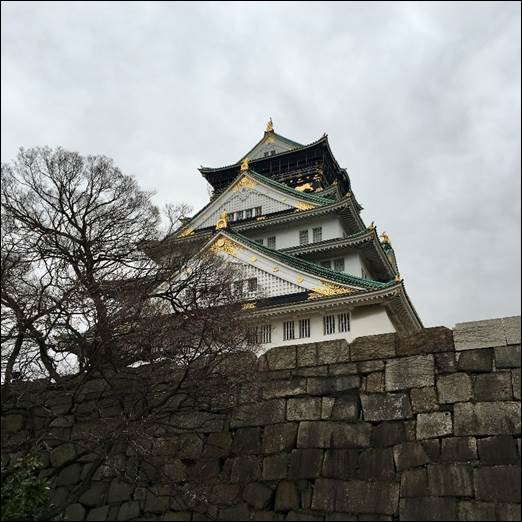
Figure 1: Osaka Castle vista from below staircase on 25th March 2019. Note: This photo shows the Osaka Castle from below, with the towering trees of early spring in front of it. The dense cloud cover makes it a lighted scene with evative contrast, symbolized by the castle’s intricately topped and heavily textured stone walls.
A visit to Osaka Castle in 2019 crystallized these inner pictures in a new way. Walking through this place and then later viewing these pictures time and again, especially this first view up of the keep with bare trees and stone walls (Figure 1 above), I came to see how profoundly this one day had influenced not just my idea but my very conception of the relationship between exterior spaces and the interior life. Osaka Castle appeared not solely in terms of a space of beauty or a tourist spot. Osaka Castle appeared rather as a mirror. Osaka Castle, in many respects, exemplified a ‘memory palace’: an lived space ‘in which stories, identities, and counter-memories are located in space’ (Sawin, 2024). The history of this castle—a history of power, of destruction, of renovation—is not dissimilar to this interplay of expectations and time in work and achievement. Historical castles exemplify this power and social order which produced them (Oliver, 2015).
Observing these stone walls and these stepped roofs in front of me, in the tight angles of the façade and the stones in Figure 2 above, I began to realize how fluid the border between imagination and reality can become. The real castle, with all its damages and reconstructions, showed me where the limits of all these perfect castles were in my imagination. At the same time, however, this same castle, with all those signs leading to it and all these efforts put into making it accessible to all sorts of people, proved to me how a historical fortress can become an interpreter not just of domination but of a collective hope and memory in their own right (Bonetti, 2021). Most importantly, however, it showed me how dreams need not disappear when they encounter reality but rather can be remade into it and even become stronger.
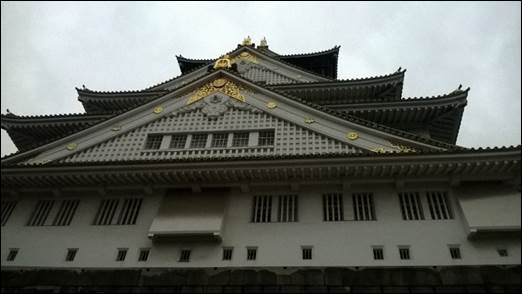
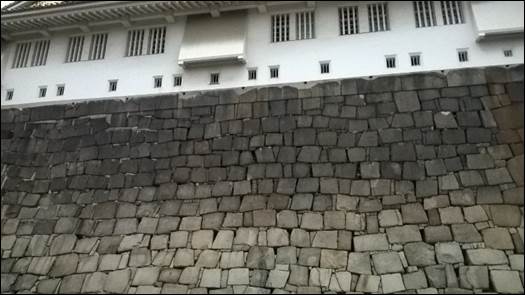
Figure 2: Two lower-angle shots taken on 25 March 2019 during the ascent up the staircase towards Osaka Castle. In the upper image, attention is drawn to the very ornate architecture of the keep tower of the castle, with attention to the wooden eaves, gold accents, and strongly vertical façade in the lower angle perspective. The lower image focuses on the thick stone wall upon which the castle is resting, pointing out the interlocking geometry of the worn stones. Taken together, these two images show a two-fold design element of Osaka Castle—the elegance and beauty above and the solidity below.
Thus, this paper will not relate the political and military history of Osaka Castle but will think through what it is to be a flesh-and-blood individual with all the accompanying doubts and desires, "confronting some monument that has withstood war, fire, and time." Through this event and using these images as a means of anchoring these observations (Figures 1-2), I hope to provide a space in which readers can think through their own personal structures and how real-world architectures, such as Osaka Castle, function to provide a framework for their own personal memory palaces (Jacobs, 2003; Sawin, 2024).
3. Walking towards the castle: early encounters and the presence of stone
The pictures I took of these structures remind me that my immediate experience was one of awe and quiet thrill. While the gold molding on the roof tops, the intricate woodwork, and geometric design of the stonework immediately drew me into a space where time seemed layered rather than linear (Figures 1 & 2), even such things as the simple train schedule of the tourist train carrying visitors towards the castle (Figures 3 & 4) seemed part of this layered experience: linear time guiding bodies towards an ancient icon. Such systematic pathways represent good practices in the preservation and spread of memory, in which contemporary pathways have been established to make these sites more accessible to visitors, according to Bonetti in 2021.
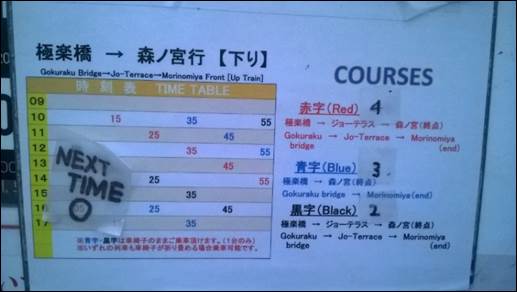
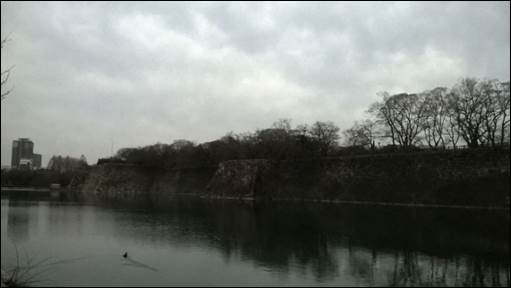
Figure 3: Two scenes photographed on 25 March 2019 during an approach to Osaka Castle. The top picture reproduces the timetable and route information of the small tourist train that runs between Gokuraku Bridge, Jo-Terrace, and Morinomiya, demonstrating the organized movement of visitors around the grounds. The bottom picture shows the still castle moat with stone ramparts and early spring trees, evoking a tranquil view of the landscape surrounding the fortress. Taken together, these images represent both the ordered modern access routes and the historical water defenses which define the visitor's passage toward Osaka Castle.
The stones themselves became my first teachers. Each block carried the memory of a mason, a soldier, a climber, a defender. Archaeological and historical studies of European castles emphasize that these masonry systems were material expressions of aristocratic authority, justice, and protection, visibly inscribed into the landscape. No castle built only in the imagination can carry that kind of weight. In my sentimental mood I couldn't resist seeing the stones as metaphors for human experiences-stacked, shaped, weathered and held together not by perfection but by persistence. Figure 2.
Standing before the walls of this castle, I felt observant in a deliberate way. I was not only seeing; I was perceiving. And while perceiving, I found myself part of a very long chain of people who stood before the same structure and asked themselves silent questions about strength, fragility, and meaning Figure 1. Like all symbolic spaces - those analysed in Hiroshima and Nagoya, among others - Osaka Castle could gather different epochs and interpretations into one single, charged landscape of memory Jacobs 2003. My own steps, camera perspectives and quiet thoughts were no more than the latest additions to that dense palimpsest.
4. The View from Above: Looking Outward and Inward
At the top observation deck, clothed with wire fencing and filled with the soft hum of visitors, I looked out over the Osaka skyline - Figure 4. Modern buildings stretched to the horizon line, cranes, offices, and parks. The reconstructed castle faced the contemporary city in striking contrast, and its harmony could not be overestimated. In such a moment, I was reminded that architecture is never just static form; it is also a narrative device through which cities tell stories about their past and future, very much like the ways in which novels and films use spatial settings to structure plot and emotion.
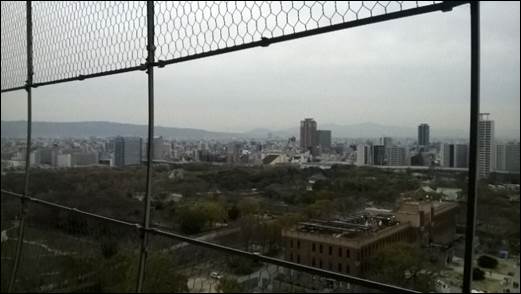
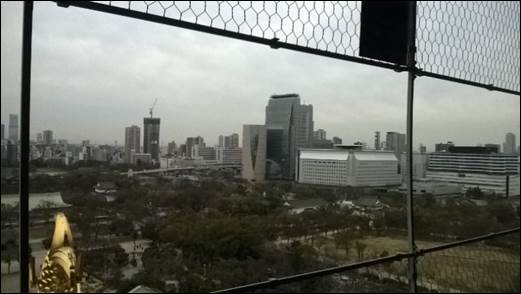
Figure 4: Two panoramic shots taken from Osaka Castle viewing platform on 25th March 2019. The top picture gives a broad view of the city, with Osaka's skyline peering out from behind the protective mesh fence surrounding the viewing platform. The bottom picture gives a different perspective of the city, with tall buildings and a golden shachihoko topping one of these structures peering into the frame. Taken together, these two pictures illustrate the contrast provided by this ancient viewing spot in contrast with buildings in this city.
The city recalled me to the castles in the air which drive economic and technological projects and social ambitions. These were not simply thoughts in the air, but were grounded in the recognition that Osaka Castle operates today both as a memorial and a living space node, researched for its contemporary military and social function (Kawamichie et al., 2003) or as a festival space with advanced information support (Tsukada, 2005) and even for immersive learning in cultural heritage through Virtual Reality support (Yanai & Ishikawa, 2025). The castle beneath my feet recalled me to the burden of history, the price of ambition, and the reality that all dreams, whatever their scope, must one day meet matter: from battles in the seventeenth century which remade Japan’s politics (Turnbull, 2012) to human remains and wounds from weapons excavated in the site (Nagaoka & Abe, 2007) and other less spectacular medical histories, such as appearances in accounts of Japanese nursing history (Ishihara, 1966).
Just as cinematic cartographies of Tokyo read the city through repeated images of streets, towers, and riverbanks (Liotta, 2007), my own private film of Osaka unfolded in successive frames: the stone base, the museum interior, the skyline framed by mesh. The camera captured this contrast through the grid of the safety net, framing the city as if it were another layer of architecture added onto the old foundations (Figure 4).
As I looked through the wire fence at the view, I felt a mixture of excitement and deep introspection. There was beauty in seeing the world from above, but also a gentle sadness that comes with recognising how small and temporary we all are. A castle built in the air feels limitless, but a real castle tells us that every dream must eventually contend with boundaries, time, and consequence. In that tension between limitless imagination and grounded stone, Osaka Castle became for me what Liotta (2007) calls a cinematic cartography: a vantage point from which the geography of human hope is mapped onto the physical fabric of the city, enriched by centuries of conflict, governance, celebration, education, and care (Ishihara, 1966; Kawamichi et al., 2003; Tsukada, 2005; Yanai & Ishikawa, 2025).
5. The Moat, the Water, and the Spaces Between
The moat at Osaka Castle presented a different type of education. The water, serene and gray beneath a cloud-filled sky, mirrored both the stone walls and the bare spring trees of early spring (Figure 3). The mirror-like surface seemed to represent a mirror placed before my own reflections. Heritage studies scholars have indicated that these border regions—the moats, gardens, and paths leading to memory sites—are essential in highlighting an experience of memory because they promote a ‘slower pace rather than a consumption approach' to a site's heritage (Bonetti, 2021). The liminal zones present in Osaka Castle Park have also provided an additional function in welcoming major events such as the Osaka-King summer festival, in which information technology and entertainment reshape the historical surroundings with a focus on a modern-day audience (Tsukada, 2005). The moat at Osaka Castle proved to represent a soft boundary of ‘memory palace,' a boundary line dividing city life with a focused ‘interior' space of the castle grounds (Sawin, 2024).
A castle in the air lacks a moat. A castle in the air is vulnerable and suspended in space. A castle in the air is not in relation to the world but rather in opposition to it. A real castle, on the other hand, is inextricably linked with the landscape and the water that defines it. A real castle is in relation to the world. The mere function of observing the water and the distant walls reminded me of the importance of the invisible spaces in which all strong structure resides. In Osaka, this meant not only a moat but a commitment to maintaining the castle grounds as a common space rather than letting them become another casualty of commercial construction, a memory lost in the face of a developing future (Jacobs, 2003). The archaeological record, such as evidence of human bones with signs of weapon damage discovered in excavations conducted at the castle site (Nagaoka & Abe, 2007), and other records such as a history of military interventions and a history of a nursing tradition (Ishihara, 1966; Turnbull, 2012) make this all a rather more fraught space.
As I sat watching a lone bird skim across the surface of the water, I felt a sudden warmth—a happiness that arises when one recognizes that memories do not fade but rather simply await our return. Reflecting on these images now stimulates this warmth in me once again, a happiness infused with sentiment, because in these pictures, I not only see the castle but also myself as I existed in 2019, silently taking it all in (Figures 1-4). Thus, in this way, Osaka Castle has become a part of my own personal interior design of hope, an eternal room in this larger memory palace where experience, city history, and simply being in the presence of water and stone have much to converse with one another (Nagaoka & Abe, 2007; Sawin, 2024; Tsukada, 2005).
5. Reconstruction and Human Meaning
One of the most interesting things about Osaka Castle is the fact that it has been burned to the ground and rebuilt a number of times. Whether it was a product of war, a flash of arson, or simply a generational renovation according to the bounders of time, this castle is interesting in all aspects of its history—and with good reason. As a function of this dynamic environment, it is important to state that all that remains of this historical spot is a reconstruction.true to history, very aesthetic, but very modern in many respects, with an archaeologically and medically important spot where remnants of battle can be found in the soil (Nagaoka & Abe, 2007).
But this state of affairs adds depth to the metaphor. A castle in the air never gets broken because it never actually existed in the first place. A real castle will get broken because it is, in fact, real. And it can all be rebuilt too. And this is a resilience in itself. I recognized this at the time but have come to appreciate it further now in viewing these images again—is perhaps this very act of rebirth a form of hope? A statement in itself that sometimes it is not impermeability but rather the willingness to start anew—whether this is actual renovation, new civic purpose, or a different way of interpreting it all, such as educational experiences in VR learning that bring new people into this story of this castle (Yanai & Ishikawa, 2025). Osaka Castle shows how reality need not be the antagonist of imagination but rather how it serves instead to ground it all.
6. Return to the Photographs: Memory as a Living Architecture
Reflecting on these pictures (Figures 1-4) a number of years later, I am touched both nostalgically and gratefully. They recall me to the sensations of this experience—excitement, wonder, gentle contemplation. They also recall to me an understanding of the nature of memory—that it is a castle in and of itself, constructed not of stone but of experience. Nowadays, my personal photo album is embedded with all sorts of other visually and narratively complex layers: movie frames of the cityscape (Liotta, 2007) historical records of war and renovation (Kawamichi et al., 2003) research studies of bones and damaged bodies (Nagaoka & Abe, 2007) nursing history texts (Ishihara, 1966) design illustrations for festival posters (Tsukada, 2005) and even digital simulations of reality reconstructions in which students can walk inside an electronic Osaka Castle (Yanai & Ishikawa, 2025).
Through these reflections, I am able to situate my personal hopes and struggles in relation to these others. The hopes I have at present are not the hopes I had in 2019, but they are linked through time. Rather than being purely objective reflections, these are reflections based on my own personal experiences and sensations of being a human being, a researcher, a traveler, and a observer of this multi-facetted world. The Osaka Castle, with all of these overlapping functions in terms of conflict, governance, education, healthcare, and festivities (Ishihara, 1966; Kawamichi et al., 2003; Tsukada, 2005; Yanai & Ishikawa, 2025) is a living archive through which I read not only Japanese history but my own unfolding personal interior.
7. Conclusion
Our trip with family to Osaka Castle in 2019 will never be just another tourist outing in my memory. It will always be a quiet moment of transition where I learned to respect both my dream and the reality framework in which it resides. The emotion I experience when I browse through these images in reflection is not nostalgia but an understanding of all experiences being a part of a larger tale. Reflecting on Osaka Castle is a reflection on our own castles, our reconstructions, and our personal ones that exist in our hearts beyond this travel experience.



Open Access By Aditum Open Access Journals id licensed under Creative Commons Attribution 4.0 International License. Based On a Work at aditum.org


