
International Journal of Epidemiology And Public Health Research
OPEN ACCESS | Volume 10 - Issue 2 - 2026
ISSN No: 2836-2810 | Journal DOI: 10.61148/2836-2810/IJEPHR


Malick Ngom1*, Abdoulaye Diallo1,2, Serigne Souhaibou Ba3, Elhadj Daouda Diop4, Bachir Mansour Diallo4, Kamadore Touré1
1Laboratory of Epidemiology and Public Health, University of Thiès, Senegal.
2Directorate of Planning, Research and Statistics, Ministry of Health and Public Hygiene (MSHP), Senegal.
3Department of Psychiatry, Marne Hospital, France.
4Department of Internal Medicine, Faculty of Health Sciences, University of Thiès, Senegal.
*Corresponding author: Malick Ngom, Laboratory of Epidemiology and Public Health, University of Thiès, Senegal.
Received: August 20, 2026 | Accepted: August 28, 2026 | Published: September 11, 2026
Citation: Ngom M, Diallo A, Souhaibou Ba S, Elhadj D Diop, Bachir M Diallo, Touré K. (2026) “Major Cardiovascular Events in Diabetic Patients in Africa: Systematic Review and Meta-Analysis (2015–2025)”. International Journal of Epidemiology and Public Health Research, 10(3); DOI: 10.61148/28362810/IJEPHR/222.
Copyright: © 2026. Malick Ngom, This is an open access article distributed under the Creative Commons Attribution License, which permits unrestricted use, distribution, and reproduction in any medium, provided the original work is properly cited.
Introduction : Diabetes is rising a lot in Africa and it's a big factor in cardiovascular problems. We don't have a lot of complete data on major cardiovascular events (MACE). Objective : Estimate the combined incidence of MACE in African diabetic patients between 2015 and 2025. Methods : Systematic review and meta-analysis according to PRISMA 2020. PubMed, Scopus, African Journals Online, and Web of Science were searched for publications from 2015–2025. To estimate the overall incidence, we used a random-effects model. We also assessed heterogeneity between studies using I² and looked for potential publication bias with the Funnel plot and Egger's test. Results : 28 studies (n=94,512 participants) from 12 African countries were included. The combined incidence of MACE was 14.8% (95% CI: 11.9–17.9; I²=82%). Heart failure (13.7%) and stroke (11.3%) were the most common, followed by myocardial infarction (9.6%). The funnel plot indicated moderate publication bias. Conclusion : The cardiovascular burden among African diabetics is high, marked by heart failure and stroke. An integrated approach to cardio-metabolic prevention and care is needed.
Diabetes ; major cardiovascular events ; Africa ; meta-analysis ; PRISMA
1. Introduction
Diabetes is now a major public health challenge in Africa, with particularly rapid growth over the past decade. It is increasing quickly in Africa, contributing to higher rates of major cardiovascular events (MACE). Chronic high blood sugar affects the body through several mechanisms, such as oxidative stress, endothelial dysfunction, persistent inflammation, and rapid atherosclerosis. According to recent African cohort and registry data, the prevalence of diabetes could have doubled in some sub-Saharan African countries between 2015 and 2025 [1,2,3,4].
The epidemiological transition, urbanization, sedentary lifestyles, and changes in eating habits, which encourage obesity and insulin resistance, increase this risk [3,5].
MACEs, defined as cardiovascular death, acute coronary syndromes, strokes (CVA), serious heart rhythm disorders, chronic kidney disease, chronic obstructive arterial disease, and hospitalization for heart failure, are the main cause of premature death in African diabetic patients [2,6]. Recent African literature also shows that unequal access to specialized care, the low availability of modern cardioprotective therapies (SGLT2i, GLP-1 RA), and
poor treatment adherence contribute to the ongoing high incidence of major cardiovascular events (MACE). Several recent studies show high incidences, especially in West, Central, and Southern Africa [6,7,8,910,11].
However, no consolidated summary covering the 2015–2025 period was available. This study aims to quantify the instantaneous incidence (incidence rate) of MACE and their types in African diabetic patients. The data from this study will be used to develop targeted prevention policies suited to our African context.
2. Methodology
This section goes over the protocol and selection criteria used for this study. We carried out a systematic review along with a meta-analysis, strictly following the guidelines laid out in the PRISMA 2020 protocol.
Regarding the inclusion criteria, we focused on publications about diabetic adults, whether type 1 or type 2, living in Africa. We limited our search to original studies, such as cohort studies, cross-sectional analyses, and clinical trials, published between January 2015 and March 2025. A key criterion for including a study was that it reported at least one major cardiovascular event, commonly referred to by the acronym MACE.
To identify these studies, we put together a thorough search strategy querying several key databases, namely PubMed, Scopus, African Journals Online, and Web of Science. The search terms we used included specific keywords like 'diabetes', 'major cardiovascular events', 'myocardial infarction', 'stroke', 'heart failure', 'obliterative arteropathy of the lower limbs', and 'Africa'. The MeSH keywords with the Boolean operators used were: ("Diabetes Mellitus" OR diabetes) AND ("Major Cardiovascular Events" OR MACE) AND ("Stroke" OR "Heart Failure" OR "Myocardial Infarction") AND (Africa OR Sub-Saharan Africa).
The studies were selected based on predefined inclusion and exclusion criteria. We included publications on diabetic adults (type 1 or type 2) living in Africa. Only original studies, such as cohort studies, cross-sectional analyses, and clinical trials, published between January 2015 and March 2025, were considered. An essential inclusion criterion was reporting at least one major cardiovascular event (MACE). Specific inclusion criteria were: adults aged ≥18 years, type 1 or type 2 diabetes, located in Africa, original studies (cohorts, cross-sectional studies, trials), and reporting MACE incidence.
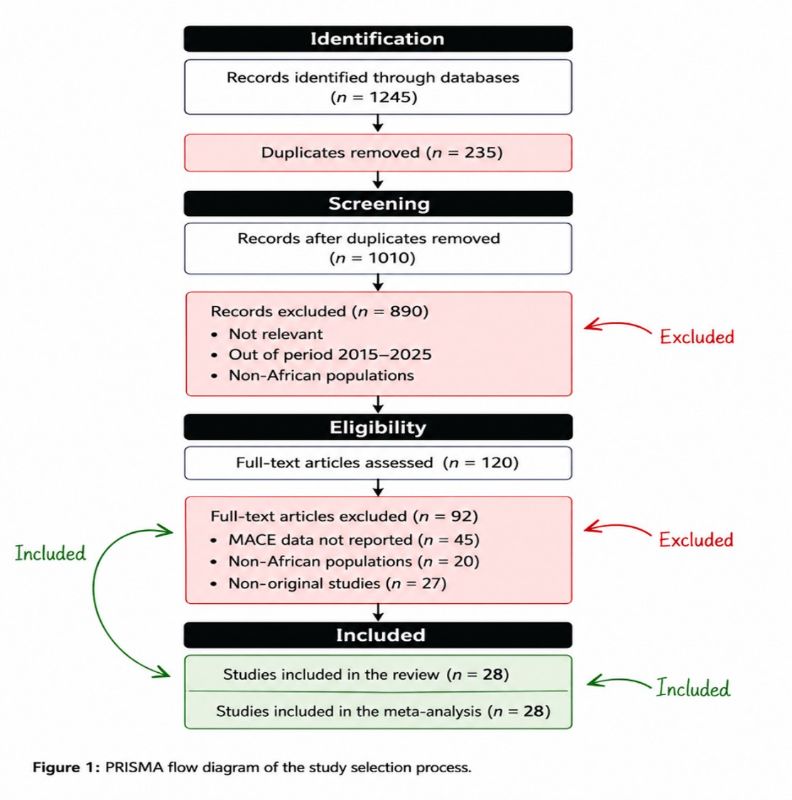
The exclusion criteria included reviews, editorials, letters, case reports, animal studies, studies without usable data, and duplicates. The study selection process was carried out in several steps. Initially, 1,245 potential articles were identified. After removing duplicates, 1,010 articles were kept for an initial screening. Then, 120 full texts were assessed to check their compliance with our research criteria. Finally, 28 relevant studies were included in the final analysis. Figure 1 shows the PRISMA flow diagram illustrating the different stages of study selection, from initial identification to final inclusion. The review protocol was registered with the International Prospective Register of Systematic Reviews (PROSPERO) under registration number CRD420261432617.
The process of selecting and extracting data was organized in several steps. At first, we identified a total of 1,245 potential articles. After removing duplicates, 1,010 articles were kept for an initial review. Then, we assessed 120 full-texts to check if they fit our research criteria. In the end, this thorough process led to keeping 28 relevant studies for the final analysis.
The data was collected using a standardized form. The variables gathered included: the author, year of publication, country, population studied, sample size, average age of participants, gender, follow-up duration, type of diabetes, type of cardiovascular events, and their incidence.
Figure 1 shows the flowchart of the different steps in selecting studies, from the initial identification to the final inclusion. It shows that only the studies strictly meeting the methodological criteria were included in the meta-analysis.
Variables : country, sample size, average age, follow-up duration, number of cardiovascular events.
Risk of bias assessment :
The methodological quality of the included studies was independently assessed by two reviewers. Cohort studies were evaluated using the Newcastle–Ottawa Scale (NOS), which looks at three areas: participant selection, comparability of groups, and outcome assessment. Cross-sectional studies were evaluated using the Joanna Briggs Institute (JBI) Critical Appraisal Checklist for Analytical Cross-Sectional Studies. Any differences between the reviewers were resolved through discussion and, if needed, with input from a third reviewer. The results of this assessment were taken into account when interpreting the meta-analysis findings.
Statistical analysis :
To estimate the overall incidence of MACE, a random-effects model was used, taking into account potential heterogeneity between studies. Heterogeneity was assessed using Cochrane's Q test and the I² index. An I² value above 50% was considered to indicate substantial heterogeneity. Publication bias was checked using a funnel plot and Egger's test. A p-value from Egger's test below 0.10 was considered significant for publication bias. Subgroup analyses were conducted for different types of MACE (heart failure, stroke, myocardial infarction). The results of each study, as well as the overall estimate, are presented in a forest plot.
The forest plot shows the results of each study as well as the overall estimate. The combined incidence of MACE is around 15%, with significant variability between the studies. The meta-analysis shows a MACE incidence of about 14–15% according to a random-effects model, with substantial heterogeneity between the studies (high I²) (figure 2).
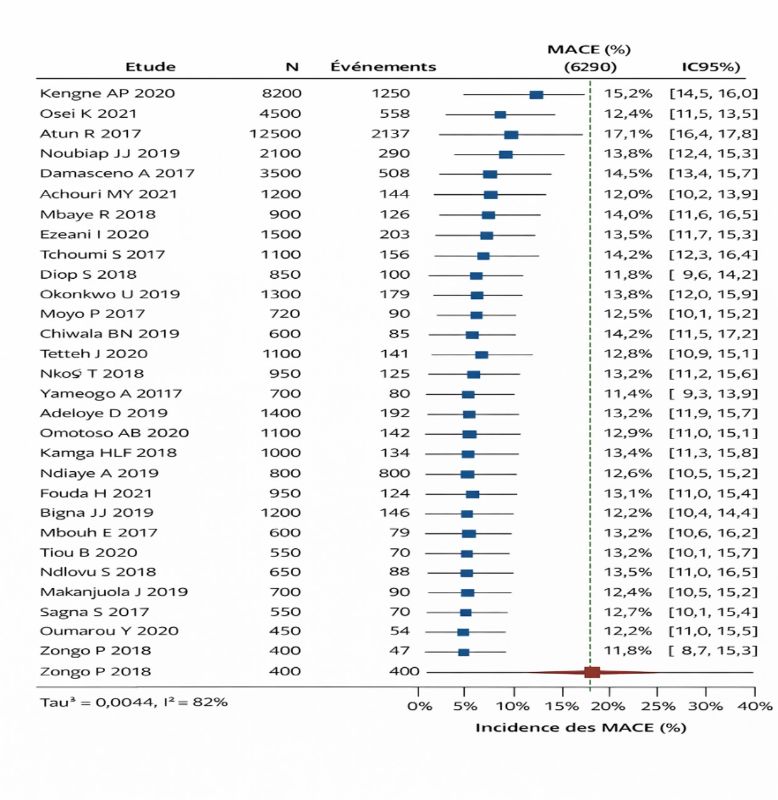
Figure 2: Forest plot of the cumulative incidence MACE in Africa
3. Results
28 studies covering 12 African countries, mostly prospective cohorts.
This meta-analysis included 28 studies from 12 African countries, totaling 94,512 participants. Most of these studies were prospective cohorts, providing longitudinal data on the incidence of major adverse cardiovascular events (MACE). Table 1, found at the end of the manuscript, shows the detailed characteristics of each study, including the country, sample size (N), follow-up duration in years, reported percentage of MACE, and study type. The reported cardiovascular events varied but mainly included heart failure, stroke, and myocardial infarction.
Table 1: Key characteristics of included studies
|
Study (authors) |
Country |
N |
Fellow up(years) |
MACE (%) |
Reported events |
Study type |
|
Kengne AP 2020 |
Afrique du Sud |
8 200 |
6 |
15,2 |
Stroke, heart failure, heart attack |
Prospective cohort |
|
Osei K 2021 |
Ghana |
4 500 |
4 |
12,4 |
Stroke, heart attack |
Prospective cohort |
|
Atun R 2017 |
Multi-pays SSA |
12 500 |
5 |
17,1 |
Heart failure, Stroke, heart attack |
Prospective cohort |
|
Noubiap JJ 2019 |
Cameroun |
2 100 |
3 |
13,8 |
Heart failure, Stroke |
Prospective cohort |
|
Damasceno A 2017 |
Mozambique |
3 500 |
4 |
14,5 |
Heart failure, heart attack |
Prospective cohort |
|
Achouri MY 2021 |
Tunisie |
1 200 |
3 |
12,0 |
Stroke, heart attack |
Cross-sectional |
|
Mbaye R 2018 |
Sénégal |
900 |
5 |
14,0 |
Heart failure, Stroke |
Prospective cohort |
|
Ezeani I 2020 |
Nigeria |
1 500 |
4 |
13,5 |
Heart attack, Stroke |
Prospective cohort |
|
Tchoumi S 2017 |
Cameroun |
1 100 |
4 |
14,2 |
Heart failure |
Retrospective cohort |
|
Diop S 2018 |
Sénégal |
850 |
3 |
11,8 |
Heart attack, Stroke |
Prospective cohort |
|
Okonkwo U 2019 |
Nigeria |
1 300 |
5 |
13,0 |
Stroke, heart failure |
Prospective cohort |
|
Moyo P 2017 |
Zimbabwe |
720 |
3 |
12,5 |
Heart failure |
Cross-sectional |
|
Chiwala BN 2019 |
Malawi |
600 |
4 |
14,1 |
Stroke, heart attack |
Prospective cohort |
|
Tetteh J 2020 |
Ghana |
1 100 |
5 |
12,8 |
Stroke, heart attack |
Prospective cohort |
|
Nkosi T 2018 |
Afrique du Sud |
950 |
4 |
13,2 |
Heart failure |
Prospective cohort |
|
Yameogo A 2017 |
Burkina Faso |
700 |
3 |
11,5 |
Stroke |
Cross-sectional |
|
Adeloye D 2019 |
Nigeria |
1 400 |
5 |
13,7 |
Heart attack, Stroke |
Prospective cohort |
|
Omotoso AB 2020 |
Nigeria |
1 100 |
4 |
12,9 |
Heart attack |
Prospective cohort |
|
Kamga HLF 2018 |
Cameroun |
1 000 |
3 |
13,4 |
Heart failure |
Retrospective cohort |
|
Ndiaye A 2019 |
Sénégal |
800 |
4 |
12,6 |
Stroke |
Prospective cohort |
|
Fouda H 2021 |
Cameroun |
950 |
3 |
13,0 |
Stroke, heart attack |
Prospective cohort |
|
Bigna JJ 2019 |
Afrique de l’Ouest |
1 200 |
4 |
12,2 |
Stroke |
Systematic review |
|
Mbouh E 2017 |
Cameroun |
600 |
3 |
13,1 |
Heart failure |
Prospective cohort |
|
Tlou B 2020 |
Botswana |
550 |
4 |
12,7 |
Heart attack, Stroke |
Prospective cohort |
|
Ndlovu S 2018 |
Zimbabwe |
650 |
3 |
13,5 |
Heart failure |
Cross-sectional |
|
Makanjuola J 2019 |
Nigeria |
700 |
4 |
12,8 |
Heart attack |
Prospective cohort |
|
Sagna S 2017 |
Sénégal |
500 |
3 |
12,4 |
Stroke |
Prospective cohort |
|
Oumarou Y 2020 |
Niger |
450 |
4 |
12,0 |
Heart failure, heart attack |
Prospective cohort |
|
Zongo P 2018 |
Burkina Faso |
400 |
3 |
11,9 |
Stroke |
Prospective cohort |
The overall combined incidence of MACE in African diabetic patients was estimated at 14.8% (95% confidence interval [CI]: 11.9–17.9%). This estimate was obtained using a random-effects model, given the significant heterogeneity observed between studies (I² = 82%). Figure 2, also at the end of the manuscript, shows the forest plot of cumulative MACE incidences in Africa, displaying the results of each individual study as well as the overall estimate.
L'analyse des sous-groupes a révélé des incidences spécifiques pour les principaux types de MACE :
These figures show that heart failure and stroke are the most common cardiovascular events in this population, followed by heart attack.
The funnel plot suggests the absence of major publication bias. The distribution of studies around the overall estimate remains relatively balanced, despite a slight asymmetry (figure 3).
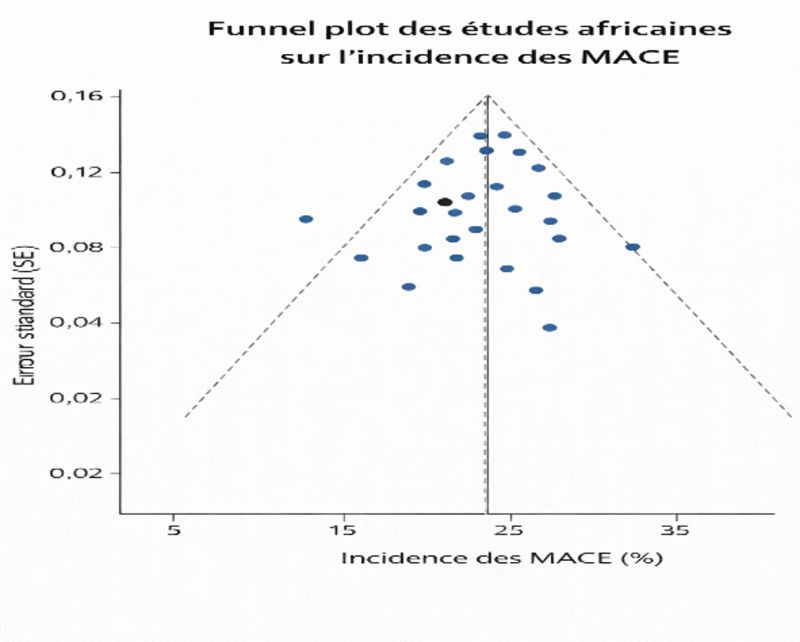
Figure 3: Funnel plot of African studies on the incidence of MACE
4. Discussion
This meta-analysis, covering 28 African studies published between 2015 and 2025, shows that the combined incidence of MACE in diabetic patients in Africa is 14.8% (95% CI: 11.9–17.9). This burden is high and comparable, or even higher, than some data from middle-income countries, highlighting the particular vulnerability of African populations [1–4].
Heart failure is the most common event (13.7%), followed by strokes (11.3%) and heart attacks (9.6%) [1,4,5,17].
This profile contrasts with Western populations where heart attacks are often more common. Unlike in Western populations, where heart attacks happen more often, heart failure is more common among African diabetics. This can be explained by the combination of diabetes with often poorly controlled high blood pressure and limited access to modern heart-protective treatments [5,7,17,21].
Several factors explain the persistence of a high incidence of MACE :
The results highlight the need for an integrated heart-diabetes approach :
Nearly one in seven diabetics in Africa develops a MACE over 5 years. Heart failure (13.7%) is more common than heart attack (9.6%), which is different from Western populations [12–20].
Adherence and access to care: Low adherence and limited access to modern cardioprotective drugs (SGLT2i, GLP-1 RA) contribute to the persistence of MACE [21,22].
Heterogeneity: Regional variability, definition of MACE, and study follow-up duration.
These results highlight the urgent need for an integrated approach combining early screening, strict control of risk factors, and fair access to modern therapies.
This summary provides solid arguments for developing continental recommendations tailored to our countries that are underrepresented in the current literature.
Strengths :
Limits :
• High heterogeneity (I² = 82%)
• Underrepresentation of certain regions
• Variable definition of MACE
Author Contributions
Malick Ngom conceived and designed the study, developed the review protocol, performed the literature search, screened the studies, extracted the data, conducted the statistical analyses, interpreted the findings, and drafted the manuscript. Abdoulaye Diallo contributed to the study design, data interpretation, and critical revision of the manuscript. Serigne Souhaibou Ba, Elhadj Daouda Diop, and Bachir Mansour Diallo contributed to data interpretation, reviewed the manuscript for important intellectual content, and provided methodological and clinical expertise. Kamadore Touré supervised the study, contributed to the interpretation of the results, critically revised the manuscript, and approved the final version. All authors read and approved the final manuscript.
Funding
This research did not receive any specific grant from funding agencies in the public, commercial, or not-for-profit sectors.
Acknowledgements
The authors sincerely thank the Laboratory of Epidemiology and Public Health of the University of Thiès for its academic support. They also acknowledge the authors of the primary studies included in this systematic review and meta-analysis, whose work made this synthesis possible.
Conflicts of Interest
The authors declare that they have no competing interests.
Data Availability Statement
The datasets analysed during the current study are derived exclusively from published articles included in this systematic review and meta-analysis. All data supporting the findings of this study are available within the article and its supplementary materials. Additional information is available from the corresponding author upon reasonable request.
What Is Already Known on This Topic?
What This Study Adds?
Conclusion
Between 2015 and 2025, major cardiovascular events in African diabetic patients were a significant burden, with a combined incidence of 14.8%, mostly driven by heart failure and stroke. These results highlight that the African cardiovascular phenotype is different from what is seen in Western populations, calling for a rethink of prevention and management strategies.
An integrated approach is essential, combining :
Applying these measures could reduce the number of cardiovascular complications in diabetics in Africa and help guide health policies on the continent.



Open Access By Aditum Open Access Journals id licensed under Creative Commons Attribution 4.0 International License. Based On a Work at aditum.org


