
International Journal of Epidemiology And Public Health Research
OPEN ACCESS | Volume 10 - Issue 2 - 2026
ISSN No: 2836-2810 | Journal DOI: 10.61148/2836-2810/IJEPHR


Malick Ngom1*, Abdoulaye Diallo1,2, Serigne Souhaibou Ba3, Elhadj Daouda Diop4, Bachir Mansour Diallo4, Kamadore Touré1
1Laboratory of Epidemiology and Public Health, University of Thiès, Senegal.
2Directorate of Planning, Research and Statistics, Ministry of Health and Public Hygiene (MSHP), Senegal.
3Department of Psychiatry, Marne Hospital, France.
4Department of Internal Medicine, Faculty of Health Sciences, University of Thiès, Senegal.
*Corresponding author: Malick Ngom, Laboratory of Epidemiology and Public Health, University of Thiès, Senegal.
Received: August 20, 2026 | Accepted: August 28, 2026 | Published: September 11, 2026
Citation: Ngom M, Diallo A, Souhaibou Ba S, Elhadj D Diop, Bachir M Diallo, Touré K. (2026) “Operationalizing The One Health Approach for Health System Resilience in Africa”. International Journal of Epidemiology and Public Health Research, 10(3); DOI: 10.61148/28362810/IJEPHR/219.
Copyright: © 2026. Malick Ngom, This is an open access article distributed under the Creative Commons Attribution License, which permits unrestricted use, distribution, and reproduction in any medium, provided the original work is properly cited.
Synopsis
Current health threats, such as zoonoses, antimicrobial resistance, and environmental degradation, clearly demonstrate the limits of compartmentalized health approaches. They call for a more integrated vision of health. In Africa, the strong interaction between human populations, animals, and ecosystems, combined with the fragility of health systems, increases vulnerability to health crises.
This editorial argues that the One Health approach now goes beyond the conceptual framework. It serves as a strategic tool for health governance. Its effectiveness relies less on theoretical adherence than on its ability to be translated into concrete actions, adapted to national and local contexts.
Three key messages emerge. First, One Health should serve as a lever to integrate health, environmental, and agricultural policies. Second, its implementation requires functional multisectoral governance, based on coordination and data sharing. Finally, Africa has real potential to operationalize this approach, provided there is sustainable investment in skills and information systems.
Integrating One Health into public policies represents a strategic opportunity. It allows for crisis anticipation, strengthens the resilience of health systems, and reinforces the continent's health security.
Summary
Context : Modern health threats are increasingly shaped by the complex interactions between human populations, animals, and ecosystems. Emerging and re-emerging zoonoses, antimicrobial resistance, climate change, land use changes, rapid urbanization, and ecosystem degradation particularly expose African countries to complex health risks. In this context, the 'One Health' approach offers an integrated framework for addressing human health, animal health, and environmental health together.
Objective : This review aims to summarize the main lessons about implementing the One Health approach in Africa, identify the main obstacles to putting it into practice, and look at the conditions under which it can help strengthen the resilience of health systems.
Methods: A narrative review of the literature was carried out to look at the available data on the application of the One Health approach in African contexts. The review focused on zoonoses, antimicrobial resistance, integrated surveillance, environmental and climate risks, multisectoral governance, funding, information systems, laboratory capacities, human resources, and community engagement.
The data were analyzed using a thematic approach to identify the main factors that support or limit the operationalization of One Health.
Results : Available data shows that the One Health approach provides a relevant framework for addressing the complexity of health threats in Africa. The main takeaways involve the need for functional multisectoral governance, integrated monitoring of human, animal, and environmental risks, strengthening diagnostic and laboratory capacities, as well as better data sharing between sectors. Fighting zoonoses and antimicrobial resistance is a particularly important area of application. However, implementing it still faces challenges like institutional fragmentation, a lack of human and financial resources, low interoperability of information systems, dependence on some external funding, and still uneven community involvement. African experience thus suggests that the effectiveness of One Health depends less on its conceptual adoption and more on institutions' ability to turn its principles into sustainable operational mechanisms. Conclusion : Putting One Health into action in Africa requires moving from a mostly conceptual approach to actually integrating it into policies and health systems. Strengthening multisectoral governance, integrating surveillance systems, building lab capacities and human resources, securing sustainable funding, and getting communities involved are all key levers. Rolling it out in a way that fits local contexts and comes with regular evaluation could help improve prevention, preparedness, and response to health threats, and more broadly, the resilience of African health systems.
One Health; zoonoses; health security; Africa; climate change; public health
1. Introduction
Global health is going through a period marked by the increasing complexity of threats. The boundaries that once separated human, animal, and environmental health are becoming increasingly blurred. In a rapidly changing world, emerging and re-emerging diseases, nearly three-quarters of which are of zoonotic origin, pose major health, social, and economic risks. Poorly planned urban expansion, accelerated land degradation, and the effects of climate change are profoundly disrupting ecosystems. These disturbances act as catalysts, facilitating the movement of pathogens between animals, humans, and the environment [1, 2, 3].
In the face of this reality, the One Health approach is emerging as an essential strategic framework. The One Health approach is promoted by the WHO (World Health Organization), FAO (Food and Agriculture Organization of the United Nations), OIE (World Organisation for Animal Health), and UNEP (United Nations Environment Programme). It encourages active collaboration across all relevant disciplines. Repeated health crises in West Africa, such as Ebola or yellow fever, as well as the global experience of COVID-19, have revealed the limitations of fragmented and sectoral responses. Without anticipation, early detection, and rapid information sharing, health systems are quickly overwhelmed [4].
Africa occupies a central position in the challenges of infectious disease 'hotspots.' Human populations, livestock, and wildlife coexist in a rich but fragile biodiversity. Human activities, such as extensive farming, hunting, or deforestation, reduce the distances between species and facilitate the transmission of diseases. Added to these risks is a more subtle but steadily growing threat: antimicrobial resistance, exacerbated by inappropriate and improper use of antibiotics in humans and animals. In this context, One Health can no longer be seen as a mere theoretical approach. It establishes itself as an essential operational response to strengthen the continent's health security, focusing on prevention, cross-sector cooperation, and skills development. It directly contributes to achieving the Sustainable Development Goals, particularly those related to health, the environment, and food security [5].
The real challenge is moving from vision to action. How can a broad and ambitious idea be translated into concrete measures that are suited to local realities? The success of the One Health concept will depend on political will, strong governance involving all sectors, and capacity building. Only in this way can this approach become firmly established at the heart of African health systems.
2. Methods
This is a narrative review of the literature focused on putting the One Health approach into practice in African contexts.
Choosing a narrative review makes it possible to put knowledge from different disciplines and sectors into perspective, including epidemiology, human medicine, veterinary medicine, environmental sciences, public health, information systems, and health policies.
The goal was to highlight the main lessons about how it's put into practice, the obstacles, the facilitating factors, and the implications of One Health for the resilience of health systems.
The relevant literature on One Health, zoonoses, antimicrobial resistance, integrated surveillance, environmental risks, and health system resilience has been reviewed.
The literature search focused on publications about African contexts and studies that help analyze the interactions between human health, animal health, and the environment, as well as the institutional, technical, financial, and community conditions needed to implement One Health.
Institutional documents produced by the main international and regional organizations involved in One Health were also taken into account when they provided relevant information on policies, strategic frameworks, and governance.
The studies selected were those focused on one or more African countries and addressing, directly or indirectly, the implementation of One Health.
The areas considered included, in particular, zoonoses, antimicrobial resistance, integrated surveillance, epidemic preparedness and response, multisectoral governance, financing, information systems, laboratory capacities, human resources, environmental and climate risks, and community involvement.
Publications that didn't have a relevant link to Africa or didn't help clarify the issue of implementing One Health weren't included.
The relevant information was organized according to several dimensions: geographical context, health issue considered, sectors involved, collaboration mechanisms, monitoring systems, institutional and technical capacities, community participation, funding, key lessons, obstacles, and facilitating factors.
The data was grouped into six thematic areas: multisectoral governance, integrated surveillance and information systems, prevention and control of zoonoses, antimicrobial resistance, environmental and climate risks, and community engagement.
These areas were then linked to the cross-cutting dimensions of sustainability, capacity building, and health system resilience.
Foundations of the One Health Concept
The One Health concept is based on an integrated vision that recognizes the interdependence of human, animal, and environmental health. It is built around three main pillars :
The One Health approach promotes close and interdisciplinary collaboration among doctors, veterinarians, epidemiologists, biologists, ecologists, and environmental experts. This synergy allows for the proactive detection, prevention, and control of health threats. If appropriate measures are not taken in time, they can escalate into major crises. It thus provides a strategic framework to strengthen the resilience of health systems and respond to global health challenges in a coordinated and effective manner [8, 9].
Strategic importance of the One Health concept
The One Health concept plays a central role in the prevention and management of contemporary health threats, highlighting the interconnection between human, animal, and environmental health.
Implementation challenges
Despite its importance, implementing One Health remains complex :
Perspectives and recommendations
To make the 'One Health' concept operational, it is necessary :
Research and finding : support for interdisciplinary studies on human-animal-environment interactions and promotion of funding for One Health initiatives While the 'One Health' vision is clear, its success in Africa hinges on moving beyond institutional silos. The transition from policy to practice requires sustainable domestic financing and the integration of local community knowledge into surveillance systems. Only by anchoring global strategies in local African realities can we ensure that health resilience becomes a tangible reality for the most vulnerable populations [10, 11].
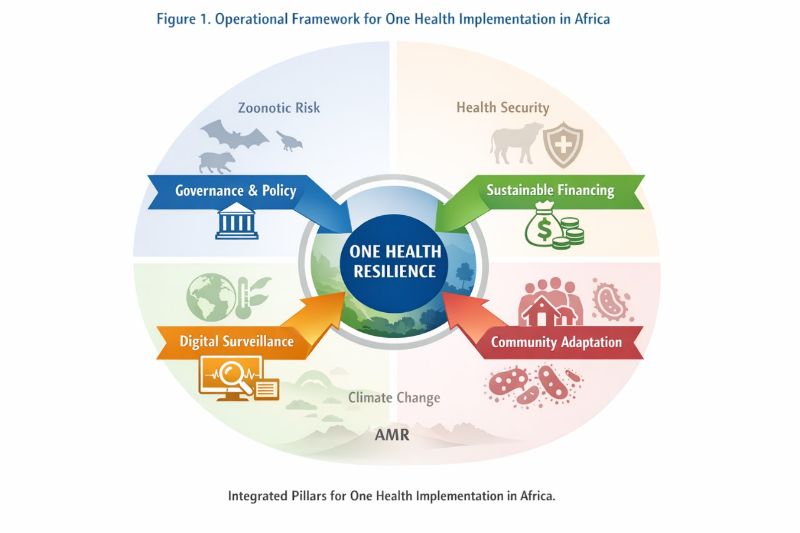
Operational framework for implementing One Health in Africa
Translating the One Health concept into practice requires more than policy endorsement; it demands institutional reform, sustainable financing, integrated surveillance systems, and strong community engagement. While more than 60–70% of emerging infectious diseases are of zoonotic origin , and Africa remains a hotspot for spillover events, operational implementation across the continent continues to face structural barriers. The following framework proposes four interconnected pillars to guide practical implementation within African contexts [2, 12, 13].
Governance model : Institutionalizing Multisectoral Coordination
Sustainable implementation of One Health depends on formal governance mechanisms rather than informal collaboration. Historically, ministries of health, agriculture, and environment in many African countries have operated in parallel, often competing for limited budget allocations. This institutional fragmentation weakens coordinated outbreak prevention and response.
The One Health Joint Plan of Action (2022–2026) calls for structured national coordination platforms anchored at high levels of government authority. Positioning national One Health platforms under the Office of the Prime Minister or President can reduce sectoral competition and promote shared accountability. Experiences from several African countries show that legally mandated coordination bodies improve cross-sector dialogue and facilitate integrated preparedness planning [3, 14].
In addition, alignment with International Health Regulations (IHR 2005) and regional frameworks led by Africa CDC strengthens governance coherence across borders [15]. Governance reform should therefore prioritize institutionalization, joint planning, shared indicators, and routine inter-ministerial evaluation mechanisms.
Financing Mechanisms: Ensuring Sustainable Resource Allocation
Financing remains one of the most critical constraints to operationalizing One Health. Surveillance systems, laboratory capacity, antimicrobial resistance monitoring, and workforce training require sustained investment. In many low- and middle-income African countries, funding structures remain heavily dependent on vertical disease programs, which may limit flexibility for integrated approaches.
Recent global initiatives such as the World Bank Pandemic Fund provide opportunities to support pandemic prevention and preparedness capacity building. However, reliance solely on external donor funding risks perpetuating dependency. A gradual transition toward domestic co-financing models, integrated into national health security budgets, is essential for sustainability [16].
Importantly, policy decisions must consider opportunity costs. Allocating resources to integrated surveillance may raise concerns about diverting funds from high-burden programs such as tuberculosis or HIV control. Economic analyses increasingly suggest that preventive investment in early detection and coordinated surveillance reduces long-term outbreak response costs and economic disruption. Therefore, cost-effectiveness evidence should inform national prioritization processes [17].
Blended financing models—combining domestic allocations, multilateral support, and targeted public-private partnerships—offer a pragmatic pathway for long-term sustainability.
Digital Surveillance Integration: Breaking Data Silos
Fragmented data systems remain a structural weakness in many African health systems. Human epidemiological surveillance, veterinary services, and environmental monitoring often operate independently, limiting early detection of zoonotic threats. Integrated digital platforms that enable real-time cross-sector information sharing are critical for early warning.
Africa CDC’s 2023–2027 strategic plan emphasizes strengthening regional surveillance networks and digital transformation to improve epidemic intelligence. Advances in genomic sequencing and laboratory networking have expanded Africa’s capacity for pathogen detection, particularly following the COVID-19 pandemic [15].
Climate change further reinforces the need for integrated surveillance. Environmental disruption and temperature shifts are projected to increase cross-species viral transmission risk and expand vector habitats across the Sahel and Central Africa. Linking meteorological data, vector surveillance, and human case reporting can enhance predictive modeling and preparedness planning [13].
However, digital integration must also address governance challenges related to data ownership, privacy, and cross-border sharing agreements. Without clear regulatory frameworks, interoperability alone will not guarantee effective collaboration.
Community-based adaptation : Embedding One Health in Local Contexts
While national governance and financing mechanisms are essential, operational success ultimately depends on community-level engagement. In many African settings, zoonotic risks are closely linked to livestock practices, wildlife trade, bushmeat consumption, and rapid land-use change.
Participatory risk communication strategies that incorporate local knowledge systems can improve early detection and reporting. Community health workers and veterinary extension services can serve as frontline actors in integrated surveillance networks. Evidence suggests that locally adapted prevention strategies improve compliance and sustainability compared to top-down interventions [18].
Climate-sensitive diseases, including arboviruses and vector-borne infections, are increasingly influenced by ecological shifts. Community-based environmental monitoring and climate adaptation strategies can therefore complement national surveillance systems [13].
Embedding One Health within local realities transforms it from a global policy narrative into a practical resilience tool. By integrating governance reform, sustainable financing, digital innovation, and community engagement, African countries can progressively operationalize One Health in ways that are context-specific, economically rational, and socially acceptable.
Discussion
Key takeaways
This review highlights a central paradox of the One Health approach in Africa: its strategic importance is widely recognized, but how much it’s actually put into practice still varies.
So the main difficulties no longer lie solely in the lack of a conceptual justification for One Health. They mostly concern the ability of systems to turn this approach into permanent mechanisms for collaboration, funding, monitoring, and decision-making.
The approach should therefore be understood as a transformation of health governance methods rather than as the addition of another vertical program.
From political support to implementation
Having national strategies and platforms is an important step, but it doesn’t guarantee they’ll actually work on a day-to-day basis. A multisector platform that has no budget, no decision-making power, no common indicators, and no monitoring mechanisms risks staying mostly just on paper. So putting things into action requires moving from declarative governance to operational governance.
Governance as a major determinant
Governance appears as a cross-cutting factor in implementation. Preventing zoonoses, fighting antimicrobial resistance, environmental monitoring, and epidemic preparedness involve different institutions. An effective response therefore requires mechanisms to resolve priority conflicts and allocate resources according to common goals. One Health structures should be integrated into national health security mechanisms rather than operating as parallel systems.
Funding and sustainability
Funding is another key factor. Relying too much on vertical or temporary funding can lead to building capacities that shrink when projects end. A sustainable strategy should therefore gradually include One Health's essential functions in national budgets and the strategic plans of different sectors.
Data and integrated monitoring
Integrated surveillance is one of the areas where the One Health approach can really add value. However, integration shouldn’t be confused with just collecting data. The priority should be on creating systems that turn data from different sectors into information that can be directly used for decision-making. This means harmonizing definitions, indicators, formats, and alert procedures.
Community participation and local adaptation
Community engagement is an essential part of One Health. Communities experience environmental changes and human-animal interactions firsthand. So, they can play an important role in the early detection of events. However, their involvement should be seen as a partnership. Interventions need to consider economic constraints and local practices rather than just delivering recommendations.
Implications for the resilience of health systems
One Health's potential contribution to resilience mainly relies on four mechanisms: anticipating risks before they escalate, detecting signals from multiple sectors, coordinating responses quickly, and adapting systems to evolving threats.
So, One Health can help shift healthcare systems from being mostly reactive to being more preventive and forward-thinking.
However, this contribution depends on the strength of the health systems themselves. One Health can't sustainably make up for the lack of human resources, labs, funding, or governance.
Gaps in the literature and research priorities
The available data show several areas that need more research. Studies describing the implementation of One Health platforms are more common than evaluations of their actual effectiveness. Data to measure the impact of One Health on health outcomes, early detection, risk reduction, or epidemic response costs are still insufficiently documented in many contexts. Economic analyses are also needed to determine the most efficient investment methods. Furthermore, environmental aspects are still less integrated into surveillance systems than human and animal aspects.
There is finally a need for common indicators to assess how operational One Health is at both national and subnational levels. Future research should therefore focus on implementation evaluations, longitudinal studies, economic analyses, governance assessments, and approaches that measure the impact of One Health on the resilience of health systems.
Implications for African health policies and systems
The lessons from this review help highlight several operational priorities. First, One Health should be integrated into national health security policies rather than treated as a standalone program. Second, national coordination mechanisms should have clearly defined mandates, indicators, and resources. Third, human, animal, and environmental surveillance systems should gradually become interoperable. Fourth, investments in laboratories, human resources, and digital systems should be seen as shared investments across multiple sectors.
Fifth, communities should be involved in the design, implementation, and evaluation of interventions. Finally, technical and financial partners should support the strengthening of national capacities and their sustainability rather than focusing solely on temporary or vertical arrangements.
Main lessons from the literature on one health in Africa
Preventing zoonoses has always been one of the main areas where One Health is put into practice. Keeping an eye on both people and animals at the same time helps spot warning signs earlier and guide investigations.
The effectiveness of such an approach, however, depends on the sectors' ability to share information and launch coordinated investigations. Simply having parallel monitoring systems doesn’t count as One Health surveillance.
One of the main lessons is that integration should be organized around common procedures: compatible case definitions, alert mechanisms, investigation protocols, sharing results, and clearly defined responsibilities.
Antimicrobial resistance really highlights the need for an integrated approach. The use of antimicrobials in human and veterinary sectors, as well as environmental contamination, all contribute to a problem that can't be effectively tackled by just one sector [5,7,8].
A One Health strategy to fight antimicrobial resistance should therefore combine microbiological monitoring, monitoring antimicrobial use, infection prevention, responsible use of medications, infection control in healthcare facilities, proper veterinary practices, and environmental monitoring.
For African health systems, the challenge is especially about building lab capacities and data systems that can track resistance trends and generate information that's comparable across sectors.
Environmental changes are altering the conditions under which populations are exposed to infectious agents and vectors. Deforestation, land-use changes, urbanization, and climate changes can transform habitats and interactions between species [3,9].
Projections about the evolution of interspecies transmission risks highlight the importance of connecting climate, ecological, entomological, animal, and human data [13].
With this in mind, One Health surveillance should gradually integrate weather and environmental data into traditional epidemiological monitoring systems. This kind of integration could improve the ability to anticipate certain events rather than waiting for them to ramp up in human populations.
Recent major health crises have shown the limits of strictly sectoral responses. Ebola outbreaks, yellow fever flare-ups, and the COVID-19 pandemic required coordination between human health, animal health, the environment, food security, research, and governance [4,7].
One of the main lessons is that coordination needs to be prepared before a crisis. So, multisectoral platforms shouldn't be activated only in an emergency. Preparation should include joint exercises, pre-established protocols, communication mechanisms, lab capabilities, and clearly defined decision-making chains.
Communities play a central role in putting One Health into action. They are often an early source of information about unusual changes observed in humans, animals, or the environment. Community workers, farmers, local veterinarians, and other local players can help with early detection and spreading prevention measures. However, community participation shouldn’t just be about passing on messages. It should also include local knowledge, risk perceptions, cultural practices, and economic constraints that influence behavior.
The fragmentation of information systems remains a major obstacle to the integration of One Health. Human, veterinary, and environmental surveillance data are often produced in different formats, on different schedules, and through different institutional channels.
Developing interoperable digital platforms could make data sharing easier and improve early detection. Advances in genomics and laboratory networks also offer significant opportunities to strengthen pathogen surveillance [15].
However, digital transformation doesn't automatically guarantee better collaboration. Issues like data ownership, privacy, governance, access, cybersecurity, and cross-border sharing also need to be considered.
Obstacles to the operationalization of one health in Africa
One of the main obstacles lies in the way administrations are organized into relatively autonomous sectors. Ministries and institutions responsible for health, livestock, agriculture, and the environment can have different priorities, budgets, information systems, and decision-making mechanisms. This fragmentation reduces the ability to develop a coordinated and sustainable response.
Making One Health operational requires professionals who can work beyond their own disciplinary field. The needs especially include epidemiologists, veterinarians, doctors, biologists, environmental specialists, biostatisticians, data experts, and public health professionals. So, capacity building should go beyond traditional training and include interdisciplinary skills.
Monitoring, labs, digital systems, training, and epidemic preparedness all need sustainable investment. External funding has helped build many capacities, but relying too much on partner funding can weaken program continuity. One Health investments should gradually be integrated into national budgets for health, public safety, agriculture, and the environment.
Just producing data isn't enough. Data needs to be accessible, comparable, understandable, and usable for decision-making. The lack of common standards and ways to exchange it limits the ability to turn data from different sectors into practical information.
One Health interventions need to take into account the economic, social, cultural, and environmental realities specific to different African regions. Farming practices, ways of using natural resources, population mobility, and perceptions of diseases vary widely. So, a one-size-fits-all strategy applied across the continent might not fully consider the local risk factors.
Ways to implement one health to strengthen health systems' resilience
Effective governance must go beyond informal collaborations. Countries should have clearly mandated national One Health mechanisms, with sufficient institutional authority and involving the relevant sectors. These mechanisms should allow for joint planning, setting common indicators, coordinating investments, sharing data, periodically evaluating activities, and coordinated preparedness for health emergencies.
The One Health Joint Plan of Action 2022–2026 provides an important international framework to support this institutionalization [14].
Aligning with the 2005 International Health Regulations and the regional strategies led by Africa CDC can also help strengthen the consistency of health security policies [15].
Funding is a fundamental condition for sustainability. Investments need to cover human resources, labs, monitoring, digital systems, research, training, as well as epidemic preparedness and response all at the same time. International mechanisms like the Pandemic Fund can support national capacities. However, external funding should help build up domestic investments gradually rather than serve as a permanent substitute. Economic analyses and cost-effectiveness evaluations should also be more integrated into investment decisions.
Effective One Health monitoring should allow for combining human, animal, and environmental data. An operational model can link human surveillance, animal surveillance, environmental monitoring, labs, integrated analysis, alert systems, decision-making, and interventions. This chain can only work if responsibilities, sharing procedures, and reporting timelines are clearly defined.
Laboratories are an essential part of One Health. Developing networks of labs that can share microbiological and genomic data can improve the identification of pathogens and our understanding of how they spread. Investments should come with quality assurance systems, staff training, and ways to use the results for public health decisions.
Digital transformation offers significant opportunities to integrate data from different sectors. However, the goal shouldn’t just be to create more platforms. It should be to enable the interoperability of existing systems. Data standards, sharing protocols, data governance, privacy protection, and cross-border sharing agreements all need to be defined alongside each other.
Communities should be seen as partners in monitoring, not just as recipients of interventions. Community monitoring systems can help spot unusual events in humans and animals early on. Including local knowledge and community players can also make prevention measures more acceptable.
Training is a strategic investment.
Training programs for doctors, veterinarians, nurses, biologists, epidemiologists, and environmental professionals should include common skills in epidemiology, surveillance, risk analysis, communication, outbreak management, data analysis, and the principles of One Health.
Ongoing training and multisectoral exercises should complement initial training.
Limits of the review
This review has several limitations. Its narrative nature does not allow for producing an overall quantitative estimate of the effectiveness of One Health interventions. Moreover, the heterogeneity of African countries in terms of health systems, governance, resources, and environmental risks limits the direct generalization of lessons from one context to another. The available literature may also be influenced by differences between countries in research and publication capacities, which can lead to unequal representation of national experiences. Finally, the diversity of approaches and indicators used in different studies makes direct comparison of results difficult and highlights the need to develop common evaluation frameworks for One Health implementation.
Conclusion
One Health is now seen as a clear and necessary response to the complex health threats facing Africa. Recent crises have shown that human health can no longer be considered in isolation. It is essential to take into account animal health and the environment. An integrated approach allows for anticipating risks, taking action earlier, and limiting the scale of crises.
The implementation of the One Health concept relies on collective will. It requires going beyond institutional silos and strengthening collaboration across sectors. It is also necessary to create shared governance frameworks. It involves a sustained investment in training, research, and information systems, in order to turn principles into concrete actions in the field.
Integrating One Health at the heart of public health and development policies represents a strategic opportunity for Africa. This approach can strengthen the resilience of health systems, protect populations, and preserve the ecosystems on which they depend. By focusing on prevention, collaboration, and coordinated actions, One Health offers a concrete and tailored way to address current and future health challenges.
Declarations
Clinical trial number: not applicable.
Funding : this article received no external funding.
Ethics approval and consent to participate : not applicable.
Consent for publication : not applicable.
Availability of data and materials : data sharing is not applicable to this article as no datasets were generated or analyzed.
Competing interests : the authors declare that they have no competing interests.



Open Access By Aditum Open Access Journals id licensed under Creative Commons Attribution 4.0 International License. Based On a Work at aditum.org


