
International Journal of Epidemiology And Public Health Research
OPEN ACCESS | Volume 10 - Issue 2 - 2026
ISSN No: 2836-2810 | Journal DOI: 10.61148/2836-2810/IJEPHR


Malick Ngom1*, Abdoulaye Diallo1,2, Serigne Souhaibou Ba3, Elhadj Daouda Diop4, Bachir Mansour Diallo4, Kamadore Touré1
1Laboratory of Epidemiology and Public Health, University of Thiès, Senegal.
2Directorate of Planning, Research and Statistics, Ministry of Health and Public Hygiene (MSHP), Senegal.
3Department of Psychiatry, Marne Hospital, France.
4Department of Internal Medicine, Faculty of Health Sciences, University of Thiès, Senegal.
*Corresponding author: Malick Ngom, Laboratory of Epidemiology and Public Health, University of Thiès, Senegal.
Received: August 20, 2026 | Accepted: August 28, 2026 | Published: September 11, 2026
Citation: Ngom M, Diallo A, Souhaibou Ba S, Elhadj D Diop, Bachir M Diallo, Touré K. (2026) “Between knowledge, Attitudes, and Practices: What Barriers and Challenges Affect the Acceptance of the HPV Vaccine in Sandiara?”. International Journal of Epidemiology and Public Health Research, 10(2); DOI: 10.61148/28362810/IJEPHR/215.
Copyright: © 2026. Malick Ngom, This is an open access article distributed under the Creative Commons Attribution License, which permits unrestricted use, distribution, and reproduction in any medium, provided the original work is properly cited.
Background: Cervical cancer remains a major public health issue in sub-Saharan Africa. However, Human Papillomavirus (HPV) is its main cause. The global strategy aims to achieve high vaccination coverage, set at 90% by the WHO, in order to reach elimination.
Methods: We conducted a descriptive and analytical cross-sectional study with 373 parents or guardians of eligible girls (aged 9 to 14) in the Sandiara municipality in October 2025. The study assessed knowledge, attitudes, and practices (KAP) regarding the virus and the vaccine, using a structured questionnaire.
Results: The vaccination coverage rate in our series was 38.3%. The average knowledge score was low (3.5 correct answers out of 8), with 40.8% of respondents having never heard of HPV. Parents showed a very strong willingness to protect their daughters (Score: 4.54/5) and great trust in healthcare personnel (Score: 4.24/5). The main barriers were fear of side effects (Score: 3.83/5) and the myth of sterility (Score: 3.50/5). Lack of information (44.3% of the unvaccinated) and the absence of school-based vaccination organization (54.9%) were major blocking factors.
Conclusion: Many parents doubt vaccines because of rumors. To reassure them, healthcare workers need to talk to them directly. It is especially important to address the fear that the vaccine causes infertility. Offering vaccination in schools can also help a lot.
HPV; Vaccination coverage; Knowledge; Attitudes; Sandiara; Cervical cancer
Cervical cancer affects many women around the world, especially in low-resource countries. This disease is mainly caused by a virus called Human Papillomavirus (HPV). The HPV vaccine is an effective preventive measure. The vaccine is a true shield that could eliminate this cancer for future generations [1].
In the face of this threat, the World Health Organization (WHO) has issued an ambitious call. It aims to eliminate cervical cancer by 2030, with a target of 90% vaccination coverage for girls before the age of 15. In sub-Saharan Africa, the introduction of this vaccine faces complex resistance. Many countries struggle to exceed 50% coverage, due to challenges beyond logistics [2, 3].
To win the battle of vaccination, it is essential to understand the reasons why some parents hesitate or refuse to vaccinate their daughters. We observe that socio-economic realities, such as a lower level of education, can create fertile ground for doubts. In this context, communities become more sensitive to rumors and often have less access to reliable and clear information. The greatest challenge comes from deeply entrenched myths, foremost among them the fear that the vaccine causes infertility. This rumor is particularly persistent and devastating. It is so because it does not concern a mere medical detail, but one of the most fundamental aspirations of a family: to one day see their daughters able to start their own households and have children. It is by understanding the power of these fears that we can hope to address them with accuracy and empathy [4].
The main objective of this study was to assess the knowledge, attitudes, and practices (KAP) of parents of girls eligible for the HPV vaccination. It also aimed to understand the barriers that prevent achieving coverage goals, in order to propose suitable and effective strategies to meet the program's objectives.
Methodology
Type and framework of the study
We conducted a descriptive and analytical cross-sectional study from October 1 to 22, 2025, in Sandiara. The commune of Sandiara is located in the Mbour department, Thiès region. The objective was to assess parents' knowledge, attitudes, and practices regarding the HPV virus and vaccine, as well as to understand the barriers and challenges.
Study population and sampling
Parents or guardians responsible for a girl eligible for the HPV vaccination were interviewed. Any adult (parent or guardian) living in Sandiara and responsible for a girl aged 9 to 14. Stratified sampling was used. Recruitment was done on a voluntary basis by administering the questionnaire directly.
Data collection
The data were collected using a structured questionnaire, including :
- Practices and blocking factors: we examined the vaccination status of the girls, the specific reasons for refusal, the sources of information used (health personnel, media, religious leaders), and practical issues (distance, schedules, role of the school).
Statistical analysis
The data were entered and analyzed using R version 4.4.0 and Excel. Sociodemographic variables were summarized using means ± standard deviation for continuous variables and counts and percentages for categorical variables. Knowledge scores were calculated based on 8 questions, and attitudes and beliefs were assessed using a 5-point Likert scale, allowing the identification of barriers and facilitators. The vaccination status of the study participants and the main reasons for refusal were described.
Bivariate analyses (chi² and Fisher's exact test) were conducted to explore the associations between knowledge, attitudes, and practices, as well as sociodemographic variables. The significance level was set at p < 0.05, and 95% confidence intervals were calculated.
Ethical aspects
Informed consent was obtained from all parents. The confidentiality and anonymity of the participants were strictly maintained. Each participant could withdraw at any time without explanation.
Results
Descriptive analysis of data from the survey conducted among 373 parents and guardians of girls eligible for HPV vaccination in the municipality of Sandiara.
Sociodemographic Characteristics of Participants
The average age of the 373 respondents was 40.2 years ± 9.92, ranging from 25 to 60 years, with a 95% confidence interval between 39.20 and 41.20 years. The sex ratio (M/F) was 0.21, with a strong female predominance.
Nearly half of the respondents (44.2%) had no level of education, and more than half (59.5%) lived on less than 50,000 CFA francs per month. These socioeconomic variables are important (Table I).
Table I : Sociodemographic Characteristics of Participants
|
Characteristic |
Categories |
Counts (N=373) |
Percentage (%) |
|
Respondent’s gender |
Female |
307 |
82,3% |
|
Male |
66 |
17,7% |
|
|
Marital statut |
Maried |
329 |
88,2% |
|
Single |
17 |
4,6% |
|
|
Widowed |
16 |
4,3% |
|
|
Divorced |
11 |
2,9% |
|
|
Education level |
None |
165 |
44,2% |
|
Primary |
105 |
28,2% |
|
|
Secondary |
72 |
19,3% |
|
|
Higher |
31 |
8,3% |
|
|
Estimed monthly income |
<50.000 F CFA |
222 |
59,5% |
|
50.000 – 100.000 F CFA |
108 |
29,0% |
|
|
>100.000 F CFA |
43 |
11,5% |
|
|
Vaccinated |
Yes |
143 |
38,3% |
|
No |
230 |
61,7% |
Vaccination status
The number of girls who had received at least one dose was 143 out of 373, representing a vaccination coverage rate of 38.3%. 66.0% of parents reported having been invited to have their daughter vaccinated. Among vaccinated girls, the majority (85.3%) received the required 2 doses.
Main Reasons for Refusal (among the 230 unvaccinated)
The parents of unvaccinated girls gave several reasons. Lack of information was the main barrier. After that came fear of side effects and the influence of rumors (Table II).
Table II : Factors behind parents’ refusal
|
Reason given for not being vaccinated |
Number of mentions |
Percentage among the unvaccinated (N=230) |
95% Confidence Interval (CI95%) |
|
Lack of information |
102 |
44,3% |
[37,8% ;50,8%] |
|
Fear of side effects |
81 |
35,2% |
[29,0% ;41,4%] |
|
Rumors |
66 |
28,7% |
[22,8% ;34,6%] |
|
Religious opposition |
25 |
10,9% |
[6,8% ;15,0%] |
|
Absence on scheduled day |
19 |
8,3% |
[4,7% ;11,9%] |
|
Explicit parental refusal |
19 |
8,3% |
[4,7% ;11,9%] |
Knowledge about HPV and the vaccine
The average score for knowledge about the vaccine and the virus was 3.5 correct answers out of 8 questions. 40.8% of respondents had never heard of HPV. The fact that the vaccine was free was well known (70.5%). The table III shows the data on participants' knowledge level about HPV and the HPV vaccine.
Table III : Knowledge of HPV and HPV vaccination among respondents
|
Statement of the question |
Correct Response |
Percentage of correct responses (N=373) |
IC95% |
|
Have you ever heard of HPV ? |
Yes |
59,2% |
[54,2% ;64,2%] |
|
Did you know that HPV can cause cervical cancer ? |
Yes |
55,5% |
[50,5% ;60,5%] |
|
Does the HPV vaccine help prevent cervical cancer ? |
Yes |
60,9% |
[56,0% ;65,8%] |
|
At what age should girls be vaccinated ? |
9-14 years |
62,5% |
[57,7% ;67,3%] |
|
How many doses are needed? |
2 |
51,7% |
[46,6% ;56,8%] |
|
Is the HPV vaccination free in Senegal? |
Yes |
70,5% |
[66,0% ;75,0%] |
|
Does the vaccine protect against other sexually transmitted infections (STIs)? |
No |
57,9% |
[52,9% ;62,9%] |
|
How many times is the vaccine given? |
Twice |
51,7% |
[46,6% ;56,8%] |
Attitudes and beliefs
Regarding what people think about the vaccine (on a Likert scale of 1 to 5), opinions were very divided: they definitely wanted to protect their daughters, but they were also afraid.
Negative beliefs (barriers) and confidence
Fear of side effects and the myth of infertility were the strongest negative beliefs. Trust in healthcare staff and the desire for protection were powerful levers to leverage. The table IV illustrates attitudes and beliefs regarding the HPV vaccine.
Table IV : Attitudes and beliefs toward the HPV vaccine
|
Statement of question |
Type of believe and attitude |
Average score / 5 |
|
I'm afraid of the side effects. |
Fear |
3,83 |
|
The vaccine can make girls infertile. |
Rumor and myth |
3,50 |
|
Vaccination encourages young people to start having sex at an early age. |
Moral fear |
3,15 |
|
The vaccine goes against my religion/culture. |
Cultural opposition |
2,78 |
|
It is important to protect my daughter against cervical cancer. |
Will to protect |
4,54 |
|
I trust the healthcare staff. |
Institutional trust |
4,24 |
|
The HPV vaccine is safe and harmless. |
Perception of safety |
3,40 |
Accessibility and sources of information
- Sources of Information
Healthcare personnel were the most reliable source (50.1% of respondents), followed by the media (38.3%) and religious leaders (16.9%). The figure 1 shows the distribution according to the source of information about the vaccine.
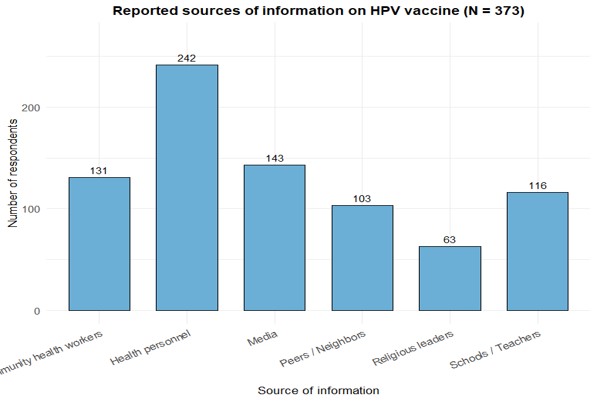
Figure 1 : Sources of information reported on the HPV vaccine
Only 2.9% of households lived more than 5 km from the center. 54.9% of parents reported that vaccination had not been organized at their daughter's school. 29.5% felt that the vaccination schedules were not suitable.
Future acceptability
77.5% of respondents whose children were not vaccinated stated that they would accept vaccinating their daughter if they received more information. The factors that could be acted upon to increase vaccination coverage were direct communication by medical staff and local community awareness. Table V describes the factors related to acceptability.
Table V : Factors related to acceptability
|
Measure likely to convince |
Percentage (N=373) |
CI 95% |
|
Discussion with medical staff |
40,2% |
[35,3% ; 45,1%]
|
|
Community meeting / mass of awareness |
29,2% |
[24,6% ; 33,8%]
|
|
Awareness / radio |
12,6% |
[9,3% ; 15,9%] |
|
Information at school |
7,5% |
[4,6% ; 10,4%] |
|
Testimonies (others parents) |
6,7% |
[4,0% ; 9,4%] |
Discussion
In our series, the vaccination coverage rate was 38.3%. The WHO's target is 90% for the elimination of cervical cancer. Many countries in sub-Saharan Africa struggle to exceed 50% after the introduction of the vaccine. Our coverage rate shows difficulties at the start [1, 3].
Almost half (44.2%) never went to school. Yet, a parent's education is often the best predictor of vaccine acceptance. These parents are less exposed to reliable information, making them more vulnerable to neighborhood rumors [4].
More than 40% of respondents had never heard of HPV. For some, accepting a vaccine against an invisible and unknown disease is absurd. This explains the negative responses and hesitations. This lack of knowledge about the direct link between HPV and cervical cancer (55.5%) is a common, fundamental barrier in our regions [5].
The average knowledge score (3.5/8) shows that we have difficulty getting precise messages across. 70.5% know that the vaccine is free. At least, cost is not the main barrier. The program has not made enough noise beforehand. There is a need to carry out a massive communication campaign to raise awareness about cervical cancer and prevention methods.
The results on attitudes show that the refusal is not ideological, but related to panic.
Fear was related to the side effects of the vaccine (Score 3.83) and the belief that the vaccine causes infertility (Score 3.50).
Regarding sterility, this rumor is not just "false information"; it affects African values concerning offspring and the future of the young girl. This myth is the hardest to dislodge in HPV programs in Africa. For a parent, the risk, even if imaginary, of compromising their daughter's fertility is worse than the distant risk of cancer. This is the crux of the battle [2].
Parents have a very strong desire to protect their daughter (Score 4.54) and great confidence in healthcare staff (Score 4.24). This is a strong point. The literature shows that when trust in caregivers is high, it creates a crucial entry point for dialogue, even in the face of rumors [6].
The study shows that more than half of parents (54.9%) say that vaccination did not take place at school. This is a serious programmatic error. The school is the best gathering point for girls in this age group. It should be used to save time [1].
The message must be delivered by an expert. A discussion with a doctor (40.2%) or community meetings (29.2%) reinforce the idea of overcoming fear and myths. A voice of scientific authority is needed, one that takes the time to answer questions without judging [1].
77.5% of parents are willing to accept the vaccine if they receive the right information.
Vaccine hesitancy in Sandiara is a classic case of an information crisis and rumor management. The main barriers are a lack of awareness of the risk (40.8% do not know about HPV) and an unfounded fear of the consequences (sterility).
It will be especially important to address concerns related to the rumor of sterility by providing clear and reassuring explanations. Vaccination could also be organized as a priority in schools to target girls. Finally, the active involvement of doctors in awareness campaigns would be essential to establish a climate of trust and respond directly to parents' questions. It is by transforming hesitation into confidence, through a precise and human communication plan, that the coverage goals can finally be achieved.
Conclusion
This study conducted in Sandiara reveals a paradoxical situation: parents want to protect their daughters but are afraid of the vaccine. Many are unaware of the HPV virus and believe that the vaccine causes sterility. However, only 38% of girls were vaccinated. To improve this situation, we can take action by :
By turning fear into confidence, Sandiara will be able to better protect its young girls against cervical cancer.
Declarations
Funding : this study received no external funding.
Ethics approval and consent to participate
Ethical approval for this study was obtained from Ethical Committee. Written informed consent was obtained from all participants (or their legal guardians).
Consent for publication : written informed consent for publication was obtained from the participants.
Availability of data and materials
The datasets used and/or analyzed during the current study are available from the corresponding author on reasonable request.
Competing interests : the authors declare that they have no competing interests.



Open Access By Aditum Open Access Journals id licensed under Creative Commons Attribution 4.0 International License. Based On a Work at aditum.org


