
International Journal of Business Research and Management
OPEN ACCESS | Volume 5 - Issue 2 - 2026
ISSN No: 3065-6753 | Journal DOI: 10.61148/3065-6753/IJBRM


Ajibola, Hussein Olamilekan1*, Adekunle, Kikelomo Julianah2, Fasina, Oludare Olakunle3, Bakare, Jalal Oyeshola4
1Federal University of Technology, Ilaro, Ogun State, Nigeria.
2Department of Accountancy, Federal University of Technology Ilaro, Ogun State, Nigeria. 3Department of Accountancy, Federal University of Technology Ilaro, Ogun State, Nigeria 4Department of Business Administration, European University of Lefke, Cyprus.
*Corresponding Author: Ajibola, Hussein Olamilekan. Department of Accountancy, Federal Polytechnic, Ilaro, Ogun State, Nigeria.
Received: August 25, 2026 | Accepted: September 25, 2026 | Published: October 13, 2026
Citation: Ajibola, Hussein Olamilekan, Adekunle, Kikelomo Julianah, Fasina, Oludare Olakunle, Bakare, Jalal Oyeshola., (2026). “Decision Usefulness and Financial Reporting of Listed Consumer Goods Companies in Nigeria”.
International Journal of Business Research and Management 5(3); DOI: 10.61148/3065-6753/IJBRM/0100.
Copyright: © 2026. Ajibola Hussein. Ph.D, Alejandro. This is an open access article distributed under the Creative Commons Attribution License, which permits unrestricted use, distribution, and reproduction in any medium, provided the original work is properly cited.
Financial reporting's decision-usefulness is based on the idea that, even if one cannot provide theoretically accurate financial statements, one may at least attempt to make them more helpful to their users. This research looked at the value of financial reporting for Nigerian listed consumer products businesses. Financial reporting was measured using discretionary accrual, and decision usefulness was assessed using earnings per share, book value of equity, and audit quality. Using an ex post facto research approach, the study collected data from secondary sources, including the Annual Reports and Accounts of ten publicly traded consumer goods businesses during a ten-year period (2015–2024). Descriptive, correlation and regression were utilized as the study’s statistical tools. It was found that earnings per share and audit quality have significant effect on discretionary accrual as a proxy of financial reporting of listed consumer goods companies in Nigeria. In contrast, it was discovered that the discretionary accrual of Nigerian listed consumer goods businesses was not significantly impacted by the book value of equity. As a result, the study came to the conclusion that profits per share and audit quality, rather than book value of equity, may be used to forecast financial reporting of the chosen consumer goods companies. In order to estimate future profits, the research advised Nigerian consumer goods businesses' management to maintain procedures that guaranty the quality of financial reporting and the prompt acknowledgment of losses in terms of company profit and loss.
Audit quality, Book value of equity, Decision usefulness, Earnings per share and Financial reporting
1. Introduction
Financial reporting's main goal is to deliver high-quality financial reporting data on economic entities, mostly financial in nature, that can be used to make economic decisions (IASB, 2018). Excellent data on financial reporting is critical because it enables capital providers and other stakeholders to make better decisions regarding lending, investing, and other resource allocation, hence improving overall market efficiency.
According to Bees et al. (2019), the term "financial reporting quality" refers to more than just financial data; it also includes disclosures and other non-financial data that is helpful in making decisions. As a result, both the FASB and the IASB (2018) expressly state in the exposure draft, an improved conceptual framework for financial reporting, that they would like to build a comprehensive measurement tool to evaluate the quality of financial reporting taking into account all aspects of decision usefulness. Because these qualities influence how relevant financial reporting information is for making decisions, this measuring tool takes into account all of the qualitative aspects.
According to Ali (2017), the accuracy with which financial reporting informs equity investors about the company's activities, particularly its anticipated cash flows, is a measure of the quality of financial reporting. The FASB Concepts No. 1 states that one goal of financial reporting is to assist current and potential investors in making logical investment decisions and in evaluating the anticipated firm cash flows, is in line with this definition.
According to Scott (2019), decision usefulness of financial reporting adopts the stance that, even if theoretically correct financial statements cannot be prepared, at least one can attempt to make financial statements more helpful to their users by identifying the users and the issues they encounter when using the financial statements for decision-making. Put another way, better decision-making will result from customizing financial statement data to the unique requirements of the statements' users.
However, Akmai et al. (2022) highlighted that the two key bodies that develop accounting standards, the IASB and FAS, have skewed and given the notion of decision usefulness to creditors and shareholders undue importance, while giving other consumers of accounting information less weight. The purpose of this study is to find out how the quality of financial reporting helps accounting information consumers make informed judgments. As a result, the study examines the financial reporting of Nigerian-listed consumer products businesses and how beneficial it is in decision making.
Research Objectives
Financial Reporting
According to Chiappetta et al. (2019), financial reporting is the process of disseminating financial data that is helpful for making decisions about credit, investments, and other business matters. It is about providing users of accounting information with both financial and non-financial information. According to Dandago and Hassan (2023), it is ethical for a reporting organization to make financial reporting as helpful as possible to designated users, even if certain changes to the theoretical financial statement are required. This is because, in any event, the beauty of financial reporting is its ability to inform decision-making. The goal of financial reporting, according to Dandago and Hassan (2023), is to publish financial statements regarding the reporting business that are helpful to lenders, other creditors, and current and prospective equity investors in making choices.
Oyerinde (2019) asserted that the financial statements' main function is to give users, especially investors, information about a company so they can make better decisions. He went on to say that financial statements should also help users become more knowledgeable and enable decision-makers to anticipate future actions.
But according to Soyinka et al. (2017), the value of accounting data taken from the financial statements is composed of several crucial foundations. These include the accounting information's timeliness, dependability, applicability, and materiality. Relevance, dependability, timeliness, comparability, comprehensiveness, understandability, and verifiability are only a few of the positive characteristics of financial statements that Bees et al. (2023) identified. Ana (2022) also categorized dependability and relevance as essential components of quality accounting information that may help consumers make wise decisions. Nevertheless, this study uses discretionary accruals to measure financial reporting.
Discretionary Accruals
Discretionary accruals (DA) are non-cash accounting adjustments where management applies judgment (e.g., bad debt provisions, inventory valuation) to align revenues and expenses with the periods in which they are earned. While some discretion accurately reflects business operations, it can be exploited to meet analyst expectations, smooth income, or achieve performance targets (Yayangida et al., 2023). Agency theory suggests that managers use discretionary accruals for self-serving goals, leading to misrepresentation. The signaling theory argues that discretionary accruals transmit private information about future prospects to investors.
Decision Usefulness
According to Jonas and Young (2019), decision usefulness ought to be the benchmark by which accounting standards are judged. This implies that before creating the report, standards setters are expected to gather information from possible consumers, such as auditors. According to Scott (2019), the decision usefulness approach to accounting theory holds that even if financial statements cannot be prepared theoretically correctly, they can still be made more useful. When implementing the strategy, two key issues need to be resolved: Who makes use of financial statements? What are the decision-making issues faced by users of financial statements, including employees, the government, creditors, investors, managers, and so forth? This helps accountants be more equipped to satisfy users' information needs.
Put another way, better decision-making will result from customizing financial statement data to the unique requirements of the statements' consumers. This enhances the financial statements' utility (Ali, 2017). In this study, decision usefulness was examined using earnings per share, book value of equity, and audit quality (as determined by audit tenure).
Earnings per Share (EPS)
Gul et al. (2018) define earnings per share as the amount of a company's earnings that is allocated to each share of common stock after taxes and preferred stock dividends. Farah et al. (2016) also described earnings per share as a gauge of a business's profitability.
According to Jeff (2023), EPS is a financial metric that is computed by dividing the average number of outstanding shares over a certain time period by the net earnings accessible to common shareholders. The EPS calculation indicates a company's capacity to produce net profits for common shareholders. The computation of earnings per share is explained in depth in this handbook (Jeff, 2023). There are two methods for calculating EPS: basic and fully diluted. Earnings per share that are fully diluted, accounting for the potential dilution effect of stock options, warrants, and securities deemed convertible into ordinary stock (Farah et al., 2016). This is more commonly reported and is usually thought to be a more accurate measure. Net profit margin is one of the most important indicators of a company's financial health, according to the Security Exchange Commission (2023).
Book Value of Equity
The accounting value of a company's assets less its obligations is the book value of equity, often referred to as shareholders' equity or net worth. This is the net amount that would be given back to shareholders if all assets were liquidated and debts were settled. It is a written representation of a company's net value and may be found on the statement of financial position (Gul et al., 2018). The book value of equity, also known as shareholders' equity or net worth, is the accounting value of a business's assets less its liabilities. If all assets were liquidated and debts were paid off, this is the net amount that would be returned to shareholders. It may be found on the statement of financial position and is a textual depiction of a business's net worth (Gul et al., 2018).
Audit Quality
The conceptual notion of audit quality is the joint possibility that an auditor will discover significant misstatements in a client's financial statements and appropriately expose them (DeAngelo, 1981). This concept emphasizes two essential elements of audit quality: auditor independence (the readiness to disclose such misstatements) and auditor competence (the capacity to identify misstatements). This perspective has been broadened by later research to include professional skepticism, adherence to auditing standards, and the efficiency of audit procedures (Francis, 2021). The degree to which external auditing improves the dependability, credibility, and transparency of financial accounts is known as audit quality. High audit quality boosts trust in reported financial results and lessens information asymmetry between management and stakeholders (Ozegbe et al., 2022). An important concept in the literature on auditing and financial reporting, audit quality reflects the extent to which an audit is conducted in accordance with professional standards and successfully increases the credibility of financial statements (Tsetim et al., 2024).
Francis (2021) asserted that high audit quality reduces information asymmetry between management and financial statement consumers and increases stakeholders' trust in reported financial information. Accountability, transparency, and prudent financial management depend on audit quality in both public and private sectors. Knechel et al. (2023) state that audit quality is a multifaceted construct that is impacted by the institutional context, client-specific factors, audit firm features, and auditor characteristics. In this study, audit tenure was employed as the proxy of audit quality.
Audit Tenure
The term "audit tenure" describes how long an external auditor has consistently supplied audit services to a certain company. Longer audit tenure may enhance audit quality from a knowledge-based standpoint as auditors learn more about the client's internal control systems, risk environment, and business processes. The planning of audits and the identification of major misstatements can be improved by this gathered information. Long-term auditor-client interactions, however, may result in familiarity risks and economic bonding, which might compromise auditor independence and lower audit effectiveness, according to agency theory (Myers et al., 2023).
Depending on how long the auditor-client connection lasts, it can be categorized as either short or lengthy term. Long audit tenure may promote better awareness of the client's business environment, internal controls, and risk profile, whereas short audit tenure may be linked to a limited grasp of the client's operations (Knechel et al., 2023). Regulatory bodies in many jurisdictions impose audit rotation requirements to mitigate the potential adverse effects of long audit tenure. For example, mandatory audit partner rotation is intended to preserve auditor independence while retaining institutional knowledge at the firm level (Francis, 2021).
Underpinning Theory
Single-Person Decision Usefulness Theory
This study's underlying idea is single-person decision usefulness theory. The idea is predicated on the perspective of a person who must decide in an unclear situation. According to Soyinka et al. (2017), the theory lays out a process for obtaining more data from reporting organizations in order to update a decision-maker's subjective evaluation of the likelihood of what may have occurred after a choice is taken.
According to El-Maud et al. (2015), the single-person decision usefulness theory's concept is to tailor financial reporting to a specific class of users so they may make the most use of all the information at their disposal and make well-informed decisions. According to Dandago and Hassan (2023), single-person decision usefulness theory adopts the stance that "if a firm can't prepare theoretically correct financial statements, at least it can try to make financial statements more useful.
Empirical Review
Soyinka et al. (2017) investigated how the public's ability to make informed judgments is aided by the quality of financial disclosures. The questionnaire was used to collect the data. 57 of the 75 sets of questionnaires that were distributed to the respondents were returned, yielding a 76% response rate. The collected data was analyzed using the Ordinary Least Square (OLS) regression method. According to the empirical findings, financial reports' dependability, comprehensibility, comparability, timeliness, and verifiability were found to have little impact on the public's ability to make decisions. However, it was shown that true portrayal and relevance had a favorable and statistically significant impact on the public's decision-making.
Ali (2017) conducted a study on decision usefulness approach to financial reporting, with particular focus on employees. The study looked at why companies should utilize corporate social responsibility and the reward system to help employees live better lives. The fundamental important role that workers play in organizational growth has garnered a lot of attention worldwide as people are essential to the success of a company's tactics and plans. The claim is that effective and efficient information from financial reporting helps employees improve the performance of the companies.
The impact of financial reporting quality on the financial performance of Nigerian manufacturing companies is investigated by Amah and Amauwa (2019). The years 2005–2014 were included in the research. Financial reporting quality was examined in relation to dividend per share, net asset per share, current asset ratio, market price per share, price earnings ratio, and earnings per share. The data gathered from the annual public financial statements of a few industrial organizations was tested using multiple regression analysis. According to the regression results, accrual as a proxy for FRQ has a positive significant association with NAPS and EPS, whereas DPS, CAR, MPS, and PER have a negative significant link with FRQ.
Ajayi-Owoeye et al. (2022) investigated how investment decisions in Nigerian listed manufacturing businesses were impacted by the quality of financial reporting. Ex-post facto research design was used in the study. 52 manufacturing enterprises listed on the Nigerian market as of December 31, 2020, made up the study's population. Ten businesses were specifically selected for the study based on their overall asset base and data availability, which covered a sample period of 2011–2020. The data was analyzed using descriptive and inferential (Multiple Regression) statistics. The results showed that the market price per share of Nigerian listed manufacturing companies is significantly impacted by the quality of their financial reporting.
Emo et al. (2025) investigated the relationship between financial choices and the financial success of Nigerian manufacturing companies that were listed between 2014 and 2023. This study's research design was ex post facto. From the 87 manufacturing companies registered on the Nigeria Exchange Group as of August 29, 2023, a sample of 50 listed enterprises was selected. Judgmental sampling was utilized in the study to determine the sample size. The analysis's secondary data came from the annual reports and accounts of the chosen firms. Panel multiple regression, correlation, and descriptive were used to assess the hypotheses. It was found that decisions in working capital, dividend policy, capital structure, and cost management have a favorable and substantial effect on return on equity.
The underlisted hypotheses were developed in accordance with the findings of the empirical review:
Ho1: Earnings per share has no significant effect on discretionary accruals of listed Nigerian consumer goods companies.
Ho2: Book value of equity does not significantly affect discretionary accruals of listed Nigerian consumer goods companies.
Ho3: Audit quality has no significant effect on discretionary accruals of listed Nigerian consumer goods companies.
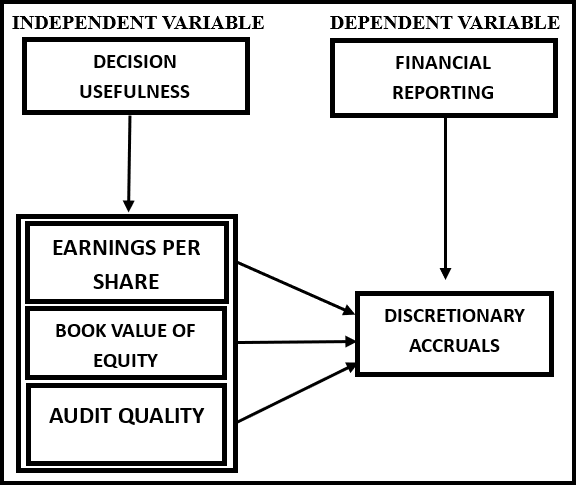
Source: Researchers (2026)
Figure 1: Conceptual Model
secondary data came from the annual accounts of the firms under study, which covers 10years (2015-2024).
An ex-post facto method was utilized. The Nigerian Exchange Group had nineteen (19) consumer products businesses listed as of December 31, 2024. Using a purposive sampling approach, ten (10) listed consumer products businesses were chosen as the sample size. Nigerian Breweries Plc., PZ Cussons Plc., Nestle Plc., Cadbury Nig. Plc., Unilever Nig. Plc., Guinness Nig. Plc., Flourmills Nig. Plc., Honeywell Plc., Vita-foam Plc., and Dangote Sugar Plc are the chosen listed industrial goods businesses. The Regression analysis was used to examine financial reporting proxies and decision usefulness. The study used discretionary accruals to quantify financial reporting, whereas profits per share, book value of equity, and audit quality were used as indicators for decision usefulness. To assess the relationship between the independent and dependent variables, the study used multiple linear regression, as seen below:
DA = f(EPS, BVE, AQ) i
The model has been formulated to suit the study as follows: DA = β0 + β1EPS + β2BVE + β3AQ + e… ii
Where;
DA = Discretionary Accruals (Dependent Variable) EPS = Earnings per Share (Independent Variable) BVE = Book value per share (Independent Variable)
AQ = Audit Quality (Independent Variable) β0 = Intercept
β1 – β3 = Coefficient of Regression e = error term
Table 1 Descriptive Results
|
|
DA |
EPS |
BVE |
AQ |
|
Mean |
3.671625 |
0.920000 |
0.448430 |
7.514440 |
|
Median |
3.535941 |
1.000000 |
0.428571 |
7.503981 |
|
Maximum |
5.809560 |
1.000000 |
0.833333 |
9.985011 |
|
Minimum |
1.397940 |
0.000000 |
0.260870 |
5.426353 |
|
Std. Dev. |
1.511649 |
0.272660 |
0.106474 |
1.434123 |
|
Skewness |
0.004599 |
-3.096281 |
0.733234 |
0.081115 |
|
Kurtosis |
1.309708 |
10.58696 |
3.625770 |
1.491366 |
|
Jarque-Bera |
11.90488 |
399.6239 |
10.59215 |
9.592902 |
|
Probability |
0.002599 |
0.000000 |
0.005011 |
0.008259 |
|
Sum |
367.1625 |
92.00000 |
44.84301 |
751.4440 |
|
Sum Sq. Dev. |
226.2232 |
7.360000 |
1.122326 |
203.6142 |
|
Observations |
100 |
100 |
100 |
100 |
Source: E-Views 12 Output, 2026.
The descriptive statistics of the variables is provided in Table 1 above. From the table, the averages of the variables are 3.671625, 0.920000, 0.448430 and 7.514440 for DA, EPS, BVE and AQ
respectively. The maximum values of the variables are 5.809560, 1.000000, 0.833333 and 9.985011 respectively. Also, minimum Table 2 Correlation Results
values were revealed as 1.397940, 0.000000, 0.260870 and 5.426353 respectively. The study concluded that all the variables are not normally distributed since their Jarque-Bera probability values (0.002599, 0.000000, 0.005011 and 0.008259) are less than 0.05 threshold.
|
|
DA |
EPS |
BVE |
AQ |
|
DA |
1.000000 |
-0.178188 |
0.272380 |
0.987009 |
|
EPS |
-0.178188 |
1.000000 |
-0.022235 |
-0.127362 |
|
BE |
0.272380 |
-0.022235 |
1.000000 |
0.214906 |
|
AQ |
0.987009 |
-0.127362 |
0.214906 |
1.000000 |
Source: E-Views 12 Output, 2026.
The table 2 presents the correlation outcomes of DA, EPS, BVE and AQ. According to the findings, BVE and AQ have weak and strong positive relationships with DA, respectively, with Table 3 Hausman Test Result
correlation coefficients of 0.272380 and 0.987009, but EPS has a mild negative link with DA with a correlation coefficient of - 0.178188.
|
|
Chi-Sq. Statistic |
Chi-Sq. d.f. |
Prob. |
|
Cross-section random |
25.379893 |
3 |
0.0000 |
Source: E-Views 12 Output, 2026.
Table 3 above indicates that the p-value of 0.000 is significant
Table 4 Random Regression Results
because the value falls below 0.05 threshold. Consequently, the regression analysis would be suitable for the random effect model.
|
Variable |
Coefficient |
Std. Error |
t-Statistic |
Prob. |
|
C |
-0.474730 |
0.727581 |
-0.652478 |
0.5158 |
|
EPS |
-0.298324 |
0.107583 |
-2.772971 |
0.0068 |
|
BVE |
0.052203 |
0.256474 |
0.203541 |
0.8392 |
|
AQ |
0.585194 |
0.091481 |
6.396892 |
0.0000 |
|
R-squared |
0.889095 |
Mean dependent var |
3.671625 |
|
|
Adjusted R-squared |
0.787591 |
S.D. dependent var |
1.511649 |
|
|
S.E. of regression |
0.168389 |
Akaike info criterion |
-0.604340 |
|
|
Sum squared resid |
2.466876 |
Schwarz criterion |
|
-0.265668 |
|
Log likelihood |
43.21702 |
Hannan-Quinn criter. |
-0.467274 |
|
|
F-statistic |
657.6064 |
Durbin-Watson stat |
1.811536 |
|
|
Prob(F-statistic) |
0.000000 |
|
|
|
Source: E-Views 12 Output, 2026.
The previously formulated model was expressed as follows;
DA = -0.474730 - 0.298324EPS + 0.052203BVE + 0.585194AQ
It is evident from the preceding equation that BVE and AQ have a positive impact on the dependent variable (DA), but EPS has a negative impact. This implies that the DA of the chosen listed consumer goods businesses will likewise decrease by 0.298324 if EPS increases by one unit. Conversely, a rise of 0.052203 for BVE and 0.585194 for AQ would result in an increase of DA. Additionally, the independent variables' respective t-test results were shown as 2.772971, 0.203541, and 6.396892. All of these values aside from BVE, which is less than two are higher than the t-tab of two. The associated probability values (p-value) for each of these are 0.0068, 0.8392, and 0.0000, respectively. Given that it is higher than the 0.05 level of significance, the probability value for BVE (0.8392) can be considered statistically insignificant. However, as the p-values for EPS and AQ are below the 0.05 limit, they can be considered significant.
Also, the R-squared value of 0.889095 was observed which indicates that the predictors (EPS, BVE, and AQ) accounts for 88.9% of any changes in DA, with the remaining 11.1% being explained by factors not included in the study. The F-Statistic’s p-value of 0.000 implies that the model developed is statistically significant because the derived figure is less than the 0.05 limit. However, the Durbin-Watson statistic value was 1.811536, which falls above1.5 threshold, suggesting that serial auto-correlation is not present, which therefore implies that the variables are in decent condition.
Hypotheses Testing
Ho1: Earnings per share has no significant effect on discretionary accruals of listed Nigerian consumer goods companies
Regression table provides a suitable perspective on the above-formulated study premise. The regression table revealed that the t-cal for EPS was 2.772971, with a matching probability value of 0.0068 which was observed to be significant because the value falls below 0.05 limit. Because of this, the study disproves the aforementioned null hypothesis and reiterates that the discretionary accruals of Nigerian listed consumer goods businesses are significantly impacted by profits per share.
Ho2: Book value of equity does not significantly affect discretionary accruals of listed Nigerian consumer goods companies.
Result from the regression analysis revealed a p-value of 0.8392 for book value of equity, and was considered insignificant at 0.05 threshold. Because of this, the study concludes that the book value of equity has no discernible impact on the discretionary accruals of listed consumer goods businesses in Nigeria and is unable to reject the second null hypothesis mentioned above.
Ho3: Audit quality has no significant effect on discretionary accruals of listed Nigerian consumer goods companies.
The regression result probability value for audit quality was 0.0000, which was deemed significant as the value falls below the threshold of 0.05. Because of this, the study disproves the aforementioned null hypothesis and reiterates that audit quality significantly influences the discretionary accruals of Nigerian listed consumer goods businesses.
Discussion of Results
Following the testing of the first hypothesis, the study reiterated that, at the 0.05 level of statistical significance, profits per share have a substantial impact on financial reporting as determined by the discretionary accruals of Nigerian listed consumer goods businesses, rejecting the first null hypothesis. Research by Amah & Amauwa (2019), Ajayi-Owoeye et al. (2022), and Emo et al. (2025) is in line with this outcome.
On the other hand, the findings showed that the book value of equity had no discernible impact on the discretionary accruals of Nigerian listed consumer products businesses. Thus, this result is consistent with research by Soyinka et al. (2017) and Ajayi-Owoeye et al. (2022), but it is inconsistent with research by Amah and Amauwa (2019).
Lastly, the regression analysis showed that discretionary accruals, a measure of the financial reporting of Nigerian consumer goods firms, are highly impacted by audit quality. This conclusion is consistent with research by Soyinka et al. (2017), Ali (2017), Amah & Amauwa (2019), and Ajayi-Owoeye et al. (2022).
Conclusion
The underlisted conclusions were reached:
The regression table showed that earnings per share as a measurement of decision usefulness have significant effect on financial reporting, represented by discretionary accruals, thus, the study concludes that earnings per share might be used by stakeholders to predict the quality of financial reporting of the selected Nigerian consumer goods companies.
However, the findings revealed that book value of equity as a proxy of decision usefulness does not significantly affects financial reporting measured by discretionary accruals. The study therefore concludes that book value of equity is an unreliable measure to be considered while predicting the quality of financial reporting of the selected listed consumer goods companies in Nigeria.
Additionally, the study's results show a probability value for audit quality of 0.0000, which was considered statistically significant as the p-value was below the significant threshold of 0.05. The study comes to the conclusion that discretionary accrual, a measure of financial reporting for the selected listed consumer goods businesses in Nigeria, is significantly impacted by audit quality as determined by audit tenure.
Recommendations
The study's findings and conclusion led to the following recommendations being offered:
In order to assist present and prospective investors predict future profits, management of consumer goods companies in Nigeria should make sure that procedures are maintained for assuring quality of financial reporting and timely recognition of losses in terms of profit and loss of enterprises.
By eliminating gaps in the application of judgments and management discretion in the calculation of assets and equity, regulators can inhibit innovative accounting methods.
The auditor-client relationship should not last more than three years due to the obvious correlation between audit duration and financial reporting. This is because the audit's neutrality and quality might be compromised if the auditor develops a close relationship with the client and works more in management's favor.



Open Access By Aditum Open Access Journals id licensed under Creative Commons Attribution 4.0 International License. Based On a Work at aditum.org


