
International Journal of Business Research and Management
OPEN ACCESS | Volume 4 - Issue 3 - 2026
ISSN No: 3065-6753 | Journal DOI: 10.61148/3065-6753/IJBRM


Reginald Ndwamaim
University of Venda, Thohoyandou, South Africa.
*Corresponding author: Reginald Ndwamai. University of Venda, Thohoyandou, South Africa.
Received: March 20, 2026 | Accepted: March 27, 2026 | Published: March 30, 2026
Citation: Ndwamai R, Tracy N., (2026). “Strengthening Accountability in Public-Private Partnerships (PPPs): A Governance Perspective”. International Journal of Business Research and Management 4(3); DOI: 10.61148/3065-6753/IJBRM/080.
Copyright: © 2026. Reginald Ndwamai, This is an open access article distributed under the Creative Commons Attribution License, which permits unrestricted use, distribution, and reproduction in any medium, provided the original work is properly cited.
Public-Private Partnerships (PPPs) have become a significant framework for infrastructure development and service delivery, merging the public sector's responsibilities with the private sector's efficiency. Nevertheless, this combined approach poses complex challenges for accountability, particularly as PPPs increasingly affect essential sectors traditionally managed by public institutions. Accountability, which is a crucial element of democratic governance, must be thoroughly integrated into the structures of PPPs to maintain transparency, legitimacy, and public confidence. This paper investigates accountability within PPPs through three primary dimensions: hierarchical accountability, which is based on conventional bureaucratic frameworks and principal-agent dynamics; horizontal accountability, which encompasses checks and balances among peers and stakeholders; and accountability as a virtue, which signifies ethical behaviour and professional responsibility in PPP interactions. It synthesizes both theoretical and empirical perspectives to examine how these accountability forms operate and occasionally falter within the context of PPPs. To frame and direct the methodology, Principal-Agent Theory is utilised, providing a comprehensive perspective to analyse the delegation of authority from public principals to private agents and the ensuing dynamics of control, oversight, and alignment of incentives. This theoretical approach facilitates a thorough exploration of how accountability mechanisms can be enhanced to reduce risks such as information asymmetry, goal misalignment, and diminished public oversight, ultimately leading to more transparent, responsive, and ethically grounded governance in PPPs.
Accountability; Governance; Oversight; Principal-Agent Theory; Public-Private Partnerships (PPPs); Transparency
Public-Private Partnerships (PPPs) have increasingly become an important governance mechanism for delivering infrastructure and public services across many countries. Governments often turn to PPPs as a strategic approach to address financial constraints, improve efficiency, and access private sector expertise in project design, financing, and management. By combining public sector mandates with private sector innovation and resources, PPPs are frequently promoted as a practical solution for accelerating development, particularly in sectors such as transportation, health, education, and energy. In many developing and developed contexts, PPPs are viewed as a way to improve service delivery and infrastructure development while reducing the fiscal burden on governments.
However, the introduction of private actors into public service provision has also generated significant governance challenges, especially regarding how responsibility, authority, and oversight are structured within these hybrid arrangements (Fombad, 2014; Pfisterer & Tulder, 2020).
Despite the potential advantages associated with PPPs, concerns about accountability remain central to debates surrounding their effectiveness and legitimacy. PPPs often operate within complex contractual arrangements where responsibilities are distributed between public authorities and private partners. This hybrid structure can obscure lines of responsibility, making it difficult to determine who should be held accountable when projects fail to meet expectations or when public interests are compromised. Scholars have noted that the blending of public and private governance logics may weaken traditional accountability mechanisms that are typically present in purely public sector arrangements (Stafford & Stapleton, 2021). As a result, ensuring transparency, democratic oversight, and responsible decision-making becomes more challenging within PPP structures.
Furthermore, the sustainability and legitimacy of PPPs depend largely on the existence of robust accountability practices that protect public value while allowing private sector participation. Without clear mechanisms for monitoring performance, ensuring transparency, and enforcing responsibilities, PPP arrangements risk undermining public trust and democratic governance. Researchers argue that effective accountability frameworks are necessary to balance the interests of governments, private partners, and citizens, particularly when PPPs are used to deliver essential public services (Onyoin & Bovis, 2021). In this context, this conceptual paper examines accountability within PPP arrangements and argues that strengthening accountability mechanisms is essential for ensuring responsible governance and safeguarding the public interest in hybrid public-private collaborations.
THE CONCEPT OF ACCOUNTABILITY
Accountability is widely recognized as a fundamental tenet of democratic governance and public administration, as it ensures that individuals and institutions vested with authority remain responsible for their decisions and actions (Mechkova, Lührmann & Lindberg, 2017). In the context of governance, accountability refers to actors' duty to explain their behavior, justify their choices, and face the consequences when their performance falls short of anticipated standards (Breuer & Leininger, 2021). This concept is pivotal in fostering transparency, responsibility, and trust between governments and citizens, especially when public resources are at stake (Fombad, 2014).
Moreover, accountability serves as a mechanism that limits the abuse of power and guarantees that governance systems function in accordance with societal expectations and democratic principles (Eckersley et al., 2024). In contemporary governance frameworks where numerous actors engage in policy execution, accountability is crucial for upholding legitimacy and protecting the public interest (Onyoin & Bovis, 2021).
Accountability in governance is frequently interpreted through various but interrelated dimensions that clarify how responsibility is enacted and overseen within institutions (Mechkova et al., 2017). A significant dimension is hierarchical accountability, which embodies traditional bureaucratic structures where authority is transmitted vertically through established chains of command (Fombad, 2014).
In this framework, subordinates must report to their superiors, and organizational actions are scrutinized through formal oversight mechanisms such as performance assessments, reporting obligations, and regulatory supervision (Stafford & Stapleton, 2021). Hierarchical accountability also illustrates the delegation relationships typically observed in governance systems, where principals assign responsibilities to agents while retaining oversight authority over their actions (Eckersley et al., 2024).
A third viewpoint frames accountability as a virtue, underscoring the ethical and normative duties of participants within governance frameworks (Eckersley et al., 2024). This viewpoint accentuates the significance of integrity, professional accountability, and ethical behavior among individuals and institutions that hold authority (Fombad, 2014). Viewing accountability as a virtue transcends mere adherence to formal regulations and reporting protocols, as it promotes the internalization of values such as transparency, honesty, and responsibility in decision-making processes (Onyoin & Bovis, 2021). The virtue-centric approach acknowledges that formal oversight mechanisms may not suffice to ensure responsible conduct, especially in intricate governance contexts where monitoring is constrained (Pfisterer & Tulder, 2020). Consequently, ethical commitment and institutional culture are crucial in maintaining accountability within governance frameworks (Eckersley et al., 2024).
In the realm of Public-Private Partnerships, these facets of accountability become increasingly intricate due to the collaborative nature of PPP arrangements, which involve actors with varying institutional logics and interests (Pfisterer & Tulder, 2020). The hybrid characteristics of PPPs frequently obscure conventional boundaries of responsibility between public authorities and private sector collaborators, complicating the identification of who should be accountable for decisions and outcomes (Stafford & Stapleton, 2021). Therefore, accountability mechanisms in PPPs must integrate a blend of hierarchical oversight, horizontal examination, and ethical responsibility to promote transparency and safeguard public value (Onyoin & Bovis, 2021). In the absence of robust accountability frameworks, PPP arrangements may jeopardize democratic oversight of public resources and erode public confidence in governance systems (Fombad, 2014).
THE CONCEPT OF PUBLIC-PRIVATE PARTNERSHIPS (PPPS)
Public–Private Partnerships (PPPs) are generally characterized as enduring collaborative agreements between public sector entities and private sector organizations aimed at delivering public infrastructure or services (Das et al., 2025). These partnerships usually entail formal contractual arrangements wherein governments assign specific duties to private partners while maintaining overall accountability for the provision of public services (Wulandari & Septian, 2024). In the majority of PPP frameworks, the private sector may take on responsibilities such as financing, designing, constructing, operating, or maintaining infrastructure projects, including roads, water systems, hospitals, or energy facilities (Lima, Brochado & Marques, 2021). Nevertheless, the public sector continues to be accountable for ensuring that these services fulfill public needs and align with policy objectives, underscoring the government's enduring role as the primary steward of public value (Handayani, 2025). Consequently, PPPs have surfaced as a governance model that integrates public oversight with the operational capabilities of the private sector to tackle infrastructure deficiencies and service delivery obstacles (Das et al., 2025).
The rationale for adopting PPPs is frequently based on various perceived benefits linked to private sector involvement in public service delivery (Liu, Clegg & Pollack, 2023). Governments often turn to PPPs to leverage additional financial resources for extensive infrastructure initiatives, especially in situations where public funding is limited or restricted (Das et al., 2025). Additionally, PPP arrangements enable governments to capitalize on private sector managerial expertise, technological advancements, and operational efficiencies, which can enhance project execution and the long-term performance of infrastructure (Liu et al., 2023). Moreover, PPPs are typically structured to allocate risks between public and private partners, permitting each party to undertake responsibilities that correspond with their respective strengths and capabilities (Handayani, 2025).
Despite the benefits associated with Public-Private Partnerships (PPPs), they also present considerable governance challenges due to the hybrid nature of public and private collaboration (Handayani, 2025). The merging of public policy goals with private profit motives can obscure conventional lines of authority and accountability, complicating the identification of responsible parties for performance results (Das et al., 2025). The intricate nature of PPP contracts further exacerbates governance issues, as these agreements frequently entail highly specialized technical requirements and long-term obligations that necessitate expert management and oversight (Aben et al., 2021). Consequently, public authorities may find it challenging to exercise effective oversight when private partners have superior technical expertise or operational insights regarding project execution (Aben et al., 2021).
Another significant governance issue linked to PPPs is the problem of information asymmetry between public and private entities (Aben et al., 2021). Private partners typically have access to more comprehensive information regarding project expenses, operational methodologies, and technological frameworks, which can lead to an information imbalance that hampers governmental capacity to effectively monitor performance (Liu et al., 2023). This disparity can undermine accountability systems and elevate the risk of opportunistic conduct if private partners prioritize profit over public interest (Das et al., 2025). Therefore, effective governance of PPPs necessitates strong contractual arrangements, transparent monitoring systems, and enhanced institutional capabilities within the public sector to navigate complex partnership dynamics (Handayani, 2025). In the absence of such governance frameworks, PPP initiatives may fail to realize their intended objectives of efficiency, innovation, and sustainable public service provision (Lima et al., 2021).
THEORETICAL FRAMEWORK: PRINCIPAL-AGENT THEORY
This study employs Principal–Agent Theory as a framework to analyze the accountability issues present in Public–Private Partnerships (PPPs). Principal–Agent Theory elucidates the dynamics of relationships where one entity, referred to as the principal, assigns authority or responsibility to another entity, known as the agent, to execute tasks on their behalf (Lane, 2020). In the realm of public governance, it is typically the case that governments or public institutions take on the role of principals, as they bear the responsibility of protecting public interests and distributing public resources (Maggetti & Papadopoulos, 2018). Conversely, private sector entities involved in PPPs function as agents, as they are contracted to design, finance, construct, or manage public infrastructure and services on behalf of the government (Wulandari & Septian, 2024). This delegation of authority underpins numerous governance frameworks in contemporary public administration, where governments depend on external entities to provide services that were historically delivered directly by the state (Handayani, 2025).
Principal–Agent Theory highlights various governance challenges that emerge when authority is transferred from principals to agents (Lane, 2020). A primary challenge is the issue of information asymmetry, which arises when the agent has access to more information regarding project performance, operational processes, or costs than the principal (Aben et al., 2021). Within PPP frameworks, private partners frequently possess specialized technical knowledge and operational skills that public institutions may not have, complicating the ability of governments to effectively monitor and assess project execution (Liu, Clegg & Pollack, 2023). This disparity in information can undermine oversight mechanisms and diminish the capacity of principals to ensure that agents adhere to contractual commitments and meet public expectations (Musawir, 2024).
To tackle these issues, Principal–Agent Theory emphasizes the significance of governance mechanisms that mitigate opportunistic behavior and align the interests of both principals and agents (Musawir, 2024). These mechanisms typically encompass comprehensive contractual agreements, performance monitoring systems, regulatory oversight, and incentive structures aimed at promoting adherence to established objectives (Wulandari & Septian, 2024). Well-structured contracts can clearly delineate roles, responsibilities, and performance expectations, thus minimize ambiguity and enhancing accountability in Public-Private Partnership (PPP) relationships (Lima et al., 2021). Furthermore, relational governance mechanisms, such as fostering trust and facilitating collaborative communication between public and private entities, can serve to complement formal contractual controls by enhancing transparency and cooperation within partnerships (Aben et al., 2021).
RELEVANCE OF THE THEORY AIM OF THE PAPER
The objective of this paper is to conceptualize accountability within Public–Private Partnerships and to investigate mechanisms that can enhance governance structures in these hybrid arrangements. Principal–Agent Theory serves as a valuable analytical framework for this purpose, as it elucidates how delegation relationships between public and private entities may lead to accountability challenges (Lane, 2020). When governments assign responsibilities to private partners through PPP agreements, the likelihood of information asymmetry, moral hazard, and goal divergence escalates, thereby increasing the risks that public interests may not be adequately safeguarded (Musawir, 2024). By utilizing Principal–Agent Theory, this paper examines how these structural challenges affect accountability practices within PPP governance systems (Maggetti & Papadopoulos, 2018).
The theoretical framework also elucidates the necessity of accountability mechanisms to manage the relationship between principals and agents in PPP arrangements (Handayani, 2025). Hierarchical accountability mechanisms, such as contractual monitoring and regulatory oversight, assist governments in maintaining supervision over private partners and ensuring adherence to public policy objectives (Wulandari & Septian, 2024). Horizontal accountability mechanisms, including independent audits and institutional oversight, further enhance transparency and mitigate the risks associated with delegated authority (Lima et al., 2021). Concurrently, ethical governance practices and professional responsibility among PPP participants contribute to accountability as a virtue, promoting responsible behavior even when formal monitoring mechanisms are constrained (Liu et al., 2023).
METHOD
This research employs a conceptual desktop review methodology to investigate accountability within Public–Private Partnerships (PPPs) by integrating insights from the existing body of scholarly literature. A desktop review approach was deemed suitable as the study aims to conceptualize accountability mechanisms and governance dynamics rather than gather primary empirical data. The review concentrated on peer-reviewed journal articles that offer both theoretical and empirical perspectives on accountability within governance systems, as well as issues related to governance and performance in PPP arrangements.
The selection of articles was guided by a purposive sampling strategy, wherein studies were selected based on their relevance to the study's objectives, their contributions to the discourse on accountability or PPP governance, and their capacity to bolster the conceptual arguments presented in this paper. In total, six peer-reviewed journal articles were scrutinized in this research. Three of these articles primarily addressed accountability in public governance, specifically those by Mechkova, Lührmann and Lindberg (2017). These studies offer significant insights into the development of accountability mechanisms, the institutional frameworks that facilitate accountability, and the influence of power dynamics and governance networks on accountability practices.
The other three articles concentrated on governance and performance within PPPs, namely those by Liu, Clegg and Pollack (2023. These studies investigate the practical functioning of PPP arrangements, emphasizing governance challenges such as innovation management, contractual frameworks, and information asymmetry between public and private entities.
THEMATIC FORMATION
The thematic synthesis of the literature reviewed has uncovered several recurring patterns that elucidate the challenges of accountability and the dynamics of governance within Public–Private Partnerships (PPPs). A thorough analysis of the selected manuscripts revealed four primary themes: the ambiguity of responsibility, information asymmetry coupled with monitoring challenges, contractual governance serving as a control mechanism, and the role of ethical leadership in safeguarding public value. These themes underscore the structural and institutional issues that influence accountability in hybrid governance frameworks where public and private entities collaborate in service delivery.
Theme one: Ambiguity of responsibility
The first theme identified in the literature pertains to the ambiguity of responsibility within PPP arrangements. Governance structures in PPPs typically encompass multiple stakeholders, including government institutions, private contractors, regulatory bodies, and occasionally civil society organizations, which complicates the assignment of responsibility (Lima, Brochado & Marques, 2021). Given that authority and operational responsibilities are dispersed among various actors, it becomes challenging to ascertain who should be held accountable when projects do not meet anticipated standards or when service delivery outcomes are inadequate (Eckersley et al., 2024). Research on public governance highlights that effective accountability systems necessitate clearly delineated roles and institutional responsibilities; however, the hybrid nature of PPPs often obscures these distinctions (Mechkova, Lührmann & Lindberg, 2017). Consequently, accountability gaps may arise, leading both public and private actors to deflect responsibility for failures, thereby diminishing transparency and eroding public trust in partnership arrangements.
Theme two: Information asymmetry
The second theme highlighted in the literature pertains to the challenges of information asymmetry and monitoring between public authorities and private sector collaborators. Information asymmetry arises when one party has more comprehensive knowledge regarding project operations, costs, or technical processes than the other (Aben et al., 2021). In public-private partnership (PPP) arrangements, private partners frequently possess specialized technical skills and operational oversight over project execution, which may hinder government institutions' capacity to effectively monitor performance (Liu, Clegg & Pollack, 2023). This disparity in information can undermine oversight mechanisms and create opportunities for opportunistic behavior if private partners prioritize profit over service quality or public value (Lima et al., 2021). Consequently, scholars contend that addressing information asymmetry is essential for enhancing accountability within PPP governance frameworks, as monitoring and evaluation processes are heavily reliant on the availability of reliable and transparent information (Breuer & Leininger, 2021).
Theme three: Contractual governance
The third theme that arises from the literature is the significance of contractual governance as a control mechanism in managing relationships within PPPs. Contracts function as the primary tools through which governments seek to regulate the actions of private partners and ensure the achievement of project objectives (Wulandari & Septian, 2024). These contracts generally encompass detailed provisions concerning performance indicators, risk distribution, financial arrangements, and reporting obligations that delineate the responsibilities of both parties (Handayani, 2025). Therefore, contractual frameworks are designed to mitigate uncertainty, clarify roles, and establish mechanisms for monitoring compliance within PPP arrangements (Aben et al., 2021).
Theme four: The role of ethical leadership
The concluding theme discerned from the review pertains to ethical leadership and the safeguarding of public value within the governance of Public-Private Partnerships (PPPs). Although formal governance structures, including contracts and monitoring systems, are pivotal in ensuring accountability, the existing literature underscores that ethical commitment and institutional integrity are equally vital for the maintenance of responsible partnerships (Eckersley et al., 2024). Ethical leadership fosters an environment in which participants in PPP arrangements are encouraged to prioritize transparency, fairness, and the public interest in their decision-making processes for infrastructure development and service delivery (Breuer & Leininger, 2021). Researchers contend that accountability should not solely depend on formal regulatory frameworks but also on the ingrained values of individuals who acknowledge their duty to safeguard public resources and uphold trust in governance systems (Mechkova et al., 2017). Consequently, ethical governance practices are regarded as an essential complement to formal accountability mechanisms within PPP frameworks.
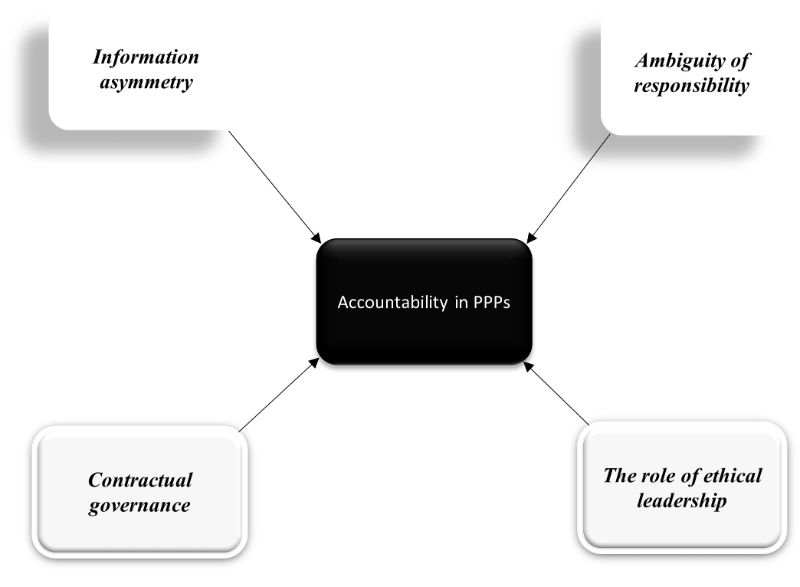 Figure 1:
Accountability in Public-Private Partnerships
DISCUSSION AND SYNTHESIS
The literature reviewed indicates that accountability in Public–Private Partnerships (PPPs) cannot depend solely on conventional hierarchical monitoring systems. Although formal contracts and regulatory oversight frameworks are crucial in directing the actions of private partners, these systems do not entirely resolve the governance issues linked to delegated authority in PPP setups (Lima, Brochado & Marques, 2021). Hierarchical accountability systems, which generally consist of reporting frameworks and contractual oversight, are often structured to ensure that private partners adhere to established project goals and service delivery criteria (Wulandari & Septian, 2024). Nevertheless, these systems may not completely eradicate governance risks, as PPP arrangements typically involve intricate contracts, long-term obligations, and specialized expertise that can hinder the effectiveness of direct monitoring by public entities (Handayani, 2025).
Moreover, the literature suggests that information asymmetry is one of the most enduring accountability issues in PPP governance frameworks. Private sector partners often have specialized technical expertise and operational authority over project execution, which can lead to an information imbalance between public institutions and private entities (Aben et al., 2021). This disparity diminishes the ability of public authorities to thoroughly evaluate project outcomes and may create avenues for opportunistic behavior if suitable accountability measures are not established (Liu, Clegg & Pollack, 2023). Principal–Agent Theory elucidates these governance challenges by emphasizing how delegation relationships can produce risks such as moral hazard and goal misalignment between principals and agents (Lane, 2020). Consequently, relying solely on hierarchical oversight mechanisms may not adequately bridge the accountability gaps present in PPP arrangements.
The results underscore the critical role of horizontal accountability mechanisms in enhancing transparency and oversight within the governance of Public-Private Partnerships (PPPs). Horizontal accountability pertains to the function of independent entities, including regulatory agencies, audit institutions, and oversight bodies, which are tasked with monitoring governance processes and ensuring that decision-makers are held accountable (Breuer & Leininger, 2021). These mechanisms foster increased transparency by adding extra layers of scrutiny that function independently of conventional hierarchical reporting frameworks (Mechkova, Lührmann & Lindberg, 2017). In the context of PPPs, horizontal accountability mechanisms may encompass independent audits, parliamentary oversight, and the involvement of stakeholders in the monitoring of public projects (Eckersley et al., 2024). Nevertheless, the efficacy of these mechanisms frequently hinges on the institutional capacity of governance systems and the capability of oversight institutions to function autonomously and effectively (Smidt, Johansson & Richter, 2024).
Another crucial insight derived from the synthesis is the importance of accountability as a virtue in maintaining responsible governance within PPP frameworks. Although formal governance mechanisms, such as contracts and regulatory oversight, are vital for managing principal-agent relationships, ethical leadership and professional responsibility are equally essential in ensuring that both public and private entities prioritize public value (Onyoin & Bovis, 2021). The concept of accountability as a virtue highlights the significance of integrity, transparency, and ethical commitment among the individuals and institutions engaged in PPP governance (Fombad, 2014). When stakeholders internalize these values, they are more inclined to act in ways that safeguard public interests, even in situations where formal monitoring mechanisms are scarce or when intricate contractual arrangements complicate oversight (Pfisterer & Tulder, 2020).
Integrating these insights, the paper contends that effective accountability within PPP governance necessitates a multi-faceted accountability framework that encompasses hierarchical monitoring, horizontal institutional oversight, and ethical governance practices. Principal–Agent Theory offers a valuable perspective on the structural challenges linked to delegated authority in PPP arrangements, especially concerning information asymmetry and misaligned incentives (Maggetti & Papadopoulos, 2018).
Nevertheless, the results also indicate that structural governance mechanisms by themselves may not suffice to ensure accountability in intricate partnership arrangements. Rather, enhancing accountability in PPPs demands the amalgamation of formal governance controls with institutional oversight and normative governance principles that emphasize transparency, responsibility, and the safeguarding of public value.
RECOMMENDATIONS
Drawing from the synthesis of the examined literature, several recommendations can be put forth to enhance accountability within the governance frameworks of Public–Private Partnerships (PPP). Firstly, governments need to focus on improving the clarity of contracts and the implementation of performance-based monitoring systems within PPP agreements. Contracts that are well-structured and clearly outline roles, responsibilities, performance metrics, and reporting obligations can diminish uncertainty and bolster accountability between public entities and private stakeholders. Furthermore, these contractual agreements should include quantifiable performance metrics and monitoring systems to guarantee that private partners adhere to service delivery standards and project goals. By reinforcing these contractual structures, governance issues such as information asymmetry and opportunistic behavior, which may occur when private partners have superior operational knowledge and technical skills, can be alleviated.
Secondly, it is crucial to strengthen independent oversight bodies that facilitate horizontal accountability mechanisms. Independent regulatory agencies, auditing institutions, and parliamentary oversight frameworks are vital in promoting transparency and monitoring the actions of participants in PPP arrangements. These bodies offer an additional level of examination beyond traditional hierarchical reporting systems, aiding in the identification of governance shortcomings and ensuring the safeguarding of public interests. Therefore, enhancing the capacity and autonomy of these institutions is imperative for advancing accountability within PPP governance frameworks and ensuring that both public and private entities are held accountable for their actions.
Thirdly, it is essential for governments and stakeholders involved in Public-Private Partnerships (PPP) to advocate for enhanced transparency through mechanisms for public reporting and citizen engagement. The clear disclosure of project details, financial agreements, and performance results enables citizens and civil society organizations to oversee PPP initiatives and hold both public authorities and private partners accountable. Furthermore, citizen involvement and stakeholder engagement can bolster the legitimacy of PPP frameworks by ensuring that public concerns are integrated into the decision-making processes. Increased transparency not only fortifies democratic accountability but also builds trust in the governance structures of PPPs.
In conclusion, governance frameworks for PPPs should promote ethical leadership and integrity within the management structures tasked with implementing these partnerships. Ethical leadership fosters responsible decision-making, integrity, and a commitment to public value among those engaged in PPP arrangements. When public officials and private sector leaders embrace ethical governance principles, they are more inclined to prioritize transparency and accountability, even in contexts where formal monitoring mechanisms may be scarce. Therefore, integrity training and ethical governance guidelines can serve to enhance formal contractual and regulatory controls by nurturing a culture of accountability within PPP institutions. Together, these recommendations contribute to a more equitable and accountable PPP governance system that safeguards public interests while facilitating effective collaboration between public and private entities.
LIMITATIONS
This research is fundamentally conceptual and is based on a desktop review of chosen scholarly literature to examine accountability in Public–Private Partnerships. Consequently, the analysis primarily relies on theoretical viewpoints and existing empirical evidence rather than on primary data gathered through fieldwork or case studies. Although the literature reviewed offers significant insights into governance dynamics and accountability mechanisms within PPP frameworks, the lack of primary empirical data restricts the study's capacity to capture context-specific experiences across various countries or sectors. Governance systems in PPPs frequently differ considerably based on institutional capacity, regulatory structures, and socio-political contexts, indicating that accountability practices may vary across different environments.
Another limitation pertains to the breadth of the literature examined in this research. While the selected articles provide crucial insights into accountability and PPP governance, the review is not comprehensive and may overlook various perspectives within the wider PPP literature. Furthermore, the conceptual framework established in this study has not undergone empirical testing in actual PPP settings. Therefore, future research should integrate empirical investigations, such as case studies, comparative analyses, or qualitative interviews with stakeholders engaged in PPP governance. Such investigations would yield deeper insights into the functioning of accountability mechanisms in practice and could assist in validating and refining the conceptual framework suggested in this paper.
CONCLUSION
Accountability continues to pose a significant governance challenge in Public–Private Partnerships (PPPs) due to the integration of public duties with private sector involvement within intricate contractual and institutional frameworks. The hybrid characteristics of PPPs frequently result in ambiguous authority and responsibility lines, complicating the identification of who should be accountable for project performance and service delivery results. This research has investigated the notion of accountability in the context of PPP governance by analyzing essential accountability dimensions and the structural dynamics that affect the exercise of responsibility within these partnerships.
Utilizing Principal–Agent Theory as a theoretical framework, the study has underscored how the delegation relationships between governmental entities and private sector partners can lead to governance risks, including information asymmetry, difficulties in monitoring, and divergence of goals. These structural dynamics elucidate the reasons behind the emergence of accountability gaps in PPP arrangements, particularly when oversight mechanisms are inadequate or when responsibilities lack clear definitions.
The findings indicate that conventional hierarchical accountability mechanisms may not suffice to tackle these governance issues, especially in complex partnership settings where numerous stakeholders participate in decision-making and project execution. The synthesis of the examined literature underscores the necessity of implementing a multi-faceted accountability framework that encompasses hierarchical monitoring, lateral institutional oversight, and ethical governance practices.
Contractual governance mechanisms alongside performance monitoring systems are essential for regulating the interactions between public and private entities, while independent oversight institutions enhance transparency and facilitate democratic scrutiny. Concurrently, ethical leadership and institutional integrity are crucial in bolstering accountability by motivating actors to emphasize public value and make responsible decisions.
In conclusion, enhancing accountability within Public-Private Partnership (PPP) governance is vital for ensuring that collaborations between public and private entities yield significant public value. Robust accountability frameworks not only enhance the performance and sustainability of PPP initiatives but also safeguard democratic legitimacy and uphold public trust in governance institutions. As governments increasingly depend on PPPs for infrastructure development and service provision, the incorporation of strong accountability mechanisms will remain essential to ensuring that these partnerships align with the broader interests of society.
Acknowledgments
The authors have read and agreed to the published version of the manuscript.
Author Contributions: Conceptualisation, Methodology, Primary Data Provision, Formal Analysis, Writing—Original Draft Preparation, Writing, Review and Editing done by all authors with equal contribution.
Funding: This study received no specific funding or grants.
Conflicts of Interest: The authors declare no conflict of interest.
Use of Artificial Intelligence Statement
The authors acknowledge the use of artificial intelligence–assisted tools during the preparation of this manuscript. These tools were used to support language refinement, structural organisation, and clarity of presentation. All conceptualisation, theoretical framing, data interpretation, and scholarly arguments are the original work of the authors. The authors take full responsibility for the content, accuracy, and integrity of the manuscript.



Open Access By Aditum Open Access Journals id licensed under Creative Commons Attribution 4.0 International License. Based On a Work at aditum.org


