
The Journal of Social and Behavioral Sciences
OPEN ACCESS | Volume 3 - Issue 5 - 2026
ISSN No: 3065-6990 | Journal DOI: 10.61148/3065-6990/JSBS


Spanaki Eirini
Laboratory and Teaching Staff, School of Science and Engineering, University of Crete, GR70013, Iraklion, Crete, Greece.
Corresponding author: Spanaki Eirini, Laboratory and Teaching Staff, School of Science and Engineering, University of Crete, GR70013, Iraklion, Crete, Greece.
Received: September 10, 2026 | Accepted: September 18, 2026 | Published: September 21, 2026
Citation: Spanaki, E., (2026) “The Teacher's Role in Enhancing Social Justice: A Consultative Role Supporting Equal Human Rights” Journal of Social and Behavioral Sciences, 3(5); DOI: 10.61148/3065-6990/JSBS/077.
Copyright: ©2026. Spanaki Eirini. This is an open access article distributed under the Creative Commons Attribution License, which permits unrestricted use, distribution, and reproduction in any medium, provided the original work is properly cited.
Education contributes to the implementation of projects and programs that help students understand the challenges posed by population diversity, thereby increasing their empathy toward various phenomena that contribute to rising social inequality (Farrell, 2019). Purpose of this study: The main purpose of this study is to investigate the views of future teachers from various disciplines regarding the value and role of their profession in fostering social justice and breaking down stereotypes, thereby promoting a better understanding of the concept of human rights. Towards this aim, questions were also posed regarding the methods and techniques that participants believe would support this educational endeavor. A total of 46 students participated in the study (67.4% female and 32.6% male). All participants were enrolled in a Certificate in Pedagogical Proficiency program to prepare them for future careers as teachers. This study focused on quantitative and qualitative data analysis (Mixed-Methods Research), using a questionnaire and performing interviews. The research findings revealed that all participants agreed that the concepts of “human rights” and “social justice” are undoubtedly not understood in the same way by all members of a society. All participants agreed that the role of the educator is important in fostering social justice and breaking down stereotypes. They also maintained that teachers play an advisory role in helping to foster positive attitudes among their students toward the development of social justice through certain strategies and methods. The strategies selected primarily included transformative learning through art, the organization of workshops, audiovisual materials, and so on. This study is a case study; however, it positively encourages the exploration of teachers’ attitudes regarding their role in fostering social justice among students and promoting an understanding of equal human rights.
Definitions of social justice have been proposed from legal, philosophical, economic, political, psychological, and educational perspectives. It is difficult to define precisely, as it encompasses many different aspects. Social equality and social justice essentially refer to phenomena and situations that emphasize the desire and effort to establish and maintain a society free from exploitation, violence, discrimination, racism, prejudice, and marginalization. The goals include equal opportunities, the elimination of injustice, and the empowerment of all people with the aim of bringing out their potential and building social solidarity (Carlson, 2007).
The term has recently been utilized in education, giving impetus to the school’s efforts toward social equality (Hytten & Bettez, 2011), across different social classes, ethnicities, cultures and educational levels, as well as students’ abilities and disabilities in schools. The call for equal opportunities focuses on eliminating exclusion from education and, more broadly, from educational structures, by legitimizing the recognition of social differences and human rights. Appropriate interventions aimed at challenging different interpretations of social reality as it relates to discrimination are crucial. Furthermore, a ‘key’ goal of education is to combat injustice, inequality, racism, and other forms of discrimination. Social justice in education is linked to access to every aspect of the school system, to equal treatment within the school, and to educational systems that empower students socially and cognitively. As an educational institution, the school is institutionally designed to foster individuals with sound judgment and a sense of community (Hytten & Bettez, 2011), which supports integration into the group and mutual respect among its members.
On this basis, several approaches have been proposed that can offer opportunities for active student participation as well as innovative approaches to education for all. Education can contribute to the implementation of activities and programs that will help students understand the challenges posed by population diversity, thereby increasing their empathy toward various phenomena that contribute to rising social inequality, such as the phenomenon of migration (Farrell, 2019). It is vital to utilize social-emotional teaching strategies. Such strategies lay the groundwork for developing friendships, recognizing emotions, and resolving conflicts and problems (Loh & Ang, 2020). Through such strategies, students can share knowledge and emotions, as well as ideas, thoughts, and perceptions regarding pluralism, marginalization, and exclusion, by developing an empathetic attitude (Hatzisotiriou & Angelidis, 2018).
The capacity for empathy is often developed through the emotions evoked, as well as the thoughts and attitudes of the student that emerge through creative expression (Hogg & Vaughan, 2010). By cultivating empathy, each unique student—as well as each teacher—places themselves in another’s shoes, transcending their own individual reality and understanding a broader range of truths and realities when interpreting situations, with a positive impact on the achievement of social cohesion (Simopoulos, 2014). Additionally, Hogg & Vaughan (2010) emphasize that education creates opportunities for the development of emotions and thoughts and shapes attitudes that are conducive to the development of “empathy.” According to other researchers, participation in groups and the exchange of ideas and opinions influence an individual’s behavior and attitudes toward “others” around them (McLeod, 2023). Furthermore, from the teachers’ perspective, teaching through different approaches can help students both feel included in the learning process and learn through various methods, as well as take into account the different perspectives that exist on various issues, so that they are able to form their own opinions (Tapper, 2013).
The exchange of ideas and opinions takes place more easily through group and experiential activities, as supported by several researchers (Lobato et al., 2010; Marin-Garcia & Lloret, 2008; Spanaki, 2026), who argue that collaborative learning and the use of multiple teaching techniques during group activities offer numerous benefits to group members. Furthermore, the findings of Spanaki (2023) emphasized the fostering of positive emotions toward other group members through collaborative group activities that focused on the use of hands-on and other visual arts materials. The arts also serve this purpose, as they seem to highlight social phenomena and inequalities—such as issues of immigration, special educational needs, economic hardship, and so on— in every historical period, through music, song, visual and plastic arts, theater, and cinema. The arts represent the inclusion of people from different cultural and social backgrounds into a new social context (Kokkos, 2011; Damanakis, 2019). One approach, therefore, being explored in contemporary schools for its outcomes involves transformative learning through the arts, which emphasizes the development of empathy and understanding of others, providing information and reshaping thoughts through the emergence of new emotions (Nikkhah, 2011; Iyer-Raniga & Andamon, 2016; Şahin & Dogantay, 2018; Spanaki, 2026). According to Mezirow and colleagues (2006) transformative learning promotes a deeper understanding of the situations and assumptions that shape the perceptions, beliefs, and emotions of members of a society (Mezirow et al., 2007, p. 67). People develop critical thinking through rational dialogues and their interactions with others. In “Transformative Learning,” learners are actively engaged in the dialogue process and, through their interactions within the group, come to understand their experiences. Equality, freedom, and social justice are fostered by offering equal opportunities to participate in the dialogue process and through reflection on past attitudes and ideas about “the other.” This is followed by an understanding of others’ experiences through relationships built on trust and appropriate conditions for communication (Mezirow et al., 2007, p. 53). In a similar manner, elements are evaluated that will lead to respect for and acceptance of a different culture and another civilization (Mezirow et al., 2007, p. 126).
Spanaki (2026) investigated the attitudes of sciences’ students regarding the use of arts in teaching. A total of 124 students in sciences participated. They utilized transformative learning through the arts, and the “Problem-Based Learning” technique. The participants observed and commented on the sculptures posted by the instructor on the theme of migration, such as “Immigrant’s mother” (city of Gijón), “Angels Unaware” (Vatican), in order to answer if the use of sculptures can contribute a deep understanding of human rights. They answer in a padlet platform and the findings show that participants expressed a positive view regarding the use of the sculptures to foster positive attitudes toward the phenomenon of migration and a deep understanding and empathy for this social phenomenon and the advocacy for human rights.
According to other scholars, the curriculum and teachers must adapt to a new pedagogical framework that supports creativity, critical thinking, an open mind, and the arts, while ensuring the success of all students (Sampaio & Leite, 2018). As a result, students will feel included in the educational process, develop “empathy” as future citizens of society, and will not be influenced by discrimination and prejudice. Within this framework, intercultural education also plays a role in implementing effective teaching that supports the elimination of stereotypes. Often, methods and techniques—such as group work, the Project Method, the use of new technologies, and experiential learning—help combat discrimination and foster concepts such as solidarity, respect, and acceptance of diversity (Nikolaou, 2011).
Based on the premise that there is a need to develop programs focused on promoting diversity, social equality, and an understanding of the human rights of immigrants (Farrell, 2019), this study focused on gathering the perceptions of students/ in the Field of Education and Teaching Proficiency of various specializations who collaborate in an educational setting regarding the role of education in strengthening social justice and equality.
Method – Procedure – Sample – Purpose of this study
This study focused on quantitative and qualitative data analysis (mixed-methods research), as a questionnaire with closed-ended questions was sent to participants via a Google Form, followed by interviews with open-ended questions, in which thematic analysis was applied to the participants’ responses (Tsiolis, 2014). The research is a case study and is subject to the corresponding limitations. Nevertheless, it presents the results of a study conducted in the field, within a Certificate in Pedagogical Competence program, in which participants from various professional backgrounds who wished to enter the field of education in the future were enrolled (Avgitidou, 2005). Case studies typically employ multiple methods of data collection and analysis to capture a comprehensive picture of the phenomenon and to enhance validity and reliability (Robson, 2010; Sarafidou, 2011). In this research study, a questionnaire was used, along with a representative sample of participants who were interviewed using questions from the questionnaire, and the researcher’s observations during the interviews. The interviews were conducted in a “focus group” format, that is, in groups. Sarafidou (2011) emphasizes the importance of a mixed-methods research approach for providing a more comprehensive description and in-depth understanding of each case studied.
Sample: A total of 46 students participated in the study (67.4% female and 32.6% male). All participants were enrolled in a Certificate in Pedagogical Competence program to prepare them for future teaching careers; 34.8% were pursuing careers in the health professions (nurses), 30.4% were in financial professions (accountants, etc.), 17.4% were social workers, 15.2% were subject-specific teachers (art and music), and 2.2% were psychologists.
Purpose of this study: The main purpose of this study is to investigate the views of future teachers in various specializations regarding the value and role of their profession in fostering social justice and breaking down stereotypes, in order to promote a better understanding of the concept of human rights. To this end, questions were also posed regarding the methods and techniques that participants believe would support this educational project.
Results
The first set of questions addresses the first research question: a) Are there differences in the understanding of the concept of “equal human rights” among members of a social group? And if so, what are the reasons for these differences?
This is addressed by the following questions:
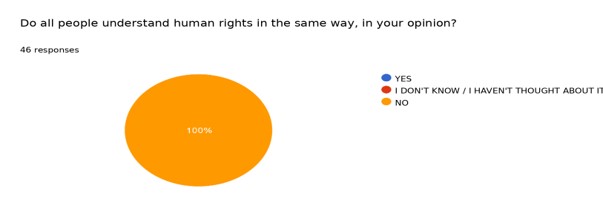
Q1) Do all people understand “human rights” in the same way?
The participants’ answers were all negative: 46 out of 46 (100%) said NO, based on both the questionnaires and the interviews.
Image1:
Q2) IF NOT.... why do you think there are differences among the views of members of a society regarding their rights?
Image 2:
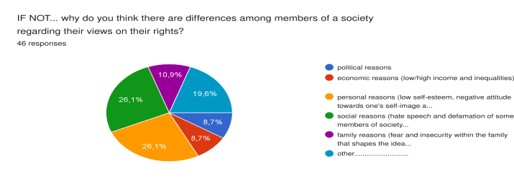
In addition to the interview questions: the prospective teachers as a group responded that the diversity that exists among members of a society is largely related to the education and upbringing they received in their families and, consequently, it is related to the development of their empathy and their prior experiences, stereotypes, and prejudices. To a less extent, they cited their political, cultural, and religious beliefs, which were consistent with their responses to the questionnaires—a fact that enhances the study’s reliability, as is typical in mixed-methods research.
Regarding the second research question— b) “Do you believe that the teacher’s role is important in fostering attitudes of ‘social justice’?”—three questions were posed:
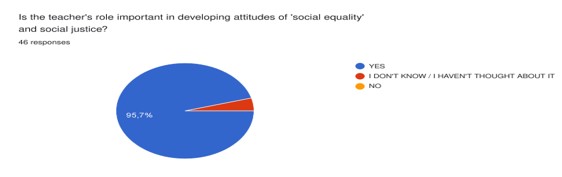
Q1: Is the teacher’s role in fostering social justice a consultive one? Is this role important?
All participants answered in the affirmative in both the questionnaires and the interviews and then indicated whether they considered this role to be important.
Image 3:
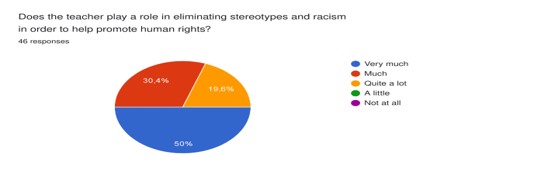
Q2: Does the teacher play an consultative role in removing stereotypes and racism in order to support equal human rights?
The participants' responses were almost positive: 100 said “Very much, Much, Quite a lot” in the questionnaires and interviews. Nobody answered negatively.
Image 4:
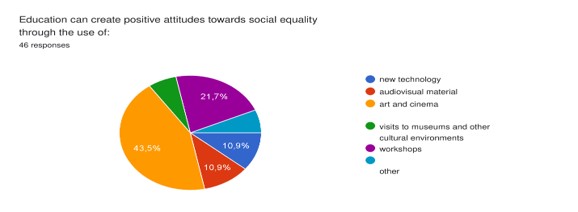
Q3: Which strategies and methods can teachers use to foster positive attitudes toward social equality and social justice?
Image 5:
The interview responses appear to be fully aligned with the questionnaire responses. All participants responded positively regarding the teacher’s advisory role in fostering concepts such as equal human rights, social justice, and the elimination of stereotypes.
Table 1: Table 1 presents representative interview responses categorized into groups:
|
|
|
|
|
The Teacher as a Shaper of Values |
The teacher is the key figure who interacts directly and meaningfully with the children. The teacher helps them develop their personalities, skills, and abilities. It is important for the teacher to instill appropriate values, attitudes, and behaviors. |
Accepting diversity and adapting educational needs—for example, through activities that put children in the shoes of minorities so they can understand the impact of racism. Also, he/she reduce stereotypes through teaching and promoting cooperation |
1. Using small groups in the classroom so that students learn to collaborate, disagree, listen, and make decisions together 2. Equal participation and learning opportunities for all 3. Projects on the topics of diversity and equality 4. Students learn to respect the opinions of others 5. Active approach to addressing conflicts and exclusion |
|
The teacher in the role of an educator who utilizes strategies |
Teachers should—if not must—identify and address phenomena of discrimination or exclusion within their classrooms, thereby creating a respectful environment where all students feel they belong |
1.Using art. Discussion of a movie or a book. 2. Activities, such as role-playing, that promote empathy. 3. The teacher should collaborate with parents and relevant organizations to organize activities 4. discussion on positive stereotypes from different cultures. |
To speak using real-life examples, to raise community awareness through role-playing, to highlight the problems and consequences of social inequality, and to provide examples of societies that thrive in an atmosphere of equality |
|
The Teacher and His or Her Teaching |
Through his/her teaching, he will promote respect, equality, and—a very difficult concept—the acceptance that it’s okay to be different! |
He/she encourages students to work together through group activities, teaching them about the positive emotions that social equality evokes. |
Teamwork, role-playing, practical exercises—perhaps through projects—and the use of transformative learning, which helps reshape ideas |
|
The Teacher and His or Her Teaching
|
The student forms stereotypes based on his or her behavior. The teacher is the primary influence on students’ minds, fostering empathy and respect for diversity. |
Screening of videos, working groups, campaigns, participation in workshops Hands-on activities, audiovisual material |
1. Utilizing discussions and activities related to diversity. 2. Promoting collaboration and the inclusion of all students in the classroom, without discrimination. 3. Using examples of social inequality from everyday life. |
|
Teacher's Personality and the Personal Example as a counselor |
It must set an example and promote equality and equal access to opportunities for all social groups, placing greater emphasis on the inclusion of everyone. |
To be free of stereotypes and prejudices that conflict with human rights, while supporting students and parents |
He/she should not hold stereotypes while he/she is teaching and estimate all children regardless of their background or economic circumstances. |
Conclusions—Discussion
This study is based on the theoretical position that it is important for the school as an institution to foster a sense of solidarity in people facing crises and to support the inclusion of all diverse students in a group that accepts all its members with mutual respect (Hytten & Bettez, 2011). Based on this premise, prospective teachers from various disciplines enrolled in the Certificate in Teaching and Pedagogical Proficiency were asked whether they believe there are differences in the understanding of the concept “human rights” among members of a social group and whether teachers can help foster social equality through their role.
Regarding the first research question, all participants responded that there are clear differences among members of a society regarding their understanding of “human rights” due to several factors, such as personal and social ones—primarily—followed by family, political, economic, and others.
Regarding the first part of the second research question, all 46 out of 46 participants (100%) responded that the teacher’s role in fostering attitudes of social equality and social justice is consultative and particularly important. The questionnaire responses are in complete agreement with the views expressed in the interviews, in which participants took a particularly positive stance toward the teacher’s consultative role. Indicative response:
‘Teachers play a vital role in mentoring their students and supporting them at every step. The same also applies to fostering positive attitudes regarding equal rights and responsibilities toward each other.’
Their responses are consistent with Farrell (2019) who emphasized the contribution of education, which, through the implementation of activities and programs, can help students understand the challenges posed by diversity in populations, thereby increasing their empathy toward various phenomena that affect the advancement of social inequality.
Regarding the second part of the two-part question, all participants responded that the teacher, to a large extent, (23 “very much,” 14 “a lot,” and 9 “quite a bit”) can utilize strategies to break down stereotypes, in agreement with Hatzisotiriou & Angelidis (2018), who argued that teachers encourage students to share knowledge, emotions, ideas, and thoughts regarding pluralism as well as marginalization and exclusion, thereby fostering an empathetic attitude.
Regarding the third part of the question, the participants argued that there are strategies teachers can use to foster supportive attitudes toward “social equality and justice,” in line with previous views that school is an educational institution that aims to foster a sense of community (Hytten & Bettez, 2011) and creates conditions of inclusion and respect for all its members. Regarding strategies, half of the participants (43.5%) chose art and film as a means of fostering positive attitudes toward social equality and helping to raise awareness of “human rights.” These responses are consistent with other researchers who have highlighted the importance of using art as an approach to foster positive emotions (Spanaki, 2026), to develop friendships (Spanaki, 2026), to recognize emotions, and to resolve conflicts and problems (Loh & Ang, 2020), as well as with other researchers (Nikkhah, 2011; Iyer-Raniga & Andamon, 2016; Şahin & Dogantay, 2018) who have emphasized the importance of the arts and film in education for developing “empathy” toward “others.” Even the interview responses align with these perspectives, as participants emphasized in their answers the value of role-playing, film, and transformative learning, as shown in Table 1.
Furthermore, a large percentage of participants’ responses emphasized the organization of workshops (21.7%). At the same time, they highlighted the use of audiovisual materials (10.9%) and new technologies (10.9%), in line with (Nikolaou, 2011), who noted that methods and techniques—such as group collaboration, the Project method, the use of new technologies, and experiential learning—contribute to combating discrimination and foster concepts such as solidarity, respect, and acceptance of diversity.
Based on their responses during the interviews, the participants appeared to support the value of teamwork and the implementation of group-based collaborative and experiential learning, in line with the findings of Lobato et al., 2010, Marin-Garcia & Lloret, 2008 etc. They supported also the use of project and the organization of workshops as strategies related to removing stereotypes, fostering concepts such as social equality and rights, and cultivating “empathy” and inclusivity, as presented in Table 1.
Undoubtedly, the participants in this study claim that not all members of a society share the same position on social justice and equality also, do not view “human rights” from the same perspective. All of them support the power of education and agree that teachers play an important consultative role in fostering feelings and attitudes of social justice, eliminating stereotypes through the strategies and methods they employ.
This research is a case study and is subject to the limitations typical of such studies. Nevertheless, the participants are prospective educators, and their attitudes and views make it clear that educators need information and training regarding their role in promoting social equality and justice and in supporting their students in understanding the concept of human rights.
In conclusion, however, the teacher’s consulting role appears to be significant in terms of the support they provide to their students to help them understand concepts such as equal human rights, social justice, and the elimination of stereotypes. It would be important to explore students’ views in the future regarding strategies that help reduce stereotypes.



Open Access By Aditum Open Access Journals id licensed under Creative Commons Attribution 4.0 International License. Based On a Work at aditum.org


