The Journal of Social and Behavioral Sciences
OPEN ACCESS | Volume 4 - Issue 3 - 2026
ISSN No: 3065-6990 | Journal DOI: 10.61148/3065-6990/JSBS


Akim M. Rahman, Ph. D1*, Dr. Momtaz Begum2
Dr. Momtaz Begum University of Science and Technology (MUST), Bhairab, Kishoreganj, Bangladesh. https://must.ac.bd/academic/
*Corresponding author: Akim M. Rahman, Dr. Momtaz Begum University of Science and Technology (MUST), Bhairab, Kishoreganj, Bangladesh. https://must.ac.bd/academic/.
Received: October 18, 2026 | Accepted: October 30, 2026 | Published: November 12, 2026
Citation: Akim M. Rahman, Dr. Begum M. (2026) “Whether Economics Instruct Innovation or Vice Versa: A Cross Examination of Voluntary Insurance as a Product in Bank-led Digital Banking Services?” The Journal of Social and Behavioral Sciences, 4(3); DOI: 10.61148/3065-6990/JSBS /095.
Copyright: © 2026 Akim M. Rahman. This is an open access article distributed under the Creative Commons Attribution License, which permits unrestricted use, distribution, and reproduction in any medium, provided the original work is properly cited.
In today’s world, the relationship between innovation and economics has become significant no matter what economy or society we talk about. This study advances for answering the question posted in the title. Accordingly, it examines the influence of emerging technologies, globalization, and shifting geopolitical scenarios on innovation and progression in economics. From the Consumer Choice Theory, economics-forces act in a dynamic loop: economics instructs consumer constraints and demand, which drives innovation, while innovation reshapes consumer preferences and expands growth in economy of a country. About Voluntary Insurance (VI) in bank-led digital banking services evaluate how risk-averse individuals make security & financial decisions by balancing personal efforts against perceived cyber and transactional risks. It models total utility as a combined function of personal awareness, self-protection investments, and legal or institutional safety nets where VI can be a new product in economy. If VI policy were in place, it could have ensured absolute risk-free digital-banking and its progression could have ensured cashless society soon. This study contributed to a comprehensive understanding of the complex interplay between economics and innovation in today’s world. Thus, the role of digital transformation in driving growth of economy and innovations cannot be ignored. Accordingly, VI should be an innovation where people’s ongoing behaviors, preferences, satisfaction, self-interest etc. influence VI policy adaptation in digital-banking services.
Economics, Innovation, Voluntary Insurance (VI) as an innovative product, Bank-led Digital-banking Services, Risk-free digital-banking services, Cashless human society soon
1. Introduction
Today’s world has witnessed rapid technological advancements where lifestyles of people are directly or indirectly connected to each other. It has shifted global dynamics and evolved consumer demands for new products in markets. It generally refers to activities like "new era of innovation, human behaviors & nation’s policies, which are linked to people’s knowledge in subject areas of Microeconomics and Macroeconomics". Here Microeconomics delas with human behaviors and Macroeconomics deals with performance & roles of an economy (Rahman, 2019; Anderson G.J. et. al., 1982).
More specifically, Macroeconomics deals with the economy, focusing on large-scale economic factors and economic aggregates rather than individual markets or single consumers. It focuses on total output (i.e., GDP), inflation, unemployment, economic growth etc. where relevant policymakers engage in completion the tasks underpinning assessment of current situation for better-ness of the nation. On the other side of the coin, Microeconomics deals with the economic behavior and decision-making of individual units, such as consumers, households, workers, and businesses, as they interact in specific markets. Here core focus areas are individual choices, supply & demand, market structures and cost & profit. Firms or individuals here decide what to produce and how to maximize their profits.
Thus, it raises questions: what is economics? How does it work in today’s human society?
The definition of economics is what an economist does where everyone is an economist in his or her domain. As for example, a mother feeds her baby when baby cries. Baby cries because baby is hungry and asking for food. That is the best choice the baby has or able to make and accordingly baby makes demand for it to maximize the baby’s satisfaction. Baby’s crying makes the mother hurt and gets pain because of the two’s biological bonding. For relieving mother’s pain, mother runs and feeds the baby. In some cases, mother gives toys to the baby with the aim of keeping the baby quiet and then mother can do her thing(s) in priority. With these economics-driven behaviors or efforts, both are benefitted and become winners where babies have created an innovative idea “crying for getting services”. On the other side, the mother has innovatively tried marginalizing her pain by addressing baby’s crying by rearranging mother’s tasks on priority basis for maximizing her satisfaction.
All these activities, efforts, actions & reactions are economics driven behaviors in today’s human society where an individual does it to fulfil the individual’s demands or needs (Goss T. et.al., 1993). This is because economics studies how people, businesses, and governments choose to use limited resources like time, money, and materials to satisfy endless wants and needs. Economics, particularly Microeconomics deals with human behaviors.
From what has laid out above as a foundation, it is desirable to present a clear framework of what is, in our view, the relationship between innovation and economic behavior(s) that create or add up to innovation in today’s world. It will answer the question(s) posed in the title of this study. Accordingly, this study advances with an example in literature – the Voluntary Insurance (VI) Proposal in bank-led digital banking services (Rahman, 2017; 2018). It is known as "Akim's Model”, which proposes introducing user-purchased insurance policies directly into bank-led and mobile-led electronic banking applications to protect everyday users from transaction risks. However, no country has yet introduced proposed policy, but countries want to ensure cashless society eventually for the interest of human society.
2. VI in Bank-led Digital Banking Services Can Ensure Cashless Society: Importance of the Study
Voluntary Insurance (VI) in digital banking services is an academic and policy framework introduced by Akim M. Rahman. It is known in financial literature as "Akim's Model," which proposes introducing user-purchased insurance policies directly into bank-led and mobile-led electronic banking applications to protect everyday users from transaction risks. Under Akim’s model (Rahman, 2018), it is a conceptual framework designed to eliminate perceived risks and boost user adoption in bank-led digital and e-banking services. By offering a low cost, optional insurance product for digital transactions, the model aims to protect users, increase transactions volume, and accelerate the shift toward a cashless society.
VI can address factors that undermine growth-trends of bank-led digital banking services
Traditional banking frameworks—such as the Federal Deposit Insurance Corporation (FDIC) in the United States—protect consumer deposits against bank failures, but they do not insure individual on-the-go digital banking transactions against e-banking pitfalls. This gap exposes customers to multiple dimensions of "perceived risk," including:
How Does Akim’s Model Work?
Instead of relying on blanket government mandates or leaving customers to bear 100% of e-banking transaction risks, Akim's Model shifts the vulnerability away from consumers through a commercial setup:
How can VI be functioning in economy?
Referring to the factors that undercut today’s bank-led e-banking progression in Thailand, adopting effective policies based on the theme - VI in e-banking services (Rahman, 2018; 2023) can help. After adopting relevant policies, the financial sector in economy can introduce VI as a product in service-market. And accordingly, the bank itself can collect premiums.
In the e-banking market under the VI model, the customer’s participation i.e., buying it or not buying it is voluntary. So, when the policy is in place, underpinning the provision(s), a bank account will attach or connect with insurance, if the accountholder wants it when s/he signs up to use e-banking services. If the accountholder does not want the VI services, the accountholder still has full access to use e-banking services. Once the policy is in place, like any other insurance program in operation, the bank will ensure premium payers with a sense of certainty under a program approved by the Central Bank. Here the bank, the premium receivers, will be responsible for taking extra measures to ensure risk-less e-banking. e-banking Service-market with Voluntary Insurance as an option.
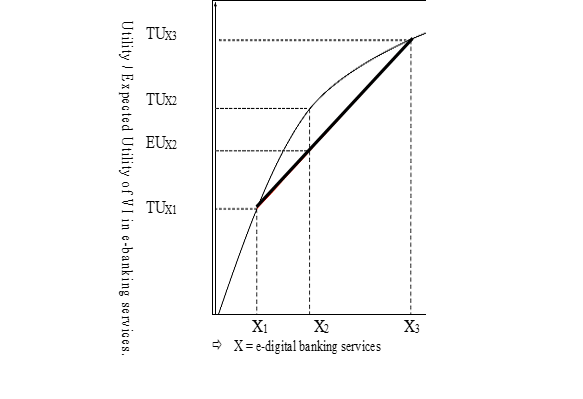
The perceived-risk factor here contributes significantly for preparation so that the VI policy can be introduced in e-banking service-market in economy country-wise such as Bangladesh. It is well recognized that using banking services, customers and probable customers prefer certainty to uncertainty. Figure 1 shows risk preferences of risk-averse banking customers.
|
Fig. 1: A case of risk-aversion in Digital Banking Services in Financial Sector Source: Rahman, Akim (2018)
|
In any uncertainty-world, the utility of using e-banking services by a customer will be on the cord – the bold line but not on the TU (X) line in Fig 1. Here (X3) stands for outcome of digital services where a customer may prefer using a certain level of service X. The (X1) stands for dissatisfactory level of digital service outcome where a customer may not or may use little digital service say X level in Fig 1. Because it represents customers’ dissatisfaction. If there is a level of uncertainty, a customer may not use (X3) units of digital-service X. Thus, the utility that this customer receives will lie somewhere on the chord (the bold line), which means nowhere outside of the bold line. |
The cord (the bold line) stands for the expected utility (EU) of using service X, which lies in the concavity of the curve. It represents the average probability whether the customer uses digital-service X or not. Consequently, the customer will not ever receive TU (X3) but will receive the EU (X3).
Market Demographics & Global Applications
Akim M. Rahman (Rahman, 2017; 2018; 2022) has adopted this model to evaluate the readiness of various regional economies transitioning toward a cashless society:
Despite growing academic analyses in multi-faucets and solid SWOT & PESTLE positioning (Rahman, 2026a; 2026b), no country has yet officially mandated or integrated Voluntary Insurance as a standard operational choice across commercial digital banking applications yet.
3. VI is "Voluntary Insurance" (Risk-Mitigation Product): How Can It Contribute?
In many developing and digital-forward economies, e-banking transactions are not legally insured by state-backed Deposit Insurance Systems (DIS), which only protect against whole-bank bankruptcy. This leaves users exposed to cyber fraud, phishing, and account hacks, creating a massive "perceived risk" that slows down digital adoption in country-wise economy.
Accordingly, when policymakers will actively encourage or regulate Voluntary Insurance (VI) inside banking apps, it will drive societal innovation in three clear ways:
[State Mandate / Sandbox] ➔ [Eliminates Customer Risk Panic] ➔ [Mass Trust & Cashless Transition] ➔ [Sustained Product R&D]
Systemic Trust Drives Product Evolution: By absorbing consumer panic over digital hacks, VI will facilitate or create an "absolute risk-free" environment. When millions of risk-averse citizens confidently flood the digital ecosystem, banks will gain the massive transaction volumes needed to reinvest in advanced, multi-tier financial products.
Encouraging Dynamic Pricing Models: Policymaker frameworks (like regulatory sandboxes) will allow Insurtech companies to design micro-insurance algorithms. Instead of flat fees, the VI product will innovate by offering variable, real-time premium pricing tied dynamically to the safety score of a user’s transactional behavior.
The Catalyst for a Cashless Society: True societal transformation will happen when cash-reliant demographics switch to mobile banking. Studies on the economics of VI show that prompt policymaker adoption will directly address psychological barriers, acting as a baseline metric for accelerating a cashless human society.
4. Why Can Policymakers’ Efforts Stifle Innovation (The Risks)?
Government intervention
Government intervention is a double-edged sword. If efforts are poorly executed, they can actively kill VI innovation:
i. Over-Regulation: Capping the profitability or pricing models of Voluntary Insurance too strictly will make it unappealing for banks to manage, causing them to pull the product from the market.
ii. Laggard Legal Frameworks: If policymakers take years to codify what constitutes a "valid digital claim" for cyber fraud, agile Insurtech startups will run out of capital before their products can be legally scaled.
Summary Matrix
|
VI Interpretation |
Policymaker’s Role |
Direct Impact on Society |
|
Voluntary Insurance |
Legitimizes cyber-theft coverage and builds frameworks to eliminate transaction risks. |
Removes consumer panic, stabilizing the growth trend toward a completely cashless society. |
|
Voice / Virtual Intelligence |
Mandates security standards, data privacy laws, and financial inclusion |
Accelerates complex, multilingual voice banking for the unbanked and elderly populations. |
Focus on financial risk mitigation (insurance)
Yes, according to the economic framework of Akim’s Model, policymakers’ efforts to adopt Voluntary Insurance (VI) as a new product in bank-led digital banking services will be the definitive preconditions to ensure continuous innovation and secure a cashless human society While banks build the transactional infrastructure, current global banking laws do not inherently insure individual digital transactions against e-fraud, phishing, or system disputes. Policymakers' proactive adoption of a legal & regulatory framework for VI is what transforms a volatile digital banking environment into an "absolute risk-free" service market, triggering a domino effect of societal and product innovation.
5. Innovation & Growth Cycle Driven by Policy Adoption
When policymakers legally codify and support the integration of VI into digital banking ecosystems, it will unlock a predictable S-curve growth trend for financial technology
[Policy Framework Adoption]
⬇
[Eliminates Customer "Perceived Risk" & Panic]
⬇
[Mass Digital Banking Adoption (S-Curve Accelerated)]
⬇
[Surplus Revenue & Data for Banks]
⬇
[Continuous FinTech & VI Product Innovation]
i) Eliminating the "Perceived Risk" Bottleneck
The greatest barrier to digital banking innovation is not technological, but psychological. Under Akim's Model, consumers experience Perceived Risk (PR) driven by
By establishing a clear policy path for a low-cost, optional VI mechanism attached directly to user accounts, policymakers give consumers a sense of certainty. This transitions hesitant demographics (particularly across diverse age and education groups) into active digital consumers, creating the massive user base required to sustain innovation.
ii) Generating the "Win-Win" Revenue Engine for Banks
In banking, if there is no new value to offer, institutions eventually wilt and stagnate. VI introduces a high-margin secondary financial product that generates a reliable, new revenue stream for the bank-led ecosystem
iii) Accelerating the Transition to a Cashless Society
A truly modern, resource-efficient human society requires reducing its reliance on physical, resource-heavy transaction models. Research evaluating digital banking trajectories in emerging economies—such as Bangladesh, Vietnam, Thailand, Pakistan, and the UAE—repeatedly concludes that VI policy adoption is the missing bridge to a stable cashless society. Policymaker intervention validates the product legally, establishing systemic trust that speeds up the growth trend of digital transactions country-wise.
6. Potential Obstacles to Policy-Led Innovation
While policymaker effort is a catalyst, it can fail to ensure innovation if it does not address specific execution vulnerabilities:
Summary: Policy as the Ultimate Precondition
Policymakers cannot physically program or invent the next iteration of FinTech. However, by adopting the legal frameworks necessary for Akim's Model of Voluntary Insurance, they can provide a safety net that turns consumer panic into institutional trust. This safety net is an absolute engine that can ensure the long-term, self-sustaining innovation of VI products across human society. Accordingly, this section advances with SWOT Analysis and PESTLE Analysis.
SWOT Analysis of Implementing the VI in Bank-led Digital Services
The SWOT analysis of implementing VI evaluates the internal mechanics and external environments of commercial banks integrating optional, user-paid transaction insurance into their digital banking frameworks.
The structural components of this SWOT framework break down as follows:
Strengths (Internal Capabilities)
Weaknesses (Internal Vulnerabilities)
Opportunities (External Market Advantages)
Threats (External Risks)
PESTLE Analysis of Voluntary Insurance as a New Product in Digital Banking Services
A PESTLE analysis is used to help businesses look at the big picture and understand the outside forces that can affect their success or failure.
PESTLE Analysis of VI in Bank-led Digital Banking Services
7. Demonstration How a Low-cost VI Product Creates Systemic Stability Simulating Economic Framework Underpinning Akim's Model Assumptions
The fundamental goal of a policymaker is to avoid pure monopoly pricing (which maximizes bank profit but shrinks adoption) and instead find the Social Welfare Maximum—where high customer adoption meets stable bank profits.
Simulation Baseline Assumptions
Economics directly instructs, shapes, and directs innovation by defining the incentives, rules, and market conditions that dictate which current ideas succeed, fail, or get funded (Mullainathan et.al., 2017). While scientists and engineers create inventions (the technical proof-of-concept), economic forces dictate innovation (the practical commercialization and widespread scaling of those inventions (Mullainathan et.al., 2017).
The intersection of economics and innovation can be broken down into specific economic drivers:
i) Market Incentives Determine Direction
ii) Institutions and Legal Frameworks
iii) Strategic Government Interventions
Advance Market Commitments (AMCs): Governments can explicitly instruct innovation by guaranteeing a buyer market for products that do not exist yet. For instance, a historic $1.5 billion vaccine commitment successfully incentivized pharmaceutical firms to develop life-saving pneumococcal vaccines for developing nations. (Gail L Rodgers and Keith P Klugman, 2016).
Despite growing academic analysis and solid SWOT positioning, no country has officially mandated or integrated Voluntary Insurance as a standard operational choice across commercial digital banking applications yet.
iv) Strategic Government Interventions
Economics does not directly command or invent innovation. But individuals’ behaviors, i.e., microeconomics deals with individuals’ behaviors and these behaviors produce ideas for maximizing individual’s benefits, satisfactions and marginalizing costs by adding ideas, or inventing products or new services. For further clarity, microeconomics behaviors based on forces and structures heavily shape, incentivize, and direct where innovative efforts go. Market demand, funding availability, competition, and cost-benefit rules act as guideposts that dictate which innovative ideas get explored and commercialized, and which ones get left behind.
8. How Economics Drives Innovation (Demand-Pull)
Consumer Choice Theory posits that individuals allocate scarce resources (income) to maximize satisfaction (utility) based on prevailing prices and preferences (Rahman, 2019). The economy shapes this process in several ways:
Budget Constraints: When the economy slows or inflation squeezes into purchasing power, consumers limit spending. This scarcity along with consumers’ ideas and firm’s efforts force firms to innovate to lower production costs, creating more affordable and efficient goods that fit revised budgets.
Income Shocks: As real incomes rise, consumer preferences shift toward higher-quality or more specialized goods. Innovators and entrepreneurs are motivated to enter the market or adapt products to capture this new consumer surplus.
Price Signals: If the broader economy makes certain inputs expensive (e.g., high energy costs), consumer demand for alternatives spikes. This prompts firms to innovate in cheaper technologies (like renewable energy) to satisfy market demands while restoring profit margins
9. How Innovation Drives the Economy (Supply-Push)
Conversely, innovation actively disrupts and expands the economy by altering the fundamental terms of consumer choice (Rahman, 2019):
New Indifference Curves: Breakthrough innovations (e.g., the smartphone, electric vehicles) do not just meet existing needs; they create new markets. They shift the consumer's indifference curve outward, offering entirely new bundles of goods that provide higher levels of utility.
Changing Relative Prices: Innovation drastically reduces the cost of once-expensive goods (e.g., computers, solar panels). This triggers the substitution effect, where consumers shift their spending away from outdated technologies toward the newly innovated, cheaper products.
Economic Growth (GDP): By increasing productivity and creating new industries, innovation expands the overall economic pie, generating new jobs and raising the general standard of living, which gives consumers more income to spend.
10. The Feedback Loop
Ultimately, the economy determines what can be afforded, translating scarcity into "demand-pull" innovation. That innovation then redefines how we live, lowering costs and creating new desires to create "supply-push" economic growth. Together, they form an interdependent cycle that fuels long-term market evolution (Anderson et.al. 1982).
Here is how the Consumer Choice Theory framework applies to the proposed VI as an innovative product in today’s digital banking services for ensured absolute risk-free digital banking services in economy (Basmann, 1956).
Digital Technology: Reshaping the Utility Function
[Income Rise / Tech Literacy] ──> [Desire for Convenience] ──> [App / Platform Innovation]
▲ │
└───────────── [New Indifference Curves / Markets] ◄────────────┘
Shift in Indifference Curves: Before smartphones or streaming platforms, consumers balanced budgets between physical media (CDs) and landline services. Innovation introduced entirely new product bundles. This shifted consumer indifference curves outward, allowing them to achieve much higher satisfaction (utility) from instant, on-demand digital access.
Network Externalities: In digital markets, an individual's utility increases as more people use digital banking services. This creates a powerful demand loop: economic adoption increases the product's perceived value, forcing continuous software innovation to retain users.
11. How does Innovation Drive Economy?
Innovation drives the economy by drastically increasing productivity, creating entirely new industries, and boosting global market competitiveness. It functions as a cycle where modern technologies or methods render older models obsolete a process known as creative destruction—resulting in a higher overall standard of living and long-term financial expansion.
Direct Impacts on Economic Structures
|
Economic Pillar |
How Innovation Transforms It |
Real-World Example |
|
Labor Market |
Replaces repetitive tasks to free workers for higher-value, creative decision-making roles. |
The transition from physical assembly lines to automated software development and digital marketing roles. |
|
Sustainability |
Shifts production models from linear to circular systems, decoupling growth from environmental waste. |
The massive expansion of the electric vehicle industry and scalable battery storage solutions |
|
Entrepreneurship |
Democratizes vital digital tools, empowering small startups to seamlessly compete with legacy conglomerates. |
Small business owners managing global logistics and reaching international buyers using localized e-commerce platforms. |
Key Pathways of Innovation-Driven Growth
Productivity Gains: Companies utilize automation, AI, and improved workflows to produce more high-quality goods at much lower costs.
New Market Creation: Radical breakthroughs construct fresh industries out of thin air, giving birth to brand-new consumer demands and career paths.
Industrial Structure Upgrading: Outdated industrial processes are replaced by advanced sectors like robotics, cloud computing, and green technology.
Global Competitiveness: Countries that pioneer innovative tech secure better footing in global trade networks and pull in massive foreign direct investments.
Answering the question posed, this study advanced theoretically to cross-examine whether innovation derives, or economy drives innovation in economy country-wise such as Bangladesh.
12. Conclusion
This study explored and analyzed the intricate connection between innovation and economics within the context of the new world where bank-led digital banking services will be absolute risk-free services. By examining relevant literature and case studies of VI as an innovative product in digital banking services, this study investigated how economics derived innovation, derived economic growth, enhanced competitiveness, and shaped socio-economic dynamics. Furthermore, it examined the influence of emerging technologies, globalization, and shifting geopolitical scenarios on innovation and progression of human activities underpinning theme of economics, particularly microeconomics. Through an interdisciplinary approach, this study contributed to a comprehensive understanding of the complex interplay between economics and innovation in the new world order. The role of digital transformation in driving economic growth and innovation cannot be ignored. Businesses that effectively leverage digital technologies are more likely to experience growth and stay competitive in the market. Thus, the role of digital transformation in driving growth of economy and innovations cannot be ignored where roles of human behaviors, preferences, satisfaction, self-interest etc., cannot be underestimated when it comes to the idea of innovation. Accordingly, VI can be an innovation where people’s behaviors, preferences, satisfaction, self-interest etc., have been influencing having the VI product in bank-led digital-banking services.



Open Access By Aditum Open Access Journals id licensed under Creative Commons Attribution 4.0 International License. Based On a Work at aditum.org