
The Journal of Social and Behavioral Sciences
OPEN ACCESS | Volume 3 - Issue 5 - 2026
ISSN No: 3065-6990 | Journal DOI: 10.61148/3065-6990/JSBS


Younes Zhiri*, Aya Tajmouati, Chaymae Taib, Oumaima Rass
ENS, Moulay Ismail University.
Corresponding author: Younes Zhiri, ENS, Moulay Ismail University.
Received: August 01, 2026 | Accepted: August 22, 2026 | Published: August 31, 2026
Citation: Zhiri Y, Tajmouati A, Taib C, Rass O., (2026) “Investigating Phonological Awareness in Moroccan EFL Teacher Education: Competence, Perceptions, and Training Gaps” Journal of Social and Behavioral Sciences, 3(5); DOI: 10.61148/3065-6990/JSBS/071.
Copyright: ©2026. Younes Zhiri. This is an open access article distributed under the Creative Commons Attribution License, which permits unrestricted use, distribution, and reproduction in any medium, provided the original work is properly cited.
This study explores the perceived significance and relevance of phonological awareness (PA) of EFL pre-service teachers at Moroccan teacher training centers, CRMEF or “Centre Régional des Métiers de l’Éducation et de la Formation”. The study assesses the PA proficiency of the trainees, identifies their phonological challenges and their readiness to teach/use PA knowledge in their prospective classrooms. A quantitative, exploratory, cross-sectional design was followed with 62 participants from several centers across Morocco. A 27-item PA test was performed in phonetic, phonemic, and suprasegmental domains, and a structured questionnaire was administered assessing attitudes, confidence, and perceived pedagogical relevance of phonology. Descriptive analyses in SPSS indicated low to moderate PA levels, with some relative strengths in phonemic awareness but significant issues for suprasegmental features. Respondents highlight that the focus on PA instruction was limited in teacher training centers. Although phonology plays a key role in teaching pronunciation and basic language skills, many trainees were less confident in the use of PA in practice. This suggests that more explicit, practical, and integrated PA instruction should be implemented in Moroccan EFL teacher education to equip pre-service teachers with the skills to teach effectively.
phonological awareness, phonemic awareness, suprasegmental features, pre-service EFL teachers, teacher training programs
Language is a complex and multifaceted system that underpins the communication process of humans as we communicate thoughts, emotions, feelings, and information in different situations. Its flexibility and structured nature are bound up in certain rules and patterns that guide the organization and interpretation of sounds, words, and sentences (Vaillant, 2024). Phonological awareness (PA) is the process of segmenting spoken language into phonemes, syllables, onsets, and rimes, essential skills for the accurate perception and processing of speech (Anthony & Lonigan, 2004). PA is not innate but must be developed through structured instruction and consistent practice. It is an important aspect of language that can be developed through the process of learning to understand, hear, and interpret the language in a systematic manner. This suggests that learners require targeted support and repeated opportunities to recognize and manipulate the sound structures of language effectively (Tibi, 2010).
In EFL pedagogically oriented teacher training programs, such as those offered at CRMEF in Morocco, PA is essential to equip prospective teachers with the foundational linguistic skills necessary for effective teaching. However, many teacher education programs in non-English-speaking contexts do not pay attention to this aspect, which is likely to impact teachers’ ability to teach core language skills in the future. Pre-service teachers with little PA will not be able to accurately identify and correct students’ pronunciation and phonological errors. Recent studies on PA in teacher education have predominantly focused on native English environments (Washburn, Joshi, & Binks-Cantrell, 2011), which is a major gap in the knowledge of how EFL pre-service teachers in multilingual and non-native environments, such as Morocco, learn and employ these skills in the field. This gap is a key aspect of developing training programs that are contextually relevant to future teachers so that they can build practical teaching competencies.
Within its scope and context, this study investigates how PA is used to support the preparation of future EFL teachers and how it can be applied in the context of teaching. In addition to the assessment of those expectations, the study assesses pre-service EFL teachers' PA levels and how confident they are about integrating phonological aspects into teaching. Aligned with these aims, the study is guided by the following research questions:
Before answering these questions, a thorough examination of previous research on PA is required, focusing mainly on the way it helps develop language skills and how it is integrated into teacher education.
1. Review of the Literature
PA has become an important focus in research on early language and literacy development because it strongly predicts the acquisition/ learning of key skills such as reading, spelling, and speaking. Defined as the ability to recognize and manipulate the sound structures of spoken language (National Reading Panel, 2000), PA plays a key part in decoding written words and spelling the right way, as well as in supporting good pronunciation and oral fluency. As a metalinguistic skill, there are a number of subskills that can be incorporated, such as awareness of larger sound units (syllables and onsets), manipulation of individual phonemes (phonemic awareness), and perception and production of sound changes in connected speech. The importance of PA is more pronounced in alphabetic languages in which the relationship between sounds and letters is essential for literacy and oral language development.
Building on this understanding, Anthony and Lonigan (2004), Schuele and Boudreau (2008), and Tibi (2010) define PA as the ability to analyze and manipulate the sound structure of language at many levels (phonemes, syllable, and word), with phonemic awareness (PMA), a subset of PA, being the segmentation and blending of some individual sounds (phonemes) in spoken words. On the other hand, phonics refers to how these sounds are represented in written language in terms of letters and spelling patterns (Ehri, 2005). These differences show that PA is a metalinguistic system with multiple layers of sound processing. Learners must develop phonemic awareness through the ability to read and write phonetically first before they can effectively use phonics in reading and spelling.
PA should also be considered as a consciously learned skill that allows individuals to monitor, reflect on, and manipulate the sound structure of a language. This enables accurate decoding and fluent word recognition. PA is something that needs to be learned and developed at a systematic level through targeted instruction and practice (Tibi, 2010). As Mayer (2005) points out, PA incorporates blending different sounds to make words (e.g., /k/ + /æ/ + /t/ = cat) as well as segmenting spoken words into their component phonemes (e.g., ship → /ʃ/ + /ɪ/ + /p/). These are seen as essential building blocks in early reading and spelling skills.
PA can be understood through two dimensions: The size of a linguistic unit and the level of explicit cognitive operations, which together describe how learners perceive, analyze, and manipulate speech sounds. The first dimension, the size of a linguistic unit, refers to the level of sound segments, which learners can perceive and manipulate, ranging from syllables to onsets and rimes and finally to individual phonemes (Lonigan, Burgess, & Anthony, 2020). At the broadest level, syllable awareness is about recognizing and manipulating whole syllables in words; for example, a learner can recognize that window consists of two syllables: win and dow. Because syllables are larger and more perceptible, they are generally easier to identify (Anthony Burgess, & Lonigan, 2019). Learners typically develop onset and rime awareness and differentiate between the initial consonant or consonant cluster (e.g., br, the onset) and any following vowel sound or consonant group (e.g., ead, the rime). The most advanced level is phoneme awareness, including recognition of sound changes, that learners isolate and manipulate in words and connected speech (Hulme & Melby-Lervåg, 2019).
The second dimension of PA is the explicitness of cognitive operations that reflect learners' care for sound structure and the complexity of the tasks involved. These cognitive operations typically go from simple recognition to more complicated mental manipulation. From the beginning, identification allow learners to recognize a certain sound in a word without studying its internal structure, such as learning that cat starts with the /k/ sound. Segmentation requires learners to break words into individual phonemes /k/, /a/, /t/, while blending involves combining phonemes to form a complete word as in cat from /k/, /a/, and /t/. The most sophisticated strategy entails altering phonemes within words, i.e., remove /k/ from cat to produce at, demonstrating deep understanding of sound structures and considerable cognitive effort (Adams, 1990). These skills develop progressively, supporting accurate pronunciation, fluent speech, and foundational literacy abilities, including reading and spelling (Hulme & Snowling, 2021).
1.1. The Role of PA in Developing Language Skills
PA plays a vital role in the development of core language skills, including speaking, pronunciation, reading, listening, and writing (Asiyah & Maghfiroh, 2021; Fakhir, 2014; Zhiri, 2023). It is well established that PA has a strong influence on reading skills, and the ability to form proper speech, decode and encode written language, and process spoken information more efficiently. These skills are fundamental to language learning and are further strengthened by the learners’ understanding of the sound structure of language.
Reading, as a key skill, is often based on a learner’s ability to perceive and manipulate the sounds in spoken words. This relies on the reader’s understanding of how letters represent sounds, the alphabetic principle, and awareness of the sound structure of spoken language (Snow, Burns, & Griffin,1998). While PA is one of the most important foundational skills to develop reading, phonemic awareness (PMA) plays a critical role in the assessment and manipulation of the smallest units of sound as phonemes. A student who has good PMA might break the word book into the sounds /b/, /ʊ/, and /k/ and then combine them to read the word correctly. It is a skill to read written words to the best of their ability (Schuele & Boudreau, 2008).
Research consistently finds that children with good PMA of letters and sounds are more successful in learning to read as they can match letters to sounds and use this ability to decode unfamiliar words. For instance, when a child sees the word ship, PMA enables them to recognize that the letters sh represent the sound /ʃ/, distinct from the separate sounds /s/ and /h/ (Melby-Lervåg, Lyster & Hulme, 2012). Instruction that includes PMA activities (e.g., finding the first or last sound in a word, segmenting sounds in a single word, substituting one sound for another (e.g., replacing the /h/ in hat with /b/ to form bat and so forth) has been found to improve reading and spelling outcomes. These activities are most effective when accompanied by the teaching of letter-sound correspondences (National Reading Panel, 2000). Without enough phonemic awareness, learners may struggle to decode new words. This of course creates barriers to reading fluency and comprehension. A child/learner that cannot distinguish between /b/ and /p/ might just confuse words like bat and pat, resulting in inaccurate word reading and disrupted understanding of the text. Therefore, strong PA and PMA is key for early reading success.
Listening, a skill dependent in part on PA, is typically the learners' first language skill to develop. While traditionally focused on reading, PMA's contribution to listening comprehension has recently grown in importance (Rost, 2011). Effective listening involves decoding auditory information and combining small units of spoken language into more meaningful larger chunks. A meta-analysis conducted by Choe, Lee & So (2020) of eight studies on the effects of PA intervention on second language listeners' comprehension showed a large overall effect size (Hedges' g= 0.99), taken as evidence that listeners' abilities were boosted significantly.
PA is obviously related to speaking because it helps with both the perception and production of sounds in spoken language. The accurate identification, segmentation, and blending of sounds at phonemic level help the learners produce speech that is fluent, intelligible and naturally patterned. For instance, segmenting a multisyllabic word like umbrella into syllables and stress patterns is a case whereby learners are aware that these parts carry meaning in the spoken language. These help with accurate rhythm and Fluency. Similarly substituting sounds as in changing /m/ from moon into /sp/ in spoon is another illustration of awareness of the relation between different sounds. These are all fundamental to pronouncing sounds accurately, especially in English, where a change of just one sound may lead to a different meaning. Therefore, confidence is increased, and the clarity of communication is greatly enhanced.
A Growing body of research supports that PA is crucial to speaking ability (e.g., Hentasmaka et al., 2022; Naeem & Khan, 2024). When learners realize that the word plant begins with the consonant cluster pl rather than only /p/ or ends with nt cluster rather than only /t/, they are more apt to articulate this appropriately and to avoid pronunciation error. According to Gillon (2004), awareness of phonemes helps learners to easily distinguish and reproduce similar sounds, as well as enhance the fluency and the clarity of the language. Yopp and Yopp (2009) also emphasized that PA plays a significant role as the foundation of oral language development as it allows learners to understand how speech is structured into sounds, syllables, and stress- not just written letters. Unless learners are aware, they will have difficulty blending and segmenting sounds which will reduce fluency and accuracy of spoken language (Masoud & Ibrahim, 2018).
The value of PA is particularly evident in environments where learners face limited immersion or low speaking confidence. Ratnasari (2020) found that many learners hesitate to speak due to fear of errors or misunderstanding. That is why PA intervention provides an easy and practical technique to make their pronunciation more accurate and their confidence higher. When learners learn to chunk the word comfortable into appropriate stress and syllable patterns, they have more control over the spoken word and feel less hesitation when they communicate. As they internalize how sounds function, learners monitor and adjust their speech, achieving greater clarity and fluency.
Phonological knowledge underpins clear spoken output and comprehensible listening, allowing learners to improve pronunciation and to self-correct errors (Asiyah & Maghfiroh, 2021). Accurate pronunciation still forms one of the key components for communicative competence and evaluation of language proficiency. Even if learners can master complex grammar and have a wide vocabulary, they cannot communicate effectively without accurate pronunciation. Many empirical studies support this relationship, such as Derwing and Munro (2005) who show that learners with explicit skills in PMA pronounce L2 language with more accuracy and have fewer foreign accents, while Kivistö de Souza (2015) points out that phonemic awareness accounts for 33% of the variance in pronunciation ability. These findings underscore PA’s role in shaping the natural rhythm, intonation, and stress patterns of fluent and natural communication.
Writing, regardless of its genre or purpose, is a fundamental language skill that uniquely provides learners with extended time for reflection and language processing. Producing a coherent and cohesive piece of writing inevitably requires PA. Research consistently shows a strong positive correlation between PA and the development of writing skills (Catts et al., 2002; Torgesen & Wagner, 1998). A descriptive study by Erdogan (2011), involving first-year primary school students, further highlighted that PA training during preschool is essential. This early intervention enables students to benefit more effectively from formal writing instruction and to move smoothly and comfortably into writing tasks.
Phonics is a method that teaches learners the relation between speech sounds and the letters or letter combinations representing those sounds in written form to achieve spelling accurately. For instance, a child/learner who hears the word phone is able to recognize that the 'f' sound is spelled 'ph' in this case and not 'f'. This makes young learners become aware that phonics extends beyond simple one-to-one sound-letter matches. This process encourages young writers to engage with the phonological structure of language and make conscious spelling decisions that reflect accurate sound-symbol correspondences (Emmitt, Hornsby, & Wilson, 2006). Unlike the phonics approach being taught in individual drills isolated from language contexts, writing task gives a real instance and opportunities for learners to practice using what they have learned about the sound-symbol correspondences in authentic context.
The complexity of English spelling implies that phonics plays a crucial role in writing. A single sound may be represented by a variety of different letter patterns. The [u:] can appear in words such as to, too, two, through, threw, clue, and shoe, each using different spellings for the same phoneme. Conversely, the same letter may represent several distinct sounds depending on the context. The letter a, for instance, is pronounced as [eɪ] in dame, [æ] in dad, [ɑː] in father, and [ɪ] in village. This lack of one-to-one sound-spelling correlation means that learning phonics for spelling requires learners to be highly competent not only to relate sounds and letters, but also to consider the other ways that certain sounds are represented in writing (the other spellings that can be produced by the same letter). A strong foundation in phonics equips learners with the skills to navigate such irregularities confidently and support both accurate spelling and clearer written communication.
Beyond phonics, the development of PA is a part of phonological processing development. Phonological processing also encompasses phonological working memory and phonological retrieval and can further contribute to many important aspects of writing. It can also influence word pattern recognition, memory for correct spelling, rapid retrieval of words, etc. For example, a phonological sensitive learner would remember the spelling of a longer word such as extraordinary better and would find it easier to retrieve words rapidly than phonologically insensitive learners would. Together, these interrelated skills form the foundation for effective writing development and underscore the indispensable role of phonics in bridging the gap between listening, speaking, and writing
1.2 Significance for Teacher Training
PA should be seen as a fundamental component of any EFL teacher training program. In-depth knowledge of the phonological system of English should provide prospective teachers with the capacity to be accurate language models. For example, when teaching the vocabulary item thought, it is vital for the teacher with their knowledge of phonology to instruct the learner on the articulation of / θ / versus /t/ to reduce the probability of error, like saying taught or tot. Similarly, in the word island, the teacher needs to be able to draw attention to the silent ‘s’ letter and explain how the spoken and written forms diverge, which is often a source of confusion for EFL learners. This level of awareness also allows teachers to explain phoneme-grapheme mismatches, such as the various representations of the [uː] sound in two, too, shoe, and clue. Without this training, pre-service teachers, mainly those who did not receive such knowledge during their academic career, may unintentionally reinforce pronunciation errors or struggle to explain them, which can limit students' oral proficiency and spelling accuracy (Celce-Murcia, Brinton, & Goodwin, 2010).
Modeling accuracy is not the only advantage. A teacher knowledgeable in phonology is much better equipped to spot and accommodate for frequent student errors or weaknesses. For example, if a student says /vɛdʒɪˌtæbl/ for vegetable instead of the reduced and more natural /vɛdʒtəbl/, a well-trained teacher who knows more about linguistics will not just call the learner incorrect. They can help the student understand the principles behind syllable reduction and stress placement in natural speech and to practice correct sentence rhythm and intonation to increase naturalism of output. Such teachers can also design targeted activities that promote PA, such as minimal pair drills to distinguish between /ɪ/ and /iː/ (e.g., ship vs. sheep) or segmenting exercises where students break down multisyllabic words like important into their syllables and stress patterns. It is noted that many pre-service teachers globally enter classrooms with limited knowledge of how to assess or teach the phonological aspects of English and experience uncertainty in correcting students’errors or influencing factors such as the effect of non-English regional accent or L1 interference on intelligibility (Ercan & Gilanlioglu, 2023). Thus, acquiring PA can change classroom practice from a matter of teaching standard language form to teaching language naturally as it is intelligibly and expressively conveyed by a communicator in spoken form.
1.3 Theoretical and Empirical Perspectives
Besides the theoretical framework, there is a need for deeper insights into how researchers have approached PA in fieldwork, particularly within the context of EFL teacher education. While Phonological Awareness Theory primarily focuses on learners’ ability to perceive and manipulate the sound structure of the language (Gillon, 2004), Second Language Acquisition theory emphasizes the importance of comprehensible input and meaningful interaction for phonological development (Long, 1996; Krashen, 1985). Cognitive Load Theory, on the other hand, suggests that controlling cognitive load and managing working memory during learning can result in efficient and effective learning of complex phonological processes (Paas, Renkl, and Sweller, 2003). Understanding the above theoretical perspectives offers a comprehensive scope of understanding the challenges and necessities of phonological training in teacher education. Taking all into account, it would be of considerable value to review the empirical literature that explored the degree of preparedness of EFL pre-service teachers to integrate PA into teaching.
Research has repeatedly shown evidence of a mixed picture among EFL pre-service teachers, consisting of both strengths and deficiencies. A study with a mixed-methods approach at a Turkish university including sixty EFL pre-service teachers revealed both strengths and weaknesses in the participants (Hismanoglu, 2011). Pre-service teachers showed adequate level of phoneme awareness including skills of phoneme deletion, blending and segmentation but a poor performance of rhyme recognition, rhyming, identification of initial or final sound and even identification of shared phonemes (Hismanoglu, 2011). Additionally, the researcher noticed insufficient awareness of suprasegmental features including sentence intonation and stress (while their word-level stress knowledge was relatively good). This suggests an overemphasis on the segmental, but not on the more critical suprasegmental features crucial to intelligibility in pronunciation and speech in general.
Building upon this concern, Alshaboul (2018) is another quantitative study undertaken with the intent to explore the knowledge, beliefs, and self-assessed PA preparedness level of pre-service EFL teachers to teach reading skills. A sample of 158 Jordanian senior undergraduate students participated in the study. Although participants with higher GPAs demonstrated stronger knowledge and more positive beliefs about PA, the study revealed a disconnect between participants’ self-perception and actual readiness. This highlights a recurring issue: surface-level confidence may mask underlying instructional gaps, which require more rigorous and explicit PA instruction within teacher education programs (Alshaboul, 2018).
Extending the discussion to the Gulf region, Almusawi, BinAli, and Alqallaf (2019) surveyed 150 prospective teachers in Kuwait to assess their broader linguistic awareness. The results were particularly striking: phoneme awareness averaged only 17.17%, significantly lower than the already modest syllable awareness score of 46.33%. Compared with prior international benchmarks, these results revealed a more serious deficit and underscore the need for systematic curricular reforms focused on building foundational linguistic competencies, especially at the phoneme level.
Lastly, Zhiri (2023) assessed attitudes and satisfaction of 55 EFL education majors in a linguistics module in Morocco. The results of this study reveal students’ strong appreciation for the relevance of phonological knowledge and the relevance of PA in teaching but had some issues and recommendations for improvements of the course such as reducing the theoretical content and introducing more practical, pedagogy-driven elements tailored to EFL instruction. These insights point to a broader pedagogical imperative: the alignment of theoretical content with classroom realities.
Taken as a whole, these empirical studies illustrate a complex yet convergent portrait of EFL pre-service teachers, revealing substantial disparities between foundational understanding and effective application, particularly at the suprasegmental level, which should urgently be addressed in their teacher education.
2. Research Methodology
In order to explore EFL pre-service teachers' level of PA with phonological concepts, their confidence when using them, and their perceptions toward phonology in teacher training and future job, a quantitative method including exploratory, descriptive, and cross-sectional design was applied. Descriptive research seems a proper strategy to give a picture-perfect description toward phenomena, condition or behavior that happens in its natural state. It also provides valuable insights into the state of teacher preparedness in this area (Creswell & Creswell, 2018).
2.1 Participants
A total of 62 pre-service EFL teachers (31 males and 31 females referring to natural gender) were selected through convenience purposive sampling to respond to this study. The participants were affiliated with different CRMEF teacher training centers in different Moroccan cities. of which 47 held a BA and 15 had an MA degree. The majority of them (n=47) were between18 and 25 years old while 15 were older than 25. Almost half of them (n=40) had already attended at least one course in phonetics or introduction to linguistics during their previous academic studies. A non-probability purposive sampling was employed to ensure that the selected sample possessed characteristics aligned with the research objectives. This approach facilitated access to a demographically and institutionally diverse group. All the 62 participants completed the PA test but only 46 filled out the second data collection tool, i.e. The questionnaire in which they were asked to share further insights about their awareness and knowledge of phonology and phonetics, as well as their perceptions of the importance of these domains in effective EFL instruction.
2.2 Instrumentation
Two instruments were designed for data collection: A phonological awareness test and a questionnaire. The phonological awareness test aimed at testing pre-service teachers' PA skills with regard to three different aspects of linguistic knowledge namely phonology, phonetics, and suprasegmentals. It was based on a multiple-choice format (27 questions in total: 10 for the phonetic aspect, 9 for the phonemic and 8 for the suprasegmental aspect). Adapted from Hismanoglu’s (2011) framework, the test ensured validity and reliability, providing a comprehensive evaluation of trainees’ phonological skills. The questionnaire, on the other hand, consisted of, in addition to demographic information, three main parts investigating pre-service teachers' attitudes toward phonology and phonetics: (1) Phonological Awareness and knowledge, which assessed participants’ familiarity with key concepts using a five-point Likert scale encompassing phonemic awareness, phonetics, and connected speech, (2) Perceptions of Phonology in EFL Teaching, which examined respondents’ views on the role of phonological knowledge in developing core language skills, and (3) Confidence in Applying Phonological Concepts, which measured participants’ self-perceived ability to integrate phonological principles into their teaching practice.
2.3 Methods of Data Analysis
The numerical data from the phonological awareness test were statistically analyzed by the use of SPSS (Statistical Package for the Social Science). Descriptive statistics (means, standard deviations, min and max scores) were employed to demonstrate an over-all picture of the PA of the respondents. The analysis was conducted at the question level to gain detailed insights into trainees’ performance across the phonetic, phonemic, and suprasegmental domains. This helps determine strengths, limitations and problematic areas that may require further attention in teacher training programs. In contrast, percentiles and figures with percentage were used to illustrate responses given in the questionnaire.
2.4 Validity and Reliability
Validity of the test and questionnaire, on one hand, was examined by faculty experts specializing in linguistics and phonology. In order to check the intelligibility of questions and find potential problems, a pilot test was administrated to a small group of participants, then participant and expert feedback were incorporated in the final form of the test. The two instruments of data collection were then widely distributed online through CRMEF English department delegates in several institutions in Morocco to secure a representative and diverse sample. Reliability, on the other hand, was considered by internal consistency (which was tested as Cronbach's alpha= 0.835 at the pilot stage test), which indicates an appropriate range of reliability. Academic background information collected were carefully checked to prevent variance due to study habits/instruction quality differences to enhance the reliability of the obtained result.
3. Data Analysis
In this section, detailed interpretation is provided based upon the gathered test data and questionnaire responses. The discussion aims to provide a clear understanding of participants’ PA and related aspects.
3.1 Test Results
First, the test was composed of 10 questions dealing with phonetic competence and phonological awareness, each question targeting a specific aspect of phonetic competence. This is demonstrated by the ten subscales presented in Table 1, which shows a wide variation in awareness level amongst the trainees' abilities regarding different aspects: consonant articulation, vowel identification, diphthong and triphthong recognition, phonological processes such as palatalization, velarization, and other sound change. Table 1 presents the mean standard deviation scores for each subscale, revealing varied levels of awareness among participants.
Table 1. Pre-Service Teachers’ Scores on Phonetic and Phonological Awareness
|
Phonetic and Phonological Awareness Item |
M |
SD |
Max |
Min |
|
1. Identifying consonants by place and manner of articulation |
0.68 |
0.47 |
1.00 |
0.00 |
|
2. Identifying vowels by tongue height, position, and lip rounding |
0.45 |
0.50 |
1.00 |
0.00 |
|
3. Identifying diphthongs in English words |
0.76 |
0.43 |
1.00 |
0.00 |
|
4. Identifying triphthongs in English words |
0.48 |
0.50 |
1.00 |
0.00 |
|
5. Identifying velarization in English words |
0.39 |
0.49 |
1.00 |
0.00 |
|
6. Identifying palatalization in English words |
0.23 |
0.42 |
1.00 |
0.00 |
|
7. Identifying labialization in English words |
0.27 |
0.45 |
1.00 |
0.00 |
|
8. Identifying glottalization in English words |
0.45 |
0.50 |
1.00 |
0.00 |
|
9. Identifying affricativization in English words |
0.27 |
0.45 |
1.00 |
0.00 |
|
10. Identifying alveopalatalization in English words |
0.10 |
0.29 |
1.00 |
0.00 |
|
Note. M = Mean; SD = Standard Deviation; Max=Maximum; Min= Minimum |
According to Table 1, participants’ proficiency in some aspects was higher, for instance, the scores for diphthong recognition (Subscale 3, M = 0.76, SD= 0.43) confirm a fairly high acquaintance with this feature. However, weaker performance was noticed in cases involving complex processes such as recognizing alveopalatalization (Subscale 10, M = 0.10, SD= 0.29). This is a relatively weaker outcome signifying trainees’ inability to identify this phonological process. Similarly, palatalization (Subscale 6) and labialization (Subscale 7) yielded low scores of M = 0.23, SD= 0.42 and M = 0.27, SD=0.50 respectively, which indicate similar negative results for these processes. For velarization (Subscale 5, M= 0.39, SD= 0.49) and affricativization (Subscale 9, M= 0.27, SD= 0.45), low levels of awareness were also observed.
Conversely participants’ moderately succeeded in recognizing basic consonant articulation (Subscale 1, M= 0.68) and some basic vowel features such as the height of the tongue and lip rounding (Subscale 2, M= 0.45), whereas triphthongs (Subscale 4, M=0.48) and glottalization (Subscale 8, M= 0.45) presented low to moderate scores, concluding that at the foundational level at least basic phonetic knowledge was retained, and that awareness of highly complex phonological processes is minimal.
The phonemic awareness component of the test involved nine different tasks that evaluate the trainees' facility in manipulating individual phonemes within words, covering tasks of phoneme deletion, substitution, addition, blending, segmentation, sequencing and identification of shared phonemes and rhymes. Table 2 showcases the means of subscales and their SD. It offers an overall report of trainees’varying levels of awareness patterns.
Table 2. Pre-Service EFL Teachers’ Scores on Phonemic Awareness
|
Phonemic Awareness Item |
M |
SD |
Max |
Min |
|
1. Deleting initial consonant phoneme |
0.76 |
0.43 |
1.00 |
0.00 |
|
2. Deleting final consonant phoneme |
0.39 |
0.49 |
1.00 |
0.00 |
|
3. Adding a consonant phoneme to the beginning of words |
0.56 |
0.50 |
1.00 |
0.00 |
|
4. Substituting consonant phonemes in a word |
0.82 |
0.38 |
1.00 |
0.00 |
|
5. Phonemic blending |
0.76 |
0.43 |
1.00 |
0.00 |
|
6. Phonemic segmentation |
0.77 |
0.42 |
1.00 |
0.00 |
|
7. Phonemic sequencing |
0.55 |
0.50 |
1.00 |
0.00 |
|
8. Identifying the shared phoneme in given words |
0.84 |
0.37 |
1.00 |
0.00 |
|
9. Identifying rhyming words |
0.37 |
0.48 |
1.00 |
0.00 |
The results reveal that trainees exhibited moderate to strong skills in phonemic awareness in several key areas, such as deletion of initial consonant phoneme (Subscale 1, M= 0.76, SD= 0.43), addition of consonant phoneme (Subscale 3, M= 0.56, SD= 0.50), substitution of consonant phoneme (Subscale 4, M= 0.82, SD= 0.38), phoneme blending (Subscale 5, M= 0.76, SD=0.43), phonetic segmentation (Subscale 6, M= 0.77, SD= 0.42), phonemic sequencing (Subscale 7, M= 0.55, SD=0.50), and identification of initial shared phonemes (Subscale 8, M= 0.84, SD=0.37). However, very low levels were reported in deletion of final consonant phoneme (Subscale 2, M= 0.39, SD= 0.49) and rhyme identification (Subscale 9, M= 0.37, SD= 0.48).
Table 3 outlines descriptive statistics on eight subscales for assessing pre-service teachers’ awareness level regarding English stress and intonation patterns. The eight subscales refer to: stressing on two-syllable nouns, two-syllable verbs, multi-syllabic words, compound words (noun or adjective), sentence level stress, intonation in yes-no question and in declarative statements.
Table 3. Pre-Service EFL Teachers’ Scores on Suprasegmental Awareness
|
Suprasegmental Awareness Item |
M |
SD |
Max |
Min |
|
1. Identifying stress in two-syllabled nouns |
0.63 |
0.48 |
1.00 |
0.00 |
|
2. Identifying stress in two-syllabled verbs |
0.68 |
0.47 |
1.00 |
0.00 |
|
3. Identifying stress in multi-syllabled words |
0.56 |
0.50 |
1.00 |
0.00 |
|
4. Identifying stress in compound nouns |
0.29 |
0.45 |
1.00 |
0.00 |
|
5. Identifying stress in compound adjectives |
0.40 |
0.49 |
1.00 |
0.00 |
|
6. Identifying stress in English sentences |
0.61 |
0.49 |
1.00 |
0.00 |
|
7. Identifying intonation in yes–no questions |
0.44 |
0.50 |
1.00 |
0.00 |
|
8. Identifying intonation in statements |
0.23 |
0.42 |
1.00 |
0.00 |
Table 3 shows trainees’ varying levels of awareness and competence across prosodic features. Pre-service teachers achieved moderate recognition skills in stress in two-syllable nouns (Subscale 1, M= 0.63 and SD= 0.48) and in two-syllable verbs (Subscale 2, M= 0.68 and SD=0.47). Similarly, they showed a moderate level of competence in recognizing stress in multi-syllabic words (Subscale 3, M= 0.56 and SD= 0.50) and in identifying sentence-level stress patterns (Subscale 6, M= 0.61 and SD= 0.49). However, their performance declined significantly in subscale 4 (M=0.29 and SD=0.45), subscale 5 (M= 0.40 and SD= 0.49), and subscale 7 (M= 0.44 and SD= 0.50), which focus respectively on stress in compound nouns and adjectives and in intonation in yes-no questions. This suggests a low to very low level of awareness in these areas. Finally, the lowest level of awareness appeared in subscale 8 (M= 0.23 and SD= 0.42), which assesses the ability to identify intonation in statements. This reflects the trainees’ limited accuracy in this aspect of spoken English prosody.
3.2 Questionnaire Results
As stated previously, 46 out of 62 trainees responded to a follow-up questionnaire, which explored pre-service teachers’ perspectives on phonological awareness. To gain deeper insight into the participants’ self-reported knowledge, the questionnaire specifically targeted key components of PA, including phonemic awareness and phonics, which are foundational to early reading and writing instruction and essential for effective language teaching. Participants indicated their familiarity with each concept on a five-point Likert scale ranging from very familiar to unfamiliar, and the resulting distributions, illustrated in figure 1, highlight the trainees’ levels of awareness and suggest potential areas for professional development.
Figure 1. Familiarity with Phonological Concepts and the Perceived Importance of Phonology in EFL Teaching
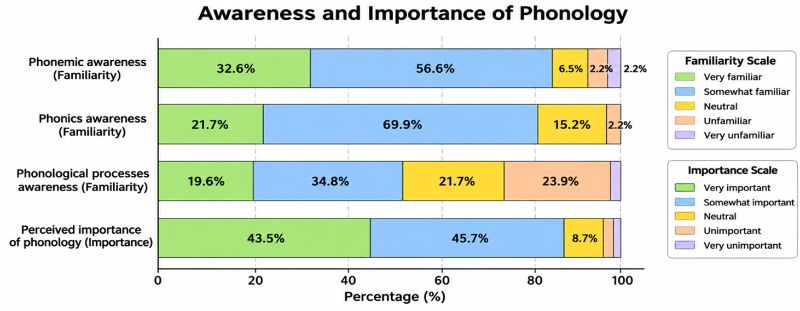
Figure 1 shows that 56.5% of the respondent felt somehow familiar and 32.6% as very familiar, which make almost 90% familiar with phonemic awareness, though with varying levels of confidence. While 6.5% remained neutral, only 4.4% are unfamiliar with the concept. The neutral responses here may reflect hesitation or partial knowledge, pointing to gaps in conceptual clarity even among trainees who are not entirely unfamiliar.
A similar pattern emerged for phonics, with 60.9% somewhat familiar and 21.7% very familiar. However, 15.2% remained neutral and 2.2% unfamiliar. Being unfamiliar with the concept of phonics might mean lack of previous training, or at best they might recognize the term of phonic but lack the knowledge or the ability to teach it; or indeed, it shows more lack of knowledge when compared to phonemic awareness.
Awareness of phonological processes in connected speech, such as linking, assimilation, and elision, proved weaker overall. While 34.8% were somewhat familiar and 19.6% very familiar, nearly half of the group reported neutral (21.7%) or unfamiliar (23.9%). The high neutral proportion suggests that many trainees may have encountered these features before, but lack confidence in identifying or applying them.
By contrast, perceptions of the importance of phonology in EFL teaching were strongly positive. A total of 89.2% considered it either important (45.7%) or very important (43.5%). Only 8.7% were neutral and 2% perceived it as unimportant. Even here, the neutral responses are noteworthy, as they may again reflect uncertainty about how phonology translates into classroom practice rather than disagreement about its value. Overall, this consensus underscores recognition of phonology’s pedagogical role. It also highlights the need to address areas of ambiguity revealed by neutral responses.
Extending these insights, the researchers also examined how pre-service teachers viewed the role of phonetics and phonology in teaching the four language skills. Figure 2 illustrates the distribution of responses across these skills, highlighting how participants rated the importance of phonetics and phonology in shaping these skills.
Figure 2. Perceived Importance of Phonetics and Phonology in Teaching the Four Language Skills Including Pronunciation
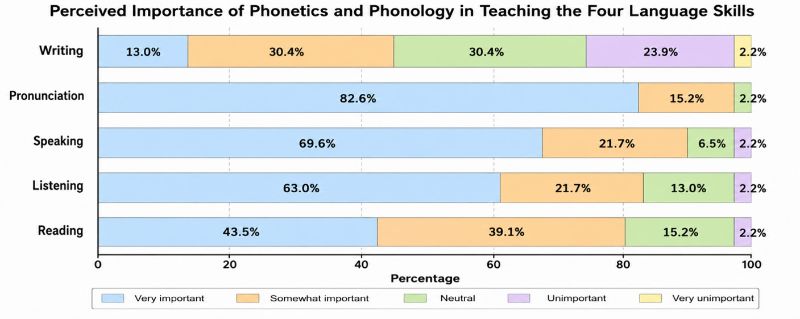
The results indicate a generally strong awareness among trainees of the importance of phonetics and phonology in teaching reading. A combined 82.6% of respondents rated these components as either very important (43.5%) or important (39.1%), suggesting a clear understanding of how phonological knowledge supports reading development, particularly in decoding and word recognition. A smaller portion (15.2%) remained neutral. This possibly hints to trainees’ uncertainty about the direct impact of phonological instruction on reading. Only 2.2%, a minority, considered phonetics and phonology unimportant in this context.
In contrast, trainees showed an even stronger consensus regarding the role of phonetics and phonology in teaching listening. A substantial 63% of participants rated them as very important, while an additional 21.7% viewed them as important. This high level of agreement (totaling 84.7%) highlights an acute awareness of the significance of phonological features in understanding spoken language. Only 13% expressed neutrality, and just 2.2% deemed these components unimportant. The slightly higher emphasis on listening compared to reading suggests that trainees may associate phonetics and phonology more directly with oral language skills.
The data also show a noticeable divergence in how trainees view the role of phonetics and phonology in writing versus speaking. For writing, responses were more evenly distributed, with 30.4% considered these components important and an equal percentage (30.4%) chose to remain neutral. Interestingly, 23.9% viewed phonetics and phonology as unimportant for writing instruction, while only 13% regarded them as very important. These results suggest some uncertainty or lack of clarity about the connection between phonological awareness and writing skills, particularly in areas like spelling, word segmentation, and pronunciation-to-orthography correspondence. The relatively high neutrality and dismissiveness toward phonology’s role in writing may reflect a perception that it is less directly applicable compared to other skills.
In contrast, responses concerning speaking were strongly affirmative. A significant majority (69.6%) viewed phonetics and phonology as very important for teaching speaking, while another 21.7% rated them as important. Only 6.5% remained neutral, and a minimal 2.2% deemed them unimportant. This overwhelming consensus highlights a clear recognition among trainees that phonological features, such as pronunciation, intonation, stress, and rhythm are central to effective spoken communication. The sharp contrast between the responses for writing and speaking once again reinforces the perception that phonetics and phonology are primarily associated with oral language development.
Additionally, the responses for pronunciation revealed a strong consensus: 82.6% of respondents rated phonetics and phonology as very important, with an additional 15.2% considered them important. This combined 97.8% agreement underscores a near-universal recognition of the essential role phonological instruction plays in developing accurate and intelligible pronunciation. These results align with earlier findings on the importance of phonology in teaching speaking (Celce-Murcia et al., 2010). This reinforces the idea that pre-service teachers view pronunciation as a key area where phonetic and phonological knowledge has immediate and practical application.
In addition to exploring the perceived importance of phonological knowledge, the questionnaire also sought to assess pre-service teachers’ self-reported confidence in using phonological aspects in their English language teaching. Confidence plays a key role in shaping classroom practices, especially when it comes to teaching pronunciation and other phonological features that may require both theoretical knowledge and practical strategies. Figure 3 illustrates how trainees rated their confidence levels.
Figure 3. Participants’ Confidence and Readiness in Teaching Phonetic and Phonological Aspects
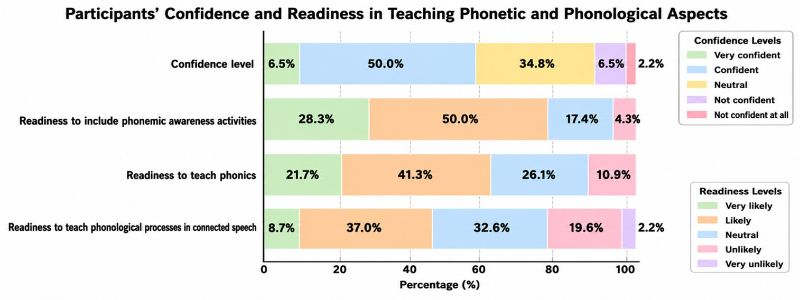
The results reveal a generally positive yet uneven picture of pre-service teachers’ confidence in teaching phonological aspects. 50% of respondents reported feeling confident, while 34.8% chose a neutral stance, indicating uncertainty likely linked to limited practical experience or insufficient training. Only 6.5% felt very confident, and a combined 8.7% expressed low or no confidence, and this suggests that some trainees feel underprepared to teach phonological aspects effectively.
Regarding the intention to integrate specific phonological components in teaching, most trainees showed strong willingness to include phonemic awareness activities. 50% stated they are likely to do so, and 28.3% very likely. The 17.4% who remained neutral reflect some hesitancy or lack of classroom experience, whereas only 4.3% were unlikely, which can be interpreted as a failure in recognizing the essential role of phonemic awareness in language instruction or may be resistance to integrate such knowledge.
A slightly more cautious attitude emerged toward phonics instruction. While 41.3% reported being likely and 21.7% very likely to integrate it, 26.1% were neutral- a sign of uncertainty possibly due to limited methodological training or perceptions that phonics suits younger learners more than older EFL students. Another 10.9% indicated they were unlikely to use it, pointing to the need for further pedagogical support in this area.
Teaching connected speech showed the highest level of hesitation. Although 37% said they are likely to teach it, only 8.7% were very likely, while a large proportion (32.6%) remained neutral more likely due to considerable uncertainty and lack of confidence. Moreover, 19.6% reported being unlikely to include it. This calls for a need for stronger practical preparation in this aspect of phonology instruction.
Finally, participants identified several challenges they anticipate when teaching phonological knowledge to Moroccan learners. Their insights, summarized in figure 4, underscore the need for targeted training to enhance both confidence and instructional competence in phonological teaching.
Figure 4. Trainee’s Anticipated Challenges in Teaching Phonology to Moroccan Students
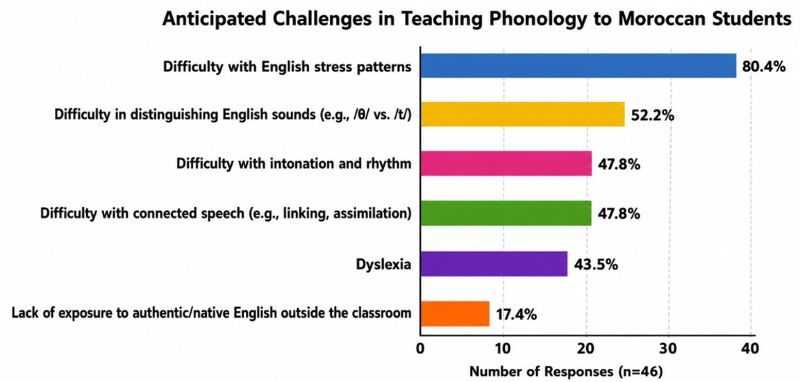
Figure 4 illustrates that the most commonly anticipated challenge among trainees is teaching English stress patterns, selected by 80.4% of respondents. This result aligns with earlier findings that revealed limited awareness and confidence in this area (Setter & Jenkins, 2005), which indicates a need for more focused training on stress placement and its communicative function in English. The second most reported challenge was distinguishing English sounds, chosen by 52.2% of participants. This highlights concerns related to segmental features such as minimal pairs and vowel/consonant contrasts, which can be particularly problematic for learners with L1 interference.
Intonation, rhythm, and connected speech processes were also identified as potential problem areas, with 47.8% of respondents expressed concern about each. These suprasegmental features are often neglected in formal instruction due to their complexity, and trainees seems to perceive them this way. Interestingly, 43.5% of participants selected dyslexia, as a possible non-linguistic challenge, showing an awareness of how phonological deficits can affect learners with specific biological difficulties. Lastly, 17.4% of respondents pointed to the lack of practice or exposure to authentic English outside the classroom as a barrier, which shows trainees’ awareness of the broader contextual limitations that can affect phonological development.
Following the exploration of anticipated challenges in teaching phonology, the questionnaire sought to gauge trainees’ attitudes toward the value of additional training in phonetics and phonology. Understanding how pre-service teachers perceive the potential benefits of further professional development is crucial for designing effective teacher education programs. Figure 5 illustrates participants’ beliefs regarding whether enhanced training would improve their teaching effectiveness.
Figure 5. Perceived Effectiveness of Further Training in Phonetics and Phonology in Enhancing Teaching
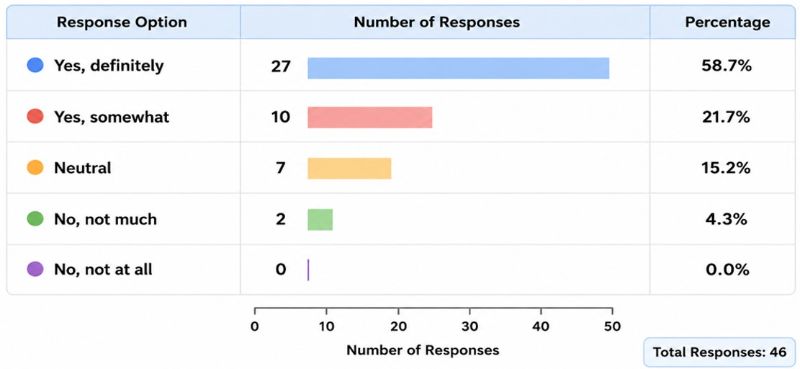
Figure 5 revealed that 58.7% hold a strongly positive view, expressing that further training in phonetics and phonology would definitely enhance their teaching effectiveness. This highlights a clear recognition of the need to deepen their knowledge to better support learners’ phonological development. Additionally, 21.7% of respondents believed that such training would somewhat improve their instructional practices, showing openness to growth but perhaps some uncertainty about the extent of the impact as well. Meanwhile, 15.2% remained neutral, which may reflect ambivalence or a lack of experience with targeted phonological training to fully appreciate its benefits. Notably, only 4.3% felt that further training would not meaningfully inform their teaching, showing skepticism about the value of phonetics and phonology in language instruction.
3.3. Discussion of Main Findings
The quantitative data revealed that Moroccan pre-service EFL teachers at CRMEF demonstrated low to moderate levels of phonological awareness, with notable variation across different phonological components. While trainees showed moderate proficiency in phonemic awareness, particularly in phonemic manipulation tasks such as substitution, blending, and segmentation, they exhibited significant challenges with suprasegmental features, including intonation patterns and compound stress, where awareness was very low. Basic segmental features like consonant and diphthong identification were relatively well understood, but more advanced phonological processes such as affricativization, labialization, and alveopalatalization posed difficulties.
The survey results indicate that while most pre-service teachers had some university-level exposure to phonetics and phonology, few reported formal pedagogical training in these areas at CRMEF, which may partly explain gaps in their phonological competence. The trainees expressed familiarity with core phonological concepts such as phonemic awareness and (somehow) phonics but were less familiar with connected speech processes. Importantly, the majority of respondents recognized phonology as crucial in teaching English, particularly for pronunciation, speaking, reading, and listening skills. Most of them also reported confidence in applying phonological knowledge in teaching, though their willingness to integrate connected speech into their future classrooms was comparatively lower, reflecting their limited familiarity and competence in this area.
When asked about potential challenges in teaching phonology, a significant proportion of pre-service teachers identified English stress patterns (80.4%) and sound discrimination (52.2%) as primary difficulties. Intonation, rhythm, connected speech (each around 47.8%), and dyslexia (43.5%), as an extra linguistic factor, were also highlighted as common concerns. A smaller number (17.4%) considered limited exposure to authentic English outside the classroom as a barrier to phonological learning and teaching.
The findings of this study align closely with broader research that highlights a moderate to low level of phonological awareness among pre-service EFL teachers, particularly with regard to suprasegmental features. This is consistent with Hismanoglu (2011) who found similar patterns of strength in phonemic tasks but notable weaknesses in suprasegmental awareness, such as stress and intonation. The present study mirrors these findings, suggesting that while segmental phonology is often prioritized in teacher training, essential suprasegmental elements are frequently overlooked. Furthermore, the discrepancy between trainees' self-reported confidence and their actual performance on phonological tasks reflects a recurring theme in the literature, where surface-level confidence does not always correspond to deep instructional readiness (Alshaboul, 2018). These findings point to a clear need for more comprehensive phonological training that balances both segmental and suprasegmental features to enable future teachers to address the full spectrum of phonological challenges in EFL teaching.
The findings of this study also align with the results achieved by Derwing and Munro (2015) and Zhiri (2023), reinforcing the critical role of targeted phonological instruction in preparing effective teachers. Both studies demonstrate that pre-service teachers who undergo specialized pronunciation or phonological training develop significantly stronger phonological awareness and instructional skills. Zhiri (2023) highlighted trainees’ call for more practical, hands-on experiences over purely theoretical content, while Derwing and Munro (2015) emphasized how focused phonological training not only sharpens teachers’ skills but also leads to improved learner outcomes. Echoing these insights, the present study underscores the necessity of integrating explicit, applied phonological training into teacher education programs.
3.4 Implications of the Study
The findings of this study carry significant implications for EFL teacher education, particularly within the Moroccan context. The low to moderate levels of phonological awareness observed among pre-service teachers, most notably in suprasegmental features such as stress, intonation, rhythm, and connected speech, highlight a critical gap in current training practices. Although participants acknowledged the importance of phonological awareness for effective language instruction, many of them reported a lack of confidence in applying this knowledge in real teaching scenarios. This mismatch between theoretical understanding and practical competence suggests a need for deeper pedagogical engagement in teacher training programs.
Importantly, these findings emphasize the necessity of equipping future teachers not only with a solid foundation in phonological theory but also with hands-on strategies to integrate this knowledge into classroom practice. The trainees’ positive attitudes toward phonological instruction, combined with their self-identified challenges, point to an opportunity for CRMEF and similar institutions to enhance program relevance and impact. Embedding explicit, well-structured instruction in phonology, accompanied by practical application opportunities could significantly contribute to producing more confident, competent EFL educators. This is especially relevant in light of the increasing recognition of phonological competence as a cornerstone of language proficiency and intelligible communication in EFL settings.
3.5 Limitations and Recommendations
Despite its contributions, this study is not without limitations. First, although the study aimed to reach a broad population of pre-service teachers, the number of participants who completed both the test and the questionnaire was limited, which may affect the generalizability of the results. Second, data collection spanned several geographical areas, potentially introducing variability in participants' educational experiences and access to resources, which could have influenced their responses. Third, the phonological awareness test was not administered face-to-face due to logistical constraints, limiting the researchers' ability to ensure consistent testing conditions. Finally, to manage the length of the test, each aspect of phonological awareness was assessed using only a single item, resulting in a surface-level evaluation of trainees' knowledge in some areas.
These limitations offer several important directions for both pedagogical reform and future research. From a practical standpoint, CRMEF and other teacher education institutions should consider integrating a dedicated course on phonological awareness into their curriculum. Such a course should go beyond theoretical instruction to include interactive and applied components such as pronunciation workshops, audio-visual materials, phoneme charts, and real-world classroom simulations. These tools can enhance pre-service teachers' engagement and better prepare them to teach phonological concepts with confidence.
For research, future studies should aim to use more robust and comprehensive assessment tools that allow for deeper evaluation of phonological competence, particularly in real-time oral contexts. Longitudinal research designs tracking the development of phonological awareness from training to early teaching practice would be especially valuable in understanding how these skills evolve and how they translate into classroom effectiveness. Furthermore, studies exploring the impact of contextual variables, such as the availability of English input outside the classroom or differences in prior educational experiences, could offer further insight into the challenges Moroccan EFL pre-service teachers face. Expanding the sample size and including more diverse participant groups would also enhance the generalizability of future findings. Ultimately, more research is needed not only on what pre-service teachers know, but also on how they are best supported in developing and applying that knowledge in authentic educational settings.
Conclusion
This study revealed that Moroccan EFL pre-service teachers exhibited a low to moderate level of phonological awareness, particularly struggling with suprasegmental features, and lacking confidence in teaching these aspects. Although trainees recognized the importance of phonological awareness in effective English language instruction, they reported limited exposure to formal training in this area. These findings highlight a critical gap in teacher preparation and align with international research documenting similar challenges among pre-service teachers in various contexts. The results underscore the urgent need for structured, practice-oriented phonological instruction within EFL teacher education programs to ensure future educators are adequately equipped for the classroom.
Ethical Statement:
The authors confirm that this is original research, not previously published or under consideration elsewhere, and that it was conducted in accordance with accepted ethical standards and responsible research principles. The study received no external funding, and the authors declare no financial or other conflicts of interest.



Open Access By Aditum Open Access Journals id licensed under Creative Commons Attribution 4.0 International License. Based On a Work at aditum.org


