
The Journal of Social and Behavioral Sciences
OPEN ACCESS | Volume 3 - Issue 1 - 2026
ISSN No: 3065-6990 | Journal DOI: 10.61148/3065-6990/JSBS


Jose Antonio Gordillo Martorell
Founder & CEO, Cultural Inquiry, Rebbergstrasse 12, 8706 Meilen, Switzerland.
Corresponding author: Jose Antonio Gordillo Martorell, Founder & CEO, Cultural Inquiry Rebbergstrasse 12, 8706 Meilen, Switzerland.
Received: July 02, 2026 | Accepted: July 16, 2026 | Published: July 22, 2026
Citation: Gordillo Martorell JA., (2026) “Breaking Molds. Comparing Analog-AI Constraints on Children’s Creativity through a Self-Portrait Drawing Technique” Journal of Social and Behavioral Sciences, 3(4); DOI: 10.61148/3065-6990/JSBS/070.
Copyright: ©2026. Jose Antonio Gordillo Martorell. This is an open access article distributed under the Creative Commons Attribution License, which permits unrestricted use, distribution, and reproduction in any medium, provided the original work is properly cited.
The creative process does not occur in a vacuum; rather, it is the result of a series of complex correlations between individual internal (cognitive) and collective external (socio-demographic, economic, cultural, etc.) factors that make it possible by, in a sense, catalysing it. In the specific case of children’s creativity, we were interested in comparing how ‘natural’ conditioning affects it in a context analogous to the way in which AI-generated conditioning does. To this end, we conducted an experimental workshop with children aged 7 to 11 years old and their families using the self-portrait technique as the main methodological tool, combined with a dynamic of progressive creative restriction – inference – to gain insight into how children re-create and express the image they have of themselves. Building on another pilot study on this topic that we conducted previously, we compared the results obtained with the LLM training logic commonly used by AI, which is based on the repetition of identical prediction patterns.While processes of restriction and challenge appear to encourage children's creativity, constraints induced by AI use may have the opposite effect. Finally, we highlight some implications regarding how this may affect children's agency in their creative process in their AI everyday life reality.
children; creativity; AI, pattern-recognition, self-identity; self-expression
1. Introduction
“Children should play and use their imagination, rather than having the world explained to them by a screen” Andrew Stanton. Toy Story 5 Director
How are children's creativity and the expression of their self-image being impacted, transformed, and reshaped by AI? Now and in the past, children's creativity does not emerge in isolation, it is contextual and historical. Creativity in childhood is best understood as a process unfolding over time, shaped by the interplay of emergence and constraint operating across individual cognitive capacities and broader sociocultural environments. These constraints — whether family dynamics, cultural norms, or educational structures — simultaneously enable and delimit how children imagine and represent themselves and their world to others.
Research on children's self-portrait drawings (Kupers et al., 2019; Subtil et al., 2023), for instance, has demonstrated how both physical and sociocultural contexts, including levels of urbanisation and cultural individualism, influence the complexity, content, and representational choices children make. With the rapid integration of AI tools into children's everyday creative lives, a new and largely uncharted layer of conditioning has emerged. This article examines how these two modes of constraint — the analogue, socially embedded kind, and the algorithmically induced kind — compare in their effects on children's creative agency, using the self-portrait drawing technique as the primary methodological lens.
This paper reports preliminary findings from a pilot workshop “Draw What AI Can't. Draw Yourself” carried out on June 13th 2026 in collaboration with The Creative Corner, a space dedicated to facilitating children’s creativity located in Feldmeilen, Switzerland. The workshop was attended by four children aged 9–10 and one parent. It explored the way and some explicit manifestations of the children reacting to analog constraints in their creative process when they are pushed to reconsider an initial outcome of their creative hand-drawing process.
2. Theoretical Frame: Child-Centered Co-Creative AI
To operate efficiently in the comparison between the analogue framework of constraints with that provided by AI, we have considered the theoretical framework Child-Centered Co-Creative AI (CCAI, “Kai”)proposed by Fusco et al. (2026), built on four design dimensions: child-centred multimodal input methods; metacognitive scaffolds for AI suggestions; embodied affordances for co-creative AI; and reducing cognitive load during co-creation. This framework is grounded in the specific characteristics of the child—their inner world and self-image, their developmental stage, and their pro-social capacity—rather than in the AI tool itself.
In addition, Thompson’s (2026) ethical approach underpins the work, grounding it in a formal commitment to children’s status as citizens with full rights (United Nations, 1989), respect for their agency, and consideration for their cultural diversity.
3. Methodology: The Self-Portrait Technique and the Creative Zoom In Approach
The workshop was structured around the concept of children’s self-image, using self-portraiture as its central technique. The hand-drawn self-portrait stands as one of the most revealing and non-invasive tools for accessing children’s inner self-image, because children naturally communicate through graphic expression long before they can fully articulate their inner lives in words (Malchiodi, 1998). When children draw, they do not reproduce a realistic copy of the external world but rather what they feel, think, and know about themselves (Koppitz, 1968).
The sequence of interaction followed with the children is based on a dynamic and organic process of progressively narrowing the parameters of their creative work. This process is organised into successive rounds, in each of which the children identify and reflect on what all the self-portraits created have in common, and use this to create a new self-portrait that does not include that element. The aim of this is to maximise the children’s creativity by setting conditions for their starting point in such a way that it acts as a stimulus for them to explore new ideas and make new connections.
In our workshop, three successive rounds were carried out. In the first two rounds, the children were provided with paper and coloured paints as basic materials for creating their self-portraits. In the third and final round, textiles were added as a material they could use. Two 7-year-old children took part, along with their two mothers. The workshop lasted an hour and a half and was conducted in German, English and French and had obtained all the necessary legal authorisations and parental consent for the children to take part.
(Include here Figs. 1, 2 and 3)
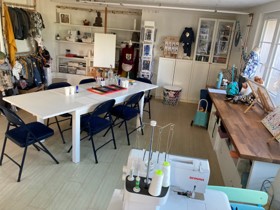
Fig. 1 Workshop Placce
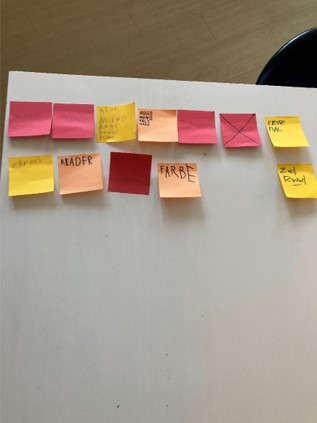
Fig. 2 Post-it Rounds
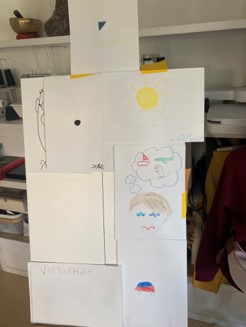
Fig. 3 Self-Portraits
4. Discussion
4.1. First Round Outcomes. A Mental Collage
Our analysis will focus on the children’s self-portraits rather than those of the adults, as the former are the main focus of the research. In this case, the adults have essentially played a supporting role, ensuring that the children were in a safe, respectful and welcoming environment.
In the first round, the children – and their families – were invited to create a self-portrait without any prior instructions that might influence them in any way. The starting point was therefore one of maximum openness and possibilities when it came to self-representation. They were asked, however, to spend some time thinking about what they wanted to do and how they wanted to do it before setting to work.
One of the children drew a self-portrait in which he depicted himself from the waist up wearing a yellow T-shirt. The other child chose a different approach, depicting himself as a hand—his own hand, which he used as a model to trace its outline onto the sheet of paper. He then completed the drawing by adding, in the centre of the palm and in a stylised manner, two eyes, a nose and a smiling mouth, like a sort of superimposed smiley face. He also added a couple of trees, one on either side of his hand.
The fact that he chose his hand as the most representative part of himself, using it as a self-portrait, is highly significant and raises a very interesting question regarding how the child chooses a part of his body – in this case, the hand – as representative of himself. We could investigate why the child in this case specifically chose the hand, what meanings it holds for him, and what correlations can be established between how he sees himself and those meanings. On the other hand, the child has fused two very disparate elements in his imagination through a kind of mental collage technique, creating a new image—a hand-face—which allows him to better express what he wants. It is also significant that he has added a typical digital element to his creation, the smiley emoticon, to express himself. In this case, the child expresses a positive emotion of happiness to represent himself. Finally, the presence of nature is particularly significant and occupies a prominent place in the child's imagination. The creative combination of what he considers the most important part of his body, the expression of his primary emotion in a digital language, and references to nature results in a creation that is extraordinarily rich, complex and full of meanings and messages to be deciphered.
Once the self-portraits had been completed, the children were asked to present them briefly to the group and identify what they all had in common. We drew up a list of all the common elements so that they were clearly visible. All the portraits had eyes, a mouth, a neck, skin, personality and smiles. We then moved on to the second round, inviting them to create their second portrait without including the common elements. Once again, they were advised to think about their strategy for a while before putting it into practice.
4.2. Second Round Outcomes. Differences Compared with Similar Experiences Using AI
The second round of self-portraits took us into a completely different realm from the first: that of objects and things. In this case, the children, influenced by their peers, chose to depict themselves as cars, deliberately avoiding the common elements we had identified in the first round.
The cars drawn by both children were very similar in terms of design and the colours used (blue and red), though not in terms of size (one was significantly larger than the other). Both met the previously agreed condition of not using the common features identified in their first self-portraits. In this case, we enter the realm of objects that children consider significant as representations of themselves. The car as an object capable of representing their identity. We could explore the reasons that led them to make this choice, the presence of this object in their daily lives and therefore their familiarity with it, as in the previous case of the hand: what meanings this object holds for the child and how these relate to the image they have of themselves.
At a certain point, the creative process took a new direction, incorporating voice and humour. The children began to play with the sound “Ka” whilst drawing the car they were simultaneously acting out, using their voices to play with the word to form the compound “Ca…ca…car”, which led them to act out this element as well. This was a moment for them of pure play, to laugh and have fun together with the sounds and to give those very sounds a visual representation to make it even more fun for them.
It is interesting to compare the results of this second round with those obtained in a previous study, in which children were offered a standard AI animation app to create their second portrait. In that study, one child drew a house, and the app failed to recognise it because it was programmed to recognise only faces and bodies. This had a clearly negative effect on the child, as their expectations of finding a result that satisfied them were dashed. In the case of this workshop, this frustration did not arise, as the children were not only able to freely express their ideas but could do so whilst enhancing their creativity. On the other hand, it is a closed, self-referential model to which it is impossible to add elements that are essential to a child’s creativity, such as play, humour, gestures or the voice.
In this regard, we can compare the ‘creative constraint’ approach adopted by the AI animation app with the ‘creative empowerment’ approach proposed by the analogous Zoom-in technique. In the former, the output provided by the child is simply another piece of data to be automatically incorporated to train the language model underpinning the app. That is the sole objective. If this in any way limits the child’s creativity, as illustrated by the earlier example of the house, the child is presented with the option of altering their drawing to match the scanned image. In contrast, in the second approach, the child’s input serves merely as a starting point from which to continue developing and expressing their own image, which is the most important aspect. Furthermore, no adjustments are imposed upon the child to which they must respond.
We are therefore faced with two qualitatively distinct approaches to children’s creativity in expressing their own image. Furthermore, and in line with the above, what is being reinforced in children as a starting point or spark to trigger their creative process is that they focus on what is not repeated, unlike LLMs, which rely on identifying what is repeated in order to establish patterns that are as broad as possible.
The common elements identified by the children in their self-portraits during this second round were: lines, wheels, circles and colours. Consequently, the third round opened up even more scope for the children to unleash their creativity by asking them to think of something that didn’t feature any of those elements. In preparation for this final round, they were provided with fabrics in a variety of patterns, colours and prints to use in creating their final self-portrait. The main aim was to open the door to three-dimensionality and the sense of touch in the creative process.
4.3. Third and last Round. Maximum abstraction with minimal materials. Questioning the norms
After an initial exploratory session, the children ruled out using textiles as a material for their final self-portraits. They did not feel that they offered anything that might interest them.
One of the children’s first reactions when he heard the challenge was to hand me a blank sheet of paper, but this failed to meet one of the criteria identified as common to this round: colour, as the sheet was white.
From there, they tried out various approaches to tackle the challenge of representing themselves without using any of the common elements that had emerged so far; ‘lines’ and ‘colour’ proved the most difficult to resolve, but for that very reason were the most striking for both children.
It is worth noting the exploratory, trial-and-error nature of the process that both children embarked upon entirely intuitively, seeking to use their imagination and their ability to think within frames of reference that were constantly being reconfigured and shifting. In this case, the children diverged once more and separated the collaborative work they had developed in Self-Portrait No. 2 through humour and sound. In this new phase, each of them individually explored possible ways of tackling the challenge. One decided simply to write his name, adding the word ‘Halt’, because for him the letters were not lines and represented a certain ‘non-colour’. The other child approached the challenge from a different angle by drawing a coconut which obviously did contain lines and colours, but which the child had deliberately chosen to use because the urgency of representing the object led him to disregard some of the rules we had set.
The process is therefore not linear, and at a certain point it may seem justified to children to deliberately disregard the rules agreed at the outset, if doing so restricts or hinders their creativity. And this is where we once again see differences with the way AI approaches creativity—based on rules that must be followed without fail, without exception. Exceptions must be avoided at all costs because they constrain the entire process. In our case, it is precisely the exception that keeps the process going.
5. Conclusion and Future Research: Towards a Children-Creativity Oriented AI
What implications might these findings have for the design of AI? Can we incorporate some of the implications that arise from them into the way LLMs are designed? Is it possible to develop AI that is oriented towards the way children create and express themselves, rather than being focused solely on the mass collection and training of data? Is it feasible to create AI that breaks its own moulds, rather than reinforcing them time and again at the expense of what does not fit within them? Can the way children express their creativity in different contexts serve as a roadmap for the design of intelligent chatbots and Agentic AI? Can the machine-to-machine conversation be reoriented towards a child-machine-child interaction? (Russ, 2004; Wilson et al., 2025; Kurian, 2025)
In 1960, in the midst of the France occupation, Simone Weil wrote with pseudonym a brilliant essay titled “The Iliad or the Poem of Force” (Weil, 1940). In it, she contrasted the concept of force with that of the interval as the ultimate means of ensuring a space for reflection—and thus for freedom—against the inherent logic of force that “…is as pitiless to the man who possesses it, or thinks he does, as it is to its victims; the second it crushes, the first it intoxicates.”
Agentic AI and the basic design structures on which it is based exert enormous power over everyone who uses it. It is true that this power is subtle and covert, but it is no less effective in reshaping deep-seated mental models and identities by accessing the image we hold of ourselves and, from there, establishing new dynamics in our relationship with it, as we have seen in the case of this experience with the phenomenon of disconnection or “short-circuiting” that triggers the transition toward automated digital animation in the child’s inner world. That void is not merely operational; rather, to borrow Katherine Hayles’s expression, it affects the kind of “cognitive assembly” (Hayles, 2022) the child is carrying out when attempting to translate the mental image reflected on paper into pixels. What falls by the wayside and what persists. This is an essential point that must be kept very much in mind.
In this article, we aim to lay the groundwork—to borrow Weil’s expression—for a framework from which to rethink a new approach to LLM that is guided from the outset by the specific characteristics of a child’s personality and their needs to express their identity and who they are, based on empirical data that we can provide in the future to developers and creators in the AI industry. Clinical psychology has demonstrated (Maté and Maté, 2022) the individual and collective consequences of this process of disconnection, in which children learn to suppress their genuine emotions and needs in order to maintain a connection with caregivers, and that this enforced inauthenticity is itself a form of trauma, with long-lasting consequences for mental and physical health.
On the other hand, as we have observed in this study on various occasions and in different ways, the internal logic of LLMs is geared toward maximizing interaction time with the user in order to subsequently monetize that interaction, using entertainment, distraction, and constant visual stimulation as the primary means of engagement. The primary long-term consequence of this is a profound creative homogenization, as it excludes key elements of the child’s internal creative process—and, by extension, of anyone who is part of it. (Daryani et al., 2025; Agarwal et al., 2025; Sourati et al., 2026) In this sense, we need to co-create LLMs that guarantee from the outset this creative integrity not only for children but for anyone who uses them, avoiding dynamics of confinement, reduction, or violent standardization.
There are undoubtedly many aspects that remain to be addressed in this regard, with the sensitivity and approach we use to understand how children perceive themselves and their surroundings—and their ability to recombine these elements to create something new—being among the most important. Children cannot be treated as mere providers of data to be fitted into the artificial and dehumanizing template of a standard algorithm, no matter how much we dress up this treatment in the guise of efficiency and adaptability in their learning process. Serialization is intentionally confused with growth and the reinforcement of potential.
(Include here Table 3)
Tab. 1 Comparison between current LLMs and Children-Centered LLMs
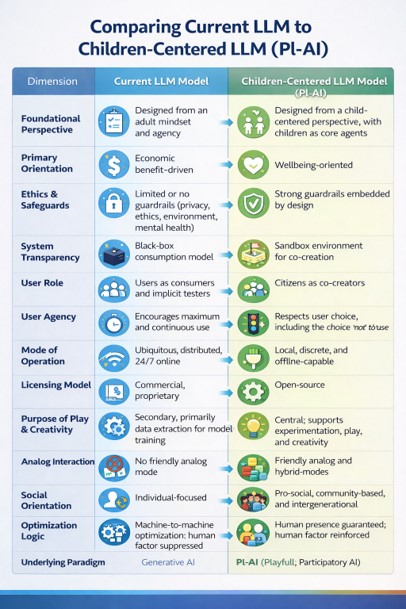
Current large language models (LLMs) are built from an adult mindset (Berdoz et al., 2026), primarily oriented toward economic benefit, and governed by minimal ethical guardrails regarding privacy, mental health, and children's wellbeing. Their operational logic favours ubiquitous, continuous engagement, optimising machine-to-machine performance while systematically suppressing the human factor. In this paradigm, children are positioned — at best — as consumers and implicit testers of systems designed neither for nor with them.
A children-centered LLM, by contrast, demands a fundamental reorientation across every design dimension. Under the Pl-AI (Playful; Participatory AI) framework proposed here, the foundational perspective shifts from adult agency to child agency, placing children not as passive recipients but as core agents and citizens-as-co-creators. Wellbeing replaces profit as the primary orientation, and strong ethical guardrails — covering privacy, mental health, environmental impact, and developmental appropriateness — are embedded by design rather than added as afterthoughts.
Critically, the Pl-AI model recognizes the purpose of play and creativity. Where current LLMs treat creative interaction as a secondary function, primarily useful for data extraction and model training, children-centered design positions play and experimentation as central to the system's very rationale. Transparency replaces the black-box consumption model, offering sandbox environments that invite co-creation and genuine exploration. Furthermore, the architecture prioritises local, discrete, and offline-capable modes of operation, resisting the attention-economy logic of 24/7 connectivity, and explicitly respects the child's right not to engage — the choice not to use.
Taken together, these criteria constitute a shift not merely in technical specifications but in the underlying ethical and social contract between AI systems and the children who interact with them.
It is clear—though unfortunately for some it remains unclear—that this can only be achieved if children are involved from the very beginning in the creation of these LLMs, allowing them to take on the role of co-creators rather than mere testers, as is usually the case when they are invited only to taste the soup and are given a hammer to do so. We must make it possible for them to be the ones who cook it with the ingredients they prefer so that later they can let us taste it with a spoon.
Declaration of Competing Interest
The authors declare that they have no known competing financial interests or personal relationships that could have appeared to influence the work reported in this paper.
Acknowledgements
The authors wish to thank the children and families who participated in the “Draw What AI Can't. Draw Yourself!” pilot workshop, and The Creative Corner for their support in organising the session.



Open Access By Aditum Open Access Journals id licensed under Creative Commons Attribution 4.0 International License. Based On a Work at aditum.org


