
The Journal of Social and Behavioral Sciences
OPEN ACCESS | Volume 3 - Issue 1 - 2026
ISSN No: 3065-6990 | Journal DOI: 10.61148/3065-6990/JSBS

Robinson B. Valenzona1*, Ralph Bryan Cruz2, Janella Bayuga3
1National University, Philippines.
2Senior High School, Munoz National High School (Main), Division of Science City of Munoz, Nueva Ecija.
3Maragol Integrated School, Division of Science City of Munoz, Nueva Ecija.
*Corresponding author: Robinson B. Valenzona, Department of Political and Administrative Studies.
Received: May 12, 2026 | Accepted: May 19, 2026 | Published: June 02, 2026
Citation: Robinson B. Valenzona, Ralph B Cruz, Bayuga J., (2026) “Once upon a Time, there was a Disney Gay Princess: The Trapped of Falling in Love with a Straight Prince and Other Villains into the Woods” Journal of Social and Behavioral Sciences, 3(2); DOI: 10.61148/3065-6990/JSBS/061.
Copyright: ©2026. Robinson B. Valenzona. This is an open access article distributed under the Creative Commons Attribution License, which permits unrestricted use, distribution, and reproduction in any medium, provided the original work is properly cited.
This study focused on the experiences of male gay individuals in falling in love with straight guys. It explored the complexities of feelings, self- expression, and romantic relationships of gays in modern society. A phenomenological study approach was used as it aimed to narrate the lived experiences of the ten (10) gay men who served as the participants of the study. A written narrative approach was used to collect the data of the study. Hence, a follow-up interview has been conducted to confirm their narration. Themes and codes from narrated experiences were utilized as analysis tools in the gathered data. Based on the responses of the participants, the following themes emerged: Acceptance and Rejection from straight guys (46 coded responses); Disclosure of feelings (29 coded responses); Experiences of Love and Attraction (19 coded responses); Dreams of a Relationship (15 coded responses); and, Coping with rejection (9 coded responses).
Many participants claimed that their feelings are usually unreciprocated, with the common quote of “because of my gender identity, I already experienced discrimination when it comes to love.” Further, gays are having difficulty expressing their feelings to straight guys despite the innuendos that the latter have made. Straight guys are giving them mixed signals that are hard to comprehend. Despite this, gays are still longing for meaningful and long-term relationships.
With this, the findings imply that the narrative of the participants showed the emotional labor that they endured to pursue the idea of love across gender boundaries, underscoring their resilience, hope, and yearning for genuine connection with straight guys. On the other hand, this study also explored the perspective of the straight guys. Most of them disregarded the idea of falling in love with gay individuals. With the twenty-eight (28) males who answered the survey, three of them narrated that they were willing to accept whatever gender they would fall in love with, and they had experienced having a close relationship with gays. This meant that the Philippines, although a country with a gay friendly community, still tends to be traditional when it comes to the concept of relationship and marriage, which contributes to being the hidden villains that the gay community is facing.
gender orientation, gender identity, gay relationships, gender acceptance, self-expressions
When it comes to love and relationships, ideologically, everyone is equal. However, reality hits particularly in marriage; homosexual individuals are put at a disadvantage, especially in having the courage to confess their feelings to straight individuals. These concerns were rarely narrated or explored, as most of the studies, such as Tiglao (2024), Galanza (2024), and Aguilar (2022), among others, focused on the “coming out” experiences and “discriminations” faced by the male gay individuals.
Mainstream media depicts the struggles of male gay characters in expressing their affection; hence, situations and scripts were mostly based on observations, not on scientific or research-based methods, which delimit real representations and struggles of male gays. This study may contribute how specific representations of male gay individuals should be represented and how these experiences seemed common and accepted, yet unexplored for research or academic pursue.
Some states, like Australia, America, and advanced societies, recognized the rights for equal love that were guaranteed in their constitutions. There were also some movements and rally fighting for the rights and anti-discriminations into different forms of love. Hence, despite these efforts, the LGBTQIC+ were limited in who they should love, especially in highly conservative countries.
In Asia, there are only two countries legalized the same-sex marriage – Taiwan and Thailand; hence, Manalastas et.al (2017) and Pew Research Center (2023), claimed that in the Japan, Vietnam, Thailand, HongKong, Cambodia, and India have a strong acceptance to same sex relationships and the Philippines. Although acceptance is present, but the idea of it and practices how gay individuals fully accepted, their experiences in finding real relationship, was under explored. The LGBTQIC+ in general, has still facing struggles and discriminations. The idea of majority, they are still laughingstock for entertainment and they are source of money, instead of fully accepted like a heterogenous relationship, as observed, since there were limited studies on how LGBTQIC+, specifically the male gay individuals, are viewed and with the rampant male sex workers, it only promote that these individuals are after sex as a pleasure, not for a long time commitment with love and care. They are mostly taken advantaged and prone for financial exploitation (Heissen & Hermann, 2020). This has been a phenomenon underexplored in the context of the Philippine society. Majority are focusing on portrayals, acceptability, and perception on the same-sex marriage, not taking a closer look on how members of LGBTQIC+ communities are struggling in the trap and dogma of one-sided love due to their gender identity.
With the premises stated above, this study would like to explore the phenomena on how the “Disney gay princess” which was referring to openly gay male individuals has been trapped in the idea of true love with a straight guy. It also discovered what were the factors that they encountered which served as the “villains” into the woods (referring to the society), revealing that these individuals could have a happy ending like real disney princesses, if the social construct about gays will be truly reversed, not by a curse or cure, but with a true love kiss or acceptance, that they should not be taken advantage of and be ridiculed due to their identity, and anybody may accept them as who they are not based on what they are capable to give and provide.
This study aimed to find out the lived experiences of male gay individuals in falling in love with straight guys. It explored the complexities of feelings, self-expression, and romantic relationships of gays in modern society.
Specifically, it explored the factors that served as the “villains” in the “woods” or reality, in attaining genuine love and relationships with straight male individuals. The trap, as referred to in the study, was the social situations that may have controlled how gay individuals encountered difficulties in attaining relationships, as discerned from the participants' narratives.
This study did not adapt theoretical underpinnings, as this was anchored with a descriptive phenomenological approach. Based on Husserl's perspectives, the aims of this approach were to explore human experiences without limitation, rather than proving or disproving theories. The study aimed to describe the lived experiences of the participants as they perceive them directly. The phenomena explored was the how gay male individuals were being trapped into falling in love with straight male individuals – their challenges and struggles in disclosing their feelings and how it was interpreted by the straight male; thus, why it would be hard for them as “Disney princesses” to find a true love due to the “villains” into the wood, or the social construct about to whom they should love freely and loudly, of course, with acceptance.
This study used the progressive iterative engagement review with the available literature related to the topic to avoid bias or exploration of narratives of the lived experiences of gay male individuals in falling in love with straight males. There were only limited studies related to the focus of this paper, which the paper explored from 2010 to 2025.
Falling in love with straight-identifying men is a complex and often challenging experience for gay men, one that has been explored across several fields—including psychology, sociology, and cultural studies. The research reveals a recurring pattern: these attractions tend to be emotionally intense and often end in disappointment. There’s an internal battle going on—a mix of hope, dented self-worth, and a constant negotiation of agency. Researchers such as Anderson (2016), Chen (2019), and Morales (2019) discussed how these emotional highs and lows were not merely personal quirks, but rather responses to broader social conditions.
Structural factors, especially heteronormativity and stigma, play a serious role here. Barker et al. (2018) and Ruiz (2020) demonstrate how these forces restricted the possibilities for same-sex desire to be reciprocated or even safely expressed. For many gay men, this means that falling for straight men is not just more common, but also more psychologically taxing. There’s a sense of longing and secrecy that runs through these stories—what some describe as “hidden courtship.” Lopez (2017) and Nguyen (2021) highlighted this dynamic, noting how it can lead to unequal power relations and a disproportionate amount of emotional labor for the gay partner. Research by Martinez & Silva (2022), and O’Neil (2020) showed that apps and online spaces often muddy the waters further. Ambiguous signals and performative heterosexuality can lead to misunderstandings, fueling hope where there may be none, and reinforcing cycles of unreciprocated pursuit of romantic relationships even among homosexual individuals. These experiences also have consequences for how gay men see themselves. Interactions with straight men can prompt intense “identity work,” as described by Patel (2015) and Yamada (2019). This might involve rethinking masculinity, choosing when and how to disclose one’s sexuality, or even reframing these attractions as fleeting phases. Many develop strategies to protect their emotional wellbeing.
Cross-cultural researches such Khan & Lee (2021) and Khan (2018) added another layer to it. In settings with strict heteronormative norms, secrecy and limited relationship options are more common. In more accepting environments, there may be more freedom to express desire, but the challenges of pursuing straight-identifying men remain.
To synthesize, the literature made it clear that gay men’s romantic attraction to straight men is not a single pathology or a simple personal choice. It emerged from a mix of personal longing, social pressures, digital environments, and ongoing identity negotiation.
This study was phenomenological in nature as it focused on the exploration of human experience about the struggles in finding genuine relationships despite of their gender preferences and identities. The study provided an understanding to the meaning that participants provided in their experiences based on the discerned patterns in the responses they provided. In observation, homosexuals’ individuals were somehow fully acknowledged in the society; however, based on the portrayals in media and other institutions, it has been apparent that these people are facing inequalities, discriminations, and prejudices in engaging relationships with their same sex. Considering this situation, it would also be hard for these individuals to express their feelings to whom they admired and loved with in fear of rejection – these collective experiences as phenomena was explored that made this study used the descriptive phenomenological design. This design was appropriate to utilize as it tried to decode how society works and influence the experiences of the participants in getting their feelings out to get a happy ending for their love story. Hence, the answers provided were purely subjected to the point of view of the participants, as they have the direct experiences to the focus of the study.
The profound experiences of the participants were stated through the conversations and written narrative approach employed in this paper.
The methods that this study employed was Purposive Sampling as it identified some criteria in selecting the participants. The following considerations were made in the selection in the first stage of data collection among the participants of this paper: (1) Openly male gay individuals; (2) Experienced to confess their feelings to a straight guy; (3) Willing to participate in the study and share their stories; and, (4) Willing to be contacted for the possibility of follow-up interviews.
After the completion of the first stage, the second round was intended to select straight male individuals who were willing to participate in the study. A randomness approach was employed, and those who only responded to the publicly made link for the questionnaire were selected as the participants of the study. To provide in-depth data, the study compared the responses of the primary participants with those of the straight guys in the written follow-up questions.
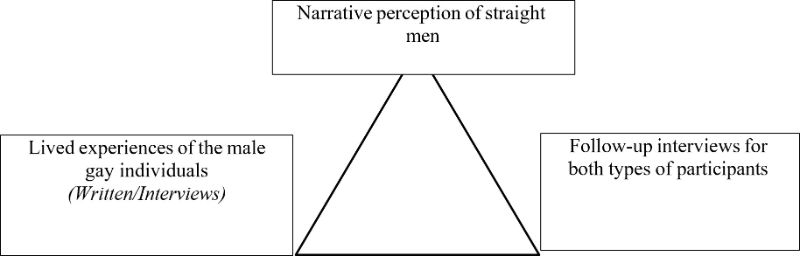
This study employed the triangulation method to gather data. There were three stages in the collection of data, the first stage involved the lived experiences of the male gay individuals in two forms – written and interviews. The second was the narrative perception of straight men into their acceptance on the possibility of homosexual relationships and how they might respond to someone who have disclosed their feelings to them. Then, those responses were compared and analyzed to find possible intersections and connections that will be basis for follow-up interviews.
The participants involved agreed upon that their responses and identity will be kept confidential, and the data will be stored for two years, the purpose of it was for validation. The personal information was not used in this paper instead code names were provided in each participant. No photos were taken, and every interview was off-the-record since they had provided narrative written responses before, and to ensure that there was no misinterpretation of their responses, the researchers mentioned the question twice and showed the participants the highlights or synthesis of what they had provided during the in-depth interviews.
The tools used for the analysis were the narrative analysis, based on the narrated lived experiences of the participants, and the themes and patterns were discerned and analyzed. The identified codes were compared and categorized to reveal specific themes from the participants' responses. To counter-check the identified themes, the responses without information about the respondents were presented to the intercoders, since both researchers have a background in linguistics, they agreed upon the codes and themes,
prior to presentation of them to the non-involved intercoder in the study. In this case, the qualitative data may be deemed reliable as researchers acting as intercoders, and the non-involved persona was included to identify codes and themes as well.
This section presents the results and analysis of the gathered data. Below is the profile of the ten gay male participants in the study.
Table 1. Participants’ Profile
|
Codename |
Age |
Relationship Distinct Experiences Status |
|
|
G1 |
18 |
Single |
Expressed repeated experiences of rejection and discrimination |
|
|
|
|
due to being openly gay. |
|
G2 |
19 |
In a situationship |
Confessed feelings to a straight man but was turned down; he |
|
|
|
|
remains optimistic about love. |
|
G3 |
20 |
Single |
Viewed attraction to straight men as natural and valued the |
|
|
|
|
emotional connection over physical attraction. |
|
G4 |
18 |
In a situationship |
Not yet rejected as he felt mixed signals yet afraid to make the |
|
|
|
|
first move. |
|
G5 |
19 |
Single |
Chose to hide emotions from straight men to avoid ridicule or |
|
|
|
|
losing friendships. |
|
G6 |
21 |
Single |
Experienced rejection but asserted strong self-worth. |
|
G7 |
29 |
Single |
Believed rejection was part of love; used faith and humor to |
|
|
|
|
cope with emotional pain. |
|
G8 |
25 |
Single |
Had fallen for multiple straight men; accepted unreciprocated |
|
|
|
|
feelings without bitterness. |
|
G9 |
19 |
In a situationship |
Desired emotional reciprocity and hoped society would |
|
|
|
|
normalize same-sex love. |
|
G10 |
23 |
Single |
Rejected but chose to explore more. |
All of the participants were still in the youth sector, and provided significant experiences regarding the acceptability and denial of feelings towards straight male individuals. Based on the profile and experiences of the participants, most of them experienced rejection but used it for personal growth, as G6 claimed, “I’ve been rejected many times, but I learned to love myself more.” In comparison, G10 and G 7 have their own ways to cope with the rejection as they provided humor and faith. As the latter said “itinatawa ko na lang, as it was part of being bakla”; this maturity response was also supported with the experience of G8.
Overall, the governing experiences of the participants focused on rejection, acceptance, and stigma surrounding the kind of love they were hoping for and aspiring to, as the younger participants were more likely to encounter mixed signals and were unable to confess due to fear of rejection.
On the other hand, based on the data gathered, the following themes had emerged in reference to the responses of the primary participants of the study.
Table 2. Decoded themes and codes for the Male Gay Individuals
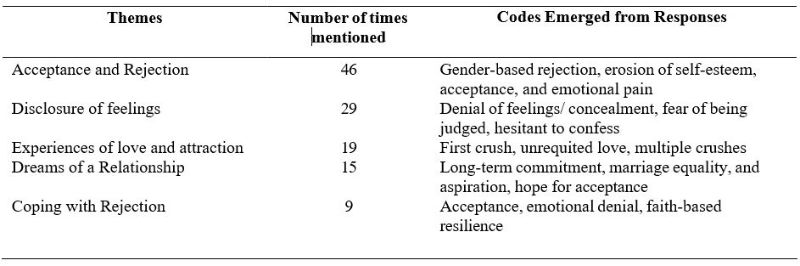
The frequent themes that appeared were the Acceptance and Rejection (f=46), in which the feelings of gay individuals towards straight males could be accepted or rejected due to their identity, appearance, or circumstances of attraction.
Most of the participants narrated that their feelings were often unreciprocated, primarily due to gender identity or perceived attractiveness. Dominant statements were “crush ko lang siya, alam ko naman di ako pipiliin,” “hindi at kailanman hindi yata ako kapilipili due to my gender identity”, “may pipili man but they are after looks and money, sa reality lang tayo.”
In this, the rejection and acceptance were visible. Participants shared that they confessed their feelings, but most of the time, straight males turned them down. Meanwhile, others mentioned that they had never been chosen despite their efforts and sacrifices. These experiences highlighted the phobias that LGBTQ+ individuals face in relationships with straight men – whereas rejection was frequently tied not just to personal preference but to societal norms and prejudices.
Furthermore, participants claimed that managing their feelings and keeping them bottled up would be hard to maintain. They have admitted to hiding their feelings from straight men as they fear being ridiculed, rejected, or losing friendships. Although some embraced openness, most described concealment, but it would be an unhealthy way to cope with their feelings. This indicated an internal conflict between their desire to express love and their need to protect themselves from pain or judgment. Most of the direct statements were “Oo, kasi mas kinakaibigan lang nila ako”, “Oo, cause alam ko naman na baka laiitin lang din ako,” and, “Know because of what happened before, I really choose to hide my feelings.”
Another theme that emerged was the experiences of love and attraction. The participants openly admitted that they had experienced falling in love, and sometimes they did their best to win the guy they wanted. They openly shared that they often have multiple crushes, which can lead to emotional investments later on. It was interesting to note that, although attraction was a universal experience, the outcomes varied — some found mutual affection, while the majority faced repeated unrequited love. With these experiences that they had, it reflected how LGBTQ+ individuals experience the same range of romantic emotions as their heterosexual peers, but compared to the latter, homosexuals encounter more challenging circumstances. Most of the directed statements were “Marami ako crushes pero hanggang dun lang yun kasi nag iinvest ako time and effort kung mainlab ako sa huli ako rin naman kawawa,” “I think it is normal to have attraction but I limit myself, you know naman here in our society and the family dynamics we have,” and, “I am fully attracted with straight male as they provided or gave me that I am a woman like in the heterosexual attraction eme.”
The fourth theme was the dreams of a relationship, whereas the majority of the participants stated that they have been dreaming of getting a long-term relationship, where true love exists. Participants dreamed of being engaged and married to straight guys, building a family, or simply having a partner who would accept them. This shows that despite the barriers, the hope for a stable and loving bond remains strong. Their visions often emphasized respect, loyalty, and acceptance, reflecting a yearning not just for romance but for validation of their worthiness to love and be loved. Most of the responses were “Oo naman, pangarap ko makasal at makahanap ng jowa pang matagalan na hindi ka peperahan lang”, “I am wishing to have a long term relationship like a normalized relationship of men and women,” and “Alam ko imposible but sana makahanap naman ako kahit ganito ako.”
The last theme was Coping with Rejection, with the experiences that participants had, they felt trapped by what was dictated by society, where straight males are intended only for women. Hence, participants provided various ways of coping with the rejection that they received. This provided a glimpse of resilience and positivity after being rejected, as they claimed it was expected due to societal standards and their strong faith in Christianity. Some of them accepted the rejections gracefully as they believed that not everyone is meant for them. Meanwhile, others struggled with regret and denial. A few anchored their coping in faith, hoping that the right person would come in time. These responses revealed the resilience and emotional strategies LGBTQ+ individuals employ when navigating love in heteronormative contexts, but it should not be the other way. This meant that in today's Philippine society, we accept gay individuals, but many of us are afraid to give them the right to love openly and freely.
Table 3. Decoded themes and codes for the Straight Male Individuals
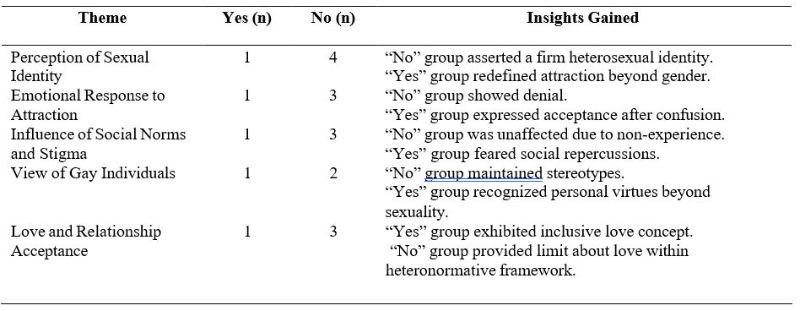
The table provided that the majority of straight males were debunking the ideas of accepting homosexual relationships, as it may affect how they viewed them, with the common response “baka kasi isipan ng iba bakla rin ako,” or “baka sabihin pera lang habol ko saka di ko talaga kaya”. This meant that straight male were perceived as having a same sex relationship, which may diminish their concept of masculinity provided by society. In contrast, there was a straight participant who was brave enough to go beyond the label as he redefined attraction beyond gender “ayos lang sa akin kasi sa kanya tumibok puso ko bakit ba?”.
On the other hand, for the emotional response to attraction, straight men claimed that they truly denied any feeling towards the same sex. There was one participant who claimed that it made him confused at first since he was attracted to the same sex. “Akala ko hindi normal pero mararamdaman mop ala ‘yun kasi beyond gender you choose someone dahil sa katangian niya,” as stated. In terms of the influence of social stigma, the majority claimed that they have no experience with such due to they were not truly involved or being attracted to the same sex, but one participant stated, “Natatakot talaga ako sa patutunguhan sa iisipin ng pamilya at kaibigan ko, sa mga tao sa paligid ko kaya hindi ko tinuloy.”
From the view of straight men to the gay individuals, many of them viewed gay individuals as comrades, but not with the possibility of having a relationship with them. They have a strong presence of stereotypes, especially when it comes to having a relationship with them, as stated, “Hanggang kaibigan lang talaga kaya ko.”
The study provided that the lived experiences of gay male individuals, as Disney princesses, who fell in love with straight guys, were accompanied by emotional, psychological, and social dynamics that put them in a disadvantaged situation. Based on the narratives, the villains identified in the narratives were social expectations among straight men, stigma, heteronormative standards, prejudice, and internal struggles to open up their feelings to those they loved. These villains trap gay male individuals and some straight males to bottle up their feelings, which leads to an unhappy ending for our Disney princesses in this study. This interpreted that gay individuals navigated a complex emotional journey for the love that they were longing to experience.
From the provided responses of the participants, five key themes emerged these were Acceptance and Rejection, Experiences of Love and Attraction, Dreams of a Relationship, and Coping with Rejection. This put the Disney princesses of this study between pulling off their authentic selves or hiding them when it comes to love due to the fear of social judgment. Likewise, the written responses of the straight males revealed the same.
Nonetheless, the resilience of the Disney princesses in this study is shown through how they dealt with rejection and turned it into acceptance. Despite what they have gone through at the hands of their cruel villains, they remained optimistic and expressed their utmost yearning for equality, mutual respect, and emotional freedom when it comes to love.
To conclude, the experiences of falling in love with a straight man of our Disney Princesses reflects both the universality of love and the unique challenges of marginalized sexual identities. The gay participants’ stories exemplify not just longing but resilience, authenticity, and an enduring belief in love’s transformative power, even when that love remains unreturned, as stigma and prejudice were present always.
For the recommendation, the study would like to recommend that, based on the narrative provided by the participants, a self-rated questionnaire should be made to quantify the findings of this paper. Future researchers may use the qualitative and quantitative findings of this study to foster support and safe spaces for those who will be struggling to express their feelings openly due to the judgment that they might meet in a heteronormative society. The educational institutions may help to promote visibility of stories regarding the acceptance struggles of homosexual individuals. As the journey of gay men falling in love with straight individuals is one that combines pain, courage, and self-discovery, the findings of this paper may be used to craft gender-based counselling or activities to promote equality in all aspects of our lives, in particular to express our love despite gender differences.



Open Access By Aditum Open Access Journals id licensed under Creative Commons Attribution 4.0 International License. Based On a Work at aditum.org


