
The Journal of Social and Behavioral Sciences
OPEN ACCESS | Volume 3 - Issue 1 - 2026
ISSN No: 3065-6990 | Journal DOI: 10.61148/3065-6990/JSBS


Jyotsna K1 and Abhishek B.P2*
1Speech Language Pathologist, San-Jose, United States of America.
2Assistant professor in Language Pathology, AIISH Mysuru.
*Corresponding author: Abhishek Budiguppe Panachakshari, Assistant professor in Language Pathology, AIISH Mysuru.
Received date: June 24, 2024
Accepted date: July 01, 2024
Published date: July 05, 2024
Citation: Jyotsna. K and Abhishek B.P. (2024) “Inestigating Lexical Semantic Organization in Neurotypical Adults.”, Journal of Social and Behavioral Sciences, 1(1); DOI: 10.61148/JSBS/003.
Copyright: ©22024 Abhishek Budiguppe Panachakshari. This is an open access article distributed under the Creative Commons Attribution License, which permits unrestricted use, distribution, and reproduction in any medium, provided the original work is properly cited.
The lexical semantic organization has been extensively studied over the course of decade’s worth of literature in the developmental population. The studies propose a trajectory of the shift in dominance of one kind of organization, through the course of childhood, but very few instances are available of this trend being tracked over the course of adulthood. In addition to this, literature in lexical semantic organization has seldom been explored by employing free word association tasks. Thus, the following study was an attempt to investigate the semantic organization in adults, while taking note of the age, gender, and modality based differences. A group of 80 neurologically healthy Kannada speaking adults, in the age groups of 20- 60 years were included as participants. Each of the participants was tested using a discrete word association task presented through visual and auditory modality. The results have been discussed in terms of dominance across various categories (thematic/ taxonomic/ attributive/ evaluative) of responses in the population studied, further, the trend of Most Common Responses were also explored.
Introduction:
Communication may take place through many primitive modes such as non-verbal gestures, blinking, vocalizations, etc. Language is the use of a sophisticated set of symbols for communication. The human language is a highly evolved code that functions through the coordination of intricate systems that originate from the neural network. A vital part of any language is the words. The humans have an astounding amount of vocabulary in their store, in order to use these languages effectively. Thus, comes about a substantial question regarding where it is all stored, and the way in which it is organized in this storage is. In order to inspect this, we would need to have an understanding of the formal aspects of language:
Language is inclusive of the following aspects- Phonology, Morphology, Syntax, Semantics, and Pragmatics. Semantics is the branch of language concerned with the study of meaning. (Breal, 1897) Study of the meaning of language may be further branched to include lexical semantics, grammatical semantics, and logical semantics. Grammatical semantics relates syntactic aspects to the meaning. Logical semantics links the logical systems to language while; lexical semantics is the study of association of word to meaning. The current topic is centered on the lexical semantic relations shared by the words in the lexicon. The study of the lexical semantic organization is an indispensable part of a study of language because words are not stored in isolation, but in relevance to each other, based on various properties they share, concepts, contexts in which they are linked, etc. Hence this is an important aspect in order to decipher the lexicon.
According to Fasold. & Connor-Linton (2006), the sense of relation between the words in the lexicon may be studied in broader terms of three major classes, namely: paradigmatic, syntagmatic, and derivational. Paradigmatic relations are found between words that belong to one category. These may also be termed as taxonomic associations or linear relationships, example: category co-ordinates (cat- dog- goat). Syntagmatic relationships are thematic associations or horizontal relationships, example: co-occurrence based (dog- leash- bone). Paradigmatic relationships may be exercised under syntagmatic relationships. Derivational relations are a third class of association in lexical semantics, where word classes or families are a common point of origin, example: Cook, cooker, cooking, etc. These words maybe separated by the use of affix amidst them. Among the three classes of relations mentioned above, paradigmatic and syntagmatic relations have been widely explored. Borghi, Caramelli and Setti (2016), in their study of the lexical semantic organization in the developmental population, further proposed an inclusion of two broader categories to classify the semantic relationships; namely: Attributive and Evaluative responses.
Attributive relations refer to perceptual/ physical characteristics and part-whole relationships shared between words. Eg: Pillow- Cotton, Cotton- white/ soft, etc.
Evaluative relations refer to experience or thoughts that are internalized, generalized sayings, idioms, etc. Eg: Candy – Really like/ bad health. The semantic relations listed above may be inspected through various perspectives including neurolinguistic and psycholinguistic realms. The literature has mentions of these two methods, a majority slightly tilted toward the psycholinguistic aspects. This brings us to the need for the current study.
There exists a gap in literature with respect to free word association tasks, in various facets:
Only a few works of literature have addressed the modality based differences that exist in lexical semantic organization:
Holcomb and Neville (1990) explored the above using an Event-related Potential (N400), and found that auditory modality has an early onset latency, and is more persistent over the visual modality. Fischer, Daltrozzo, and Zumbusch, A. (2011) gave support to the above findings through a lexical decision task. The available literature concerned with exploring developmental aspects of lexical semantic organization is in abundance. There are studies that support the occurrence of a “shift hypothesis” in children. At a younger age, taxonomic and thematic associations are present, (Waxman & Gelman, 1986). Younger aged children prefer thematic relations (event-based co-ordinates) over taxonomic connections (category co-ordinates) on cued and serial recall tasks. The taxonomic associations are bolstered by the fast development of vocabulary at that age. Owing to the expansion of vocabulary in the pre-school period, children have a change in the tendency to prefer taxonomic over thematic associations. This phenomenon has been termed as the shift hypothesis. As the child’s vocabulary develops, the words are organized hierarchically and stronger relationships amongst certain concepts emerge over time.
In the Indian context, notable studies suggest the plausibility of the shift hypothesis in developmental aspects. Chithra and Prema, 2008, investigated the lexical semantic organization in bilingual children of age 6-8 years. Repeated word association task with thematic and taxonomic examples was administered, and the results of the study indicated that children at 6 years of age dominantly associated thematically, and in the developing years, a paradigmatic (taxonomic) shift was noticed. Thus, this is in support of the association shift paradigm in children. A few studies have attempted to investigate the lexical semantic organization in children and compare the results with those of adults:
In an investigation by Smiley & Brown in 1979, where they employed a match-to-sample task, in which the participants were forcibly asked to match the given stimuli to either a taxonomically or a thematically related item, found that children and the elderly prefer thematic relationship, whereas adults have a preference towards taxonomic matches. In contrast to the above study, Radeau in 1983 compared the semantic organization between adults and children, through a lexical decision task. The method employed used semantically related and unrelated word pairs to verify the effects of semantic priming. Through the findings, he concluded that the semantic organization in children beyond 6-7 years of age could be equated to that of adults’. This is in a continuum with the shift hypothesis mentioned in children there have been few mentions in the literature about the preferential associations in adults. Thus, there have been very few attempts in the past to establish the semantic associations beyond the developmental frame, and those that exist are inconclusive. Further, the methods frequently used to study the associations have been a closed set task including matching, sorting or recall tasks. This has the potential to bias the participants and affect the results.
A study by Murphy in 2001 has proven this by comparing tasks involving stimuli that were strongly taxonomically organized with stimuli that were strongly thematically organized, and the participants were asked to perform a sorting task. The adult participants preferred taxonomic association in the former task and thematic associations in the latter. Hence, the method of testing and the stimuli have always played a major role in identifying the associations under test. Landrigan and Mirman, (2016) conducted an online survey wherein the participants were supplied with a questionnaire that contained 659-word pairs and they were asked to rate them as being taxonomically or thematically related with two different set of instructions. The results revealed that the participants rated the stimuli as being dominantly taxonomic/ thematic, based on the instructions given before each task, thus affecting the outcome of the data. Thus, it is seen that closed set task may cause bias. A new approach will aid in gaining another perspective in the adult lexical semantic organization, as the current literature has but modest answers. Hence open set association tasks will serve the purpose of establishing the lexical semantic organization. These include free word associations, discrete word association tasks etc. These terms may be defined as:
Free word association task- Participants are asked to list as many words that come to their mind, as soon as they are presented with stimuli.
Discrete word association task - Participants are asked to list as many words that come to their mind, in relevance to the presented stimuli, as it is being presented.
There have been attempts to make word association norms for children and adults (e.g.: Palermo & Jenkins, 1964), but very rarely in older. Some of the earliest views comparing the elderly with the younger demographic, on word association task, stated: "They are represented better by hierarchies of association principles that differ in the probability of use, rather than by hierarchies of specific word-word affinities" (Moran & Swartz, 1970). In 1982, Lovelace and Cooley studied free association in older adults and revealed that the associations were affected by vocabulary, irrespective of the age.
One of the early views to oppose the above findings included those of Riegel and Riegel (1964), and Bolton and Hamison (1975), who employed a free association task, to compare the younger and elder population, where they concluded that word relationships in the semantic memory affects the association to a given word, and this may be affected with increased age. In 1979, Perlmutter compared younger and older adults, with mean ages 20 and 63, respectively, in a free association task, and found that the elderly participants produced less commonly associated responses, with less consistent responses in repeated trials, as opposed to their younger counterparts. Thus, suggesting differences across age groups. Since then, there have been more support from works of literature, such as Burke and Peters (1987), made an attempt at making word association norms for younger (mean age- 21.7 years) and older adults (mean age – 71.6 years). The two groups were asked to give out relevant words to the stimuli presented, which included verbs, nouns and adverbs. The auditory stimuli presented were simultaneously augmented with visual stimuli on a card.
The participants were not restricted in terms of the number of responses for each word. The results took into account three most common responses in each group under investigation. The study revealed that the three most popular responses had a high variability index of 39.5%, which further strengthens the impression that there may be a variation in responses between the younger and the older population, which are yet to be explored. In 2014, a study by Zortea et al., aimed to investigate age-related differences among children, adults and the elderly through a word association task. Graphical analysis of the responses obtained suggested that the there was an increase in the connectivity of the network across age, reaching its peak in young adults and a slight decline was witnessed in the elderly. The existing literature illustrates that a few attempts have been made at comparing the typical and atypically aging population. The typically aging individuals are shown to have a mild increase in multi word responses to lexical naming tasks due to word finding difficulty. (Loon-Vervoorn &Willemsen,1987). Fitzpatrick, Playfoot, Wray and Wright in 2015 compared word association responses between the elderly population with and without dementia and reported that the elderly tended to give multi-word responses and blank response. These findings further fortify the plausible shift in word association due to word finding and retrieval difficulty due to aging.
In the context of Indian literature, a few studies in the recent years have made use of free association task in order to explore the semantic organization in developmental population. These include:
Nithya and Prema, 2017, who compared children across 6-9 years of age using free association task on a set of abstract and concrete word stimuli and the results were suggestive of a dominant attributive, relationship, followed by the taxonomic, introspective and thematic relation in the case of concrete words. A noteworthy attempt to explore the lexical semantic organization in Indian adults through word association task was made by Prarthana and Prema (2013). The study aimed to determine the mental lexicon for nouns and verbs in adult speakers of Kannada. The participants were given concrete and abstract nouns and verbs. They were asked to give out words which came to their mind as soon as the target stimulus is presented. The responses were analyzed and a set of possible words associating with the target word were determined.
In summary, the past research has established many views on the organization of the mental lexicon in the developing population, with an auxiliary role played by the Indian literature. There have been very few works that focus beyond the developmental frame. To add to this, in the available reports of adults, there have been rare employments of open set tasks to investigate the Lexical semantic organization.
Method:
In reference to the review ensconcing the need to study lexical semantic organization in adults, the present study aimed to investigate lexical semantic organization in four groups of participants, ranging between the ages of 20- 60 years. Henceforth, the participants from-20- 30 years, 30- 40 years, 40 to 50 years, 50 to 60 years; will be referred to as – Group I, Group II, Group III, and Group IV, respectively. This categorization was done to facilitate the study of Lexical semantic organization in terms of aging. The study design was a standard group comparison. The tests were carried out through auditory and visual stimuli, in order to explore the diversity in responses through the two modalities. 20 words each, were used to elicit responses through both the modalities. The tests were counterbalanced by exposing the participants alternately to auditory and visual stimuli in different order for different participants. The responses were further categorized based on the semantic relationship to the stimulus.
Participants:
A group of 80 neurologically healthy individuals between the ages of 20- 60 years served as participants in the study. A total of 20 participants (10 male and 10 female) were included through convenience sampling under each age group. All the participants were given a discrete association task, wherein they were asked to list five words, relevant to the presented stimulus. All the participants were enrolled in the study through prior informed consent. The inclusion criteria of the participants are as follows:
Inclusion criteria:
Initially, demographic details of the participants in terms of age, gender, education, occupation, were collected to verify their criteria to be categorized in a group for the study. All the participants enrolled in the study were required to have normal cognitive functions with no history of cognitive communicative disorders. Further they were required to have high school education of more than 10 or more years. Literacy level in the inclusion criteria has been set as mentioned above as it has been sourced through literature that children with more than six years of education perform more closely to adults in association tasks, than adults who lack literacy. (Cole, 1990; Nelson, 1977) Intact physical status with mother tongue as Kannada, were also set as required criteria.
Stimulus:
The experiment consisted of two tasks: One task had twenty visual stimuli; the other included twenty auditory stimuli. All the words were concrete, picture-able, nouns, across various lexical categories -animals, common objects, body parts, fruits; in order to elicit responses.
The visual stimuli were colour photographs, taken from Internet web pages and presented on a laptop (HP Pavilion g6) with 15.6” monitor. They were presented at a comfortable distance of 15” from the participants.
Example:


Figure 1: Examples of Visual stimuli representing: /mara/, /koduglu:/
The auditory stimuli were preseneted by the clinician,at the time of testing. A few words include:
Procedure:
The study included neurologically healthy individuals aged between 20- 60 years and organized as four groups. The participants were instructed to list five words relevant to the presented stimulus. The stimuli consist of twenty pictures presented through visual modality, presented through Microsoft PowerPoint (version 2010), and twenty auditory stimuli presented, by the investigator.
Task:
Each participant was presented with a total of twenty visual and twenty auditory stimuli and they were instructed to name five words relevant to each presented stimulus, and instructed to do so in Kannada. The participants were given examples as mentioned above with the instructions only in Task one. The participants were not restricted by time, for either of the tasks. They were not provided with cues during the procedure. The order of presentation were Visual followed by auditory, in some, and vice versa in the others.
Testing Environment:
The testing was carried out in a well-ventilated room with minimal intrusion from noise or light. The participants were seated comfortably throughout the duration of testing. The responses were recorded by the investigator using a voice recorder, at the time of testing, for convenience. It was later transcribed for analysis.
Results:
The present study aimed at investigating the adult lexical semantic organization. The main objective of the study was to investigate the lexical semantic organization as a function of aging and gender. The secondary objectives included studying the lexical semantic organization with respect to the modality of stimulus presentation and third objective was to determine the Most Common Responses (MCR) for visual and auditory word list. The first step towards the objectives described was to classify the responses obtained in one of four categories: Thematic, Taxonomic, Attributive, and Evaluative. The responses were classified based on the definitions given by Borghi, Caramelli and Setti (2016); by the investigator.
The independent variables included in the current study were: age, gender, modality of task presentation and the dependent variables included the categories of lexical semantic organization (Thematic, Taxonomic, attributive, and evaluative)
The number of responses in each of the categories was calculated, and the number of responses given by each participant was different, in spite of repeated instructions given while obtaining the responses, due to lack of adherence to the word limit (5 words). Thus, percentages of the same were calculated in order to facilitate comparison of the four categories of responses mentioned above.
A standard group comparison was carried out with the data. Gender differences were calculated with age as an independent variable and age differences were calculated with gender as an independent variable. Further, task differences within each modality, according to the age and gender, were calculated in order to find the dominant pattern of lexical semantic organization.
Statistical analysis was carried out with SPSS software 20.0. Test of normality was initially carried out using Shapiro Wilk test of normality and Kolmogorov- Smirnov test. The data failed to follow normality with four significant outliers that affected the median value, hence the outliers were removed and further analysis was carried out using non- parametric tests.
The objectives of the study were in the following order:
To investigate the responses of a Discrete Association Task in neurologically healthy individuals, to study:
The high values of Standard deviation throughout the data and the lack of normality lead to the inference that the median values are of importance, and non-parametric tests using the same were carried out.
In order to further elucidate objective 1, non-parametric tests including Kruskal-Wallis- to find age wise differences, and Mann-Whitney U test to look for significant gender-wise differences were carried out. Further pairwise comparisons in the gender that revealed a significant difference (Female) were carried out through Mann-Whitney U test. The differences between the modality of stimulus presentation (Auditory and visual) were calculated separately across the genders and age groups using Friedman’s test.
The comparison of the four age- groups was done with gender as an independent variable, through Kruskal- Wallis test. This revealed significant differences in females across the age groups, thus the data from this group was further subjected to pair-wise comparison through Mann- Whitney U test.
Male
In males, this comparison across age groups revealed no statistically significant differences (p> 0.05) in any of the response categories. Thus, the results suggest that no age related differences exist in males.
Female
|
|
|
ThAP |
ThVP |
TAP |
TVP |
AAP |
AVP |
EAP |
EVP |
|
|
|
|
|
|
|
|
|
|
|
|
|
/z/ |
8.377 |
2.033 |
6.974 |
5.885 |
7.986 |
9.586 |
21.17 |
26.405 |
|
|
P value |
.039 |
.566 |
.073 |
.117 |
.046 |
.022 |
.000 |
.000 |
|
|
|
|
|
|
|
|
|
|
|
Table 1: Comparison across genders through Kruskal- Wallis test.
In females, this comparison facilitated the revelation of significant differences (p<0.05) in all the response categories except the following: Taxonomic-auditory and visual, Thematic- visual. Thus, in females, there were significant differences across age groups in ThA_p, AA_p, AV_p, EA_p, and EV_p, with /z/ values of 8.37, 7.98, 9.58, 21.17, and 26.40, respectively. Thus, the results are suggestive of age based differences in female gender.
The results indicate the presence of age-wise difference that is statistically significant in the female gender. The age related differences in lexical semantic organization have been studied in the available literature in the context of free association task. The current finding on the age-related differences finds support in studies by Riegel and Riegel (1964), Hamison (1975), and Perlmutter (1979) which have previously proposed age related differences, stating that association for concrete nouns varies with age, across adults. The most recent study available in this context, done by Burke and Peters (1987) also portrayed 39.5% variability across the ages from adults to geriatrics. Thus, this change in the organization as a function of aging finds support through the existing literature, although gender-based comparisons of this change have not been previously explored. Since variability was seen to exist in the groups, the between-group differences in modality of stimulus presentation have also been compared:
The current findings suggest that significant modality based differences exist in three out of four response classes taken into account in the study including Thematic, Attributive, and evaluative response classes, especially in the younger age group.
Comparing the median values, as done in the earlier part of this section, revealed that thematic category responses significantly higher in auditory rather than the visual modality, and varying dominance existed in the other response categories. The current finding of the existing difference across the modalities have been previously studied in closed set tasks by Holcomb, and Neville,1990, and Daltrozzo et al., 2011. They state that there exist subtle differences across the two modalities and the existence of an earlier onset for the auditory modality. Correlating with the current findings, where auditory modality is seen to facilitate the thematic class of responses, which is the most dominant category across all the age groups compared, constituting a major share of all the responses. Thus, this study supports the modality based difference through the free word association task.
Comparison across gender:
In par with the above stated objective 1, comparison between the two genders, with age as an independent variable was carried out using Mann-Whitney U test. The following graphs display a comparison of the median values of percentages of various response categories within the four age groups considered to facilitate comparison across the two genders:
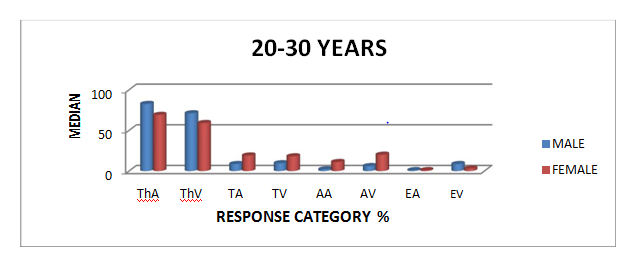
Figure 2: Median values of Group I
The median values of the two genders reveal apparent gender-wise differences in group I, which have been further analysed using Mann- Whitney test. The test revealed a statistically significant difference (p<0.05)in four response categories, namely, ThAP, TAP, TVP, AVP, in this age group, with z values: 3.189, 2.414, 2.003, and 2.29, respectively.
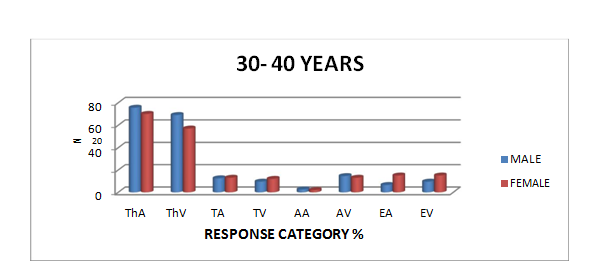
Figure 3: Median values of Group II
The median values of the two genders reveal statistically insignificant (p>0.05) gender-wise differences in group II, through Mann-Whitney U test.
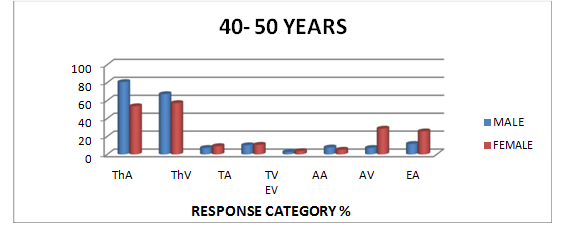
Figure 4: Median values of Group III
The median values of the two genders analysed through Mann- Whitney U test revealed a statistically significant difference (p<0.05) in group III. The following response categories: ThAP, ThVP, EAP, EVP with the z values: 2.496, 2.086, 3.48, 3.25, respectively, showed significant differences. The median values of the two genders analysed through Mann- Whitney U test revealed a statistically insignificant difference (p>0.05) in group IV
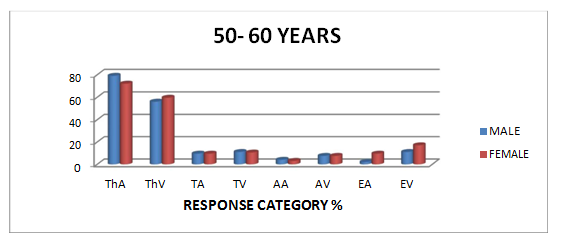
Figure 5: Median values of Group IV
The results of the Mann-Whitney U test were suggestive of gender wise differences in Gp I (for Thematic Auditory, Taxonomic- auditory and visual, and Attributive visual) and III (for Thematic- auditory and visual and Evaluative- auditory and visual). Thus, four of the eight measured response categories showed significant differences in group I and III, suggestive of gender-wise difference, hence the two genders were considered separately for the age wise comparison, stated earlier.
The gender difference in lexical semantic organization is indicated to exist in Group I and Group III, in the present study. This is an aspect that has been rarely studied in the past. In the developmental population, studies including Nithya and Prema, 2017, have indicated the presence of gender difference in certain parameters in the developmental population. But, since the adult population in this study did not show a continuous difference across the gender in age groups, and descriptively, all four age groups did not show a very significant deviance in their response pattern, this gender difference could be attributed to the heterogeneity of the sample considered.
Most Common Responses:
The most common responses (MCR) for each category, tabulated for all the age groups and the two genders. The three most common responses for each word, along with the number of times the responses occurred in each group were calculated. The trend of the first MCR across both the modalities has been compared as follows:
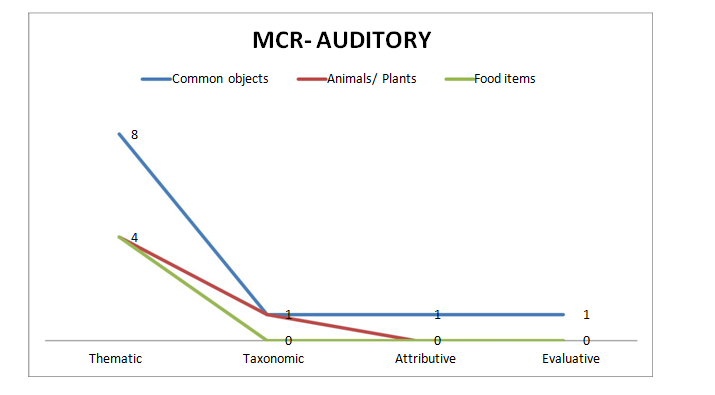
Figure 6: Representation of the 1st MCR in the auditory modality
The other MCR in case of common objects and animals included, one each in taxonomic and attributive and evaluative categories. (/haɖu/- /pakʃi/, /hasu/-/biLi/,)./koLalu/- /kriʃna/). Thus, the most common responses obtained across all the ages and genders compared, imply thematically dominant pattern for all the lexical categories included i.e.; common household objects, animals/plants, and food items. This is in line with the trend exhibited by the responses of being dominantly thematic, across modalities. The calculation facilitated comparison of various lexical categories including common household objects (11), animals/ plants (5) and food items (4), in each modality.
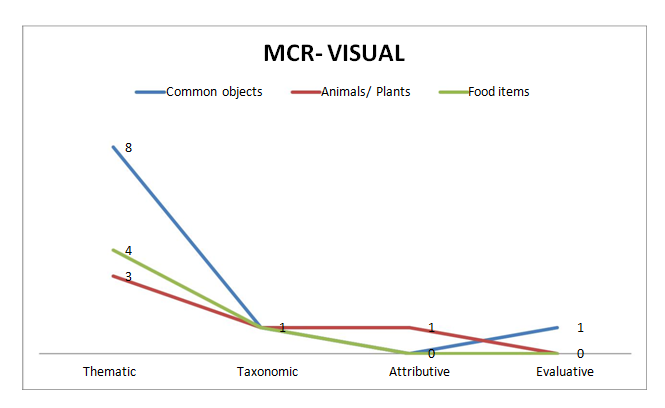
Figure 7: Representation of the 1st MCR in the visual modality
The above figure is a visual representation of the number of times the 1st MCR in the auditory modality along with the response category (Thematic, Taxonomic, Attributive, and Evaluative) each of them belong. The MCR, in line with the most dominant class of responses cited previously in the results, constitute primarily of the thematic category. (Example- /ungu:ra /- /maɖvɛ/, /gu:bɛ/- /ra:tri/, /mɛnsu- /kemmu/). This was the trend seen in all three lexical categories included in the study. The other responses class included one each in Taxonomic ( /kurtʃi/-/medʒu/) attributive (/mara/- /hasiru/), and evaluative (/manɛ/- /ʃa:nti/) in the common objects category, and one taxonomic MCR seen in animals was (/gu:bɛ/- /pakʃi/). The comparison across various lexical categories in the visual modality included the following: common household objects (10), animals/ plants (5) and food items (5).
The following is a visual representation of the number of times the 1stMCR in the visual modality along with the response category (Thematic, Taxonomic, Attributive, and Evaluative) each of them belongs. A previous attempt to compile the MCR in Kannada language was done by Prarthana and Prema, 2012, where the study suggests the existence of various feature based relations for concrete nouns, which are not arbitrary in nature. The verbs, on the other hand, had very few feature based relations. The current study has included only concrete nouns, and has witnessed a concrete feature based relation for the 1ST MCR. The succinct version of the present findings also suggests a high thematic incidence of the relationship to the word, across all age groups.
The inter-rater reliability for the classification of responses as belonging to one of the four response categories was obtained. Operational definitions of Thematic, Taxonomic, Attributive and Evaluative responses were circulated to two Speech Language Pathologists with a Master’s degree qualification. 10% of the obtained responses were subjected to this reliability check. The obtained percentages of responses belonging to each of the categories were subjected to comparison using Cronbach’s Alpha (ɑ) test of reliability. A value of (ɑ) 0.906, was obtained through this, suggesting high reliability.
Conclusion:
The present study aimed at investigating the lexical semantic organization in adults. It attempted to examine four categories of responses across age groups, gender, and modality of responses. The study also aimed at giving out most common responses for the same. The study employed a discrete word association task, an open set task, in order to facilitate this comparison across the categories of comparison stated above. It was implemented through 20 words presented in auditory modality and 20 words presented in visual modality. The participants were required to respond verbally to each of the words presented with 5 words, related to the stimuli. The responses obtained were transcribed in broad IPA and categorized as belonging to thematic, taxonomic, attributive, or evaluative, class of responses ( Borghi, Caramelli, &Setti, 2016) and the number of responses belonging to each category was calculated and processed through SPSS version 20.0. The median scores varied across gender. The trend of responses remained constant across the the groups
Implications of the study:
This research contributes to the existing literature about word association in elderly individuals and has attempted to elucidate if age is a determinant for degradation in associations. The study helps establish thematic association as being dominant across all the age groups, in accordance to the currently existing sparse literature. The differences found across the responses with respect to different modalities and age groups help us realize the need for further development of age and gender specific norms. The study has contributed to developing cues, through the MCR, which serve as markers for enabling production of certain words in assessment and intervention of individuals. The current findings of Most Common Responses may be used in priming based studies.



Open Access By Aditum Open Access Journals id licensed under Creative Commons Attribution 4.0 International License. Based On a Work at aditum.org


