
Journal of Dermatology and Venereology
OPEN ACCESS | Volume 4 - Issue 1 - 2026
ISSN No: 3065-677X | Journal DOI: 10.61148/3065-677X/JDV

Sergei V. Jargin
Peoples’ Friendship University of Russia
Miklukho-Maklaya str. 6, 117198 Moscow, Russian Federation.
*Corresponding author: Sergei V. Jargin, Peoples’ Friendship University of Russia
Miklukho-Maklaya str. 6, 117198 Moscow, Russian Federation.
Received: August 02, 2026 | Accepted: August 22, 2026 | Published: August 26, 2026
Citation: Sergei V. Jargin., (2026) “The Treatment of Gonorrhea in Russia: Past and Presence” Journal of Dermatology and Venereology, 4(1); DOI: 10.61148/3065-677X/JDV/062.
Copyright: © 2026 Sergei V. Jargin. This is an open access article distributed under the Creative Commons Attribution License, which permits unrestricted use, distribution, and reproduction in any medium, provided the original work is properly cited.
Topical treatments of gonorrhea, routinely used in Russia in the recent past and recommended by some manuals to date, have been known to the groups of risk, discouraged them from visiting the dermato-venereological dispensaries (prevention and treatment centers). Infected individuals treated themselves with antibiotics; some of them continued spreading the infection. It seems to be early to completely discard the topical therapy. The antimicrobial resistance is developing. There are concerns that gonorrhea may become untreatable by antibiotics, which would bring the topical therapy back to the agenda. One of the factors contributing to antimicrobial resistance is the use of antibiotics beyond their evidence-based applications. Topical treatments of gonorrhea such as instillations of antimicrobial solutions into the urethra and tests of cure (chemical and mechanical provocations) are briefly reviewed here. Factors contributing to the use of invasive procedures with questionable indications included partial isolation from the international scientific community, insufficient consideration of the principles of professional autonomy and informed consent, as well as paternalistic attitude to patients. In conditions of paternalism, misinformation of patients, persuasion and compulsory treatments are deemed permissible. Suboptimal practices have been used as per instructions by healthcare authorities and leading experts’ publications.
gonorrhea; urethritis; topical treatment; medical ethics
Previously we reported several cases related to the title of this article. One of the observations was that topical treatments of gonorrhea (summarized below) and other sexually transmitted infections, known to the groups of risk, discouraged them from visiting the dermato-venereological dispensaries (prevention and treatment centers). Infected individuals treated themselves with antibiotics. More responsible ones administered themselves regular courses of antibiotics; but others continued spreading the infection [1].
During the Soviet time, some motivated physicians purchased expensive foreign books. Even in central libraries of Moscow new editions were generally not available [2]. Apropos, today the libraries acquire almost no foreign clinical manuals; but some valuable books are available in an electronic form, being readily plagiarized [3]. The situation has radically changed thanks to the free Internet resources, PubMed in the first place, used by freeloaders worldwide.
According to the recommendations by the Russian Society of Dermatovenerologists and Cosmetologists, chemical and mechanical provocations as tests of cure of gonorrhea (discussed below) are not indicated. In regard to the topical therapy such as the instillations of antimicrobial solutions into the urethra, it is claimed to be “ineffective” [4,5]. Apropos, the same expert recommended in an earlier edition the topical therapy including washings, bougienage and tamponade of the urethra [6]. Apparently, it is a “once bitten, twice shy” type of reaction. Instillations of antimicrobial solutions may be unpleasant but they are effective if applied correctly. The topical treatment of gonorrhea was inherited from the pre-antibiotic era. After the discovery of sulfonamides and especially of penicillin, the local treatment of gonorrhea and provocative tests of cure have been largely abandoned. Admittedly, during the Soviet time, topical treatments could have been indicated in some cases because of the limited availability of modern antibiotics.
It seems to be early to completely discard the topical therapy. The antimicrobial resistance is developing. There are concerns that gonorrhea may become untreatable by antibiotics [7,8]. One of the factors contributing to antimicrobial resistance is the use of antibiotics in the feeding of cattle, addition to milk and other perishable foodstuffs, which has occurred in Russia [9]. The use of antibiotics as cattle feeding additives was recommended [10,11]. Antibiotics have been used as food preservatives, being found in various foodstuffs (meat, milk, fish, eggs, fruit) often above permissible concentrations [12]. It has been noticed since the 1990s that non-sterilized (short-life) milk is going rancid rather than sour. Pharmaceuticals after expiry date can be acquired inexpensively. Antibiotics in food may cause gastrointestinal dysbiosis and have other adverse effects [13], which is outside the scope of this mini-review. The use of antibiotics beyond their evidence-based applications might accelerate the acquisition of resistance by microbial populations, which has international implications. The need to update the treatment of gonococcal infection to respond to antimicrobial resistance has been pointed out in the Guidelines by the World Health Organization [14].
The treatment of gonorrhea: recent past
Here follow several extracts from instructions by the Ministry of Health, textbooks and manuals containing essentially the same recommendations. The topical therapy was recommended for patients diagnosed with gonorrhea, also in the absence of Neisseria gonorrhoeae in urethral smears, which implied occasional overtreatment of cases with non-specific inflammation. According to some instructions for acute gonorrhea, a topical treatment must be started after the completion of a course of antibiotics. In “fresh torpid” and chronic forms of the disease, the topical therapy was performed prior to the antibiotic treatment (at a hospital) or afterward (in ambulant patients) [15,16]. Some instructions and monographs [17-28] recommended the following topical treatments: ample urethral washings with potassium permanganate solution, instillations into the urethra of 0.25-1 % silver nitrate solution with an additional treatment of focal lesions by 10-20 % silver nitrate through urethroscope. In acute inflammation only distal urethra must be washed during first 3-5 days using ~0.5 l of liquid each time [6]. Urethroscopy was recommended prior to the start of topical therapy [29]. If potassium permanganate washing is ineffective, the same with mercury oxycyanide is recommended by a recently re-edited handbook [28]. The bladder lavage and other applications of the latter substance may cause poisoning; it is not in use long since [30]. Washings with the above-mentioned substances are recommended also for non-specific urethritis. The same author stated that intrurethral manipulations may cause urethritis [28]. The indications for urethroscopy included chronic urethritis of any etiology [31]. Previously we reported on cystitis in radiation-exposed patients after the Chernobyl accident, exacerbated due to repeated urethroscopies and mapping biopsies [32].
The bougienage, urethral massage on the urethroscope or bougie (Fig. 1) and tamponade of the urethra were recommended both for soft and hard infiltration. Subsequently, the urethral mucosa is smeared by ichthammol (ichthyol), a tar-like substance produced from oil shale, or Vishnevski liniment containing tar and xeroform [19,20,22,24,27,31,33-35]. Potential carcinogenicity of both latter unguents has been discussed previously [36]. Up to seven tamponades were performed per a treatment course [31]. The electrocoagulation of paraurethral glands was applied in cases when periurethritis was diagnosed [18]. Both atrophic and catarrhal colliculitis was to be treated by curved bougies [22]. In more recent instructive editions, the following was recommended (verbatim from Russian): “In case of a mixed or firm infiltration a tamponade of the urethra must be performed… Colliculitis is treated by bougienage” [37]; insertion of straight or curved (for the proximal urethra) metallic bougies repeated every 2-3 days; two bougies with increasing diameters are introduced into the urethra during each procedure being left in place for 5-10 minutes. Thereafter, ample washing with potassium permanganate or mercury oxycyanide is recommended [28]. As mentioned above, washing with the latter substance may cause poisoning [30], especially if the mucosa is damaged by the instrumentation. Besides, vaginal washings with mercury bichloride (sulema) were used post coitum at prevention centers [38], which may cause poisoning as well [39]. Similar recommendations, including instillations of silver nitrate, tamponade and bougienage were given in the textbooks [6,16,28,40].
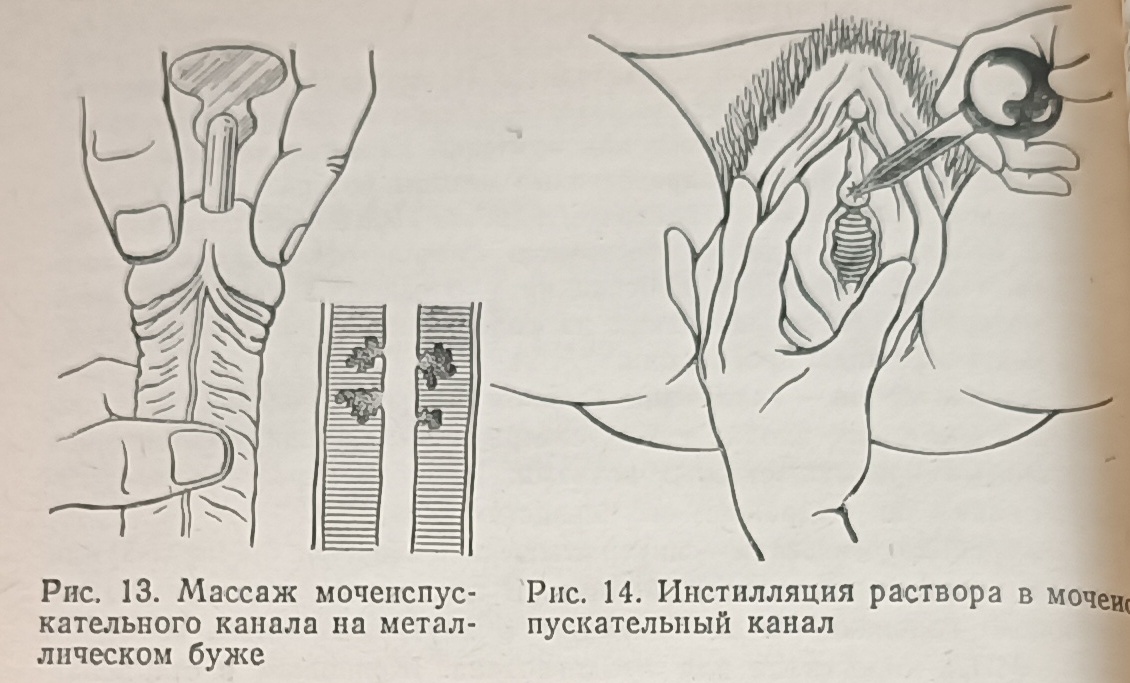
Fig. 1. Treatment of gonorrhea. Left - massage of the urethra on a metallic bougie; right - instillation of silver nitrate solution into the urethra [24].
It is not clearly evident for a pathologist, what kind of histological substrate corresponds to the “firm infiltration”, where the bougienage was recommended [17,19]. Brudner claimed that the firm infiltration is due to fibrosis and noticed “easy vulnerability”. The same expert performed urethroscopy (along with the topical treatment) in 323 women with gonorrhea, concluded that the method must be obligatory for the diagnostics and tests of cure, and recommended a broad use of urethroscopy by gynecologists and urologists in various inflammatory conditions [41].
The tests of cure, recommended for all treated gonorrhea patients, included mechanical and chemical provocations. The latter included instillations of silver nitrate solution into the urethra (0.5-1% for males, 1-2 % for females), smearing of the cervical canal with 2-5 % solution of silver nitrate or with Lugol’s iodine solution. Mechanical provocations included urethroscopy and massage of the urethra on a urethroscope or (straight) bougie (Fig. 1). Combinations of different provocation methods were often used. The first provocation was usually performed one week after the treatment, the second one - a month later. In case of doubt the provocations have to be repeated, also in patients with non-specific urethritis after healed gonorrhea [6,15,24,26,28,35,40]. If symptoms reappear, also in the absence of N. gonorrhoeae in the smears, the treatment and tests of cure must be repeated. The urethral discharge is examined after a provocation several times. In the absence of discharge, an examination of secretions from the prostate and seminal vesicles was recommended. If no N. gonorrhoeae were found after the first provocation, another one including urethroscopy is performed a month later [15].
In addition to the described above, the following recommendations pertain to women. The urethroscopy and bimanual examination, known to be quite unpleasant, were recommended for diagnostic purposes both in acute and chronic gonorrhea, whereas “technical difficulties” of the urethroscope insertion were pointed out [42,43]. Considerable discomfort was associated with those “technical difficulties”. For chronic urethritis the following was recommended: urethral instillations of silver nitrate solution, smearing of the urethral and endocervical mucosa with ichthammol or Vishnevski liniment, massage on the urethroscope, coagulation of inflamed paraurethral glands, cautery of cervical ectopies (ectropions) [33,34,42,44]. It should be commented here that diathermocoagulation, cryodestruction or laser treatment of cervical ectopy without preceding Pap-smear, that is, also in the absence of epithelial dysplasia, was performed routinely. Cervical erosions and ectopies were found at mass preventive examinations (dispensarizations) and treated by electro- or thermocautery; details and references are in [45].
If no Neisseria gonorrhoeae are found in the urethral smears at a first appointment after the treatment, a provocation by instillation of silver nitrate solution into the urethra and cervical canal was recommended [42]. The test of cure included urethroscopy [19,31,46]. The provocation in women was performed 7-10 days after the treatment, repeated after the next menstruation, and again after 2-3 periods. The combined provocations repeated thrice have been recommended also for gonorrhea in adolescents and children [15,19,27,47-49]. If the symptoms persisted, but no Neisseria are found in the smears, the same topical treatment as for chronic gonorrhea was prescribed. For women with suspected gonorrhea and for those with urogenital inflammatory conditions of unclear etiology, the same treatment as for chronic gonorrhea was recommended [33,42]. As a result of this approach, non-gonococcal urethritides have been sometimes overtreated. The sexual contacts were to be treated even if no N. gonorrhoeae are found in the smears [15]. Finally, there was research with instillation into the urethra of patients diagnosed with gonorrhea of various substances e.g. oxygen foam, gastric juice or herbal decoctions [50-52].
The methods of topical treatment and provocation described here have been mentioned neither by internationally used textbooks nor by recommendations by the World Health Organization; while the bougienage is used only for strictures. Excessive intra-urethral manipulations in conditions of suboptimal procedural quality may contribute to the spread of infections such as viral hepatitis. Some physicians realized that instructions are outdated and made exceptions. Ideation of punishment has obviously played a role in some personnel and public health functionaries. According to witnesses, abortions and gynecological manipulations were sometimes painful, especially in women seen as socially unprotected or “immoral”. At the same time, Pap-smears for early detection of cervical cancer and precancerous lesions have been infrequent and not up to the international standards, cervical cancer being diagnosed relatively late [45,53].
Discussion and conclusion
Previously we have reported on invasive procedures applied in some countries of the former Soviet Union without sufficient indications [54]. As far as we know, the Soviet and present rulers, the party and military nomenklatura [55], did not allow invasive procedures without indications on themselves and their relatives. According to an estimate, ~60% today’s elites in Russia have nomenklatura backgrounds [56]; the real percentage is probably higher. Some functionaries, endorsing the Ukraine war, engage in moralizing, among others opposing the sex education and birth control, depicting childbearing as a duty. Suchlike propaganda can be regarded as reproductive coercion [57]. Coming back to gonorrhea, the functionaries’ sons did not undergo tamponade and bougienage of the urethra; alcoholics from their milieu have not been compulsorily treated by drip infusions being infected with viral hepatitis, neither have they drunk technical ethanol sold in vodka bottles through legally operating shops [58]. As for the medical personnel, it is unlikely that they applied dry cutting and poor-quality fillings to discoloured pits and fissures in their children, cauterized cervical ectopies, or performed Halstead mastectomy with removal of Pectoralis muscles on their family members [59]. This implies that there has been conscious infliction of bodily harm.
Factors contributing to the use of invasive procedures with questionable indications included partial isolation from the international scientific community, insufficient consideration of the principles of professional autonomy, informed consent and scientific polemics, as well as paternalistic attitude to patients. In conditions of paternalism, misinformation of patients, persuasion and compulsory treatments are deemed permissible [60]. Suboptimal practices have been used as per instructions by healthcare authorities and leading experts’ publications.
The training of medical personnel under the imperative of readiness for war has been a motive for the overtreatment and “hyper-radicalism” in surgery. Certain invasive methods with questionable indications have been advocated by military surgeons [59]. Justifications of surgical hyper-radicalism could be heard in private conversations among medics, for example: “The hopelessly ill are dangerous” i.e. may commit reckless acts undesirable by the state. For example, glioblastoma patients were routinely operated on, which was unreasonable in some cases, just forcing the patients to spend the rest of their lives in bed [59].
The partial isolation from international scientific community, with lack of coordination of medical research, leads to parallelism with repetition of studies performed abroad, unnecessary experimentation, and application of invasive procedures without indications. Considering shortcomings of medical practice, research and education, governmental directives and increase in funding are unlikely to be sufficient. Measures for improvement of the healthcare in Russia must include participation of authorized foreign advisors.



Open Access By Aditum Open Access Journals id licensed under Creative Commons Attribution 4.0 International License. Based On a Work at aditum.org


