
International Journal of Telehealth and Digital Medicine
OPEN ACCESS | Volume 1 - Issue 1 - 2026
ISSN No: - | Journal DOI: 10.61148/IJTDM


Rehan Haider1*, Shabana Naz Shah2, Sara Naqvi3, Rehab Al-Baker4
1Head of Marketing and Sales, Riggs Pharmaceuticals, Karachi; Department of Pharmacy.
2Professor of Pharmaceutical Chemistry, Faculty of Pharmacy, SBB Dewan University.
3Assistant Professor, Faculty of Pharmacy, Iqra University, North Campus.
4Assistant Professor, Department of Biology, College of Education for Girls.
*Corresponding author: Rehan Haider, Head of Marketing and Sales, Riggs Pharmaceuticals, Karachi; Department of Pharmacy.
Received: September 15, 2026 | Accepted: October 02, 2026 | Published: October 07, 2026
Citation: Rehan Haider, Shabana Naz Shah, Sara Naqvi, Rehab Al-Baker. (2026) “From Injectable to Oral Interferon-α: Nano-Encapsulation Strategies for Overcoming Barriers in Cytokine Delivery” International Journal of Telehealth and Digital Medicine, 1(1); DOI: 10.61148/2766-8614/JCCRCS/002.
Copyright: © 2026 Rehan Haider. This is an open access article distributed under the Creative Commons Attribution License, which permits unrestricted use, distribution, and reproduction in any medium, provided the original work is properly cited.
Interferon-α (IFN-α) is a multifunctional cytokine with antiviral, antiproliferative, and immunomodulatory properties and has been used clinically in several viral, malignant, and immune-related conditions. Despite its therapeutic value, IFN-α has traditionally been administered by injection because oral delivery of protein therapeutics is limited by gastrointestinal degradation, poor epithelial permeability, and loss of biological activity. These limitations can contribute to treatment burden and may affect patient acceptance of repeated injections.
Advances in nanotechnology have created new opportunities for protecting protein-based medicines during gastrointestinal transit. Nano-encapsulation can provide a protective microenvironment, modify drug release, increase interaction with intestinal surfaces, and potentially facilitate transport across biological barriers. These characteristics make nanocarriers an attractive platform for investigating whether IFN-α could be developed as an oral therapeutic.
This narrative review examines the potential application of nano-encapsulation strategies to oral IFN-α delivery. Polymeric nanoparticles, chitosan-based systems, solid lipid nanoparticles, nanostructured lipid carriers, and polymeric–lipid hybrid nanoparticles are considered in relation to their formulation characteristics, gastrointestinal protection, controlled release, intestinal interaction, and potential to preserve protein activity.
Evidence from oral delivery studies involving IFN-α and other protein therapeutics provides a scientific rationale for further investigation of nano-encapsulated IFN-α. However, findings obtained with other proteins cannot be directly considered evidence of successful oral IFN-α delivery. Important challenges remain, including preservation of cytokine structure and activity, formulation stability, intestinal absorption, dose optimization, manufacturing reproducibility, safety, immunogenicity, and regulatory evaluation.
Overall, oral nano-encapsulated IFN-α should currently be regarded as an investigational concept rather than an established therapeutic alternative. Further formulation studies, animal investigations, pharmacokinetic and pharmacodynamic assessments, and well-designed clinical trials are needed to determine whether nano-encapsulation can translate the theoretical advantages of oral cytokine delivery into meaningful clinical benefits.
Interferon-α (IFN-α) is a type I interferon that plays an important role in antiviral defense, immune regulation, and control of abnormal cell growth. Its biological effects are mainly mediated through binding to type I interferon receptors (IFNAR), followed by activation of intracellular signaling pathways, particularly the Janus kinase–signal transducer and activator of transcription (JAK–STAT) pathway. Activation of this pathway stimulates the expression of numerous interferon-stimulated genes that contribute to antiviral activity and modulation of immune responses (1,2). These properties have made IFN-α an important therapeutic cytokine in several clinical settings.
Although IFN-α has considerable therapeutic potential, its administration presents practical limitations. Protein-based medicines are generally vulnerable to degradation and structural changes, and IFN-α is no exception. Conventional injectable administration avoids many of the barriers associated with the gastrointestinal tract, but repeated injections can increase treatment burden and may negatively affect patient convenience and adherence. The development of alternative administration routes is therefore an important area of pharmaceutical research (3).
Oral administration would be particularly attractive because it is convenient, non-invasive, and generally more acceptable to patients than repeated injections. However, the gastrointestinal tract presents several formidable barriers to protein delivery. Gastric acidity, digestive enzymes, intestinal mucus, epithelial tight junctions, and limited permeability of large hydrophilic molecules can substantially reduce the amount of intact protein available for absorption (4,5). Consequently, conventional oral administration of protein therapeutics frequently results in very low systemic bioavailability.
The challenge becomes even greater when the therapeutic molecule must retain its three-dimensional structure and biological activity after passage through the gastrointestinal tract. Exposure to acidic conditions and proteolytic enzymes can cause fragmentation, denaturation, or aggregation of proteins. Even when a fraction of the administered molecule survives gastrointestinal transit, transport across the intestinal epithelium may remain insufficient to produce therapeutically meaningful systemic concentrations (6, 7, 8).
Interest in oral delivery of IFN-α has nevertheless existed for several decades. Experimental investigations have reported biological effects following oral administration despite limited systemic absorption, suggesting that the gastrointestinal immune system may participate in the response to orally administered cytokines (6,9,10). The presence of gut-associated lymphoid tissue (GALT), Peyer's patches, epithelial immune cells, and other mucosal immune components provides a biologically plausible pathway through which locally delivered cytokines could influence immune activity (12). However, the mechanisms and therapeutic significance of these observations require careful interpretation.
Nanotechnology offers another potential solution to the problem. Nano-encapsulation can place a protein within a protective carrier that reduces direct exposure to the gastrointestinal environment and may provide controlled release at appropriate intestinal sites. Depending on their composition and surface characteristics, nanoparticles can also interact with mucus, epithelial surfaces, and immune-associated tissues and may improve the residence time of encapsulated molecules (7,16).
Several nanocarrier platforms have been investigated for oral delivery of proteins and peptides. Polymeric nanoparticles, particularly poly(lactic-co-glycolic acid) (PLGA)-based systems, can provide biodegradable and controlled-release characteristics (15). Chitosan-based nanoparticles have attracted attention because of their mucoadhesive properties and potential ability to enhance interaction with the intestinal epithelium (16, 14). Solid lipid nanoparticles (SLNs), nanostructured lipid carriers (NLCs), and polymeric–lipid hybrid systems provide additional possibilities for protecting sensitive biomolecules and modifying their release and transport characteristics (13,14,20).
At the same time, evidence obtained from oral delivery of proteins such as insulin cannot automatically be considered evidence of successful oral IFN-α delivery. Protein therapeutics differ in molecular structure, receptor interactions, stability, dose requirements, and susceptibility to degradation. Therefore, the development of an oral nano-IFN-α formulation requires formulation-specific assessment of protein integrity, biological activity, gastrointestinal stability, intestinal transport, pharmacokinetics, pharmacodynamics, safety, and immunogenicity.
Against this background, the present review examines the scientific rationale for using nano-encapsulation to facilitate oral IFN-α delivery. It discusses the biological characteristics of IFN-α, barriers to oral cytokine administration, relevant nanocarrier platforms, potential interactions with intestinal and mucosal immune systems, and the major challenges that must be overcome before this concept can progress toward clinical application. The overall objective is to evaluate whether nano-encapsulation provides a realistic pharmaceutical strategy for moving IFN-α from an established injectable therapy toward a potentially more convenient oral delivery system.
Literature Review
Biological Activity and Therapeutic Importance of IFN-α
IFN-α belongs to the type I interferon family and has broad biological effects involving antiviral defense, immune regulation, and inhibition of cellular proliferation. Following interaction with IFNAR, intracellular JAK–STAT signaling is activated, leading to transcription of interferon-stimulated genes. The resulting cellular responses can influence viral replication, antigen presentation, natural killer cell activity, and other components of innate and adaptive immunity (1,2).
The therapeutic use of recombinant IFN-α has demonstrated the clinical importance of cytokine-based medicines. However, the pharmacological properties of IFN-α also create formulation challenges. As a protein therapeutic, its activity depends on preservation of an appropriate molecular structure, while its relatively large and hydrophilic nature makes passive transport across biological membranes difficult. These characteristics contribute to the difficulty of developing effective non-parenteral formulations (3, 20).
Barriers to Oral Delivery of Protein Therapeutics
The gastrointestinal tract is highly effective at processing dietary proteins, but this same protective system creates a major obstacle for orally administered therapeutic proteins. After ingestion, proteins encounter acidic gastric conditions and a range of proteolytic enzymes. The intestinal mucus layer provides another physical barrier, while the epithelial lining restricts the passage of large hydrophilic molecules into systemic circulation (4,5,17).
As a result, conventional oral administration of many peptide and protein medicines results in limited bioavailability. The problem is not simply degradation of the therapeutic molecule; successful oral delivery requires coordinated protection, release, epithelial interaction, and absorption. These challenges have stimulated extensive research into formulation approaches capable of protecting biological molecules while facilitating their transport across the gastrointestinal tract (7, 8).
IFN-α presents many of the same challenges. A formulation that protects the cytokine during gastric and intestinal transit must also release it in a form that retains biological activity. Excessive protection without appropriate release may prevent the therapeutic molecule from becoming available, whereas premature release may expose the cytokine to degradation before it reaches the intended site.
Previous Investigations of Oral IFN-α
Interest in oral IFN-α predates the current generation of nanomedicine. Experimental studies have reported biological responses following administration of low doses of IFN-α by the oral route, even when systemic absorption was difficult to demonstrate (9,10). These findings generated interest in the possibility that oral cytokine administration might involve local interactions with mucosal immune tissues rather than depending entirely on conventional systemic absorption.
Systemic immune responses following oral administration of IFN-α have also been investigated, providing further support for the concept that biologically active cytokines can interact with the gastrointestinal immune environment (9). However, these observations should not be interpreted as proof that conventional oral IFN-α provides predictable systemic drug exposure. Instead, they highlight the complexity of cytokine activity at mucosal surfaces and suggest that both local and systemic mechanisms may need to be considered.
The presence of GALT provides a particularly interesting biological context. GALT includes organized lymphoid structures such as Peyer's patches as well as numerous immune and epithelial cell populations distributed throughout the intestine. Mucosal delivery systems can potentially influence these structures by controlling where and when a bioactive molecule is released (12). Whether nano-encapsulation can reproducibly exploit these mechanisms for IFN-α remains an important unanswered question.
Nano-Encapsulation as a Strategy for Oral Protein Delivery
Nano-encapsulation has emerged as one of the approaches being explored to address the limitations of oral protein delivery. In general, a nanocarrier can surround or associate with a therapeutic protein and provide some degree of physical protection from the external environment. The carrier can subsequently release the payload under selected physiological conditions (13).
This approach may provide several advantages over administration of the free protein. Protection from gastrointestinal degradation can increase the fraction of intact molecule that survives transit through the stomach and intestine. Modification of surface properties may improve interaction with mucus or intestinal epithelial surfaces, while controlled-release characteristics may prolong exposure of the therapeutic molecule at a selected site.
Research involving other protein therapeutics has provided much of the scientific foundation for these approaches. For example, extensive work on oral insulin delivery has demonstrated both the potential and the continuing difficulties of protecting proteins and improving their intestinal absorption (8,20). Such studies are valuable for formulation development, but their findings must be extrapolated to IFN-α cautiously because different proteins have different physicochemical and biological properties.
Polymeric Nanoparticles
Polymeric nanoparticles are among the most extensively studied nanocarriers for pharmaceutical delivery. PLGA is particularly attractive because it is biodegradable and has a long history of investigation as a drug-delivery material. Its degradation characteristics can be modified through formulation variables, allowing researchers to investigate controlled release of encapsulated molecules (15).
For an IFN-α formulation, a polymeric carrier could theoretically provide protection during gastrointestinal transit and subsequently release the cytokine under more favorable conditions. However, formulation of proteins within polymeric systems can itself introduce challenges. Processing conditions, interfaces, solvents, temperature, and degradation products may affect protein stability. Therefore, successful encapsulation must be demonstrated together with preservation of IFN-α structure and biological activity.
Chitosan-Based Nanoparticles
Chitosan has attracted considerable interest in non-parenteral drug delivery because of its mucoadhesive properties and interaction with biological surfaces. Its physicochemical characteristics can vary according to molecular weight, degree of deacetylation, formulation conditions, and environmental pH (16).
For oral protein delivery, chitosan-based nanoparticles may increase the residence time of a formulation at intestinal surfaces and may facilitate interaction with epithelial tissues. Mucoadhesion may be advantageous because prolonged contact with the intestinal surface can potentially increase the opportunity for drug release and uptake (14).
However, chitosan does not eliminate the fundamental barriers to oral protein delivery. Its behavior can change substantially under different gastrointestinal conditions, and formulation reproducibility remains an important consideration. Therefore, its potential application to IFN-α requires systematic optimization rather than assuming that findings from other proteins will translate directly.
Lipid-Based Nanocarriers
Lipid-based systems, including SLNs and NLCs, represent another important group of nanocarriers. These systems can provide a protective lipid environment and may allow controlled release of incorporated therapeutic molecules (17). Their interaction with intestinal lipids also creates a potential pathway for influencing the absorption and distribution of encapsulated compounds.
NLCs can incorporate both solid and liquid lipid components, providing greater flexibility in formulation than conventional SLNs. This may improve loading characteristics and allow researchers to modify release behavior. Nevertheless, lipid-based systems may present their own challenges, including physical instability, limited incorporation of some hydrophilic proteins, and changes in particle characteristics during storage.
Polymeric–Lipid Hybrid Nanoparticles
Polymeric–lipid hybrid nanoparticles combine selected characteristics of polymeric and lipid-based systems. Such platforms may provide a polymeric structural core together with a lipid interface that influences stability, cellular interaction, or release behavior (18).
For oral IFN-α delivery, hybrid systems are conceptually attractive because they may allow several delivery functions to be incorporated into a single carrier. At the same time, greater structural complexity can make manufacturing, characterization, scale-up, and quality control more difficult. The increased complexity must therefore provide a meaningful pharmaceutical benefit to justify its use.
Preservation of IFN-α Biological Activity
One of the most important requirements for an oral nano-IFN-α formulation is preservation of biological activity. Encapsulation efficiency alone is not sufficient. A formulation may contain a high percentage of the administered protein while the encapsulated protein has undergone structural changes that reduce its ability to interact with IFNAR.
Protein delivery research emphasizes the importance of maintaining molecular stability during formulation, storage, gastrointestinal exposure, and release (17,25). Consequently, future IFN-α formulations should be evaluated using appropriate biochemical and biological assays rather than relying only on particle size, drug loading, or encapsulation efficiency.
Mucosal Immunity and GALT
The gastrointestinal tract is not simply an absorption surface; it is also a highly active immunological environment. GALT and other mucosal immune structures provide potential sites of interaction for orally delivered biological molecules (12). This is particularly relevant to IFN-α because its pharmacological effects are closely linked to immune signaling.
The possibility of local immune modulation makes oral IFN-α different from conventional orally administered small-molecule drugs. A successful formulation may not necessarily need to reproduce the exact pharmacokinetic profile of an injection if clinically useful pharmacodynamic or mucosal effects can be achieved. Nevertheless, this hypothesis requires rigorous experimental investigation.
Translational Challenges
Despite substantial progress in oral protein and nanomedicine research, translation into clinically reliable oral biological therapies remains difficult. Manufacturing processes must be reproducible, protein integrity must be maintained, and the final formulation must remain physically and chemically stable during storage. In addition, particle size, surface characteristics, drug loading, release behavior, and degradation products require careful characterization (7,24).
Safety is another major consideration. Nanocarriers may interact with intestinal cells, immune tissues, and the microbiological environment of the gastrointestinal tract. For an immunologically active molecule such as IFN-α, potential immunogenicity and unintended immune activation require particular attention.
The regulatory pathway may also be more complicated than that for conventional small-molecule medicines because the product combines a biologically active protein with a nanoscale delivery system. Standardized characterization and reliable manufacturing will therefore be essential for future development.
Taken together, the literature provides a strong scientific rationale for investigating nano-encapsulation as a strategy for oral IFN-α delivery, but it does not yet establish oral nano-IFN-α as a clinically validated therapy. The greatest opportunity lies in integrating advances in protein stabilization, nanocarrier engineering, intestinal targeting, controlled release, and mucosal immunology. Future studies should focus on formulation-specific evidence demonstrating that these theoretical advantages can be converted into reproducible biological and therapeutic outcomes.
Research Methodology
A structured narrative literature review was undertaken to examine the scientific rationale, formulation strategies, and translational challenges associated with oral nano-encapsulated IFN-α delivery. Relevant literature was identified using major biomedical and pharmaceutical databases and combinations of keywords including “oral interferon-α,” “interferon alpha oral delivery,” “nano-encapsulation,” “cytokine delivery,” “protein nanoparticles,” “oral biologics,” “nanocarrier systems,” “chitosan nanoparticles,” “PLGA nanoparticles,” and “lipid nanoparticles.”
Literature published from 2000 through 2025 was considered, with particular attention given to studies addressing oral IFN-α, oral protein and peptide delivery, nanoparticle-mediated gastrointestinal protection, intestinal transport, controlled release, and preservation of biological activity. Relevant experimental studies, animal investigations, pharmacokinetic studies, formulation studies, and authoritative review articles were considered.
The literature was evaluated according to several predefined themes: protection of protein therapeutics from gastrointestinal degradation; improvement of intestinal interaction and transport; preservation of biological activity; controlled and sustained release; potential interaction with mucosal immune tissues; formulation stability; safety; and translational feasibility.
Information extracted from the literature included nanocarrier composition, formulation characteristics, encapsulation efficiency where reported, particle characteristics, stability, release behavior, biological activity, pharmacokinetic findings, and therapeutic implications.
Because the available evidence differs substantially among IFN-α studies and studies involving other protein therapeutics, findings were interpreted qualitatively rather than pooled quantitatively. Particular care was taken to distinguish direct evidence involving IFN-α from indirect evidence obtained from other protein-based medicines. This approach was used to identify the current scientific rationale, knowledge gaps, and priorities for future development of oral nano-encapsulated IFN-α.
Statistical Analysis
As this study was designed as a structured narrative literature review, no original experimental dataset was generated, and no meta-analysis was performed. Therefore, statistical testing of pooled outcomes was not considered appropriate. Findings reported in the selected literature were reviewed and compared descriptively according to the type of nanocarrier, formulation characteristics, gastrointestinal stability, intestinal transport, preservation of biological activity, pharmacokinetic behavior, and reported immunological effects.
Where individual studies reported quantitative parameters, such as encapsulation efficiency, particle size, drug-release characteristics, maximum plasma concentration (Cmax), area under the concentration–time curve (AUC), relative bioavailability, or duration of biological activity, the reported findings were considered in the context of the original study design and experimental model. Statistical significance was interpreted according to the criteria used by the respective investigators and was not recalculated across studies.
Because the reviewed studies differed substantially in experimental design, animal models, protein therapeutics, nanocarrier composition, dosage, administration conditions, sampling schedules, and outcome measures, direct numerical pooling was avoided. Particular caution was applied when evidence obtained from proteins other than IFN-α was considered, because such findings cannot be assumed to represent the pharmacokinetic or pharmacodynamic behavior of IFN-α.
The analysis therefore focused on qualitative comparison and identification of consistent patterns, potential advantages, limitations, and research gaps relevant to the development of orally administered nano-encapsulated IFN-α. Any future quantitative synthesis should be undertaken as a systematic review and meta-analysis using sufficiently homogeneous studies and predefined statistical methods.
Results
Findings from the Literature Synthesis
The literature reviewed here suggests that oral delivery of IFN-α remains challenging because the cytokine is vulnerable to gastrointestinal degradation and has limited ability to cross the intestinal epithelial barrier. At the same time, studies of oral IFN-α and other protein therapeutics provide a scientific basis for investigating nanotechnology-based approaches that could improve gastrointestinal protection, intestinal interaction, and controlled release.
Gastrointestinal Protection of IFN-α
Protein therapeutics administered orally are exposed to acidic gastric conditions, digestive enzymes, intestinal mucus, and other physiological barriers. The reviewed literature indicates that encapsulation within suitable nanocarriers can reduce direct exposure of protein molecules to these unfavorable conditions and may improve their stability during gastrointestinal transit (7,11–13).
For IFN-α specifically, however, the available evidence remains more limited than that available for some other protein therapeutics. Therefore, the protective effects observed with insulin and other proteins should be considered supportive evidence for the delivery strategy rather than direct proof of successful oral nano-IFN-α delivery.
Potential Enhancement of Intestinal Transport
Studies included in the review suggest that nanocarrier surface characteristics, particle size, composition, mucoadhesion, and release behavior can influence interaction with intestinal tissues. Chitosan-based systems are of particular interest because their mucoadhesive properties may increase contact between the formulation and the intestinal mucosa and may facilitate interaction with epithelial surfaces (16, 14).
Lipid-based nanocarriers may provide additional opportunities for interaction with intestinal lipids and, depending on their composition, may influence absorption and lymphatic transport (17, 19). However, these effects are formulation-dependent and cannot be assumed to occur uniformly across different nanocarrier systems.
Preservation of Biological Activity
Preservation of IFN-α biological activity is a critical requirement for successful oral delivery. The literature on protein and peptide delivery indicates that nanocarriers can provide a protective environment that reduces exposure of encapsulated molecules to damaging physiological conditions (7,17,21).
Nevertheless, encapsulation efficiency alone does not demonstrate preservation of biological activity. Protein structure, aggregation, release conditions, and receptor-binding capacity must also be evaluated. Evidence obtained from other proteins therefore provides a formulation rationale but does not establish that nano-encapsulation will necessarily preserve the activity of IFN-α.
Potential Mucosal and Immunological Effects
Previous studies of orally administered IFN-α have reported biological effects despite limited systemic absorption (6,9,10). These findings suggest that the gastrointestinal tract may represent an important site of cytokine interaction and that oral IFN-α activity may involve mechanisms beyond conventional systemic drug absorption.
The presence of gut-associated lymphoid tissue (GALT), Peyer's patches, epithelial cells, and other mucosal immune components provides a potential biological pathway for local cytokine activity (12). Nano-encapsulation may theoretically modify the location and duration of IFN-α exposure within the gastrointestinal tract. However, whether this results in clinically meaningful immunological effects requires direct experimental investigation.
Comparison of Nanocarrier Platforms
The literature synthesis identified several nanocarrier platforms with potential relevance to oral IFN-α delivery. PLGA nanoparticles offer biodegradability and controlled-release characteristics, while chitosan-based systems provide mucoadhesive properties and potential enhancement of epithelial interaction (11,12,16).
SLNs and NLCs provide lipid-based environments that may improve protection and modify release characteristics (17). Polymeric–lipid hybrid nanoparticles may combine properties of polymeric and lipid carriers, potentially allowing greater control over protection, release, and cellular interaction (18).
No single nanocarrier platform can currently be identified as definitively superior for oral IFN-α delivery. Differences in protein characteristics, particle composition, formulation conditions, dose, release behavior, and biological models make direct comparison difficult.
Pharmacokinetic and Pharmacodynamic Considerations
The available literature suggests that successful oral delivery of a protein therapeutic should not be assessed solely by measuring plasma concentrations. Parameters such as Cmax, AUC, relative bioavailability, duration of exposure, biological activity, and pharmacodynamic responses may provide complementary information.
For oral IFN-α, the relationship between systemic exposure and biological response may be particularly complex because previous investigations have suggested that mucosal immune interactions can occur despite limited systemic absorption (10, 11). Future studies should therefore evaluate pharmacokinetic and pharmacodynamic outcomes together rather than relying on a single measure of absorption.
Formulation and Translational Challenges
Several barriers were identified across the reviewed literature. These include maintaining IFN-α integrity during encapsulation, achieving adequate loading, controlling particle characteristics, preventing premature release, maintaining stability during storage, and ensuring reproducible manufacturing.
Additional concerns include gastrointestinal safety, immunogenicity, dose optimization, scale-up, batch-to-batch consistency, and regulatory characterization. These factors become increasingly important as nanocarrier formulations move from laboratory development toward animal studies and eventually clinical investigation.
Overall Result
Overall, the literature supports the scientific feasibility of investigating nano-encapsulation as a strategy for oral IFN-α delivery, particularly because nanocarriers may provide gastrointestinal protection, controlled release, and improved interaction with intestinal tissues. However, the available evidence does not yet establish that an orally nano-encapsulated IFN-α formulation can reliably achieve therapeutically effective systemic exposure or replace injectable IFN-α.
The strongest conclusion from the literature synthesis is therefore that nano-encapsulation provides a promising investigational platform, but direct formulation-specific evidence is still required. Future studies should demonstrate preservation of IFN-α structure and biological activity, gastrointestinal stability, intestinal transport, pharmacokinetics, pharmacodynamics, safety, and therapeutic efficacy before clinical translation can be considered.
Table 1. Summary of Nanocarrier Strategies for Oral Interferon-α Delivery
|
Nanocarrier system |
Representative material |
Primary function |
Potential advantages |
Major limitations |
Supporting references |
|
PLGA nanoparticles |
Poly(lactic-co-glycolic acid) |
Protection and controlled release |
Biodegradable; established delivery platform; tunable release |
Possible burst release; protein stability requires optimization |
13, 15 |
|
Chitosan nanoparticles |
Chitosan |
Mucoadhesion and interaction with intestinal surfaces |
Mucoadhesive properties; potential enhancement of epithelial interaction |
pH-dependent behavior; formulation variability |
16, 14 |
|
Solid lipid nanoparticles |
Solid lipids |
Protection and controlled release |
Potential protection of encapsulated molecules; relatively established lipid platform |
Possible limitations in protein loading and physical stability |
17 |
|
Nanostructured lipid carriers |
Solid and liquid lipids |
Enhanced loading and sustained release |
Greater formulation flexibility; potential for improved encapsulation |
Greater formulation complexity |
17, 19 |
|
Polymeric–lipid hybrid nanoparticles |
Polymer and lipid components |
Combined protection and controlled delivery |
Potentially combines structural stability, controlled release, and cellular interaction |
More complex manufacturing and characterization |
18, 22 |
Table 2. Comparison of Nanocarrier Systems for Oral Delivery of Interferon-α
|
Nanocarrier system |
Representative material |
Primary function |
Potential advantages |
Major limitations |
Supporting references |
|
PLGA nanoparticles |
Poly(lactic-co-glycolic acid) |
Protection and controlled release |
Biodegradable, established pharmaceutical platform, controlled release |
Possible initial burst release; formulation optimization required |
13, 15 |
|
Chitosan nanoparticles |
Chitosan |
Mucoadhesion and permeability enhancement |
Strong interaction with mucosal surfaces; potential enhancement of epithelial transport |
pH-dependent properties; formulation variability |
16, 14 |
|
Solid lipid nanoparticles (SLNs) |
Solid lipids |
Protection and controlled release |
Potentially good biocompatibility and protection of encapsulated molecules |
Limited loading capacity for some proteins; physical stability concerns |
17 |
|
Nanostructured lipid carriers (NLCs) |
Solid and liquid lipids |
Enhanced loading and sustained release |
Greater formulation flexibility and potentially improved encapsulation |
Greater formulation complexity |
17, 19 |
|
Polymeric–lipid hybrid nanoparticles |
Polymer and lipid components |
Combined protection and controlled delivery |
Potentially improved stability, cellular interaction, and drug loading |
More complex manufacturing and characterization requirements |
18, 22 |
Abbreviations: PLGA, poly(lactic-co-glycolic acid); SLN, solid lipid nanoparticle; NLC, nanostructured lipid carrier.
Figure 1. Nano-Encapsulation Strategy for Oral Interferon-α Delivery
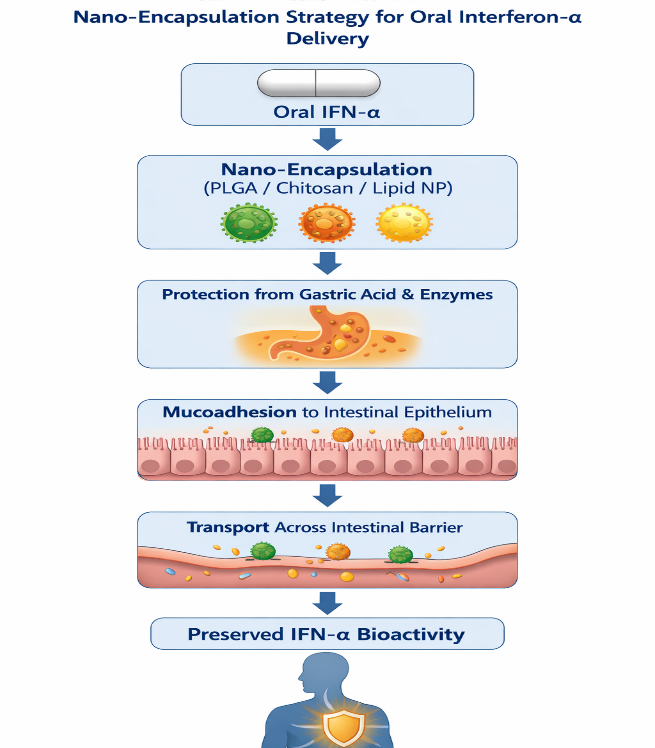
Source: Created by Haider et al. 2026, conceptual illustration based on established principles of oral protein delivery and nano-encapsulation, adapted from published studies on nanoparticle-mediated cytokine protection and intestinal transport (des Rieux et al., 2006; Makadia and Siegel, 2011; Illum, 1998; Mehnert and Mäder, 2001).
Figure 2. Mechanism of Immune Activation and Absorption of Oral Nano-IFN-α
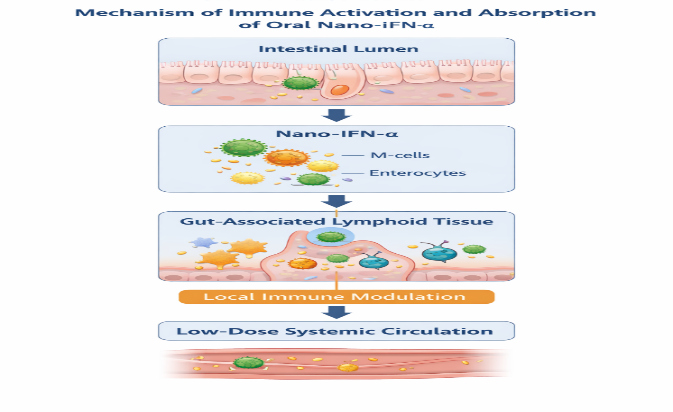
Source: Created by Haider et al. (2026), a schematic representation illustrating immune modulation and absorption pathways of orally administered nano-encapsulated interferon-α, developed based on reported mechanisms of gut-associated lymphoid tissue (GALT) activation and low-dose oral cytokine bioactivity (Brod et al., 1997; Brod, 2000; Neutra and Kozlowski, 2006).
Figure 3. Comparison of Conventional Injectable and Oral Nano-Encapsulated IFN-α
|
Parameter |
Injectable IFN-α |
Oral nano-encapsulated IFN-α |
|
Route of administration |
Parenteral |
Oral |
|
Gastrointestinal protection |
Not required |
Required |
|
Systemic exposure |
Established |
Formulation-dependent |
|
Mucosal immune interaction |
Limited |
Potentially enhanced |
|
GALT targeting |
Not a primary feature |
Potential advantage |
|
Patient convenience |
Lower |
Potentially higher |
|
Injection-related burden |
Present |
Potentially reduced |
|
Dosing frequency |
Formulation-dependent |
Potentially reduced through controlled release |
|
Clinical evidence |
Established for approved indications |
Primarily investigational |
Figure legend:
Comparative overview of conventional injectable IFN-α and investigational oral nano-encapsulated IFN-α. Oral nano-IFN-α may offer advantages in patient convenience and mucosal targeting; however, its clinical effectiveness and systemic bioavailability remain dependent on successful formulation development and clinical validation (3,6,9).
Discussion
The findings of this narrative review indicate that converting interferon-α (IFN-α) from an injectable formulation to an oral dosage form remains scientifically challenging but potentially achievable through advances in nanotechnology. IFN-α is a biologically active protein whose therapeutic effects depend on preservation of its molecular structure and interaction with interferon receptors. Conventional injection bypasses the gastrointestinal tract and therefore avoids many of the barriers that limit oral delivery of protein therapeutics. In contrast, oral administration exposes IFN-α to acidic gastric conditions, digestive enzymes, mucus, epithelial barriers, and limited intestinal permeability [1,3–5].
Previous investigations of orally administered IFN-α provide an important basis for considering alternative administration routes. Some studies have reported biological or immunological responses following low-dose oral IFN-α despite limited evidence of conventional systemic absorption [6,9,10]. These findings suggest that orally administered cytokines may interact with mucosal immune tissues and potentially influence immune signaling without necessarily producing plasma concentrations comparable to those achieved by injection. However, these observations should not be interpreted as evidence that oral IFN-α can currently replace injectable therapy.
Nano-encapsulation offers several theoretical advantages for addressing the major limitations of oral protein delivery. Encapsulation within biodegradable polymeric or lipid-based carriers may reduce direct exposure of the protein to gastrointestinal degradation and provide a more controlled release environment [7,11,13,17]. Polymeric nanoparticles, particularly PLGA-based systems, have been widely investigated for controlled delivery because of their biodegradability and ability to protect incorporated molecules. Nevertheless, formulation of proteins within polymeric systems can itself create challenges, including exposure to organic solvents, interfacial stress, aggregation, loss of biological activity, and incomplete release [15, 20].
Chitosan-based systems provide another potentially useful approach because of their mucoadhesive properties and ability to interact with intestinal surfaces. Chitosan and its derivatives have been investigated for non-parenteral delivery of proteins and other macromolecules, partly because they may prolong residence at mucosal surfaces and facilitate interaction with epithelial barriers [16, 14]. Chitosan-coated lipid nanoparticles have also demonstrated potential for oral protein delivery in experimental systems [19]. However, these findings primarily involve proteins such as insulin and should be considered supporting evidence rather than direct proof of successful oral IFN-α delivery.
Lipid-based nanocarriers, including solid lipid nanoparticles (SLNs) and nanostructured lipid carriers (NLCs), may provide an additional protective environment for biological molecules. Their lipid composition can be modified to influence gastrointestinal stability, release behavior, and interaction with biological membranes [17]. NLCs may offer greater formulation flexibility than conventional SLNs because the combination of solid and liquid lipids can improve loading characteristics. Nevertheless, protein incorporation, physical stability, reproducibility, and long-term storage remain important formulation considerations.
Polymeric–lipid hybrid nanoparticles are particularly interesting because they may combine properties of polymeric and lipid-based systems. A polymeric component can provide structural integrity and controlled release, while a lipid component may improve surface characteristics and biological interaction. Despite this potential, hybrid systems generally require more complicated manufacturing and characterization procedures. Their value for IFN-α delivery therefore remains a research question requiring direct experimental validation.
An important consideration is the preservation of IFN-α biological activity during formulation and gastrointestinal transit. Protein therapeutics are sensitive to temperature, pH, shear stress, oxidation, aggregation, and interfaces encountered during processing and storage [3,25]. Consequently, achieving a high encapsulation efficiency alone would not demonstrate successful delivery. A suitable formulation must retain the structural integrity and biological activity of IFN-α after encapsulation, storage, release, and exposure to relevant gastrointestinal conditions.
The mucosal immune system may represent both an opportunity and a challenge. Oral nanocarriers can interact with intestinal immune structures, including components associated with gut-associated lymphoid tissue (GALT), potentially creating opportunities for localized immunological effects [12]. However, increased interaction with immune tissues could also alter the pharmacodynamic profile of IFN-α and may produce effects that differ from those of systemic injectable administration. Therefore, future studies should distinguish between local mucosal activity and therapeutically relevant systemic exposure.
From a translational perspective, several parameters require systematic evaluation. These include particle size and distribution, surface charge, encapsulation efficiency, loading capacity, release kinetics, gastrointestinal stability, intestinal permeability, pharmacokinetics, bioavailability, pharmacodynamic activity, immunogenicity, and toxicity. The relationship between these parameters should be examined rather than relying on a single formulation characteristic as an indicator of therapeutic success.
The current literature also demonstrates an important evidence gap. Considerable research exists on oral delivery of proteins and peptides and on nanocarrier systems for macromolecular delivery [4, 5, 13, 6, 7, 8]. However, this broader evidence cannot automatically be extrapolated to IFN-α. Differences in molecular size, structure, dose, receptor biology, stability, and pharmacodynamic requirements may substantially influence formulation performance. Direct studies using nano-encapsulated IFN-α are therefore necessary before meaningful conclusions can be made about its clinical feasibility.
Overall, the evidence supports nano-encapsulation as a rational research strategy rather than an established therapeutic solution. Future development should progress from formulation screening and in vitro characterization to gastrointestinal stability studies, intestinal transport models, appropriate animal studies, and ultimately well-designed clinical investigations. Such a stepwise approach would help determine whether oral nano-encapsulated IFN-α can achieve adequate biological activity while reducing the limitations associated with repeated injections.
Conclusion
Oral delivery of interferon-α represents an attractive pharmaceutical objective because it could reduce the practical limitations associated with repeated injectable administration and potentially improve patient convenience. However, the gastrointestinal environment presents substantial barriers to the delivery of intact and biologically active IFN-α.
Nano-encapsulation provides a promising platform for addressing several of these barriers by protecting the protein from gastrointestinal degradation, modifying release, increasing interaction with intestinal surfaces, and potentially facilitating mucosal or systemic delivery. Polymeric nanoparticles, chitosan-based systems, solid lipid nanoparticles, nanostructured lipid carriers, and polymeric–lipid hybrid nanoparticles each offer potentially useful formulation strategies.
At the same time, the current evidence should be interpreted cautiously. Evidence obtained from oral delivery of other proteins and peptides provides a scientific rationale for nano-encapsulation but does not establish that oral nano-encapsulated IFN-α is clinically effective. Direct formulation-specific studies are still required to demonstrate preservation of IFN-α activity, adequate intestinal absorption or appropriate mucosal activity, reproducible pharmacological effects, safety, and therapeutic benefit.
Future research should therefore focus on optimized nanocarrier composition, protein stabilization, controlled intestinal release, targeting of relevant intestinal tissues, pharmacokinetic and pharmacodynamic evaluation, long-term stability, immunogenicity, toxicity, manufacturing scalability, and regulatory requirements. With systematic development and rigorous experimental validation, nano-encapsulation may contribute to the future development of oral IFN-α formulations. At present, however, oral nano-encapsulated IFN-α should be regarded as an investigational pharmaceutical approach rather than an established replacement for injectable IFN-α therapy.
Acknowledgment
The authors sincerely acknowledge the contributions of colleagues, researchers, and institutions whose scientific work has contributed to the understanding of interferon biology, protein therapeutics, nanomedicine, and oral drug-delivery systems. The authors also appreciate the scientific literature and publicly available research resources that supported the development of this narrative review.
Conflict of Interest: The authors declare no conflict of interest.
Funding and Financial Support: The authors received no financial support for the research, authorship, or publication of this article.

Open Access By Aditum Open Access Journals id licensed under Creative Commons Attribution 4.0 International License. Based On a Work at aditum.org


