
International Journal of Integrative and Complementary Medicine
OPEN ACCESS | Volume 2 - Issue 1 - 2026
ISSN No: 3070-4146 | Journal DOI: 10.61148/3070-4146/IJICM


Running title: Early Continuous Renal Replacement Therapy improves mortality in adult patients of Sepsis Associated Acute Kidney Injury
Dr Soumya Sankar Nath, MD1*, Dr Hina Ashraf, MD2, Dr Prakriti Gupta3, Dr Praveen Kumar Das, MD4, Dr Virendra Kumar, MD5, Dr Namrata Rao, DM6
1Professor, Department of Anesthesia and CCM, Dr Ram Manohar Lohia Institute of Medical Sciences, Lucknow, INDIA. 2Senior Resident, Department of Anesthesia and CCM, Dr Ram Manohar Lohia Institute of Medical Sciences, Lucknow, INDIA.
3Assistant Professor, Department of Anesthesia and CCM, Dr Ram Manohar Lohia Institute of Medical Sciences, Lucknow, INDIA.
4Professor, Department of Anesthesia and CCM, Dr Ram Manohar Lohia Institute of Medical Sciences, Lucknow, INDIA.
5Professor, Department of Anesthesia and CCM, Dr Ram Manohar Lohia Institute of Medical Sciences, Lucknow, INDIA.
6Professor, Department of Nephrology, Dr Ram Manohar Lohia Institute of Medical Sciences, Lucknow, INDIA.
*Corresponding author: Soumya Sankar Nath, Professor, Department of Anesthesia and CCM, Dr Ram Manohar Lohia Institute of Medical Sciences, Lucknow, INDIA.
Received: June 01, 2026 | Accepted: July 10, 2026 | Published: July 20, 2026
Citation: Soumya S Nath, Ashraf H, Gupta P, Praveen K Das, Kumar V, Namrata Rao., (2026) “Evaluation of Outcome after Early versus Late initiation of Continuous Renal Replacement Therapy in adult patients of Sepsis Associated Acute Kidney Injury’” International Journal of Integrative and Complementary Medicine, 2(1). DOI: 10.61148/ 10.61148/IJICM/017.
Copyright: © 2026 Soumya Sankar Nath. This is an open access article distributed under the Creative Commons Attribution License, which permits unrestricted use, distribution, and reproduction in any medium, provided the original work is properly cited.
Background and aims: Prospective studies comparing outcomes following early against late initiation of CRRT, labelled as per KDIGO guidelines, in patients of sepsis-associated acute kidney injury (S-AKI) are lacking. The aim was to compare the 28-day mortality rate, renal recovery rate, and length of stay in ICU and hospital among patients of S-AKI with early against late institution of continuous renal replacement therapy (CRRT).
Patient and methods: 60 consenting adult patients (18-70 years) of SA-AKI needing CRRT were recruited. The early CRRT group, it was instituted in KDIGO stage 1 AKI with complications (either raised serum potassium, metabolic acidosis, uremia, acute pulmonary edema) or stage 2. The late CRRT group was when CRRT was initiated in patients of KDIGO stage 3 or Stage 2 if CRRT could not be started within two hours.
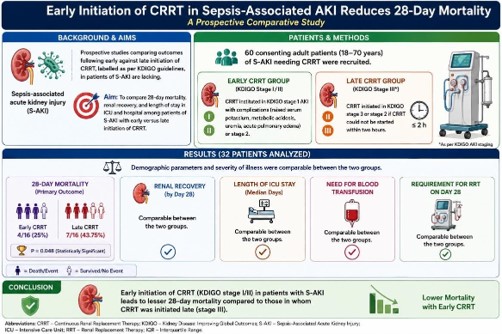
Results: The data from 32 patients were collected and analyzed in the study. The demographic parameters and the severity of illness among the patients of the two groups were comparable in the early and late CRRT groups. The length of ICU stay, need for blood transfusion, renal recovery, and the requirement for RRT on Day 28 were comparable between the two groups. The 28-day mortality rate among patients in the early CRRT group was lower than that of patients in the late CRRT group. (4/25% versus 7/43.75%, p-value 0.048)
Conclusion: Early initiation of CRRT (KDIGO stage I/II) in patients with S-AKI leads to lesser 28-day mortality compared to those in whom CRRT was initiated late stage III.
Sepsis, Acute kidney injury, Renal Replacement Therapy
Sepsis-associated acute kidney injury (S-AKI) had been characterized as acute kidney injury (AKI) in patients of sepsis and in the absence of substantial contributing factors supporting the diagnosis of AKI or distinguished by the coexistence of both Sepsis-3 and kidney disease: Improving Global Outcomes (KDIGO) criteria.1,2 The pathophysiology of sepsis is complex and distinct. Similarly, the pathophysiology of S-AKI is quite different from other phenotypes of AKI. Moreover, though sepsis is the most frequent reason of AKI, any cause of AKI also makes the patient highly susceptible to sepsis.3 S-AKI is a frequently encountered complication among patients with sepsis, with mortality varying from 15-60%.4
SA-AKI is thought to be due to inflammatory damage-induced perturbations in microcirculatory oxygen delivery, possibly because of decreased flow and restricted diffusion in the presence of organ edema and inflammation. Although the exact implications of these disturbances in microcirculation are yet to be fully understood, it is evident that sepsis intensifies the expression of inflammatory cytokines and promotes leukocyte activity. These together lead to capillary plugging and the formation of micro-thrombi. This causes the production of reactive oxygen species (ROS) and the induction of nitric oxide synthase. ROS and nitric oxide damage the endothelial barrier and the glycocalyx, causing structural and functional changes in the kidneys.5 Moreover, during sepsis, the Toll-like receptors identify the pathogen-associated molecular pattern and damage-associated molecular pattern, which elicit tissue inflammation followed by injury. These, in turn, provoke the formation of thrombosis of the microvasculature. There is increased vascular permeability and interstitial edema, which, in turn, damages renal microcirculation, leading to venous congestion of the kidneys and, thus, a reduction in glomerular filtration.6 Further, it was reported that in patients of septic shock, the concentrations of circulating inflammatory cytokines correlates with the mortality. Sood et al. reported that AKI which could be treated early led to enhanced survival in sepsis.7 Therefore, it is believed that measures to reduce volume overload which will avoid the resultant renal venous congestion and interstitial edema along with adequate removal of inflammatory mediators from the circulation might prove life-saving in a condition with otherwise poor outcome. In critical care, CRRT is presently preferred over intermittent (RRT) renal replacement therapy techniques as it ensures stable hemodynamic parameters, efficient volume control with fluid and solute clearance, rectifying acid-base and electrolyte disorders, and removal of pro-inflammatory mediators.8
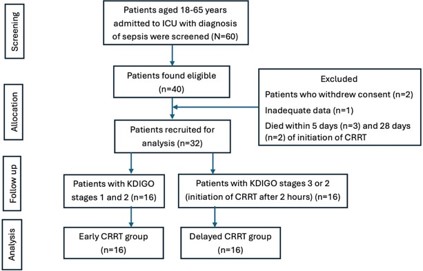
Both early and late initiation of CRRT have their pros and cons. The early institution of CRRT ensures early metabolic and uremic control and avoidance of fluid overload. Prevention of fluid overload and acidemia offer protection from injury to kidneys and other organs. It is claimed that early initiation of CRRT can stabilize the internal milieu and eliminate mediators of Figure 1shows the flowchart of the study protocol.
inflammation.9 Hence, early CRRT may control excessive inflammation, thus decreasing kidney injury and, possibly, improving patient survival. On the other hand, delayed initiation might save some patients from the potential ill effects of CRRT whose kidneys had high chances of recovery without CRRT. In critically ill patients with AKI, the STARRT-AKI trial failed to find lower risk of death at 90 days in those who received accelerated RRT compared to those who received RRT as per standard-strategy group.10 As of date, prospective studies comparing outcomes following early versus late initiation of CRRT, labelled as per KDIGO guidelines, in patients of S-AKI are lacking.11 So, the primary objective of the present study was to compare the 28-day mortality among adult patients with S-AKI who received early versus those with late initiation of CRRT. The secondary objectives were to compare renal recovery rate and the length of stays in the intensive care unit (ICU) and hospital among critically ill patients of S-AKI with early and late initiation of CRRT.
Methods
This study is designed as hypothesis generating, phenotype focused, single-centre prospective, observational, open-label study that was performed in adult patients of S-AKI who received CRRT in the ICU of a teaching hospital during the study period of 18 months after getting approval from the Institute Ethical Committee (IEC No. 81/23, Date-22/06/23), and registering in Clinical trials registry-India [CTRI Registration No-CTRI/2024/07/071659]. Informed consent was acquired from the nearest relative of all the patients before enrolling them in the study. Adult patients (between 18-65 years) of S-AKI, as per KDIGO classification, whose nearest kin agreed to CRRT, were recruited in the study. Those with pre-existing chronic kidney, previous renal replacement therapy, do not resuscitate (DNR) status, CRRT instituted for indications other than KDIGO guidelines designated AKI, CRRT stopped within 24 hours, death before completion of CRRT, post renal transplant patients were excluded from the study.
We observed two groups of 20 patients, each according to the KDIGO stage in which CRRT was initiated. The two groups of patients were labelled as early or late CRRT as below:
Early CRRT group: When CRRT was instituted in patients of SA-AKI with KDIGO stage I AKI with hyperkalemia (serum potassium >5.5mEq/L) or metabolic acidosis (pH <7.2) or features of uremia (encephalopathy), or acute pulmonary edema, or at KDIGO stage II. A maximum of two hours was allowed between the clinical decision regarding initiating CRRT and the actual commencement of CRRT.
Late CRRT group: When CRRT was initiated in patients of SA-AKI in KDIGO stage III and Stage II, if CRRT could not be started within two hours.
Figure 1: Flowchart of the study protocol (KDIGO-Kidney Disease Improving Global Outcome guidelines for acute kidney Injury, CRRT-Continuous renal replacement therapy, DNR-Do not resuscitate)
Sample size calculation: From the data of a previous study, the sample size was estimated with a confidence interval of 95%, a power of 80% and a assuming non-response rate of 10%.12 The following formula was used:
n=2x(Z1-a/2 + Zb)2 pq = 2x(1.96+0.844)2 x 63x 37 = 15.22~ 16 ( p1- p2)2 (49)2
Where Z1-a/2 = 1.96 at 95% Confidence Interval; Z1-b= 0.84 at 80% power, n= sample size, a is level of significance, 1-b is the power of the test, b is type 2 error i.e. 0.84, Z is standard normal variant, p= p1 + p2 = 63, p1=87.5 (Early CRRT group), p2=38.5 (Late CRRT group), q= 100-p. Thus, the calculated sample size was 16 patients in each group. In order to compensate for dropouts, it was decided to recruit 20 patients in each group.
After admission to the ICU of our institution, all patients were evaluated with a thorough physical examination and laboratory investigations. Arterial blood gas analysis was done at the time of admission into the ICU and repeated twice a day during ICU stay, or more frequently as deemed by the on-duty doctor. Disease severity was evaluated using the Acute Physiology and Chronic Health Evaluation II (APACHE II) score. CRRT was started by the intensive care treating team as per existing ICU protocols. Before commencing CRRT, different blood and urine variables were documented. The treating ICU team decided CRRT prescription. The CRRT effluent dose was noted once daily during ongoing CRRT therapy. CRRT can be stopped if renal recovery, defined by urine output (UO) met the stipulated criteria (UO>400mL in 24 hours without diuretics or UO>2100mL in 24 hours with diuretics). If criteria for terminating CRRT were not met, CRRT was continued for at least five days. Citrate was used for regional anticoagulation. Observation of filter life span, length of ICU stays, requirement for transfusion, renal function recovery and duration of CRRT, and other parameters were assessed for every patient undergoing CRRT in ICU. Serum creatinine, (Sr Cr), RRT requirement, and mortality at the end of 28 days were recorded.
Hemodialysis catheter was inserted through the femoral or right internal jugular veins. Continuous veno-venous hemodiafiltration was done using the Gambro Prismaflex (Baxter, Sweden) machine. CRRT commenced with 100 ml/min of blood flow, progressively increasing to 150 ml/min. The dose of ultrafiltration was aimed at 40 ml/kg/h. In addition, CRRT circuit was changed when the blood pump was stopped and when the transmembrane pressure went beyond 300 mmHg. The patients were weighed using an in-bed scale every morning, and the dose of ultrafiltration was regulated accordingly.
We used CRRT specific commercial solutions for replacement as they are recommended over custom-made solutions because of the risks of compounding errors and break in sterility with the latter.8 The fluid used in regional citrate anticoagulant is Regiocit™ (Baxter, Sweden) (sodium chloride and sodium citrate) as a pre-blood pump. Prismasol™ (Baxter, Sweden) was used as a post blood pump. Biphozyl™ (Baxter, Sweden)) fluid was used as diasylate. The pre-pump fluid was given at 1000ml/hr, and the post-pump fluid was given at 300 ml/hr. Infusion of calcium gluconate was started and titrated to maintain serum ionic calcium between 1-1.2 mmol/l.
The following data were collected, demographics (gender, age, admission dates), admission status, 28-day outcome, CRRT related (time of onset, duration, vascular access and mode of anticoagulation) and baseline values (collected within 24 hours of admission) like blood urea, and Sr Cr, APACHE 2 scores, C Reactive protein (CRP) and serum bicarbonate (HCO3-). Further, urine output per 24 hours, and KDIGO staging were noted. Renal recovery, or the absence of it was based on the levels of Sr Cr and blood urea at discharge or the last report before demise. We used 28-day death as the primary endpoint and 28-day renal recovery as a secondary endpoint.
It was deemed that the kidney functions had recovered when the serum creatinine level or the creatinine clearance (Cr Cl) started falling, calculated with the use of six-hour timed urine output when urine flow increased to more than 30 ml per hour. Cr Cl was intermittently monitored to decide whether further continuation was warranted. CRRT was continued if the Cr Cl was less than 12 ml per minute and was stopped if it exceeded 20 ml per minute. For intermediate values of Cr Cl, decision to continue or discontinue, was left to the clinician. Further, the treating physicians was free to manage RRT in patients with kidney failure persisting beyond 28 days after recruitment or in those who were shifted out of ICU before day 28, as decided by the treating physicians because of otherwise improved condition.13
Statistical analysis: The continuous and categorical variables were expressed as mean ± standard deviations (SD), and numbers and percentages, respectively. The student t-test and the χ2 test were used to compare the continuous and categorical variables of baseline characteristics of the two groups. The SPSS (Statistical Package for Social Science) Version 26.0 was used for the statistical analysis.
Results
Sixty patients were screened for recruitment in the study, out of which 40 patients satisfied the norms for CRRT and were recruited for the study. Out of 40 patients, three patients died within five days of CRRT initiation, two patients died before 28 days, one patient, there was inadequate data collection, and two patients` kins withdrew their consent before completion of the study. Hence, data from 32 patients were collected and analyzed in the study.
Table 1 shows the comparison of the demographic and baseline parameters between the two groups. The demographic parameters and the severity of illness among the patients of the two groups, as measured by APACHE II scores, were comparable in the early and delayed CRRT groups. The pre-CRRT mean Sr Cr was significantly higher, and urine output was significantly lesser in the late CRRT group compared to the early CRRT group. The baseline Sr Cr was lower, and UO before the start of CRRT was higher in the early CRRT group compared to the late CRRT group. As the definition of different stages of KDIGO AKI depends on Sr Cr and UO, it is obvious that these two parameters were significantly different between the two groups.
Table 1: Comparison of demographic and baseline parameters between the two groups
|
Parameter |
Group |
Mean±SD |
P value |
|
Age (years) |
Early |
57.06± 21.16 |
0.285 |
|
Late |
54.71±15.60 |
||
|
Predicted body weight (kg) |
Early |
62.06±4.61 |
5.14 |
|
Late |
60.81±5.14 |
||
|
Gender (number of males) |
Early |
9 |
0.51 |
|
Late |
6 |
||
|
APACHE II score |
Early |
25.50±4.97 |
0.697 |
|
Late |
23.18±4.30 |
||
|
Duration of CRRT (days) |
Early |
5.00±1.71 |
0.355 |
|
Late |
4.53±1.46 |
||
|
Effluent Dose (ml/kg/hr) |
Early |
25.63±4.57 |
0.345 |
|
Late |
26.41±5.44 |
||
|
Baseline serum creatinine (mg/dL) |
Early |
1.05±0.42 |
<0.001* |
|
|
Late |
2.99±2.97 |
|
|
Urine output before CRRT (ml) |
Early |
301.88±62.96 |
<0.001* |
|
Late |
201.94±146.23 |
*Significant, APACHE: Acute Physiology and Chronic Health Evaluation, CRRT: Continuous renal replacement therapy
Table 2 shows the comparison of various parameters like blood urea nitrogen (BUN), serum CRP, Sr Cr, serum bicarbonate, and urine output between the two groups on different days from day 1 to Day 5 of CRRT, and we found that on day 2, the Sr Cr and bicarbonate were significantly lesser in early CRRT group compared to the delayed CRRT group. All other factors were comparable in the two groups from day 1 to day 5. Thus, serum bicarbonate and creatinine correction happened faster in the early CRRT group compared to the delayed CRRT group.
Table 2: Comparison of various parameters between the two groups on day 1 to Day 5 of CRRT.
|
Day of CRRT |
Groups |
Parameters |
|||||||||
|
BUN (mg/dl) Mean±SD |
P value |
Sr creatinine (mg/dl) Mean±SD |
P value |
CRP (mg/L) Mean±SD |
P value |
- HCO3 (mEq/L) Mean±SD |
P value |
Urine output (ml) Mean±SD |
P value |
||
|
Day 1 |
Early |
63.69±22. 74 |
0.56 |
3.95±1.46 |
0.52 |
60.44±24. 23 |
0.37 |
19.41±2.56 |
0.70 |
355.44±192. 42 |
0.13 |
|
Late |
69.59±20. 85 |
5.01±1.98 |
51.24±26. 92 |
19.62±2.62 |
352.06±250. 88 |
||||||
|
Day 2 |
Early |
58.77±18. 75 |
0.98 |
4.06±1.32 |
0.00 6* |
55.88±23. 96 |
0.94 |
20.83±2.14 |
<0.00 1* |
547.19±262. 38 |
0.55 |
|
Late |
60.45±17. 76 |
4.34±1.08 |
52.94±22. 78 |
20.47±4.61 |
351.25±300. 31 |
||||||
|
Day 3 |
Early |
66.63±23. 88 |
0.89 |
4.05±1.20 |
0.31 |
56.94±25. 54 |
0.43 |
18.58±2.99 |
0.06 |
818.31±382. 57 |
0.68 |
|
Late |
55.54±25. 48 |
3.59±1.01 |
47.59±22. 75 |
21.17±4,51 |
451.65±445. 79 |
||||||
|
Day 4 |
Early |
53.0±19.7 |
0.34 |
4.11±1.28 |
0.89 |
54.25±29. 41 |
0.63 |
19.48±2.52 |
0.98 |
971.88±531. 56 |
0.80 |
|
Late |
54.35±25. 02 |
4.36±1.15 |
48.47±31. 42 |
19.31±2.65 |
710.47±562. 65 |
||||||
|
Day 5 |
Early |
48.06± 26.21 |
0.61 |
4.18±1.52 |
0.41 |
59.44±27. 61 |
0.94 |
20.62±2.72 |
0.688 |
1027.69±62 1.46 |
0.55 |
|
Late |
58.76± 23.65 |
3.98±1.26 |
53.48±27. 32 |
19.59±2.8 |
735.0±586.7 7 |
||||||
*Significant, CRRT: Continuous renal replacement therapy, BUN: Blood urea nitrogen, CRP: C Reactive protein, HCO -:Serum bicarbonate
Table 3 compares various outcome parameters between the two study groups. The length of ICU stay, need for blood transfusion, renal recovery at Day 28, and the requirement for RRT at Day 28 were comparable between the two groups. We found fewer 28-day mortality among patients in early compared to the late CRRT groups. (4/25% versus 7/43.75%, p value 0.048). The relative risk and the odds ratio, for mortality between groups were 0.57 (95%CI 0.21-1.58) and 0.43(95% CI 0.095-1.925), respectively.
Table 3: Comparison of various outcome parameters between the early and late CRRT groups
|
Parameter |
Group |
Mean±SD |
P value |
|
Length of ICU Stay (Days) |
Early |
13.81±3.78 |
0.980 |
|
Late |
13.76±3.80 |
||
|
Transfusion requirement |
Early |
1.56±0.51 |
1.00 |
|
Late |
1.53±0.51 |
||
|
Renal recovery at 28th Day |
Early |
8(50%) |
0.508 |
|
Late |
6(37.5%) |
|
RRT requirement at Day 28 |
Early |
10(62.5%) |
1.00 |
|
Late |
10(62.5%) |
||
|
Mortality at day 28 |
Early |
4(25%) |
0.048* |
|
Late |
7(43.75%) |
*Significant
Discussion
We observed that the demographic parameters and APACHE II scores, which assessed the severity of illness among the patients, were comparable among the groups in the early and late CRRT groups, (25.5±4.97 and 23.18 ±4.3, respectively, p=0.69) (Table 1). The renal recovery at Day 28 (50% in early CRRT group versus 37.5% in the delayed CRRT group, p-0.325) (Table 1) and the requirement for RRT (62.5% in both the groups, p-1.0) at Day 28 were comparable among the two groups. (Table 3) We found that there was lesser 28-day mortality among patients in the early CRRT group (25%) contrasted to the delayed CRRT group (43.75%) (p-0.048). (Table 3).
Although there are several studies and systematic reviews that compared the outcomes like mortality and renal recovery among patients of AKI who underwent early or late CRRT, most of them are either retrospective, with arbitrary definitions of early/late initiation of CRRT, or involving patients other than those afflicted with SA-AKI. Thus, ours is the first prospective study to evaluate renal recovery and mortality on day 28, specifically among patients with SA-AKI who underwent early/late initiation of CRRT.
The observations of our study are similar to those of Wang X et al. (2011) and Vats HE et al. (2011).14,15 Wang X et al. (2011) described in a meta-analysis of 15 studies that among those who underwent CRRT, early CRRT group had significantly lesser mortality compared with delayed CRRT (27.8% versus 43.0%).14 The characterization of early and delayed commencement of CRRT varied in different reports comprised in the meta-analysis. For instance, early CRRT was labeled when RRT was started within 12 hours if urine output <30ml/kg/h, whereas late was labeled when RRT was started when urea>40meq/L or serum potassioum>6.5mmmol/L,16 RIFLE criteria (risk) was labeled early whereas, it was late when RRT was initiated in failure class.17 Further, early CRRT was initiated when blood urea was below 21.4 mmol/L, and late was when blood urea exceeded 21.4 mmol/L,18 and so on. Since the early and delayed CRRT groups were labelled differently in studies which were incorporated in the meta-analysis, there is a cloud of doubt on the conclusion of the meta-analysis. None of those studies incorporated in the concerned meta-analysis, defined ‘early’ and 'late' RRT based on the KDIGO grades for renal failure, as KDIGO guidelines were made public long after this meta-analysis was published.14 Further, the population studies included mixed ICU patients. The authors themselves agreed that though they found early CRRT had a beneficial effect on ICU mortality, the study suffered from publication bias as they could include only a handful studies, and of the 15 trials, only three were randomized control trials, and the rest were retrospective studies.14
In the retrospective study by Vats HE et al. (2011), the diagnosis of AKI warranting CRRT did not follow KDIGO guidelines (because KDIGO guidelines came in 2014). They labelled AKI as a Sr Cr level ≥ 2.0mg/dl when the baseline value was less than 1.5mg/dl, or serum creatinine level ≥ 2.5mg/dl if the baseline value exceeded 1.5mg/dl. It included a mixed ICU population and not specifically patients of SA-AKI. They further defined early CRRT as those in which it was started within six days of confirmation of AKI, whereas the delayed CRRT group was those in which CRRT was started beyond six days of diagnosis of AKI. They reported that the risk of the patient dying in the delayed CRRT group was greater than the early CRRT group, with the former having an odds ratio of 11.66 (95%CI of 1.26-107.91, p-value-0.03).15
We chose KDIGO stages at which CRRT was instituted to distinguish the early CRRT group from the delayed CRRT group.2 KDIGO stages had a better sensitivity for labelling AKI and robust capability to envisage the outcome, so it is sensible to utilize KDIGO stages at which the RRT was initiated for labelling early/late CRRT groups.
In the ELAIN study, the authors recruited patients with septic shock, intractable fluid overload or ARDS or SOFA score 2 or more with KDIGO stage II AKI and randomized them to two groups- early (RRT began within eight hours of confirmation of stage II AKI) and late groups (RRT was started within 12 hours of confirmation of stage III AKI). They found that when CRRT was started early, the 90-day mortality was significantly reduced compared to the late group (39.3 vs. 54.7%, p-value -0.03). Further, early initiation of CRRT led to regaining of renal functions at day 90 (53.6% vs. 38.7%, p-0.02), reduced mean length of mechanical ventilation (125.5 hours vs. 181 hours, p-0.02), and decreased duration of stay (51 days vs. 82 days, p-<0.001). However, the requirement of RRT for the groups at day 90 (13.4% vs. 15.1%) and the total days spent in ICU (19 days vs. 22 days) were comparable.19 It is worth mentioning that most of the patients recruited in the study were surgical patients, unlike our cohort of SA-AKI patients.
Wu X et al. performed a retrospective study involving SA-AKI patients undergoing early (at KDIGO stage I/II) and late CRRT (Stage III). They found that, though the CRRT duration was shorter in the early CRRT group, the length of ICU and hospital stays, 28-day and 90-day mortalities, and 28-day and 90-day RRT disengagement or dependent rates were comparable among the groups. Even the 90-day cumulative survival rates were comparable.20
Fan Y et al. (2022) performed a retrospective study where the results of different approaches of RRT, RRT versus non-RRT, and early versus late RRT in patients with SA-AKI were evaluated. They defined early/late CRRT groups on the basis of time from admission to the beginning of RRT, i.e., those in whom RRT was started within or after 24 hours of confirmation of SA-AKI. The renal recovery at 90 days in the early group was higher than that of the late group. (87% vs 38.5%, p=0.032). When they compared early and late groups based on the KDIGO stage in which RRT was instituted, i.e., early (KDIGO stage 2, n= 13) and late KDIGO stage 3, n=25), the authors found that both the groups showed comparable outcomes, like renal recovery (p=0.153) and mortality (p=0.89) at 90 days.21
Thus, we could identify only two studies that examined the roles of early versus late CRRT in patients of SA-AKI, though both were retrospective ones.20,21 Of these, only one was labeled as early and late based on KDIGO guidelines for AKI.20 Unlike us, the authors found that all outcome parameters studies, including mortality and renal recovery, were comparable. Being a retrospective study, it suffers from the usual pitfalls like recall bias, difficulty in controlling confounders, and limitations in data quality due to data collected not being designed for the future research question.
Early institution of CRRT may be beneficial as it would prevent fluid overload, eliminate toxins, establish acid-base homeostasis, attenuate systemic inflammation, and prevent other complications of AKI. Further, it is claimed that there is possibility of washout of inflammatory mediators from the plasma due to early CRRT, as these are eliminated through CRRT, and could also protect the kidneys and other organs.8,19
We used regional citrate anticoagulation for CRRT in all patients. Anticoagulation with heparin is fraught with the risk of bleeding to the tune of 30-50% and resulting mortality of 15%. RCA offers safer alternative because of prolonged filter life and lesser bleeding complications. 22,23
Limitations of our study: Our study was limited to one centre. The study was underpowered to detect modest differences in mortality. Exclusion of very early deaths and missing cases may result in a bias towards a survival benefit in one group. We observed the study patients until day 28, so it cannot be said with certainty whether early CRRT endows mortality benefit or simply postpones mortality to a later date.
Conclusion
From the analysis of the data collected in our study and review of literature, we may conclude that in this single-centre prospective cohort of patients with sepsis-associated AKI, early initiation of CRRT (KDIGO I/II) was associated with lower 28-day mortality compared to later initiation (KDIGO III). Given the small sample size and observational design, these findings should be considered hypothesis-generating and warrant confirmation in larger multicentre trials. Also, the study has short follow up (28 days) and there is lack of long term renal ourcomes and there is limited adjustment for confounding factors.
Declaration
The authors declare the following:

Open Access By Aditum Open Access Journals id licensed under Creative Commons Attribution 4.0 International License. Based On a Work at aditum.org


