
International Journal of Artificial Intelligence in Medicine and Healthcare
OPEN ACCESS | Volume 1 - Issue 2 - 2026
ISSN No: 3144-7961 | Journal DOI: 10.61148/IJAIMH


Guan Shuangcheng¹, Hao Junjie², Zhang Jiren¹*
1Life Science Research Institute, Zhongxu Medical Group, Hengqin, Zhuhai 519031, China.
2The University of Texas at Austin, Austin 78712, Texas, USA.
*Corresponding author: Zhang Jiren, Life Science Research Institute, Zhongxu Medical Group, Hengqin, Zhuhai 519031, China.
Received: October 05, 2026 | Accepted: October 20, 2026 | Published: November 12, 2026
Citation: Shuangcheng G, Junjie H, Jiren Z., (2026) “Construction and Mechanistic Study of a Vascular Health Homeostasis Assessment Model Based on a 7D, 128-State Hypercube Topology” International Journal of Artificial Intelligence in Medicine and Healthcare, 1(2); DOI: 10.61148/IJAIMH/058.
Copyright: ©2026. Zhang Jiren. This is an open access article distributed under the Creative Commons Attribution License, which permits unrestricted use, distribution, and reproduction in any medium, provided the original work is properly cited.
To address current research limitations—such as the fragmentation of vascular health assessment dimensions, the absence of quantitative homeostasis metrics, delayed risk warnings, and a lack of supporting systematic theoretical models—this study integrates discrete graph theory topology with the statistical physics Ising phase transition model to construct a 7-dimensional, 128-state hypercube topological model for vascular health homeostasis assessment (7D-HTSEM-128). By selecting seven core dimensions of vascular health, a global discrete state space comprising 128 categories is established using binary domain encoding. A 7D hypercube topological network is utilized to quantify characteristics of deviations from vascular health homeostasis. Furthermore, a vascular system free-energy landscape is constructed by incorporating a multi-particle Ising model, revealing the nonlinear evolution of vascular homeostasis and the dynamics of critical phase transitions. Finally, a 7D vascular robustness index (R7) and a multidimensional risk stratification system are established, enabling systematic, quantifiable, and predictive modeling of vascular health states. Moving beyond traditional linear assessment paradigms based on single indicators, this study constructs a theoretical framework for vascular health homeostasis from the perspective of complex system dynamics, offering a novel theoretical model and quantitative tools for identifying subclinical vascular damage, elucidating mechanisms of homeostatic imbalance, and providing early warnings for cardiovascular risks.
vascular health; hypercube topology; Ising model; steady-state phase transition; risk stratification; complex system modelling
1. Introduction
Vascular homeostasis is the fundamental basis for maintaining the physiological stability of the cardiovascular system. The progressive imbalance resulting from multidimensional pathological changes—such as structural degeneration, loss of elasticity, accumulated chronic inflammation, and perfusion abnormalities—underlies the pathogenesis of atherosclerosis, coronary heart disease, stroke, and major adverse cardiovascular events [1-2]. Current clinical and basic research primarily assesses vascular health using isolated imaging markers, biochemical inflammatory indicators, or vascular functional parameters. These methods reflect only localized, static pathological features and fail to capture the complex, nonlinear characteristics of the vascular system, such as multi-factor coupling, dynamic evolution, and critical instability [3-4]. The vascular system is a quintessential high-dimensional, complex dynamic system; its decline in health is not merely a simple accumulation of single-dimensional lesions, but a dynamic process involving the synergistic deviation of multidimensional physiological parameters and the continuous dissipation of homeostatic potential energy, ultimately leading to abrupt instability upon crossing a critical threshold [5].
Traditional linear assessment models struggle to quantify system-level homeostatic impairment or detect subtle, subclinical homeostatic shifts, resulting in inadequate early risk identification and delayed warning windows. Current vascular assessment models suffer from significant systemic flaws: first, assessment dimensions are isolated, lacking a comprehensive framework that encompasses structure, function, inflammation, perfusion, and baseline risk, thereby preventing a complete characterization of vascular health; second, state descriptions are static, lacking standardized, digital, and comprehensive discrete state-coding systems, which hinders the precise quantification and cross-sectional comparison of individual vascular health; third, risk mechanisms are treated linearly, ignoring the system's critical phase-transition characteristics and failing to explain the pathological pattern of "long-term insidious progression followed by sudden clinical events"; and fourth, evaluation metrics are overly simplistic, lacking quantitative indices that reflect the system's overall stability [6-8]. Therefore, constructing a theoretical model of vascular health homeostasis—one that is high-dimensional, comprehensive, quantifiable, and capable of characterizing nonlinear phase-transition dynamics—is crucial to overcoming the theoretical bottlenecks in vascular health assessment. Drawing on complex system theory and high-dimensional topological modeling, this study constructs a seven-dimensional, 128-state hypercube topological model for assessing vascular health homeostasis. It establishes seven core dimensions of vascular health to ensure comprehensive coverage of health states and generates 128 standardized, discrete health states using binary encoding. The study quantifies homeostatic deviation based on the seven-dimensional hypercube topology, employs a seven-dimensional Ising model to construct a vascular free-energy landscape—thereby elucidating the mechanisms of homeostatic evolution and critical phase transitions—and develops a vascular robustness index alongside a multi-gradient risk stratification system. This research aims to establish a comprehensive theoretical framework for modeling vascular health homeostasis, providing a new theoretical foundation for the systematic assessment of vascular health and early risk warning.
2. Model Construction and Research Methods
2.1 Construction of the Seven-Dimensional Vascular Health Assessment Framework
Based on vascular structural characteristics, functional reserves, pathological injury mechanisms, and clinical risk profiles, seven mutually independent and comprehensive dimensions (D1–D7) for vascular health assessment were selected and established to achieve a systematic and complete characterization of vascular health status; each dimension possesses clear physiological and pathological definitions. D1 represents vascular structural integrity, covering intimal smoothness, vessel wall structural integrity, plaque burden, and the degree of stenosis, thereby reflecting the extent of pathological damage to vascular anatomical structures. D2 represents arterial elasticity reserve, characterizing arterial compliance, stiffness, and degenerative changes in elasticity, thus reflecting the degree of vascular functional aging. D3 represents plaque calcification and stability, quantifying calcification grade, plaque vulnerability, and progression risk, which reflects high-risk structural pathological features. D4 represents vascular inflammation and oxidative stress, integrating chronic inflammatory factors, oxidative stress levels, and markers of endothelial injury to characterize the degree of chronic inflammatory vascular degeneration. D5 represents peripheral blood perfusion reserve, assessing microcirculatory supply capacity, flow reserve, and tissue perfusion compensation, thereby reflecting overall vascular circulatory efficiency. D6 represents baseline comprehensive risk history, incorporating intrinsic risk factors such as age, underlying diseases, and glucose/lipid metabolic abnormalities to characterize an individual's baseline risk level. D7 represents metabolic and environmental load, integrating the body's metabolic status and exogenous risk factors that influence vascular homeostasis. These seven dimensions cover structural, functional, pathological, metabolic, and environmental characteristics, providing a standardized dimensional basis for high-dimensional state modeling.
2.2 Construction of the Seven-Dimensional Hypercube Topological State-Space Model
This study integrates discrete graph theory with high-dimensional topology and draws upon ancient Chinese wisdom to construct a seven-dimensional, 128-state hypercube topological state-space model for vascular health (7D-HTSEM-128), enabling comprehensive digital modeling of vascular health status. A seven-dimensional discrete state space is constructed based on the binary field \(F_2^7\), with the seven assessment dimensions defined via binary encoding: a value of 0 represents the normal physiological state, while 1 represents the pathological abnormal state. Through seven-dimensional binary combinations, \(2^7=128\) mutually exclusive and exhaustive discrete states of vascular health are generated, each corresponding to a unique seven-dimensional binary code, thereby achieving a standardized, digital, and comprehensive representation of vascular health status. A state network is built upon the topological structure of a standard seven-dimensional hypercube (Q7), where the 128 health states correspond to the hypercube's 128 topological nodes; connecting edges are established between nodes only when the Hamming distance equals 1, representing reversible state transitions associated with changes in a single physiological dimension, thus accurately simulating the evolutionary patterns of steady-state shifts in vascular health across both single and multiple dimensions.
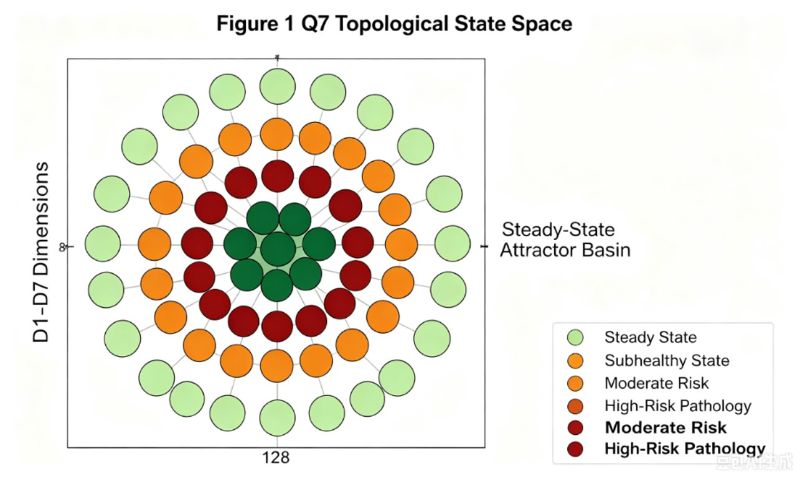
based on the topological and geometric characteristics of the hypercube, the central node cluster corresponds to the healthy steady-state attractor domain (zero-dimensional anomaly), while the topological edge nodes correspond to high-risk pathological states (multi-dimensional anomalies). The topological displacement distance of a node relative to the center allows for the precise quantification of the overall steady-state damage to the vascular system, thereby providing a topological foundation for subsequent steady-state quantification, risk stratification, and mechanistic analysis.
2.3 Construction of a Vascular Steady-State Phase Transition Theory Based on the 7D Ising Model
The degeneration of vascular system homeostasis is a classic nonlinear thermodynamic evolutionary process characterized by three stages: steady state, metastable state, and critical abrupt instability; traditional linear mathematical models fail to capture the mechanism of this critical abrupt transition. This study introduces the many-body Ising model from statistical physics, drawing analogies between the seven vascular assessment dimensions and spin particle units, and between pathological coupling across dimensions and particle interactions. A 7D vascular system Hamiltonian function is constructed to quantify the system's pathological potential energy and dimensional coupling strength, thereby characterizing the dynamic evolution of vascular homeostasis.
Dimensional state normalization is performed using the spin transformation \(s_i=2x_i-1\) to construct the 7D vascular system Hamiltonian:
H=-i=17j=17Jijsisj-i=17hisi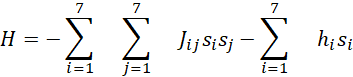
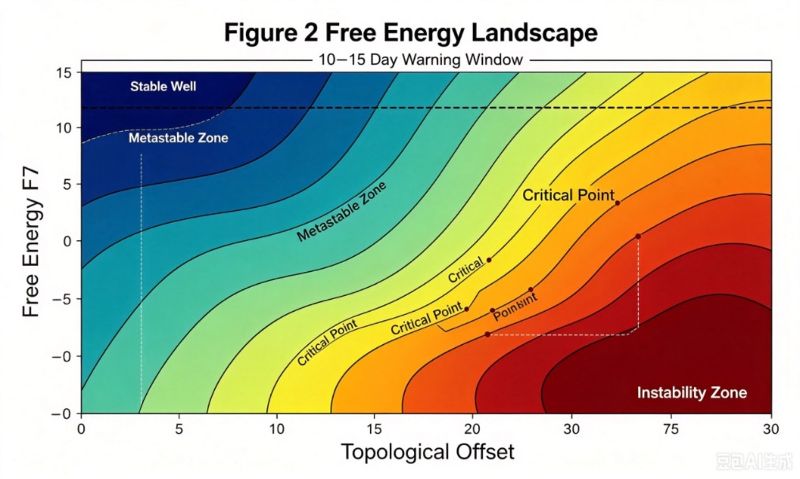
a dimension; and \(h_i\) represents the external field potential of a single dimension, reflecting the level of independent pathological damage within that dimension. By solving the Hamiltonian to determine the system's normalized free energy, a free energy landscape for vascular health is constructed. Characteristics such as the depth and curvature of the free energy surface, along with abrupt changes in its second derivatives, are utilized to identify steady-state regions, metastable transition zones, and critical phase transition points. As multidimensional pathological abnormalities accumulate and coupled damage intensifies, the system's free energy rises, potential wells shallow, and steady-state stability declines. When the topological shift reaches a critical threshold, the system undergoes an abrupt phase transition—shifting from a reversible metastable state to an irreversible unstable state—which corresponds to the critical juncture for the onset of adverse vascular events, thereby enabling the development of predictive models for high-risk cardiovascular incidents.
2.4 Construction of the Seven-Dimensional Vascular Robustness Index (R7)
To quantify the overall homeostatic stability of the vascular system and overcome the limitations of single-metric evaluations, this study constructs the Seven-Dimensional Vascular Robustness Index (R7). This index is modeled by integrating topological offset distances, dimensional damage weights, and the extent of multi-dimensional coupled damage, with a value range of 0 to 1. An R7 value approaching 1 indicates a balanced multi-dimensional vascular homeostasis, strong system resilience against perturbations, and high overall health stability; conversely, an R7 value approaching 0 signifies severe cumulative multi-dimensional pathological damage, significant homeostatic imbalance, and an extremely high risk of system instability. The formula for calculating the R7 index is as follows:
R7=1-17i=17ωidi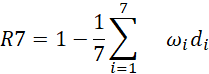
In the formula, \(\omega_i\) represents the weighting coefficient for pathological damage in the \(i\)-th dimension, determined by integrating the pathological contribution of that dimension with its clinical risk weight; \(d_i\) represents the state deviation in a single dimension. By integrating multidimensional damage information and topological deviation characteristics, the R7 index enables a unified, quantitative comparison of vascular homeostasis stability across different individuals and injury patterns, serving as a core quantitative metric for risk stratification.
2.5 Construction of a Multidimensional Gradient Risk Stratification Model
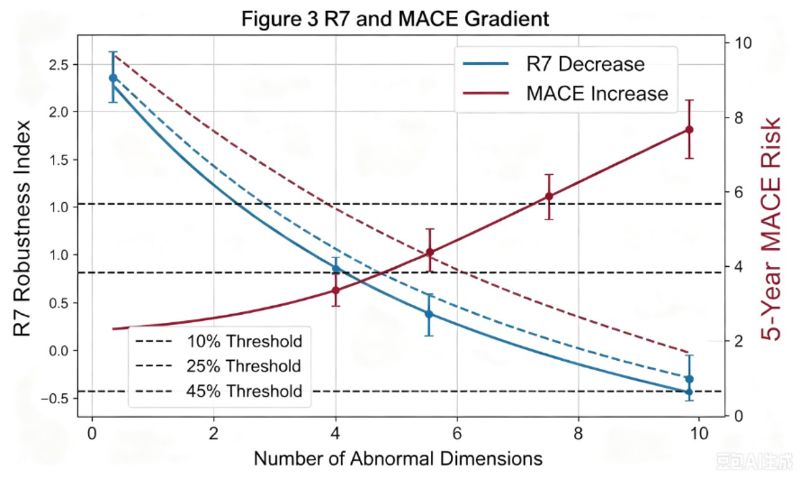
A multi-level gradient vascular risk stratification model was constructed based on the cumulative number of abnormal dimensions across 128 discrete vascular health states, incorporating the R7 robustness index and clinical MACE risk characteristics. Using the cumulative number of abnormal dimensions as the primary stratification variable, the model characterizes the pattern of progressive accumulation of multidimensional vascular damage. It analyzes the dose-response relationship between the number of abnormal dimensions, system robustness, and the risk of long-term cardiovascular events, establishing a four-tier risk stratification standard (low, medium, high, and very high risk) to enable refined and standardized risk assessment of vascular health status.
2.6 Construction of a Quantitative Model for Dimensional-Pathological Coupling
J47=Cov(s4,s7)Var(s4)Var(s7)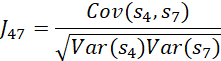
In the formula, \(\omega_i\) represents the weighting coefficient for pathological damage in the \(i\)-th dimension, determined by combining the pathological contribution of that dimension with its clinical risk weight; \(d_i\) denotes the state deviation in a single dimension. By integrating multidimensional damage information and topological deviation characteristics, the R7 index enables a unified assessment of vascular homeostasis stability across different individuals and injury patterns.
3. Core Model Results and Characteristic Analysis
3.1 Hierarchical Characteristics of the 7D Topological State Space
The Q7 hypercube topological state space constructed in this model comprehensively covers 128 discrete states of vascular health, exhibiting a distinct concentric-layer gradient pattern regarding steady-state characteristics. The "pure health" state (zero-dimensional abnormality) is concentrated within the steady-state attractor domain at the topological center, characterized by the deepest potential well and optimal system stability. As the number of abnormal dimensions increases, state nodes shift layer-by-layer from the center toward the topological periphery: 1–2 dimensional abnormalities correspond to reversible steady-state shifts (sub-health); 3–4 dimensional abnormalities correspond to subclinical moderate damage; and 5–7 dimensional abnormalities correspond to severe pathological instability. The topological shift distance shows a strict positive correlation with the degree of multidimensional vascular damage, enabling an intuitive and quantitative characterization of the vascular system's steady-state shift and facilitating the visualization and hierarchical assessment of vascular health.
3.2 Critical Phase Transition and Early Warning Characteristics of the Vascular System
Results from the free-energy landscape model reveal distinct three-stage dynamic characteristics in the evolution of the vascular system's steady state. In the steady-state interval (0–2 dimensional abnormalities), the system's free-energy potential well is deep, offering strong resistance to perturbations and no risk of spontaneous instability. In the metastable transition interval (3–4 dimensional abnormalities), the potential well shallows progressively; system fault tolerance and steady-state stability decline significantly, accompanied by a risk of insidious progression. In the critical phase transition interval (topological shift of 4.5–5.0), a sudden change occurs in the second derivative of the free energy, leading to a total collapse of the steady state and a transition into a state of pathological instability. The model precisely defines the subclinical early-warning window for vascular lesions and captures signals of steady-state instability prior to clinically overt events, demonstrating significant potential for early risk warning.
3.3 Correlation between the Robustness Index and Risk Gradient
Quantitative gradient analysis reveals a significant linear negative correlation between the cumulative number of abnormal vascular dimensions and the R7 robustness index, alongside an exponential positive correlation with the risk of long-term MACE. In the absence of dimensional abnormalities, vascular robustness remains high and the risk of cardiovascular events is extremely low; however, as multi-dimensional damage accumulates, system robustness steadily declines while pathological risk rises exponentially. The four-level risk stratification criteria established by the model accurately distinguish between individuals with varying degrees of vascular damage, demonstrating excellent risk discrimination capabilities and enabling the precise, quantitative grading of vascular health risks.
3.4 Characteristics of Multi-dimensional Pathological Coupling Imbalance
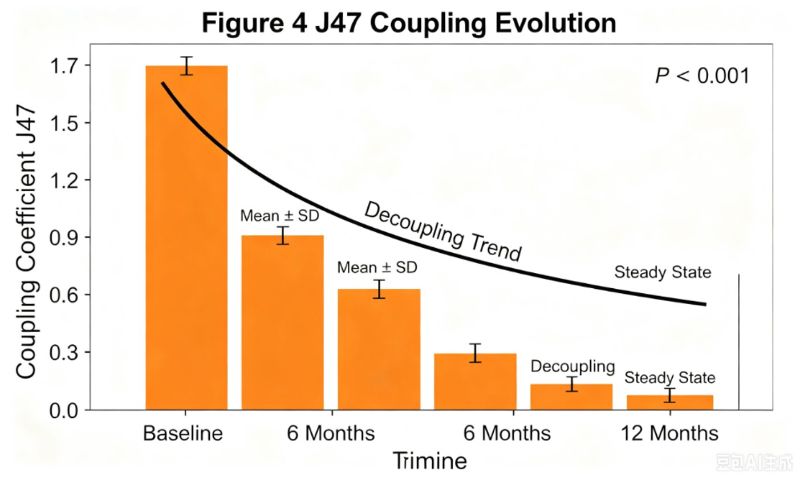
Results from the dimensional coupling model indicate a significant endogenous pathological coupling effect between the vascular inflammation and metabolic environment dimensions, identifying this as the critical coupling pair driving the progressive imbalance of vascular homeostasis. Under conditions of high coupling, exogenous metabolic loads can continuously amplify vascular inflammatory damage and accelerate multi-dimensional homeostatic deviation; this coupling imbalance serves as a key dynamic mechanism underlying the insidious progression of subclinical vascular lesions. The model effectively quantifies synergistic multi-dimensional pathogenic effects, addressing the limitations of traditional single-dimension assessments in explaining complex, interconnected pathological mechanisms.
4. Discussion
This study successfully constructed a seven-dimensional, 128-state hypercube topology model for assessing vascular health homeostasis. Drawing on high-dimensional topology theory, statistical physics phase transition mechanisms, and multidimensional coupled quantification concepts, the study established a comprehensive theoretical framework for the systematic assessment of vascular health, thereby overcoming the inherent limitations of traditional models—namely, their unidimensionality, static nature, ambiguous mechanisms, and inability to provide early warnings. Compared to traditional assessment systems, this model demonstrates significant theoretical innovation and systemic completeness.
First, this study constructed a comprehensive seven-dimensional framework for vascular health, covering multifaceted characteristics such as vascular structure, function, inflammation, perfusion, baseline risk, and metabolic environment. This approach achieves a systematic integration of factors influencing vascular health, resolving issues of fragmentation and one-sidedness found in traditional assessments. By employing binary domain encoding to standardize the modeling of 128 discrete health states, the study achieved—for the first time—the construction of a comprehensive, fully covered, digitizable, and comparable state space for vascular health, providing a novel standardized paradigm for precise, quantitative assessment.
Second, the study introduced hypercube topological geometry theory to transform deviations in vascular health homeostasis into quantifiable topological geometric distances, enabling the visualization and quantitative characterization of the vascular system's overall stability. Topological hierarchical features precisely correspond to the gradient evolution of vascular health—progressing from health and sub-health to subclinical damage and severe pathological instability—thereby accurately capturing the dynamic characteristics of the progressive deterioration of vascular homeostasis.
Third, leveraging a seven-dimensional Ising phase transition model, the study revealed the core nonlinear mechanism underlying the "hidden progression and sudden destabilization" characteristic of vascular diseases. It identified the three-stage evolutionary pattern of vascular homeostasis and the critical phase transition warning window, explaining the pathological essence of the transition from subclinical progression to acute cardiovascular events from the perspective of system thermodynamics, thus providing a robust theoretical foundation for the early warning of vascular diseases. In conclusion, the R7 vascular robustness index and the multidimensional coupling model developed in this study enable the unified quantification of overall vascular homeostatic stability and the precise analysis of multidimensional, synergistic pathological mechanisms. This approach effectively overcomes the limitations of traditional single-metric methods in assessing system-level homeostatic impairment, offering a novel quantitative tool for vascular health risk stratification, the elucidation of pathological mechanisms, and early risk warning.
At this stage, the model focuses on the construction of the theoretical framework and mechanistic modeling; however, certain limitations remain. Future work involving large-scale clinical datasets will allow for the calibration of dimensional weights, the validation of the model's predictive performance, and the continuous optimization of its accuracy. Ultimately, this theoretical model could serve as the foundation for developing an intelligent vascular health assessment system, providing innovative technical support for clinical vascular health screening, risk stratification, and early prevention and control.
5. Conclusion
This study successfully constructed a theoretical model for assessing vascular health homeostasis based on a 7D, 128-state hypercube topology. It established a comprehensive theoretical framework encompassing a global dimensional system, discrete state space, topological quantification system, phase transition early-warning mechanism, robustness index, risk stratification model, and dimensional coupling quantification model. From the perspective of complex systems, the model reinterprets the dynamic evolution patterns and nonlinear instability mechanisms of vascular health homeostasis, overcoming the theoretical limitations of traditional linear assessment systems; it enables precise quantification, hierarchical stratification, and early risk warning regarding vascular health status. The novel interdisciplinary theoretical framework established in this study provides a new theoretical paradigm and quantitative foundation for the systematic evaluation of vascular health, the study of pathological mechanisms, and the early prevention and control of cardiovascular disease risks.

Open Access By Aditum Open Access Journals id licensed under Creative Commons Attribution 4.0 International License. Based On a Work at aditum.org


