
International Journal of Advanced Interdisciplinary Research and Innovation
OPEN ACCESS | Volume 1 - Issue 1 - 2026
ISSN No: - | Journal DOI: 10.61148/IJAIRI


Paul C. Mocombe
West Virginia State University, The Mocombeian Foundation, Inc.
Corresponding author: Paul C. Mocombe, West Virginia State University, The Mocombeian Foundation, Inc.
Received: September 02, 2026 | Accepted: September 12, 2026 | Published: September 17, 2026
Citation: Paul C. Mocombe. (2026) “Deontological Ethics In MOCOMBEIAN Consciousness Field Theory” International Journal of Advanced Interdisciplinary Research and Innovation, 1(1); DOI: 10.61148/IJAIRI/003.
Copyright: © 2026 Paul C. Mocombe. This is an open access article distributed under the Creative Commons Attribution License, which permits unrestricted use, distribution, and reproduction in any medium, provided the original work is properly cited.
The absolute vacuum is the Mocombeian ontological name for the fifth dimensional probability wavefunction (the world of noumena, i.e., the in-itself) that gives rise to the material worlds, their facts, relations of ideas, and mathematical principles, we as a species experience as material reality. In this article, I utilize Mocombe’s consciousness field theory emanating out of the aforementioned ontology of the absolute vacuum to refute Kant’s epistemological unknowability of the noumenal world, i.e., the absolute vacuum in Mocombeian epistemology, while maintaining his deontological ethics, which for me is revealed and reinforced by our knowability of the in-itself, noumena, absolute vacuum, of the consciousness field.
For Mocombe (2019, 2021a, 2021b), our consciousness, ontologically speaking, is the (phenomenological) basis upon which we know, understand, and constitute our being-in-the-world. Consciousness here refers to subjective awareness of phenomenal experiences, qualia, (ideology, language, self, feelings, choice, control of voluntary behavior, thoughts, etc.) of internal and external worlds (Chalmers, 1996; Hameroff & Penrose, 2014; Mocombe, 2021, 2021a). The academic (scientific) literature “describes three possibilities regarding the origin and place of consciousness in the universe: (A) as an emergent property of complex brain neuronal computation, (B) as spiritual quality of the universe, distinct from purely physical actions, and (C) as composed of discrete ‘proto-conscious’ events acting in accordance with physical laws not yet fully understood” (Hameroff & Penrose, 2014, p. 70). The former, (A), is a materialist perspective, which emphasizes the laws of classical physics to posit consciousness as the by-product of the neural correlates of the physical substrates of the material brain (Chalmers, 1996).
The latter two (B and C) are post-materialist approaches to understanding consciousness, which emphasize the emergence of consciousness as an external phenomenon that exists outside of the physical substrates of the brain either in the form of panpsychism or cosmopsychism/panspiritism. Both post-materialist perspectives use the concepts and theories of quantum mechanics (i.e., superposition, entanglement, multiverse, etc.) to either complete the materialism of the (A) camp, i.e., the (C) camp, or to ground fourteen paranormal and parapsychological (near-death experiences, telepathy, telekinesis, out-of-body experiences, physic mediumship, etc.) empirical data as proof for the external nature of consciousness, i.e., the (B) camp, which is received and facilitated by the brain (Chalmers, 1996; van Lommel, 2010; Mocombe, 2021, 2021a).
All three positions are problematic in that they are unable to resolve the hard and binding problems of consciousness, however (Chalmers, 1996). In the materialist camp (A), they are unable to account for how the neural correlates of the physical substrates of the material brain bind to give us the phenomenal subjective experience of consciousness. Just the same, in the post-materialist camps (B and C), they are unable to account for either how consciousness in everything, panpsychism, emerges/combines, or decombines from a god or the cosmos, panspiritism and cosmopsychism, respectively, in the material brain to give rise to consciousness (van Lommel, 2010).
Mocombe’s (2019, 2021, 2021a) consciousness field theory (CFT), which is part of his larger theory of phenomenological structuralism, resolves the hard and binding problematics of all three camps by positing the origins and nature of consciousness to be an emergent fifth force of nature that is cycled and recycled throughout the multiverse as a resonating channel or station of and on a frequency wavelength via its embodied elementary particle, psychion, which has spin, mass, charge, and phenomenal properties, i.e., qualia. It is upon this contemporary ontological conception of the origins and nature of consciousness, as opposed to that of the Enlightenment philosophers and subsequent theorists, that Mocombe, ontologically and epistemologically, builds his interdisciplinary theory and methodology of phenomenological structuralism and consciousness field theory. In this article, I posit that the absolute vacuum is the Mocombeian ontological name for the fifth dimensional probability wavefunction (the world of noumena, i.e., the in-itself) that gives rise to the material worlds, their facts, relations of ideas, and mathematical principles, we as a species experience as the structure of material reality. I utilize Mocombe’s consciousness field theory emanating out of the aforementioned ontology of the absolute vacuum to refute Kant’s epistemological unknowability of the noumenal world, i.e., the absolute vacuum in Mocombeian epistemology, while maintaining his deontological ethics, which for me is revealed and reinforced by our knowability of the in-itself, noumena, of the consciousness field.
Background of the Problem
Kantian transcendental idealism “attempts to combine empirical realism, preserving the ordinary independence and reality of objects of the world, with transcendental idealism, which allows that in some sense the objects have their ordinary properties (their causal powers, and their spatial and temporal position) only because our minds are so structured that these are the categories we impose upon the manifold of experience” (Blackburn, 2008, pg. 356). Kantian transcendental idealism removes God out of the equation as the basis upon which knowledge is based with the forms of sensibility (space and time) and understanding (categories of the mind) which ground the phenomenal world that we, the structural feature of our experience (the transcendental unity of apperception—TUAP) come to know, experience, understand, and impose the order we see in the phenomenal world. So time and space (forms of sensibility) plus the twelve Kantian schematized categories of the understanding, divided into four groups of three (1. The axioms of intuition, i.e., unity, plurality, and totality; 2. The anticipations of perception, i.e., reality, limitation, and negation; 3. The postulates of empirical thought, i.e., necessary, actual, and possible; 4. The analogies, i.e., substance, cause, and reciprocity), make experience and knowledge of the phenomenal world possible, which also makes the noumenal world, and any metaphysical concepts of it, impossible (Thomson, 2004).
In other words, for Kant experience in the phenomenal world requires both the senses, the a priori forms of sensibility, i.e., space and time, and the understanding, i.e. the twelve categories. A unified consciousness (not a self or the Cartesian “I”), which is a structural feature of experience necessary to provide the unity to our experience, what Kant calls, “the transcendental unity of apperception,” rule-governed and connected by the categories, experiences real objects that we perceive and exist independently of our perception of them. Thus, the spatio-temporal objects are necessarily relative to and subject to the (synthetic) a priori forms of experience, i.e., forms of sensibility and the understanding. In this sense, Kant does away with the metaphysics of the noumenal world of absolutes, which is unknowable as the independent objects are phenomenal, relative to the a priori forms of experience and understanding, and are not utilized to know the nature of reality as such (noumena).
Unlike Kant, however, Mocombe’s phenomenological structural epistemology ties consciousness to noumena and therefore knowable. That is, for Mocombe the noumenal world of the absolute vacuum is, like the phenomenal world, a part of our consciousness and the structural feature of our experience. Kant overlooks the twelve forms or categories of the noumena, which are a priori, psychonic a priori, just like the synthetic forms of the understanding, and make the in-itself knowable and part of the structural features of our experience, for the analytic and synthetic truths that make the phenomenal world knowable. For Kant, the latter two are inapplicable (as they only apply to the world of phenomena) to the noumenal world and as a result its (noumenal world) truths are unknowable for us.
Like Kant, Mocombe’s (2009, 2016, 2019, 2021a, 2021b) physics, metaphysics, and philosophy (phenomenological structuralism) posits that we humans experience the material world via consciousness, the awareness of internal and external phenomenon, qualia. Unlike Kant, however, Mocombe makes the noumenal world part of the structural features of experience of our consciousness via the resonance of its subatomic particle, psychion, which reveals its noumenal (psychonic a priori) truths via twelve paranormal and parapsychological categories (forms of the in-itself or noumena) of consciousness. For Mocombe, consciousness, is an emergent fifth force of nature that arises from beings experiencing superimposed and entangled worlds, which gives rise to consciousness fields (consciousness field theory) the phenomenal properties, qualia, of which emerge as psychions, the subatomic particle of consciousness (along with the elementary particles of the other forces of nature) that is integrated in the absolute vacuum (the noumenal world) following matter disaggregation across the multiverse. In Mocombe’s theory of phenomenological structuralism, in other words, consciousness is an emergent fifth force of the universe, composed of elementary (carrier) particles, psychions (psychon once embodied), with phenomenal properties, qualia, that are received by the brain as resonance, from the absolute vacuum and local consciousness fields, and integrated by its (the Brain’s) electromagnetic field to constitute mind, practical consciousness, and the self in material worlds of the multiverse. The phenomenal properties, qualia, of the psychions of a consciousness field, following matter disaggregation throughout the multiverse, either collapse upon other superimposed and entangled versions (resonances) of themselves throughout the multiverse, or are integrated, along with the subatomic particles of the other four forces (gravity, electromagnetism, and the weak and strong nuclear forces), in the absolute vacuum of a (fifth-dimensional) superverse to create (via quantum fluctuation and tunneling) future beings and worlds with consciousness and phenomenal properties. As such, the psychions of the consciousness field, once assimilated in the absolute vacuum, is an interconnected, endless, and nonlocal fifth force of nature, which, initially, emerges following matter aggregation and disaggregation in the multiverse. It is an endless assimilation of all past, present, and future information (practical activities and memories), Platonic forms, of beings of the multiverse cycled and recycled via the absolute vacuum (empty space in which elementary particles, quarks, and constituents of matter and forces of nature have become one), which fluctuates as a probability wave function, to give rise to entangled and superimposed worlds, each with their own consciousness fields, which produce future things and beings with consciousness. In other words, for Mocombe “the absolute vacuum,” exists independently of the (local) reality/realities we experience, which is a particular manifestation of the probability wavefunction of it (absolute vacuum) (Mocombe, 2019, 2021a, 2021b). Hence, for Mocombe the multiverse and its worlds are a material by-product of the absolute vacuum, i.e., nonlocal spacetime, and local consciousness fields, which bear the facts, relations and states of affairs, and things (including consciousness) emanating from the probability wavefunction of the former (absolute vacuum). It (the absolute vacuum), as defined by Mocombe, is whole (containing all of the phenomenal properties of the multiverse as a probability wavefunction), emergent (phenomenal properties, qualia, of embodied subatomic particles experiencing local consciousness fields), uncreated, and limited (the latter two a result of, and constrained by, the former two, i.e., the absolute vacuum emerges from, and is the experience of, the elementary forces of nature and the multiworlds they have created).
Epistemologically, we know about the absolute vacuum (the form of the noumena or the in-self), like the phenomenal world, in consciousness, which is a frequency wavelength emanating from it (absolute vacuum). However, unlike the phenomenal world, which is known to us via, as Kant rightly posits, the forms of the understanding and categories of sensibility; the psychonic a priori truths of the noumenal world are revealed to us via twelve paranormal and parapsychological extrasensory perceptions and experiences, i.e., categories (Van Lommel, 2010; Mocombe, 2021a, 2021b). We know about the noumenal world in consciousness via what I am calling here the forms of the noumena, and we know about the material worlds it produces via logical relations of things and states of affairs, the five senses and forms or categories of the understanding as highlighted by Kantian epistemology.
In other words, on top of the Kantian forms of sensibility and understanding, which gives us access to, and allows us to experience, the phenomenal world, we must add the forms of the in-itself, which gives us access to, and allows us to experience the noumenal world. These psychonic a priori forms of the in-itself or noumena, which are tied to the quantum experience of consciousness where we encounter the noumenal world, are, 1) out-of-body and 2) near-death experiences, 3) psi phenomena, 4) telepathy, 5) remote viewing, 6) presentiments, 7) effects of intention on non-biological systems, 8) effects of intention on biological systems, 9) remote staring, 10) reincarnation, 11) mediumship, and 12) deathbed communications. Kant by not including the truths emanating from the psychonic a priori forms of the in-itself or noumena, removes the latter from the structural features of conscious experience, I do not. For me, both the noumenal and phenomenal world are experienced and knowable via the structural features of experience, which are the forms of the understanding, sensibility, and noumena of consciousness. There is no need for a separate theorizing of the categorical imperatives, which Kant uses to ground practical reason, if the noumenal world is considered part of our structural features of experience and consciousness, which reveals its psychonic a priori truths that get reified via religion and ultimately the universality of science. In other words, the ethic of duty and responsibility regardless of outcome associated with Kantian deontological ethics does not come from reason, but from revelation from the consciousness field, which seeks to maintain balance and harmony, given our interconnectedness in the absolute vacuum, in the multiverse via just acts, i.e., reciprocal justice, respect for nature and the environment, and communal living.
Theory and Method
In Mocombe’s (2008, 2016, 2019, 2021, 2021a) theory of phenomenological structuralism and consciousness field theory, consciousness is an emergent (fifth) force of the universe, composed of an elementary particle, psychion, with mass, charge, spin (a boson with spin S=1), and phenomenal properties, qualia, that is received by the brain, from, or in, multiple, entangled, and superimposed local consciousness fields, Schumann waves, and integrated by its (the Brain’s) electromagnetic field as psychon to constitute mind, practical consciousness, and the self, as resonating channels or stations of, or on, frequency wavelengths, in material worlds of the multiverse (see Figure 5 for the elementary value of quantum energy for brain and Schumann waves) (Kozlowska and Kozlowski, 2016, p. 795).
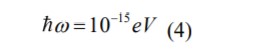
Figure 5. Adopted from Kozlowska and Kozlowski. The formula represents the elementary value of quantum energy for brain and Schumann waves.
The phenomenal properties, qualia, of the psychions of a consciousness field, following matter disaggregation, disconnection as psychon from the Schumann waves, throughout the multiverse, either collapse, as a resonating channel or station of a frequency wavelength, upon other superimposed and entangled versions (wavelengths) of themselves throughout the multiverse, or are integrated, along with the other four forces (gravity, electromagnetism, and the weak and strong nuclear forces), in the absolute vacuum of a superverse to create (via quantum fluctuation, tunneling, and inflation) future beings with consciousness (the phenomenal properties of lived-experience in the form of qualia, informational content of subatomic particles, i.e., psychions). As such, the psychions of the consciousness field as psychons they are local and connected to (entangled) multiple superimposed worlds with, and through, Schumann waves; once assimilated in the absolute vacuum, they are psychions, the elementary particle of consciousness, an interconnected, endless, and nonlocal fifth force of nature, with qualia or phenomenal properties, which, initially, emerges following matter aggregation and disaggregation, disconnection from Schumann waves, in the multiverse. It (the psychions of the consciousness field) is an endless assimilation of all past, present, and future information (practical activities and memories) of beings of the multiverse cycled and recycled via the absolute vacuum (empty space in which elementary particles, quarks, and constituents of matter and forces of nature have become one), which fluctuates as a probability wave function, to give rise to entangled and superimposed worlds, each with their own Schumann waves and consciousness fields, which produce future beings with consciousness, an individualized resonating channel or station, psychion, on the frequency wavelength of the Schumann wave and the absolute vacuum (Mocombe, 2021, 2021a).
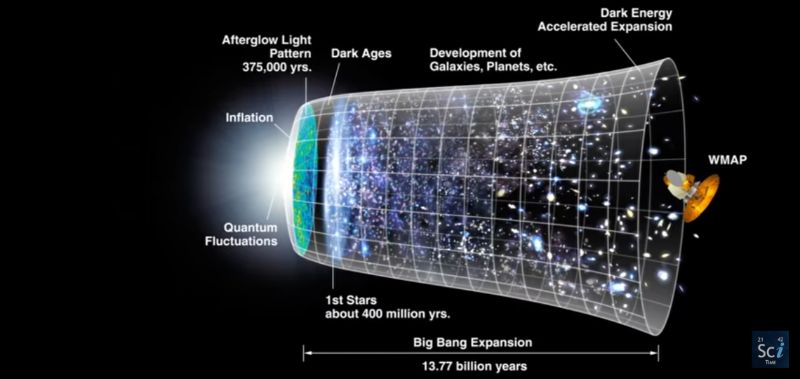
Figure 7. For Mocombe, one superverse created (from the absolute vacuum) a universe, via quantum fluctuation, tunneling, and inflation, and its informational content is entangled and superimposed on top of another universe with the informational content of the previous universe emerging in it via black holes as highlighted in Figure 3. Figure 7 highlights the stages by which these multiverses emerge and unfold from the absolute vacuum. Hence what you have are a layer of multiverses, superimposed and entangled, whose informational contents are shared or recycled via black holes, which organize and structure the multiverses similarly. As such, quantum fluctuation and big bangs are constantly occurring and producing the same worlds, ad infinitum. So, when physicists look out to the cosmic microwave background (CMB), they are looking at the remnant from an early stage of our universe, which came forth from its older version a layer above it, and so on ad infinitum. Put more concretely, the physicists are in a superverse, of our universe, in our milky-way galaxy, looking out to the black hole of a milky-way galaxy from the superverse/multiverse above us with its own consciousness field.
As highlighted in Figure 7, the absolute vacuum is a fifth dimensional superverse or cosmic soup where all the elementary particles are one, and fluctuate, as a probability wavefunction, tunnel, and inflate to produce four dimensional spacetimes (multiverses) where consciousness emerges as individuated psychonic fields or resonating channels/stations produced by the firing of neurons in the brain where the elementary particle, psychion, of consciousness are embodied and tied to the frequency wavelength of Schumann waves of entangled and superimposed worlds, which are tied to the oscillating frequency wavelength of the absolute vacuum, which transmits the signal of phenomenal subjective consciousness to the psychions. Each individual consciousness has their own resonating psychionic channel or station (which is measurable on EEG machines) on the frequency wavelength of the earth’s Schumann wave, which is tied to the frequency wavelength of the absolute vacuum, which transmits phenomenal consciousness to the psychionic channel (see Figure 4).
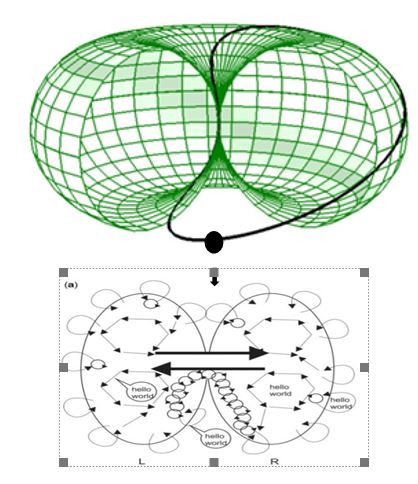
Figure 4. This figure represents how the psychions are embodied, as psychons, from the consciousness field (CF) in the neurons of brains (figure a, adopted from McFadden, 2020, represents the human brain—left (L) and right (R) hemispheres—and its EM field, which holds together and integrates the qualia of psychions, informational content of the superverse/multiverses, which becomes individuated consciousness recursively organized and reproduced as practical consciousness), which produces an EM field that holds together and integrates the qualia of the psychions as individuated consciousness on channels or stations of frequency wavelengths from the absolute vacuum. For Mocombe, building on BHBBT, the superverses with entangled and superimposed (via black holes) multiverses share the same informational content. So, the hypothesis here is that one superverse created (from the absolute vacuum) a universe, and its informational content is entangled and superimposed on top of another superverse with the informational content of the previous universe emerging in it via black holes. Hence what you have are a layer of multiverses and superverses, superimposed and entangled, whose informational contents are shared or recycled via black holes, which organize and structure the multiverses similarly. As such, quantum fluctuation and big bangs are constantly occurring and producing the same worlds, ad infinitum. The informational content, qualia, of these multiverses and worlds are encoded and transmitted as psychions (channel frequency of wavelengths) and embodied in the neurons of brains, which create an EM field that holds and integrates the psychions as individuated consciousness.
Φ = 10⁻15 eV₍₄₎ ± f (0)
Figure 6. Garyian consciousness wave equation for individual consciousness. The formula represents the elementary value of quantum energy for brain and Schumann waves plus or minus the resonating frequency channel or station of subjective phenomenal consciousness.
Figure 6, the Garyian equation, represents the equation of, and for, individual consciousness: phi Φ is the symbol for consciousness; 10⁻15 eV₍₄₎, adopted from Kozlowska and Kozlowski, the formula represents the elementary value of quantum energy for brain and Schumann waves (see Figure 5); f (0), represents the resonating psychionic channel or station of individual phenomenal consciousness received from the absolute vacuum. The absolute vacuum houses and incorporates, as phenomenal property, qualia, all of the past, present, and future, lived experiences of all individual consciousnesses as a fifth force of nature and resonating frequency wavelength, which is transmitted to, Schumann waves of entangled and superimposed multiworlds, and received and facilitated by, in human beings, the material brain, brainstem, and central nervous system.
In Mocombe’s (2016, 2019, 2021, 2021a) physics and metaphysics, quantum superposition, entanglement, wave-function realism, and paranormal and parapsychological evidence (categories of noumena) in Haitian Vodou of spirit possession, which represent ancestors from a parallel world, Vilokan, of the earth’s of which we ought to pattern our behaviors and structures, are grounding proofs for the acceptance of the multiple worlds hypothesis of quantum mechanics. Within the latter hypothesis, the understanding is that “each possibility in a superposition evolves to form its own universe, resulting in an infinite multitude of coexisting ‘parallel’ worlds. The stream of consciousness of the observer is supposed somehow to ‘split’, so that there is one in each of the worlds—at least in those worlds for which the observer remains alive and conscious. Each instance of the observer’s consciousness experiences a separate independent world, and is not directly aware of any of the other worlds” (Hameroff and Penrose, 2014, pg. 50) (see Figure 3).
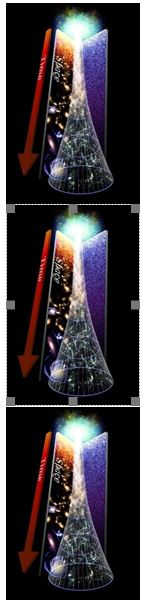
Figure 3. For Mocombe, building on BHBBT, the superverses with entangled and superimposed (via black holes) multiverses share the same informational content. So, the hypothesis here is that one superverse created (from the absolute vacuum) a universe, and its informational content is entangled and superimposed on top of another superverse with the informational content of the previous universe emerging in it via black holes. Hence what you have are a layer of multiverses and superverses, superimposed and entangled, whose informational content are shared or recycled via black holes, which organize and structure the multiverses similarly. As such, quantum fluctuation and big bangs are constantly occurring and producing the same worlds, ad infinitum. So, when physicists look out to the cosmic microwave background (CMB), they are looking at the remnant from an early stage of our universe, which came forth from its older version a layer above it, and so on ad infinitum. Put more concretely, the physicists are in a superverse, of our universe, in our milky-way galaxy, looking out to the black hole of a milky-way galaxy from the superverse/multiverse above us with its own consciousness field.
It is within this multiple world hypothesis, physics, that Mocombe constitutes the notion of consciousness in the universe according to his theory of phenomenological structuralism. For Mocombe, consciousness is an emergent fifth force of nature, a quantum material substance/energy, psychion, the phenomenal properties, qualia, of which are recycled/entangled/superimposed throughout the multiverse and becomes embodied via the neurons of brains. It (consciousness) is manifested in simultaneous, entangled, superimposed, and interconnecting material resource frameworks as embodied praxis or practical consciousness, which in-turn becomes the phenomenal properties, qualia, of material (subatomic particle energy, psychion) consciousness that is recycled/entangled/superimposed throughout the multiverses.
In other words, I adopt from the “membrane theory” model of Lisa Randall and Raman Sundrum (1999) the assertion, in keeping with the logic of Haitian Vodou, that there might be an additional dimension, i.e., the absolute vacuum or zero-point field, which exists as a probability wavefunction, on the cosmological scale, the scale described by general relativity, which gives rise to four dimensional multiverses within, or out of, it (see Figures 3 and 7). That is to say, our universe is embedded in a vastly bigger five-dimensional space (the four-dimensional space of relativity, plus a fifth dimension for the subatomic forces including consciousness), a kind of super-universe. Within this super-space, our universe is just one of a whole array of co-existing universes (Haitian Vodou only accounts for our universe and its parallel), each a separate four-dimensional bubble within a wider arena of five-dimensional space where consciousness (a subatomic force) is recycled/entangled/superimposed between the five-dimensional super-space, i.e., absolute vacuum, and its entangled and superimposed four-dimensional multiverses (see Figures 3 and 7).
The origins of consciousness within this phenomenal structural paradigm is emergent, and not the product of a supreme creator or god. For this position, I build on the mathematics of Richard Gauthier (2020) in his “univon multiverse hypothesis.” Unlike Gauthier, who holds on to God or a supreme creator (panspiritism) to account for the origins and nature of consciousness within the multiverse, I do not. According to Gauthier’s (2020) model,
identical univon quantum particles, produced from a univon quantum field, created not only our universe but also many other identically fine-tuned universes in a multiverse. The univon, also called a cosmic quantum, is composed of a helically-circulating superluminal primordial information quantum (sprinq). [(The univon is the quantum particle of a conscious cosmic quantum field having both physical and mental potentialities. Quantum fields may be composed of cosmic ectoplasm or mind-stuff, which according to yoga philosophy is a subtle vibrational substance formed from consciousness by a cosmic creative power, that takes the form of objects within a cosmic mind)]. The physical [(and mind-stuff)] constants carried in the information content of each univon’s sprinq are exactly the same in all univons and in all sprinqs, though sprinqs express different fundamental particle attributes in different environments. The univon is radioactive. The decay of a univon into less energetic products is the starting point (t=0) of its created universe. The univon’s sprinq rapidly multiplies itself into different quantum fields and particles, leading very quickly to the early universe’s exponentially-rapid inflationary period and then to the Big Bang, which produces abundant relic dark matter particles of the universe as well as the less abundant ordinary matter. Univons made many other [(entangling)] equally fine-tuned universes with identical fundamental forces and constants…. (pgs. 1-3).
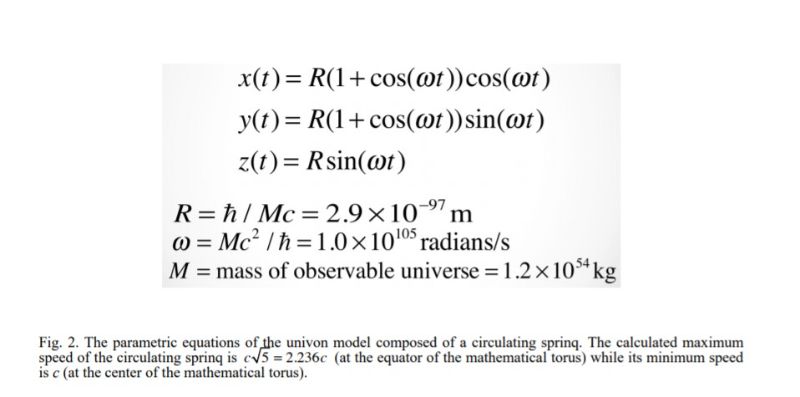
In my model, which differs in language and the need for a “cosmic mind,” the “univon” is the cosmological scale described by Einstein constituted by the forces, constants, particles, etc., sprinqs in Gauthier’s hypothesis and phenomenal properties or qualia in my model, of the multiverses, with gravity and the psychionic force of consciousness emergent forces following matter aggregation, evolution, and disaggregation, which give rise to inflation, big bangs, and additional (entangled) universes with similar informational (physical and mental) content. Hence, the mathematics for both models are the same as seen in Figures 1 and 2, which is adopted from Gauthier (2020).
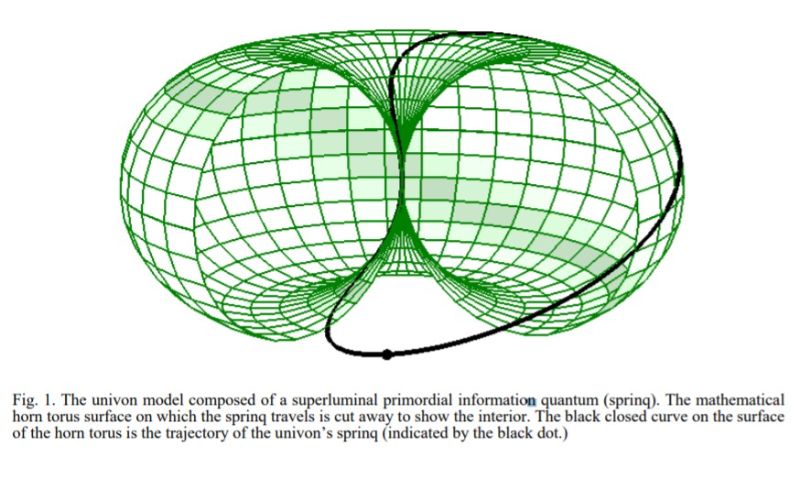
I tie this model to Mocombe’s notion of the absolute vacuum and structuration theory, phenomenological structuralism, to explain the emergence and constitution of consciousness and minds in the multiverses.
Hence for Mocombe, the consciousness field, and its elementary particle, psychion, emerged separately from the first four forces (gravity, electromagnetism, the strong and weak nuclear forces) of nature, the subatomic particles of which fluctuated, inflated, and tunneled as a wave function from the absolute vacuum, the probability wave function where all the elementary particles were one at the beginning of the multiverse, to create an original universe or entangled and superimposed multiverse (see Figures 3 and 7). This original universe/multiverse, evolved and replicated itself, via “black holes (BHBBT),” and inflation, to create present and future replicas of itself, multiverses, which evolved to produce, entangled and similarly situated, organic and inorganic life whose initial experiences of the Schumann waves of superimposed worlds produced the qualia of the psychons that would constitute subatomic particles, psychions, of emerging consciousness fields connected to both the absolute vacuum and the Schumann waves as individuated resonating frequency channels/stations with phenomenal properties emerging from experience (see Figures 1, 2, 3, 4, and 5) (Anderson, 2020). In this Mocombeian view, consciousness is not fundamental; instead, it is an emergent (material) property of the multiverse, which is constituted and expressed, in the human sphere through subatomic particle aggregation, mode of production, language, ideology, ideological apparatuses, communicative discourse, and praxis (Mocombe, 2019).
In the human sphere, beings’ experience (sensation), via central nervous systems, brains, and brainstems, of aggregated matter created by the initial four forces of nature, via quantum fluctuation, tunneling, and inflation from the fifth dimension of the absolute vacuum, gives rise to qualia, emerging sensations of experience, phenomenal properties, that are encoded as information and memories in the subatomic elementary particle of consciousness, psychion, psychon once embodied, which creates consciousness fields given their connection, as psychonic waves, to entangled and superimposed Schumann waves of the multiverse created by the absolute vacuum. Mocombe argues that consciousness, early on (at the very beginning of the evolution of aggregate matter), emerges from the initial neuronal activities of the brain, brainstem, and central nervous system experiencing local material reality, which produces its first phenomenal essence, i.e., qualia, which is the affect of pleasure and unpleasure (Mocombe, 2021, 2021a). This initial essence, which produces other emerging essences (emergent essence), phenomenal experiences, qualia, via the brain, body, and the central nervous system, held together by the brain’s electromagnetic field, once constituted from experience of material realities with Schumann waves, is absorbed and recycled throughout a global consciousness field (cosmopsychism) created by the absolute vacuum, zero-point field, following matter disaggregation, of the multiverse to continuously produce beings with (local) consciousness, psychion/psychon, that have phenomenal properties or qualia, which becomes embodied in the physical substrates (neurons, dendrites, etc.) of the brain to receive and facilitate consciousness, which can be impaired if the mechanical brain and central nervous system are damaged or under the influences of drugs, alcohol, etc. Hence neural correlates of the brain come to facilitate and act on consciousness, which following matter aggregation is a fifth force, psychion, of nature with phenomenal properties, mass, charge, and spin, resonating as an individuated channel or station of the material brain from the absolute vacuum or zero-point field in entangled and superimposed Schumann waves of material realities.
Following matter disaggregation across the multiverse, the elementary particle of consciousness, psychion, which has mass, charge, spin, and phenomenal properties, i.e., qualia, integrates into the absolute vacuum to give rise to future worlds with conscious beings. In this sense, Mocombe eliminates any spiritual elements, the (B) camp, regarding consciousness constitution for a strict materialist perspective, i.e., the (A) and (C) camps, which does not solely attributes consciousness to the mechanical brain, i.e., the neural correlates of consciousness; instead, the brain is a receiver and facilitator of consciousness, the subatomic particle, psychion, of which, once disconnected from the Schumann waves of entangled and superimposed multiple worlds, is recycled, replicated, entangled, and superimposed as psychon throughout the multiverse via neurons of the brain and its electromagnetic field (see Figure 4).
Consciousness, following matter disaggregation, in other words, became a permanent aspect of the multiverse, via the absolute vacuum, cosmopsychism, and has emerged as a fifth force of nature that produces a field, a consciousness field, whose elementary particle, psychion, has mass, charge, spin, and phenomenal properties, i.e., qualia, that is subsequently received by aggregated matter with brains and central nervous systems via the resonance of the elementary particle of consciousness embodied, psychon (see Figure 4). The consciousness field is a classical field produced by accelerating psychionic charges that contain and transmit all the phenomenal properties, qualia, (as an individuating consciousness) of the absolute vacuum to the Schumann waves of material realities, and the psychonic waves of brains, brainstems, and central nervous systems connected to the latter, Schumann waves, which are connected to the former, absolute vacuum or zero-point field, as a resonating frequency wavelength channel or station with different amplitudes (see Figure 5 for the elementary value of quantum energy for brain and Schumann waves). The consciousness field is the combination of a psychonic field or wave (produced by the psychionic elementary particle), an electric field, and a magnetic field. The psychonic field or wave, like the magnetic field, is produced by moving charges or currents, and the electric field stationary charges. The consciousness field can be regarded as a smooth, continuous field, a stream of consciousness, that propagates in a wavelike manner, and interacts with charges and currents. The reciprocal information transfer between the absolute vacuum, the Schumann waves of entangled and superimposed material realities with consciousness fields, and the psychion/psychon of subjects of experience takes place via the distinct resonances of everything and everyone, which is an individuated rhythmic channel/station on the frequency wavelength of Schumann waves and the absolute vacuum that is entangled and superimposed, and can be detected by EEG machines (see Figure 6 for the Garyian equation representing individual consciousness).
Each person, animal, plant, and thing have their own individuated (resonating) channel/station on the frequency wavelength of the absolute vacuum, which gives rise to the entangled and superimposed Schumann waves of the consciousness field where their existences are unfolding. Consciousness, from this perspective, is an emergent fifth force of nature with an elementary particle, psychion, which produces the consciousness field, from the absolute vacuum, tied to the electromagnetic waves, Schumann waves, of superimposed and entangled physical worlds via the brain’s psychonic waves produced from the firing of neurons. The firing of neurons in the structures (ARAS system) of the brain, and the central nervous system, produces the psychonic electromagnetic wave, composed of the psychion with qualia, sense experiences of aggregate matter, which ties the individual to the Schumann waves, the electromagnetic fields of (superimposed and entangled) physical worlds of the multiverse, which emerge from, and tied to, the absolute vacuum or zero-point field of nonlocal space where the elementary particles of the forces of nature are one in the form of a probability wavefunction. The absolute vacuum transmits individual consciousness as a resonating frequency wavelength, channel or station with phenomenal properties, qualia, on the Schumann resonance of the earth and the psychonic wave of the individual, which share the same frequency with different amplitude (see Figure 5). The brain is a receiver of consciousness with the elementary particle, psychion, of consciousness serving as the resonating channel or station of individuated consciousness, and the Schumann and psychonic waves serving as the bandwidth; the absolute vacuum produces a carrier wave, i.e., the psychonic waves of individual consciousness, that is modulated in frequency by the signal that is to be transmitted in the form of the psychonic wave of the psychion (see Figure 6). Following matter disaggregation across and throughout the multiverse, the psychion, subatomic particle of consciousness, and its qualia, phenomenal property, is subsequently integrated into the absolute vacuum, the wavefunction of the multiverse, which in its inception was only four forces, where all the fundamental forces of nature emerged, of the multiverse to give rise to future worlds with conscious simple and complex beings whose qualia, phenomenal properties, is never destroyed (emergent panpsychism), but is the frequency of an individual consciousness recycled throughout the multiverse (see Figure 6). For Mocombe what accounts for the unity of experience is the psychion, subatomic particle, of the emergent psychonic/panpsychic subatomic field of the multiverse that has phenomenal properties, qualia, which gets embodied as a resonating neuronal particle of the aggregated brain, which experiences a material resource framework as an “I,” a channel/station of, or on, a frequency wavelength, whose phenomenal properties, subjective experiences of material reality, following matter disaggregation either returns back to the field or collapses in other worlds, with their own consciousness fields, where the same matter exists as distinct resonating frequency channels of wavelengths (individual psychionic waves connected to Schumann waves of multiverses connected to the absolute vacuum as frequency wavelengths, which can be measured in Hertz). Death, in other words, is either integration into the probability wavefunction of the absolute vacuum, which produces the Schumann waves of superimposed and entangled material worlds each with their own superimposed and entangled consciousness fields, where individuated consciousness emerges, or the collapse of the resonating channel of the psychion/psychon unto another version of its vibrating and oscillating frequency wavelength and phase across the multiverse.
On this physics, Mocombe builds his systemic philosophy, sociology, and psychology called phenomenological structuralism by tying the emergence of the field of consciousness, the consciousness field, composed of psychions to human sociological and psychological development and experiences, which constitute the phenomenal properties (qualia) of the psychions, which form the tripartite structure (ego, personal and collective unconscious) of the emerging (iterative) human mind manifested as their practical activities. Psychologically speaking, in other words, the field of consciousness or consciousness field is the basis for psychological development. The field is an emergent fifth force of nature composed of the psychion, which is the energy substance that constitutes and transmits, as a wave, the ego essence (subjective experiences of material realities) of an individual person to the neurons of brains (see Figure 4). The ego essence, psychion, is composed of all of the personal and collective sense experiences (personal and collective unconscious of the ego), the phenomenal properties or qualia, of the individual person, which becomes embodied in the neurons in the brain as a result of matter aggregation across multiple simultaneous existing past/present/future worlds/universes. The structure of the mind, in the end, is composed of the ego and the personal and collective unconscious, which becomes embodied, as the qualia of psychions, via the neurons of the aggregated brain and its EM field across replicated simultaneous past/present/future worlds of the multiverse. The EM field’s “source is the electrical dipoles within the neuronal membranes caused by the motion of ions in and out of those membranes during action potentials and synaptic potentials. The periodic discharge of neurons—firing or action potentials—generates EMF waves that propagate out of the neuron and into the surrounding inter-neuronal spaces where they overlap and combine to generate the brain’s global EM field that is routinely measured by brain scanning techniques such as electroencephalography (EEG) and magnetoencephalography (MEG)” (McFadden, 2020, pg. 5). The EM field integrates and holds together, like a glue, the ego essence, individuated consciousness of being, their psychion, which emerges out of its own (emergent) force, the consciousness field, from the absolute vacuum. The ego, in other words, is the (material) essence, psychion, of the individual being. It is a composite of their past/present/future experiences, which emerge as the personal and collective unconscious, i.e., qualia, of the ego. The latter two as such are the past/present/future biological and sociological sense experiences of the ego over all of its lived-experiences across the multiverse. Following matter disaggregation, the psychion, either collapses unto other versions (wave patterns) of itself still in existence in the multiverse or returns to the consciousness field of the absolute vacuum. The individual, doing embodiment, only becomes aware of itself as an ego with personal and collective tastes that individuates them from other objects and persons when they encounter conflict, throughout their lifespan, in becoming and being-in-worlds constituted via five (sociological) systems, i.e., mode of production, language, ideology, ideological apparatuses, and communicative discourse, which “enframes” the consciousness field of a particular dispensation of spacetime by those who control the material resource framework by means of one of two forms of system and social integration, communally (the Vodou Ethic and the spirit of communism) or individually (the Protestant Ethic and the spirit of capitalism).
Discussion and Conclusion
Epistemologically, we know about the absolute vacuum (the form of the noumena or the in-self), like the phenomenal world, in consciousness, which is a frequency wavelength emanating from it (absolute vacuum). However, unlike the phenomenal world, which is known to us via, as Kant rightly posits, the forms of the understanding and categories of sensibility; the psychonic a priori truths of the noumenal world are revealed to us via twelve paranormal and parapsychological extrasensory perceptions and experiences, i.e., categories (Van Lommel, 2010; Mocombe, 2021a, 2021b). We know about the noumenal world in consciousness via what I am calling here the forms of the noumena, and we know about the material worlds it produces via logical relations of things and states of affairs, the five senses and forms or categories of the understanding as highlighted by Kantian epistemology.
In other words, on top of the Kantian forms of sensibility and understanding, which gives us access to, and allows us to experience, the phenomenal world, we must add the forms of the in-itself, which gives us access to, and allows us to experience the noumenal world. These psychonic a priori forms of the in-itself or noumena, which are tied to the quantum experience of consciousness where we encounter the noumenal world, are, 1) out-of-body and 2) near-death experiences, 3) psi phenomena, 4) telepathy, 5) remote viewing, 6) presentiments, 7) effects of intention on non-biological systems, 8) effects of intention on biological systems, 9) remote staring, 10) reincarnation, 11) mediumship, and 12) deathbed communications. Kant by not including the truths emanating from the psychonic a priori forms of the in-itself or noumena, removes the latter from the structural features of conscious experience, I do not. For me, both the noumenal and phenomenal world are experienced and knowable via the structural features of experience, which are the forms of the understanding, sensibility, and noumena of consciousness. There is no need for a separate theorizing of the categorical imperatives, which Kant uses to ground practical reason, if the noumenal world is considered part of our structural features of experience and consciousness, which reveals its psychonic a priori truths that get reified via religion and ultimately the universality of science via two ontological forms of system and social integration, communally (the Vodou Ethic and the spirit of communism) or Hobbesian individual struggle of all against all (the Protestant Ethic and the spirit of capitalism). In other words, the ethic of duty and responsibility regardless of outcome associated with Kantian deontological ethics does not come from reason, but from revelation from the consciousness field, which seeks to maintain balance and harmony, given our interconnectedness in the absolute vacuum, in the material realities of the multiverse via just acts, i.e., reciprocal justice, respect for nature and the environment, and communal living associated with the Vodou Ethic and the spirit of communism over and against the Protestant Ethic and the spirit of capitalism form of system and social integration, the latter of which is destructive and antagonistic towards nature and being itself. All of the past, present, and future lived-experiences of things and beings of the multiverse are the phenomenal properties, i.e., qualia, of the atomic particles of the absolute vacuum, which are projected as structured material realities. Human actions in material reality are different timelines of our choices in the absolute vacuum, which directs us towards balance and harmony between the things and beings of material reality and their encapsulation as the probability wavefunction of the absolute vacuum. This superdeterminism of action suggests that our actions ought to be directed at, as Kant rightly suggests, universalism, i.e., as universal Truth that all similarly situated would perform so as to prevent disequilibrium between material reality and the probability wavefunction of the absolute vacuum, which occurs when conduct is directed by a struggle of all against all that is associated with the Protestant Ethic and the spirit of capitalism.
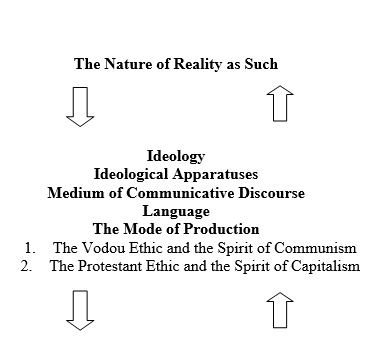
Diagram 1. Societal Constitution in Mocombeian Phenomenological Structuralism. The initial human experience of the material resource framework that is the earth determines the mode of production by which they satisfy their biological needs, which comes to be associated with the nature of reality as such through language, medium of communicative discourse (TV, print and social media, folklores, etc.), ideological apparatuses (the family, religion, education, politics, and social relations), and ideologies (democracy, capitalism, socialism, etc.). Culture is the plethora of material and immaterial characteristics placed on the two modes of organizing the material resource framework. The ultimate aim of society is to organize the material resource framework around the nature of reality as such, which for Mocombe is associated with the Vodou Ethic and the spirit of communism over the Protestant Ethic and the spirit of capitalism due to the fact that the latter has shown to be destructive, exploitative, and a threat to all life on earth.
Table 1. Characteristics of Brain Waves.
|
Frequency Band |
Frequency |
Brain States |
|
Gamma (γ) |
35 Hz |
Concentration, problem solving |
|
Beta (β) |
12-35 HZ |
Anxiety dominant, active mind, external attention, relaxed |
|
Alpha (α) |
8-12 Hz |
Very relaxed, passive attention |
|
Theta (θ) |
4-8 Hz |
Deeply relaxed, inward focused |
|
Delta (δ) |
0.5-4 Hz |
Sleep, dreaming |
|
Psychionic / psychonic (Φ) |
0-0.5 HZ |
Transmission from the absolute vacuum to Schumann wave |

Open Access By Aditum Open Access Journals id licensed under Creative Commons Attribution 4.0 International License. Based On a Work at aditum.org


