
Clinical Medical Case Reports and Case Series
OPEN ACCESS | Volume 3 - Issue 2 - 2026
ISSN No: 3065-7644 | Journal DOI: 10.61148/3065-7644/CMCRCS


Athanasios Kontos1,2*, Ioannis Riris3, Ioannis Tziortziotis4, Dimitrios Kypraios4
1Endoscopy Unit, Gastroenterology Department, Hospital Universitario Río Hortega, Valladolid, Spain.
2Scholarship Recipient of the Hellenic Society of Gastroenterology, Athens, Greece.
3Student of Medicine, Medical School of Athens, National and Kapodistrian University of Athens, Athens, Greece.
4Gastroenterology Department, Agios Savvas Hospital, Athens, Greece.
*Corresponding author: Athanasios Kontos, Endoscopy Unit, Gastroenterology Department, Hospital Universitario Río Hortega, Valladolid, Spain.
Received: July 25, 2026 | Accepted: July 31, 2026 | Published: August 03, 2026
Citation: Kontos A, Riris I, Tziortziotis I, Kypraios D. (2026) “Pancreatic Head Cancer as an Independent Risk Factor for Difficult Biliary Cannulation Requiring Precut Papillotomy: A Retrospective Comparative Study versus Choledocholithiasis”, Clinical Medical Case Reports and Case Series, 3(2); DOI: 10.61148/3065-7644/CMCRCS/066.
Copyright: © 2026. Athanasios Kontos. This is an open access article distributed under the Creative Commons Attribution License, which permits unrestricted use, distribution, and reproduction in any medium, provided the original work is properly cited.
Background/Aims: Difficult biliary cannulation (DBC) during endoscopic retrograde cholangiopancreatography (ERCP) often requires precut papillotomy, a rescue technique associated with a higher risk of adverse events than successful standard cannulation. Whether the underlying indication for ERCP influences the likelihood of DBC independently of papillary morphology remains unclear. We investigated whether pancreatic head cancer (PHC) is associated with an increased need for precut papillotomy compared with choledocholithiasis.
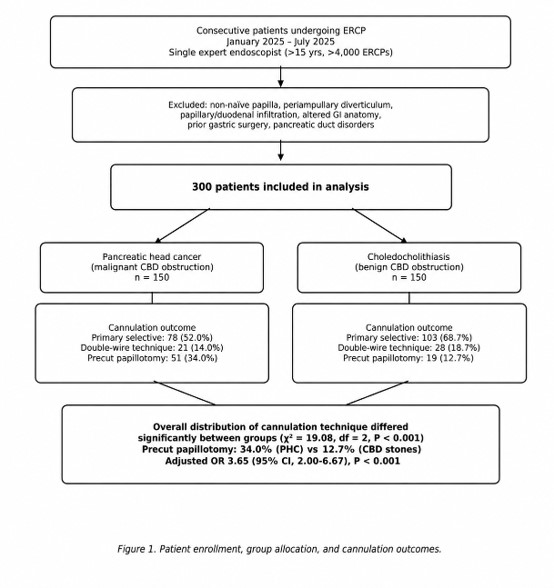
Methods: In this single-center retrospective study, 300 consecutive patients who underwent ERCP between January and July 2025 were divided into two equal groups: 150 with malignant distal biliary obstruction due to PHC and 150 with choledocholithiasis. All procedures were performed by a single endoscopist with more than 15 years of experience and over 4,000 ERCPs. DBC was defined per European Society of Gastrointestinal Endoscopy (ESGE) criteria. The association between clinical condition and need for precut papillotomy was assessed using the chi-square test, odds ratio (OR), relative risk, and multivariable logistic regression adjusting for age, sex, and papilla type (Haraldsson classification).
Results: The two groups were well balanced for age, sex, and papilla type. Precut papillotomy was required in 51 of 150 patients with PHC (34.0%) versus 19 of 150 patients with choledocholithiasis (12.7%; χ² = 19.08, P < 0.001). Patients with PHC had 3.55-fold higher crude odds of requiring precut papillotomy (95% CI, 1.97–6.39), which remained significant after adjustment (adjusted OR, 3.65; 95% CI, 2.00–6.67; P < 0.001). Haraldsson Type III papilla was independently associated with precut papillotomy (adjusted OR, 2.63; 95% CI, 1.28–5.43; P = 0.009), whereas age and sex were not.
Conclusions: Pancreatic head cancer is independently associated with a substantially increased need for precut papillotomy, beyond the effect of papillary morphology. Anticipating this risk may allow earlier, more controlled use of advanced cannulation techniques in patients with PHC undergoing ERCP, potentially reducing procedure-related adverse events.
difficult biliary cannulation; pancreatic head cancer; precut papillotomy; ERCP; selective biliary cannulation
Endoscopic retrograde cholangiopancreatography (ERCP) is among the most technically demanding procedures in gastrointestinal endoscopy, particularly for less experienced endoscopists1-2. Selective deep biliary cannulation represents the first and most critical step for a successful therapeutic ERCP. According to the European Society of Gastrointestinal Endoscopy (ESGE), difficult biliary cannulation (DBC) is defined by the presence of one or more of the following criteria: more than five cannulation attempts at the native papilla, a cannulation time exceeding 5 minutes after initial contact with the papilla, or more than one unintended pancreatic duct cannulation or contrast opacification3. ESGE has also published evidence-based recommendations regarding advanced cannulation techniques for the management of difficult biliary access3.
The reported incidence of DBC varies considerably across studies, with an average rate of approximately 20%4-6. Several factors have been identified as independent predictors of difficult biliary cannulation. The most consistently reported include endoscopist experience, papillary morphology according to the Haraldsson classification, and the underlying indication for ERCP7-8. Additional factors associated with increased cannulation difficulty include suspected sphincter of Oddi dysfunction, an intradiverticular or distal (D3) papilla, a papilla concealed by a mucosal fold, and a downward-facing papillary orientation9-10.
Although papillary morphology has been shown to influence cannulation difficulty, accumulating evidence suggests that its impact becomes less pronounced when ERCP is performed by highly experienced endoscopists7-8. In expert hands, the adverse effects of unfavorable papillary anatomy, morphology, and orientation on successful biliary cannulation appear to be substantially reduced.
In this single-center retrospective study, we aimed to investigate whether the underlying disease itself influences the difficulty of biliary cannulation and, consequently, the need for precut papillotomy, a procedure associated with a higher rate of adverse events compared to successful selective biliary cannulation11-13. Specifically, we evaluated patients with pancreatic head cancer (PHC), a condition frequently associated with jaundice, and compared them with patients undergoing ERCP for uncomplicated choledocholithiasis14. The primary objective was to determine whether pancreatic head cancer is associated with an increased requirement for precut papillotomy to achieve successful biliary cannulation compared with benign biliary stone disease.
Methods
We conducted a retrospective comparative study including 300 patients who underwent endoscopic retrograde cholangiopancreatography (ERCP) between January 2025 and July 2025. All procedures were performed by a single experienced endoscopist with more than 15 years of expertise and experience of over 4,000 ERCP procedures, thereby minimizing operator-related variability and potential procedural bias.
Clinical and procedural data were retrieved retrospectively from the standardized endoscopy reports, which routinely include comprehensive demographic, clinical, and procedural information.
Patients were divided into two equal groups comprising 150 patients each. The first group included patients with malignant distal biliary obstruction secondary to pancreatic head cancer (PHC), while the second group consisted of equal number of patients undergoing ERCP for choledocholithiasis as a comparison group. None of the included patients had endoscopic or radiological evidence of duodenal lumen infiltration or direct invasion of the major duodenal papilla.
Difficult biliary cannulation (DBC) was defined according to the European Society of Gastrointestinal Endoscopy (ESGE) criteria as the presence of one or more of the following: more than five cannulation attempts at a native papilla, a cannulation time exceeding 5 minutes following the first contact with the papilla, or more than one unintended pancreatic duct cannulation or contrast opacification.
Biliary cannulation was performed following the ESGE-recommended stepwise approach. Initial cannulation was attempted using the standard guidewire-assisted technique. Following unintended guidewire cannulation of the pancreatic duct, the double-guidewire technique was employed. If biliary access remained unsuccessful, precut papillotomy was subsequently performed. The papillary morphology was classified according to the Haraldsson classification, and all papillary types were included in the analysis.
All ERCP procedures were performed under general anesthesia with fluoroscopic guidance. Rectal indomethacin was administered prophylactically before the procedure for the prevention of post-ERCP pancreatitis. Only the index ERCP procedure was analyzed for each patient; no procedure was intentionally abandoned and repeated at a later session.
Patients were excluded if they had incomplete medical records, a previously manipulated (non-naïve) papilla, periampullary diverticulum, papillary or duodenal infiltration, choledochoduodenal fistula, previous gastric surgery resulting in altered upper gastrointestinal anatomy, or pancreatic duct disorders that could affect biliary cannulation, including main pancreatic duct (Wirsung duct) stricture, pancreatic duct stones, or pancreas divisum.
Categorical variables, including sex, papilla type, clinical condition (choledocholithiasis or pancreatic cancer), and the need for precut papillotomy, were compared using Pearson's chi-square (χ²) test. The association between clinical condition and the need for precut papillotomy was quantified by calculating the odds ratio (OR), relative risk (RR), 95% confidence intervals (95% CI), and the absolute risk difference. To identify independent predictors of precut papillotomy, a binary logistic regression analysis was performed with precut papillotomy (yes/no) as the dependent variable. The independent variables included clinical condition (pancreatic cancer vs. choledocholithiasis), age, sex, and papilla type. All statistical analysis were conducted considering a p value <0.05 statistically significant.
Results
The pancreatic cancer and choledocholithiasis groups did not differ significantly with respect to age, sex, or papilla type, indicating that these baseline characteristics were well balanced between the two groups (Table 1). Therefore, the higher frequency of precut papillotomy observed in patients with pancreatic cancer is unlikely to be explained by differences in these measured variables. Nevertheless, the absence of statistically significant differences does not exclude the potential influence of unmeasured confounding factors.
Table 1: Demographic and anatomical characteristics by underlying disease
|
Parameter |
Choledocholithiasis (n=150) |
Pancreatic head cancer (n=150) |
P value |
|
Age, years (mean ± SD) |
66.23 ± 9.75 |
66.97 ± 9.82 |
0.513 |
|
Male sex, n (%) |
86 (57.3%) |
85 (56.7%) |
0.907 |
|
Papilla type (overall) |
|
|
0.586 |
|
Type I |
72 (48.0%) |
63 (42.0%) |
|
|
Type II |
26 (17.3%) |
34 (22.7%) |
|
|
Type III |
31 (20.7%) |
29 (19.3%) |
|
|
Type IV |
21 (14.0%) |
24 (16.0%) |
|
The overall distribution of cannulation techniques differed significantly between the pancreatic cancer and choledocholithiasis groups (Pearson χ² = 19.082, df = 2, P < 0.001) (Table 2, Figure 2A). Patients with pancreatic head cancer had a lower rate of successful primary selective biliary cannulation and required precut papillotomy more frequently than patients with choledocholithiasis. Although the use of the double-wire technique was numerically lower in the pancreatic cancer group, the observed difference in the overall distribution of cannulation techniques was primarily driven by the substantially higher rate of precut papillotomy in these patients.
Table 2 : Distribution of final cannulation technique
|
Technique |
Choledocholithiasis |
Pancreatic head cancer |
Total |
|
Primary selective biliary cannulation |
103 (68.7%) |
78 (52.0%) |
181 (60.3%) |
|
Successful double-wire technique |
28 (18.7%) |
21 (14.0%) |
49 (16.3%) |
|
Precut papillotomy |
19 (12.7%) |
51 (34.0%) |
70 (23.3%) |
Precut papillotomy was required in 51 of 150 patients with pancreatic head cancer (34.0%) compared with 19 of 150 patients with choledocholithiasis (12.7%), representing a statistically significant difference (Pearson χ² = 19.081, df = 1, P< 0.001). Patients with pancreatic head cancer had 3.55-fold higher odds of requiring precut papillotomy than those with choledocholithiasis (crude OR, 3.55; 95% CI, 1.97–6.39). The corresponding relative risk (RR) was 2.68 (95% CI, 1.67–4.32), while the absolute risk difference was 21.3 percentage points (95% CI, 12.1–30.6).
The association between pancreatic head cancer and the need for precut papillotomy remained significant after adjustment for age, sex, and papilla type in a multivariable logistic regression model. The adjusted odds ratio was 3.65 (95% CI, 2.00–6.67; P < 0.001). The minimal difference between the crude and adjusted odds ratios (3.55 vs. 3.65) suggests that these measured variables did not materially confound the observed association between pancreatic head cancer and the need for precut papillotomy (Figure 2B).
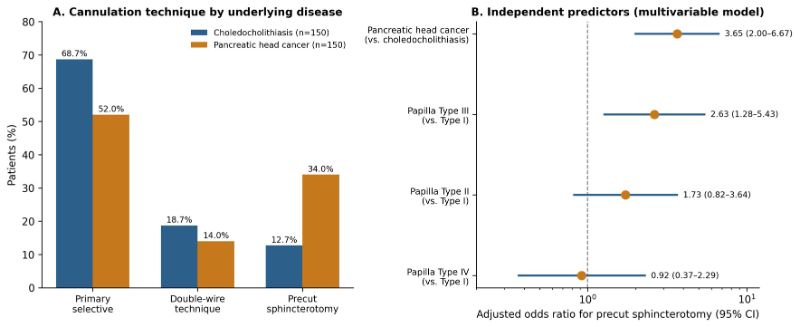
Figure 2. (A) Distribution of final cannulation technique by underlying disease. (B) Adjusted odds ratios (95% CI) for precut papillotomy from the multivariable logistic regression model.
Papilla type, according to the Haraldsson classification, was independently associated with the need for precut papillotomy (overall Wald χ² = 8.481, df = 3, P = 0.037). Compared with Type I papillae, Type II papillae were not significantly associated with the need for precut papillotomy (adjusted OR, 1.73; 95% CI, 0.83–3.64; P = 0.147), whereas Type III papillae were associated with significantly higher odds of precut papillotomy (adjusted OR, 2.63; 95% CI, 1.28–5.43; P = 0.009). No significant association was observed for Type IV papillae (adjusted OR, 0.92; 95% CI, 0.37–2.29; P = 0.855). Age and sex were also not independently associated with the need for precut papillotomy. (Table 3).
Table 3: Multivariable logistic regression
|
Variable |
Adjusted OR |
95% CI |
P value |
|
Cancer vs choledocholithiasis |
3.652 |
2.001–6.667 |
<0.001 |
|
Age |
1.018 |
0.988–1.049 |
0.236 |
|
Male sex |
1.264 |
0.710–2.250 |
0.426 |
|
Papilla type (overall) |
|
|
0.037 |
|
Type II vs I |
1.733 |
0.825–3.642 |
0.147 |
|
Type III vs I |
2.632 |
1.276–5.430 |
0.009 |
|
Type IV vs I |
0.919 |
0.369–2.289 |
0.855 |
The principal finding of this study is that pancreatic head cancer was independently associated with a significantly increased need for precut papillotomy, even after adjustment for age, sex, and papilla type. In addition, Type III papilla, according to the Haraldsson classification, was independently associated with an increased likelihood of requiring precut papillotomy. Importantly, the distribution of papilla types did not differ significantly between the pancreatic head cancer and choledocholithiasis groups (P = 0.586). Therefore, although papilla morphology represents an independent technical determinant of difficult biliary cannulation, it does not account for the higher rate of precut papillotomy observed in patients with pancreatic head cancer. These findings suggest that pancreatic head cancer itself is an independent determinant of difficult biliary cannulation beyond the influence of papillary morphology.
Discussion
The reported prevalence of difficult biliary cannulation (DBC) varies considerably across published studies4,5. Although the European Society of Gastrointestinal Endoscopy (ESGE) provides a standardized definition of DBC3, comparisons among studies remain challenging because of substantial heterogeneity in patient selection, operator experience, papillary anatomy, underlying pathology, and procedural techniques.
Our institution is a tertiary referral teaching center where ERCP procedures are performed by endoscopists with different levels of experience. However, to minimize operator-related bias, only procedures performed by a single expert endoscopist with more than 15 years of experience and over 4,000 ERCPs were included in the present study.
Numerous factors have been associated with difficult biliary cannulation. Previous studies have identified altered surgical anatomy (e.g., Billroth II reconstruction), large or multiple common bile duct stones, advanced age, trainee involvement, limited endoscopist experience, suspected biliary strictures, ampullary tumors, small papilla, periampullary diverticula, papillary morphology, female sex, the absence of cholangitis, normal serum bilirubin levels, and the type of major papilla as independent or potential predictors of DBC14-20. In contrast, pancreatic head cancer has been specifically evaluated as a predictor of difficult cannulation in only two previous studies by Cáceres Escobar et al. (2021)14 and Ben Abdallah et al. (2022)1.
The present study was specifically designed to minimize potential confounding factors particularly given that difficult biliary cannulation in patients with distal malignant biliary obstruction may represent an underestimated problem15. We included only patients with a native papilla and excluded those with periampullary diverticula, papillary or duodenal infiltration, altered upper gastrointestinal anatomy, previous gastric surgery, and pancreatic duct disorders that could influence cannulation. Furthermore, all papillary morphologies according to the Haraldsson classification were included and recorded8. By controlling these variables, we sought to evaluate the independent effect of the underlying disease—specifically pancreatic head cancer—on the likelihood of difficult biliary cannulation and the subsequent need for precut papillotomy.
Needle-knife precut papillotomy represents an effective rescue technique for achieving selective biliary access after failed standard cannulation21-23. When performed by experienced endoscopists and according to current ESGE recommendations, it has a high technical success rate with an acceptable safety profile9. Although post-procedural bleeding has been reported in approximately 2%–5% of cases, most episodes are mild and manageable with endoscopic therapy12-13. The risk of adverse events, however, increases when precut techniques are performed by less experienced operators or after prolonged unsuccessful cannulation attempts.
It is also important to identify patients who are likely to present with difficult biliary cannulation (DBC) before or during the early stages of ERCP, as early recognition may reduce the risk of post-ERCP adverse events. In such cases, the endoscopist should maintain a low threshold for early needle-knife precut papillotomy. This strategy may reduce overall procedure time and, according to several studies, is associated with a lower risk of post-ERCP pancreatitis compared with prolonged standard cannulation attempts or alternative rescue techniques, such as the double-guidewire technique24-26.
Early precut papillotomy (EP) has been well established as an effective technique for achieving biliary cannulation in cases of difficult biliary cannulation (DBC), while also reducing procedure-related complications, particularly post-ERCP pancreatitis24-29. The available evidence suggests that EP is especially beneficial in patients with a prominent oral protrusion and, according to the findings of our study, in those undergoing ERCP for pancreatic head cancer. Therefore, EP may be considered a first-line advanced cannulation technique after failure of standard cannulation in these selected patients30-31.
Although papillary morphology has been reported as a determinant of cannulation difficulty, several studies have demonstrated that its impact becomes less pronounced when ERCP is performed by experienced endoscopists7,8. This observation supports our decision to control for operator experience in the present study. In our study, among the different papilla types classified according to the Haraldsson classification, only Type III papilla was independently associated with an increased likelihood of requiring precut papillotomy, whereas the overall papilla classification was not significantly associated with this outcome. Importantly, the distribution of papilla types was comparable between the two groups, suggesting that the observed differences in precut papillotomy rates were not attributable to differences in papillary morphology but rather to the underlying disease.
The multivariable analysis, together with the comparison of two clinically comparable patient groups differing only in the underlying pathology (pancreatic head cancer versus choledocholithiasis), identified pancreatic head cancer as an independent predictor of difficult biliary cannulation and an increased requirement for precut papillotomy32. These findings suggest that the underlying disease itself may substantially influence cannulation difficulty, even in the absence of papillary or duodenal tumor infiltration. Τherefore, it is essential that the endoscopist is aware of these factors, as this may facilitate appropriate procedural planning and potentially reduce ERCP-related adverse events and procedure duration, as suggested by previous studies25-26. Nevertheless, procedure time and adverse events were not evaluated as endpoints in our study.
Several limitations should be acknowledged. First, this was a retrospective, single-center study, which may limit the generalizability of the findings. Second, the size and number of common bile duct stones were not systematically recorded. Likewise, tumor size and other radiological characteristics of pancreatic head cancer were unavailable for analysis, preventing assessment of their potential influence on cannulation difficulty.
Further prospective, multicenter studies are warranted to validate our findings and to better define the independent predictors of difficult biliary cannulation. Improved identification of high-risk patients before ERCP may facilitate optimal procedural planning, encourage timely implementation of advanced cannulation techniques such as precut papillotomy, and ultimately improve technical success while minimizing procedure-related adverse events.
Conclusions
In this retrospective comparative study of 300 patients undergoing ERCP by a single experienced endoscopist, pancreatic head cancer was independently associated with a substantially higher requirement for precut papillotomy than choledocholithiasis, even after adjustment for age, sex, and papillary morphology. These findings indicate that the underlying disease itself—independent of papillary anatomy—is a determinant of difficult biliary cannulation. Recognizing pancreatic head cancer as a risk factor for difficult cannulation may prompt earlier use of precut papillotomy by experienced operators, which could shorten procedure time and reduce the risk of post-ERCP pancreatitis. Given the retrospective, single-center design, these findings should be confirmed in prospective, multicenter studies before being generalized to broader clinical practice.
Author Contributions: A.K. conceived and designed the study, collected the data, and drafted the manuscript. I.R. performed the statistical analysis and contributed to manuscript preparation. I.T. critically revised the manuscript for important intellectual content. D.K. performed all ERCP procedures and critically reviewed the manuscript. All authors read and approved the final version of the manuscript.
Funding: This research received no external funding.
Conflicts of Interest: The authors declare no conflicts of interest.
Data Availability Statement: The data supporting the findings of this study are available from the corresponding author upon reasonable request.
Ethics Statement: The study was conducted in accordance with the principles of the Declaration of Helsinki.
Informed Consent Statement: Written informed consent for the use of anonymized clinical data for research purposes was obtained from all patients.


Open Access By Aditum Open Access Journals id licensed under Creative Commons Attribution 4.0 International License. Based On a Work at aditum.org


