
Clinical Case Reports and Clinical Study
OPEN ACCESS | Volume 13 - Issue 4 - 2026
ISSN No: 2766-8614 | Journal DOI: 10.61148/2766-8614/JCCRCS


Ghouzlanı Imane, A. Chraibi, M. Lahjaouj, M. Loudghırı, W. Bıjou, Y. Oukessou, S. Rouadı, R.L. Abada, M. Roubal, M. Mahtar
Service D’ORL Et Chirurgie Cervico-Faciale, Hopital 20 Aout Casablanca.
*Corresponding author: Ghouzlanı Imane, Service D’ORL Et Chirurgie Cervico-Faciale, Hopital 20 Aout Casablanca.
Received: July 15, 2026 | Accepted: July 27, 2026 | Published: August 13, 2026
Citation: Imane G, A. Chraibi, M. Lahjaouj, M. Loudghırı, W. Bıjou, Y. Oukessou, S. Rouadı, R.L. Abada, M. Roubal, M. Mahtar. (2026) “Automated eFACE Grading Of Facial Function After Facial Nerve Decompression: Agreement With Clinician eFACE And The Sunnybrook System” Clinical Case Reports and Clinical Study, 13(4); DOI: 10.61148/2766-8614/JCCRCS/246.
Copyright: © 2026 Ghouzlanı Imane. This is an open access article distributed under the Creative Commons Attribution License, which permits unrestricted use, distribution, and reproduction in any medium, provided the original work is properly cited.
Objective: To evaluate the agreement between an automated, smartphone-application–based eFACE, clinician-graded (manual) eFACE, and the Sunnybrook Facial Grading System (Sunnybrook) for grading facial motor function in patients who had undergone facial nerve decompression, and to determine whether an automated tool can reliably stand in for expert clinician assessment.
Methods: Sixteen consecutive patients operated on for peripheral facial palsy were assessed. At the post-operative visit, facial function was graded with the House-Brackmann (HB) scale, the Sunnybrook, a clinician-graded eFACE, and an automated eFACE generated by the mobile application from a standardized photo/video set. Agreement was analyzed with Pearson and Spearman correlations, Bland-Altman limits of agreement, and the intraclass correlation coefficient (ICC).
Results: Complete grading with all three instruments was feasible in 13 of 16 patients (81%; the remaining three had bilateral or non-gradable palsy). Scores correlated strongly across instruments (automated vs. clinician eFACE r = 0.89; clinician eFACE vs. Sunnybrook r = 0.93; automated eFACE vs. Sunnybrook r = 0.90; all p < 0.001). Bland-Altman analysis showed that the automated eFACE systematically scored 8.6 points lower than the clinician eFACE (95% limits of agreement −16.7 to −0.6), while the ICC between the two was moderate (0.60).
Conclusion: An automated smartphone eFACE tracks clinician grading and the Sunnybrook closely but systematically underestimates facial function by roughly nine points. It is a promising, accessible screening and monitoring tool, yet clinician grading should remain the reference until the systematic bias is corrected.
Few things are read as instinctively as a human face, and few losses are felt as acutely as the loss of its movement. Severe peripheral facial palsy reshapes how a person eats, speaks, closes an eye, and is seen by others, and it carries a measurable psychological burden. Facial nerve decompression remains a valuable option in this setting—most clearly after temporal bone trauma, when electrophysiological testing points to a poor chance of spontaneous recovery1,2—and modern middle-fossa and transmastoid techniques have made the intratemporal course of the nerve reliably accessible.3 The operation itself has a long lineage, from the first descriptions of complete decompression4 to the systematic rehabilitation of the traumatically injured nerve.5
Yet an operation is only as meaningful as our ability to measure what it achieves, and here otology has never quite settled on a single language. The House-Brackmann scale is still the most widely spoken6,7, prized for its simplicity, but its six coarse grades flatten the very differences—resting tone, voluntary excursion, synkinesis—that matter most to a recovering patient. The Sunnybrook Facial Grading System was designed to be more sensitive, weighting these components into a single composite score8,9, and the clinician-graded electronic facial function scale (eFACE) went further still, capturing static, dynamic, and synkinetic domains on continuous 0–100 scales.10,11 Repeated calls for uniformity12 and dedicated synkinesis metrics13 reflect how unsettled the field remains.
Into this landscape has come the smartphone. Automated, application-based grading promises to put a reproducible eFACE in the hands of any clinician—or patient—with a camera, but its trustworthiness against expert assessment is not yet established. Recent work has shown that even the manual eFACE and Sunnybrook behave differently in the hands of trained versus untrained raters14, which makes it all the more important to ask a simpler, practical question before an app enters routine use: when an algorithm grades the face, does it agree with the surgeon? We addressed this question in a cohort of patients followed after facial nerve decompression, comparing an automated eFACE against clinician-graded eFACE and the Sunnybrook.
Materials And Methods
Study design and patients
We conducted a single-center, cross-sectional study at a tertiary referral center. Sixteen consecutive patients who underwent facial nerve decompression for peripheral facial palsy and attended structured post-operative facial-function assessment were included. Patients with incomplete follow-up or without a recorded post-operative grading set were not analyzed. The study followed the principles of the Declaration of Helsinki, and institutional approval and patient consent were obtained.
Grading instruments
At the post-operative visit, each patient was graded with four instruments. The House-Brackmann scale provided a global six-grade severity anchor6,7. The Sunnybrook composite score (0–100) was computed from resting symmetry, voluntary movement, and synkinesis8,9. A clinician-graded (manual) eFACE was completed by an experienced examiner across its static, dynamic, and synkinetic subdomains, yielding a total score of 0–100.10 Finally, an automated eFACE total was generated by the mobile application from a standardized photographic and video set acquired at the same visit, under the same lighting and instructions used for the clinician assessment—an approach consistent with reported in-person versus video equivalence work for the eFACE.15
Statistical analysis
Continuous scores are reported as mean ± standard deviation with ranges. Relationships between instruments were quantified with Pearson and Spearman correlation coefficients. Agreement was assessed with Bland-Altman analysis—reporting the mean bias and 95% limits of agreement (bias ± 1.96 SD)—and with the two-way random-effects, absolute-agreement intraclass correlation coefficient (ICC).22 A two-sided p < 0.05 was considered significant. Analyses were performed in Python (SciPy).
Results
The cohort comprised 16 operated patients—13 with a traumatic and 3 with an idiopathic etiology—with palsy of the right side in 8 and the left in 8, and pre-operative House-Brackmann grades ranging from I to IV. Post-operative delay at assessment ranged from the immediate post-operative period to 66 months. Complete grading with all three quantitative instruments (Sunnybrook, clinician eFACE, automated eFACE) was feasible in 13 of the 16 patients (81%); the remaining three could not be graded with symmetry-based instruments because of bilateral or profoundly severe palsy and were therefore excluded from the agreement analysis. Patient characteristics and scores are summarized in Table I.
Across the 13 gradable patients, mean scores were 72.4 ± 16.3 for the Sunnybrook, 78.4 ± 9.0 for the automated eFACE, and 87.0 ± 8.3 for the clinician eFACE. The three instruments correlated strongly with one another (Fig. 1): the automated eFACE tracked the clinician eFACE with a Pearson r of 0.89 (Spearman ρ = 0.89), the clinician eFACE and the Sunnybrook agreed most closely (r = 0.93; ρ = 0.94), and the automated eFACE correlated with the Sunnybrook at r = 0.90 (all p < 0.001). Correlation was preserved across both traumatic and idiopathic patients.
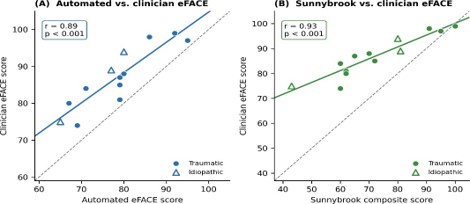
Figuee 1. Correlation between grading instruments in the 13 gradable patients. (A) Automated versus clinician-graded eFACE. (B) Sunnybrook versus clinician-graded eFACE. Solid lines are least-squares regression fits; dashed grey lines are lines of identity.
Circles denote traumatic and open triangles idiopathic etiology. Pearson r is annotated; all p < 0.001. Correlation, however, is not agreement, and the Bland-Altman analysis told the more clinically important story (Fig. 2). The automated eFACE scored, on average, 8.6 points lower than the clinician eFACE (95% limits of agreement −16.7 to −0.6), a consistent, one-directional underestimation across the range of severity; the corresponding ICC was moderate (0.60). The clinician eFACE in turn ran above the Sunnybrook by 14.6 points (95% limits of agreement −3.2 to 32.5), reflecting the known scaling difference between the two instruments rather than disagreement about rank order. Representative automated eFACE outputs for two of our patients are shown in Figure 3.
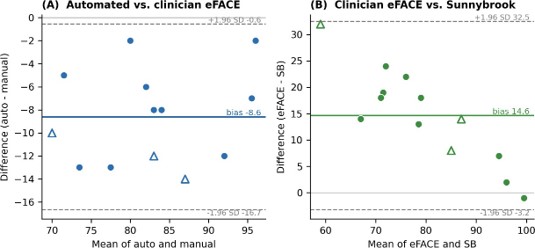
Figure 2. Bland-Altman agreement plots. (A) Automated versus clinician eFACE: the automated score is systematically lower (mean bias −8.6). (B) Clinician eFACE versus Sunnybrook. Solid coloured lines mark the mean bias; dashed grey lines mark the 95% limits of agreement (bias ± 1.96 SD). Symbols as in Figure 1.
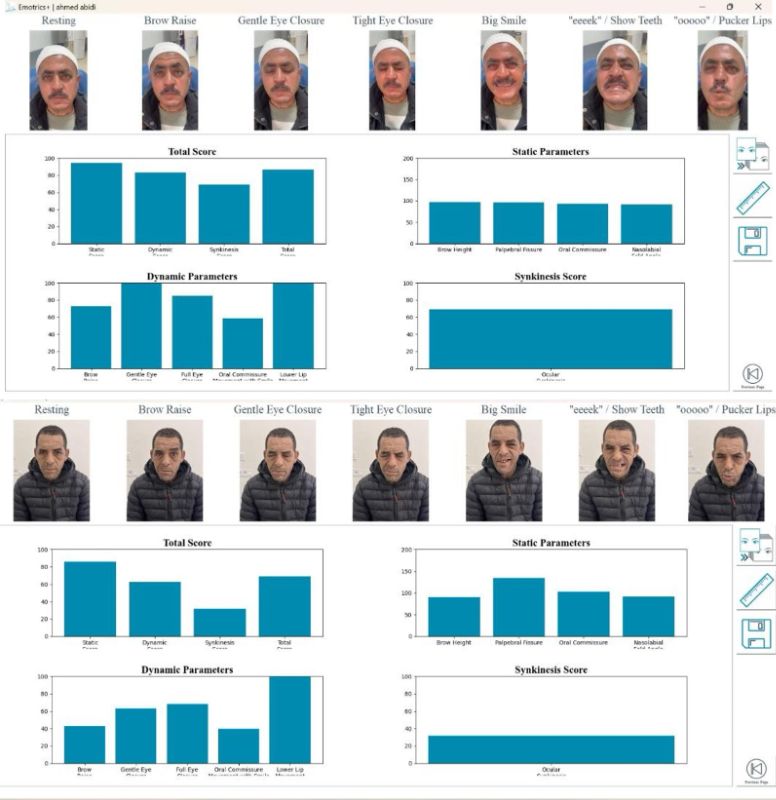
Figure 3. Representative automated eFACE application outputs for two study patients.
Table I. Facial-function scores of the 13 patients graded with all three instruments.
|
Patient |
Etiology |
HB |
Sunnybrook |
Auto eFACE |
Clin. eFACE |
Side / delay |
|
P1 |
Traumatic |
II |
62 |
79 |
81 |
Right / 66 mo |
|
P2 |
Traumatic |
II |
62 |
67 |
80 |
Right / 55 mo |
|
P3 |
Traumatic |
III |
65 |
79 |
87 |
Left / 46 mo |
|
P4 |
Traumatic |
III |
60 |
69 |
74 |
Right / 31 mo |
|
P5 |
Traumatic |
III |
72 |
79 |
85 |
Left / 32 mo |
|
P6 |
Traumatic |
I |
95 |
95 |
97 |
Left / 36 mo |
|
P7 |
Traumatic |
II |
91 |
86 |
98 |
Right / 16 mo |
|
P8 |
Idiopathic |
III |
81 |
77 |
89 |
Right / 9 mo |
|
P9 |
Traumatic |
II |
70 |
80 |
88 |
Left / 8 mo |
|
P10 |
Idiopathic |
II |
80 |
80 |
94 |
Left / 6 mo |
|
P11 |
Traumatic |
I |
100 |
92 |
99 |
Right / 9 mo |
|
P12 |
Idiopathic |
III |
43 |
65 |
75 |
Right / post-op |
|
P13 |
Traumatic |
III |
60 |
71 |
84 |
Left / post-op |
|
Mean ± SD |
— |
— |
72.4 ± 16.3 |
78.4 ± 9.0 |
87.0 ± 8.3 |
— |
HB = House-Brackmann grade; mo = months; post-op = immediate post-operative assessment. Delays are approximate.
Discussion
Our central finding is reassuring and cautionary in equal measure: an automated smartphone eFACE agrees with expert grading in rank and trend but not in absolute value. The strong correlations we observed—up to r = 0.93 between clinician eFACE and Sunnybrook—sit comfortably within the range reported when these instruments are compared head to head14, and they confirm that all three scales are measuring the same underlying construct in operated patients. The clinically decisive result, however, emerged only from the Bland-Altman analysis: the automated eFACE underscored the clinician eFACE by a consistent 8.6 points. A high correlation with a fixed offset is the signature of a tool that ranks patients correctly while miscalibrating the scale—precisely the pattern one wants to detect before an app is used to make longitudinal decisions.
This distinction matters because the different instruments were built with different sensitivities. Novice and expert raters are known to converge on the Sunnybrook only after dozens of gradings16, and cross-cultural validations have repeatedly confirmed its robustness once learned17. Comparative studies of the House-Brackmann, Facial Nerve Grading System 2.0, and Sunnybrook have similarly shown high agreement in rank with meaningful differences in granularity18,19, and even the House-Brackmann–Sunnybrook relationship, though strong overall, weakens at baseline severity20. Our results extend this literature to an automated tool and to a decompression cohort specifically, where accurate serial measurement is essential to judge surgical benefit and to counsel patients whose quality of life tracks closely with their grade21.
The practical implication is nuanced. An automated eFACE that reliably underestimates by a known margin is not useless—far from it. Once its systematic bias is characterized and corrected, it could democratize follow-up, allowing a patient to capture a standardized recording at home and a clinician to trend recovery without a clinic visit. What it should not yet do is replace an expert grade in a treatment decision, nor be compared naively against a manual eFACE recorded on a different day. The moderate ICC of 0.60 between automated and clinician eFACE underscores this: adequate for screening and monitoring, insufficient as a stand-alone reference.
Our study has clear limitations. The sample is small and single-center, three of sixteen patients could not be graded with symmetry-based instruments because of bilateral involvement, and assessments were cross-sectional rather than longitudinal, so we could not yet test whether the automated bias is stable over time within a patient. Etiology and post-operative delay were heterogeneous, and a single clinician performed the manual grading, leaving inter-rater reliability of the manual eFACE unexamined in this cohort. Larger, longitudinal, multi-rater studies—ideally incorporating intra-operative facial nerve monitoring data24 and standardized endoscopic or middle-fossa operative documentation23—will be needed to calibrate the automated tool and confirm its place in routine practice.
Conclusion
In patients followed after facial nerve decompression, an automated smartphone eFACE correlated strongly with clinician-graded eFACE and the Sunnybrook system but systematically underestimated facial function by roughly nine points. The tool is a promising, accessible way to screen and monitor recovery, yet clinician grading should remain the reference standard until this reproducible bias is corrected. Automated facial grading is close to clinical usefulness—provided we read its numbers with the offset in mind.



Open Access By Aditum Open Access Journals id licensed under Creative Commons Attribution 4.0 International License. Based On a Work at aditum.org


