
Clinical Case Reports and Clinical Study
OPEN ACCESS | Volume 14 - Issue 2 - 2026
ISSN No: 2766-8614 | Journal DOI: 10.61148/2766-8614/JCCRCS


Hüsnü Değirmenci*, Muhammed Zeki Mertcan, Halil İbrahim Tanrıseven, Muhammet Tahir Gül
Department of Cardiology, Erzincan Binali Yıldırım University Mengücek Gazi Training and Research Hospital, Erzincan, Türkiye.
*Corresponding author: Hüsnü Değirmenci, MD, Professor of Cardiology, Department of Cardiology, Erzincan Binali Yıldırım University Mengücek Gazi Training and Research Hospital, Erzincan, Türkiye. E-mail: hdegirmenci@erzincan.edu.tr.
Received: October 10, 2026 | Accepted: October 20, 2026 | Published: October 23, 2026
Citation: Değirmenci H, Muhammed Z Mertcan, Halil İ Tanrıseven, Muhammet T Gül. (2026) “Successful Endovascular Revascularization Followed by Limited Bowel Resection in Acute Superior Mesenteric Artery Occlusion: A Case Report” Clinical Case Reports and Clinical Study, 13(5); DOI: 10.61148/2766-8614/JCCRCS/258.
Copyright: © 2026 Hüsnü Değirmenci. This is an open access article distributed under the Creative Commons Attribution License, which permits unrestricted use, distribution, and reproduction in any medium, provided the original work is properly cited.
Background: Acute mesenteric ischemia (AMI) is a life-threatening vascular emergency in which delayed reperfusion may result in irreversible bowel injury. Endovascular revascularization is an important treatment option in selected patients with acute superior mesenteric artery (SMA) occlusion.
Case summary: A 52-year-old man with diabetes mellitus presented with acute abdominal pain. He was hemodynamically stable, with a white blood cell count of 12.9 × 10⁹/L and serum lactate of 4.8 mmol/L, and had no clinical signs of peritonitis. Computed tomography angiography demonstrated total SMA occlusion approximately 7 cm distal to its origin. Urgent endovascular treatment with balloon angioplasty, thrombus aspiration, and implantation of two stents restored SMA patency and mesenteric branch flow. During follow-up, the patient developed a rigid abdomen and underwent emergency surgery, during which a 40-cm non-viable jejunoileal segment was resected. He subsequently recovered and was discharged in improved condition.
Conclusion: This case highlights the complementary roles of endovascular revascularization and surgery in acute SMA occlusion. Rapid reperfusion followed by close surgical surveillance may help preserve viable bowel while allowing timely resection of irreversible ischemic segments.
acute mesenteric ischemia; superior mesenteric artery occlusion; endovascular revascularization; thrombus aspiration; mesenteric stenting; bowel ischemia
Acute mesenteric ischemia (AMI) is an uncommon but life-threatening vascular emergency caused by an abrupt reduction in intestinal blood flow. Despite advances in diagnostic imaging and treatment, it remains associated with substantial morbidity and mortality, particularly when diagnosis and restoration of mesenteric perfusion are delayed. Superior mesenteric artery (SMA) occlusion is one of the major causes of arterial AMI and may rapidly progress from reversible ischemia to bowel infarction and peritonitis. Computed tomography angiography (CTA) plays a central role in the early diagnosis of AMI by identifying the site and extent of vascular occlusion and associated intestinal findings [1].
Early restoration of mesenteric blood flow is a key component of treatment in patients with acute SMA occlusion. The 2025 European Society for Vascular Surgery (ESVS) guidelines state that endovascular revascularization should be considered as first-line therapy in patients with AMI caused by thrombotic or embolic SMA occlusion (2). Importantly, successful endovascular revascularization does not exclude the need for subsequent surgical exploration when signs of peritoneal irritation or non-viable bowel develop. Therefore, vascular and surgical management should be considered complementary components of the treatment strategy (2). The guideline specifically notes that laparotomy may still be required after technically successful endovascular revascularization when persistent peritoneal signs suggest non-viable bowel.
In this report, we present a patient with acute mesenteric ischemia due to SMA occlusion who underwent successful endovascular revascularization with balloon angioplasty, thrombus aspiration, and stent implantation, followed by surgical exploration and limited jejunoileal resection. This case highlights the potential role of mesenteric revascularization within a multidisciplinary treatment strategy aimed at restoring intestinal perfusion and limiting bowel loss.
Case Presentation
A 52-year-old man with a known history of diabetes mellitus presented to the emergency department with acute abdominal pain. On admission, his blood pressure was 130/65 mmHg, heart rate was 95 beats/min, and oxygen saturation was 95%. Laboratory evaluation revealed a white blood cell count of 12.9 × 10⁹/L and a serum lactate level of 4.8 mmol/L. Abdominal examination revealed no guarding or rebound tenderness, and there were no clinical signs of peritonitis.
Contrast-enhanced computed tomography angiography (CTA) of the abdomen demonstrated total occlusion of the superior mesenteric artery (SMA) approximately 7 cm distal to its origin, with no distal contrast opacification. The abdominal aorta was normal in caliber and contrast filling, without evidence of aneurysm or dissection. The celiac trunk and inferior mesenteric artery were patent.
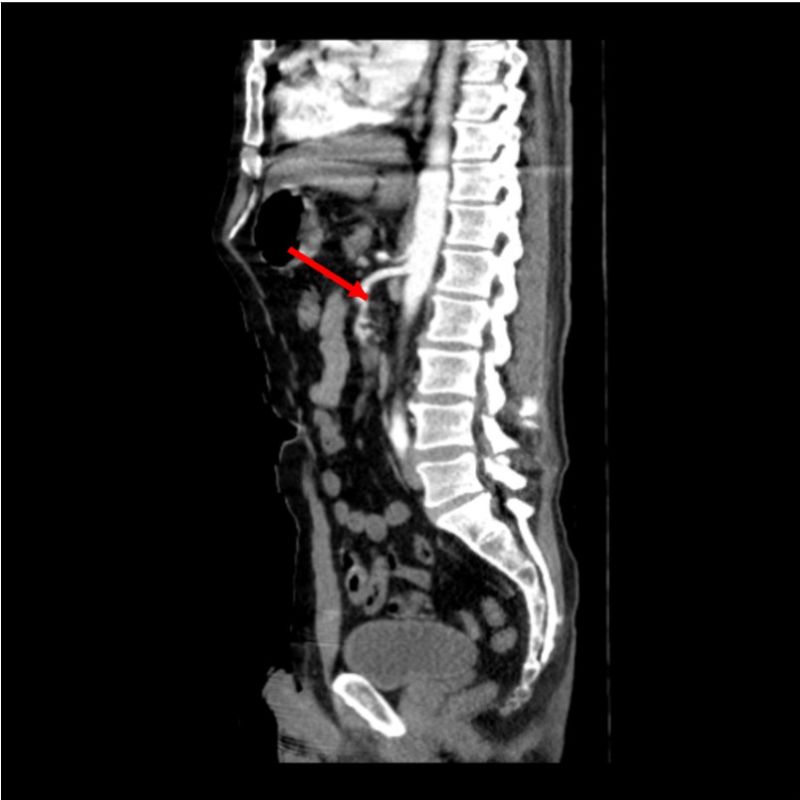
Figure 1. Preprocedural computed tomography angiography showing total occlusion of the mid-superior mesenteric artery (SMA) approximately 7 cm distal to its origin, with loss of distal contrast opacification (arrow).
Given the diagnosis of acute SMA occlusion in the absence of clinical signs of peritonitis, urgent invasive mesenteric angiography and endovascular revascularization were performed. Angiography confirmed occlusion of the mid-SMA. Repeated balloon angioplasty and thrombus aspiration initially restored antegrade flow; however, recurrent impairment of flow occurred because of vessel recoil and residual thrombus. Therefore, two 4 × 22 mm stents were implanted across the affected segment. Final angiographic assessment demonstrated restoration of vessel patency and opacification of the mesenteric side branches. Additional balloon angioplasty was performed, and no procedure-related complications occurred. Following revascularization, antithrombotic therapy with aspirin, clopidogrel, and low-molecular-weight heparin was initiated, and the patient was transferred to the general surgery service for close clinical monitoring. An illustrative postprocedural sagittal image demonstrating restored contrast opacification across the previously occluded mid-SMA segment is shown in Figure 2.
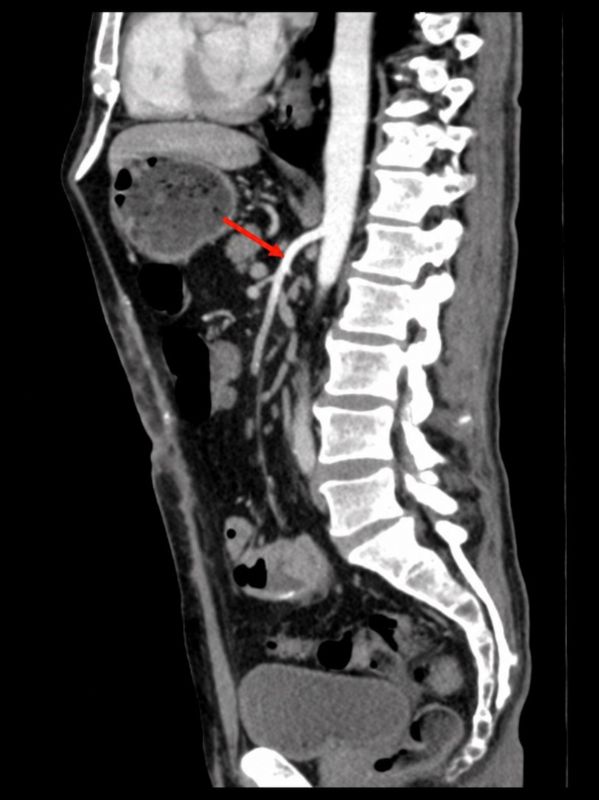
Figure 2. Illustrative postprocedural sagittal contrast-enhanced image showing restored contrast opacification across the previously occluded mid-superior mesenteric artery (SMA) segment, approximately 7 cm distal to its origin, after endovascular revascularization (arrow).
During subsequent follow-up, the patient developed progressive abdominal findings with a rigid abdomen and clinical signs of peritoneal irritation. Emergency surgical exploration was therefore performed. Intraoperatively, a non-viable jejunoileal segment was identified, and a total of 40 cm of small bowel was resected. Following surgery, the patient was monitored in the anesthesiology and reanimation intensive care unit. After clinical stabilization, he was transferred back to the general surgery ward. His subsequent clinical course was favorable, and he was discharged in improved condition.
Discussion
Acute mesenteric ischemia is a vascular emergency in which delayed restoration of mesenteric perfusion may rapidly lead to irreversible bowel injury. Clinical findings can be nonspecific in the early phase, and laboratory abnormalities such as leukocytosis and elevated lactate should not be used alone to determine the presence of bowel necrosis or the treatment strategy (1,2). In our patient, lactate was elevated and mild leukocytosis was present, but he was hemodynamically stable and had no guarding, rebound tenderness, or other signs of peritonitis. Together with CTA-confirmed SMA occlusion, these findings supported urgent endovascular revascularization as the initial approach.
Current ESVS guidelines recommend considering endovascular revascularization as first-line therapy in patients with acute mesenteric ischemia due to thrombotic or embolic SMA occlusion (2). In our case, balloon angioplasty and thrombus aspiration initially restored flow, but recurrent impairment due to recoil and residual thrombus required stent implantation. Final angiographic assessment demonstrated restoration of SMA patency and mesenteric branch flow.
Importantly, successful endovascular revascularization does not exclude the presence of irreversible bowel injury. Patients may still require surgical exploration if peritoneal signs develop after reperfusion (2). In our patient, a rigid abdomen subsequently developed, prompting emergency surgery and resection of a 40-cm non-viable jejunoileal segment. This clinical course illustrates that endovascular and surgical treatment are complementary rather than competing strategies in acute mesenteric ischemia.
The limited extent of bowel resection is also noteworthy. Current guidelines support considering revascularization before bowel resection, as restoration of mesenteric perfusion may facilitate assessment of bowel viability and help preserve viable intestine [2]. Systematic reviews have also supported the role of endovascular revascularization as an initial strategy in appropriately selected patients (3,4). However, because this is a single case, a direct causal relationship between revascularization and limited bowel loss cannot be established. This case instead supports the concept that rapid restoration of mesenteric perfusion, combined with close surgical surveillance and timely resection of non-viable bowel, may help preserve viable intestine in selected patients with acute SMA occlusion.
Conclusion
In patients with acute SMA occlusion without initial signs of peritonitis, an endovascular-first strategy may provide rapid restoration of mesenteric perfusion. Subsequent development of peritoneal signs should prompt immediate surgical evaluation, as successful revascularization does not exclude irreversible bowel injury. A multidisciplinary approach combining timely endovascular and surgical management may help optimize bowel preservation and clinical outcomes.



Open Access By Aditum Open Access Journals id licensed under Creative Commons Attribution 4.0 International License. Based On a Work at aditum.org


