
Clinical Case Reports and Clinical Study
OPEN ACCESS | Volume 13 - Issue 4 - 2026
ISSN No: 2766-8614 | Journal DOI: 10.61148/2766-8614/JCCRCS


Running title: Sulfasalazine-Induced DRESS Syndrome in Pregnancy: A Case Report
Fabricio Alejandro Maradiaga1, Miguel Antonio Rubio2*, Sergio Saul Sanchez Salazar1, Osmar Missael Hernandez1, Héctor Alejandro Medina1
1Department of Critical Care, Hospital Universitario Dr. Jose Eleuterio Gonzalez.
2Department of Medicine, Universidad Nacional Autónoma de Honduras en el Valle de Sula.
*Corresponding author: Miguel Antonio Rubio, Department of Medicine, Universidad Nacional Autónoma de Honduras en el Valle de Sula, San Pedro Sula, Cortes, Honduras, 21101.
Received: September 25, 2026 | Accepted: October 05, 2026 | Published: October 08, 2026
Citation: Fabricio A Maradiaga, Miguel A Rubio, Sanchez Salazar SS, Osmar M Hernandez, Héctor A Medina. (2026) “Sulfasalazine-Induced DRESS Syndrome in a Pregnant Patient: A Case Report of Successful Dual Maternal-Fetal Recovery” Clinical Case Reports and Clinical Study, 13(5); DOI: 10.61148/2766-8614/JCCRCS/254.
Copyright: © 2026 Miguel Antonio Rubio. This is an open access article distributed under the Creative Commons Attribution License, which permits unrestricted use, distribution, and reproduction in any medium, provided the original work is properly cited.
Drug Reaction with Eosinophilia and Systemic Symptoms (DRESS) represents a severe hypersensitivity reaction, which is most frequently associated with antiepileptic and antibiotics. Clinically it manifests with widespread rash, fever, lymphadenopathy, hematological abnormalities (eosinophilia and lymphocytosis) and visceral organ involvement. Although rare, DRESS represents a severe clinical challenge associated with life-threatening complications and a mortality rate as high as 20%. Consequently, prompt recognition and immediate therapeutic intervention are critical to improving patient outcomes. We present a case of severe sulfasalazine-induced DRESS syndrome in a 28-year-old pregnant woman at 16.1 weeks of gestation presenting with ARDS and MRSA septic shock, successfully managed with prone positioning, targeted antimicrobials, and systemic corticosteroids while preserving fetal survival.
DRESS syndrome, Pregnancy, MRSA, Severe ARDS, Ventilator-associated pneumonia
Drug Reaction with Eosinophilia and Systemic Symptoms (DRESS) syndrome, also referred to as Drug-Induced Hypersensitivity Syndrome (DiHS), is a severe, T-cell–mediated drug hypersensitivity reaction characterized by an extensive cutaneous eruption, fever, lymphadenopathy, hematologic abnormalities, and multi-organ involvement [1–3]. Disease-modifying antirheumatic drugs (DMARDs) and immunosuppressants, including sulfasalazine and hydroxychloroquine, are essential agents widely utilized in the long-term management of autoimmune conditions such as rheumatoid arthritis and Sjögren’s syndrome [1-3]. Although these therapies are generally well-tolerated, hypersensitivity reactions related to DMARDs represent a significant clinical concern due to their potential to trigger life-threatening adverse cutaneous reactions, accounting for substantial mortality among hospitalized patients [3,4].
Multi-organ involvement significantly elevates the complexity and mortality of severe DRESS syndrome [4, 5]. In the setting of early pregnancy, treatment becomes a delicate clinical balance between aggressive maternal resuscitation and fetal preservation [1–4]. While prompt withdrawal of the offending drug and systemic corticosteroid initiation remain the mainstays of therapy, the development of severe ARDS and secondary ventilator-associated pneumonia requires a coordinated critical care approach involving dermatology, rheumatology, critical care, and obstetrics [5–7].
Despite increasing recognition of DRESS syndrome worldwide, documented cases of severe DRESS complicated by ARDS and septic shock during the first trimester of pregnancy remain extremely rare.
Case Presentation
A 28-year-old pregnant woman presented with a 1-week history of persistent dry cough, high-grade fever (38.8°C), oppressive chest pain, and left upper extremity paresthesias. Her medical history was significant for rheumatoid arthritis and Sjögren’s syndrome both diagnosed 8 months prior, and maintained on prednisone, hydroxychloroquine, and sulfasalazine. She received outpatient symptomatic treatment without clinical improvement, subsequently developing disseminated erythematous rash, progressive pruritus, and facial edema.
Upon evaluation by dermatology the patient exhibited a maculopapular rash involving the face, trunk, and extremities, affecting approximately 64% of total body surface area, with negative Nikolsky sign (Figure 1). Initial laboratory work showed severe leukocytosis (20.8 x 10^3/μL) with progressive eosinophilia (3.56 x 10^3/μL, 17.1%), transaminitis (AST 164 U/L), and acute kidney injury (creatinine 1.2 mg/dl). Given the suspicion of DRESS, rheumatology was consulted. Discontinuation of sulfasalazine was recommended, and immunosuppression with methylprednisolone 80 mg/day was initiated. Skin biopsy confirmed a reactional dermatitis with endothelial damage, erythrocyte extravasation, apoptotic bodies, and epidermal hypoxia. During hospitalization the patient experienced rapid respiratory and hemodynamic collapse, requiring emergency intubation and ICU transfer. Ultrasonography revealed a single fetus with normal heart rate (128 BPM) and fetometry corresponding to 16.1 weeks. Respiratory virus PCR panel, measles PCR, and serologies for HIV, HBV, HCV, and Dengue were negative.
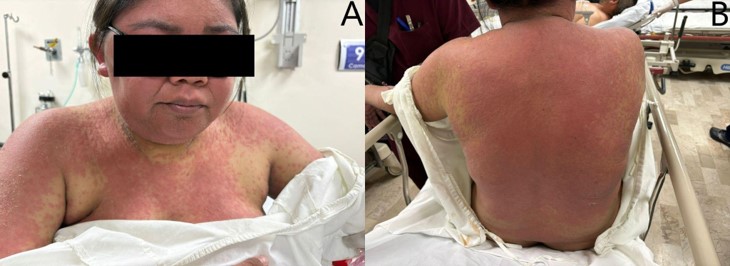
Figure 1. (A) Anterior view showing prominent facial edema and a confluent, dark erythematous maculopapular rash on the neck, upper chest, and shoulders. (B) Posterior view demonstrating an extensive exanthem covering over 80% of the back.
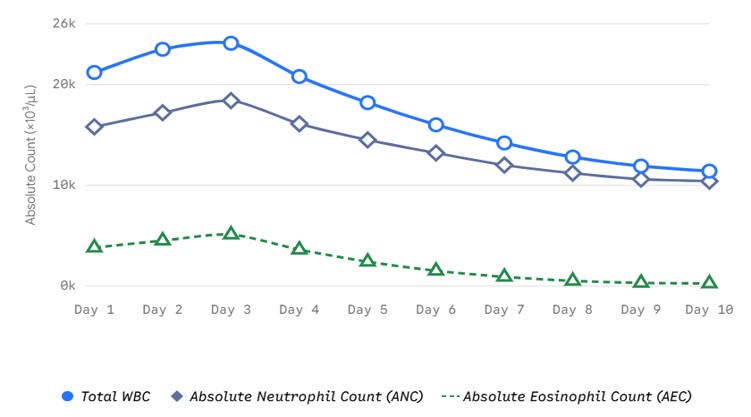
Figure 2. Longitudinal tracking of Total WBC, Absolute Neutrophil count, and Absolute Eosinophil count across 10 first hospitalization days. A concurrent peak was observed on Day 3, followed by progressive descent to baseline after steroid and antimicrobial therapy.
During her ICU stay, the patient developed ventilator-associated pneumonia (VAP) and secondary septic shock. Blood cultures drawn on day 3 yielded methicillin-resistant Staphylococcus aureus (MRSA). Bronchoalveolar lavage (BAL) fluid cultures obtained on day 4 confirmed MRSA (50,000 CFU/mL ) and Klebsiella aerogenes (50,000 CFU/mL). Antimicrobial therapy consisting of vancomycin, ertapenem, alongside topical mupirocin was initiated. Concurrently, she developed ARDS (Figure 3) with an initial PaO2/FiO2 of 91 mmHg, which improved substantially to 217 PaO2/FiO2 of mmHg following a 16-hour prone positioning session.
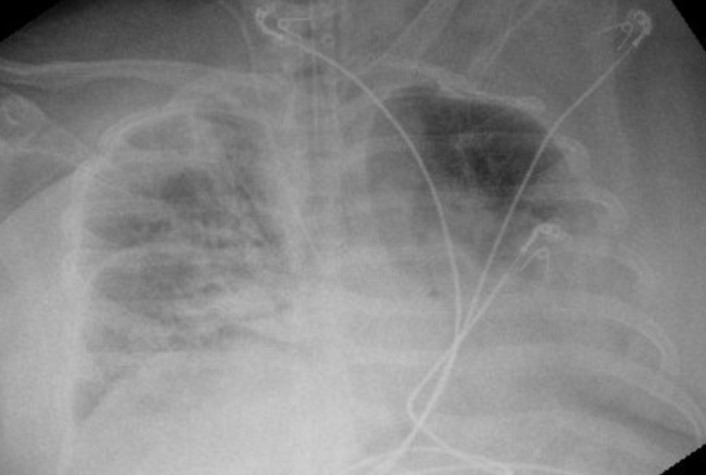
Figure 3. AP chest X-ray showing extensive bilateral patchy alveolar and interstitial infiltrates, consistent with severe ARDS.
During her ICU stay, the patient achieved progressive clinical improvement with gradual resolution of organ dysfunction, by day 8 her absolute eosinophil count had diminished to 0.395 x 10^3/μL. The patient transitioned into a high-output polyuric phase of acute tubular necrosis, leading to complete renal recovery. Following extubation on day 9, she maintained adequate oxygenation on low-flow nasal cannula, demonstrating continuous clinical recovery without recurrent respiratory failure, allowing for her ICU discharge on day 10 at 17.4 weeks of gestation, with documented fetal stability and continued viability throughout her critical illness.
Discussion
Drug Reaction with Eosinophilia and Systemic Symptoms (DRESS) syndrome represents a rare and rapidly progressive severe cutaneous adverse reaction characterized by an extensive morbilliform eruption, facial edema, fever, lymphadenopathy, severe hematologic derangements, and multi-organ involvement [2–5]. Data from epidemiological registries indicate that DRESS carries a high mortality rate 10–20%, primarily driven by hepatic necrosis, acute respiratory failure, or secondary septic shock [1–5, 7].
The establishment of large international registries, such as the European Registry of Severe Cutaneous Adverse Reactions (RegiSCAR), has provided crucial insights into the demographics, precipitating drugs, and clinical patterns of DRESS [1-4, 6]. According to RegiSCAR data, solid-organ involvement affects up to 90% of confirmed cases, with the hepatic system being the most frequently involved (60–80%), followed by renal (10–30%), pulmonary (25–32%), and cardiac (5–10%) manifestations [1–5, 7]. Hematologic derangements are a hallmark of the syndrome, with peripheral hypereosinophilia (>1.5 × 10³/μL) occurring in up to 70% of patients alongside atypical lymphocytosis and leukocytosis [1]. While our patient presented with classic features including extensive cutaneous involvement (64% TBSA), facial edema, severe hypereosinophilia (3.56 × 10³/μL), transaminitis, and acute kidney injury, her clinical course rapidly escalated to include severe ARDS and secondary MRSA septic shock, highlighting the wide variability and potentially catastrophic trajectory of DRESS presentations [1–5, 7].
The diagnostic criteria (Table 1) proposed by the RegiSCAR uses a combination of clinical, histological, and laboratory criteria to categorize cases as negative (<2), possible (2–3), probable (4–5), or definitive (>5). With a score exceeding 5, our patient fulfilled the requirements for a definitive diagnosis of DRESS [1,2]. Over 40 medications are linked to DRESS syndrome, in which a drug trigger is established in roughly 80% of cases. Primary offending agents include aromatic anticonvulsants, sulfonamides, dapsone, NSAIDs, vancomycin, allopurinol, and beta-lactam antibiotics. Notably, secondary agents such as amoxicillin often function as aggravating co-factors rather than primary drivers [1].
Table 1. RegiSCAR criteria used in DRESS syndrome
|
Features |
No |
Yes |
Unknown |
|
Fever >38.5°C |
−1 |
0 |
1 |
|
Lymph node involvement |
0 |
1 |
0 |
|
Organ involvement* |
|
|
|
|
One |
0 |
1 |
0 |
|
Two or more |
|
2 |
|
|
Skin rash, edema, infiltration, scaling |
0 |
1 |
|
|
>50% body surface |
−1 |
1 |
|
|
Biopsy suggestive DRESS |
−1 |
0 |
|
|
Resolution in >15 days |
−1 |
0 |
−1 |
|
Atypical lymphocytes |
0 |
1 |
0 |
|
Eosinophilia |
0 |
|
|
|
10–19.9% or 700–1499/µL |
|
1 |
|
|
>20% or >1500/µL |
|
2 |
|
|
Evaluation of other potential etiologies** |
0 |
1 |
0 |
* Heart, liver, kidney, muscle, pancreas or others; **: ANA, ANCA, HIV serologies; Evaluation: Score 1–3: possible; 4–5: probable; 6 or higher: definite.
Table 2. Drugs most commonly associated with DRESS
|
Group |
Drugs |
|
Antiepileptics
Antibiotics
Anti-Tuberculosis Agents
NSAIDs
Others |
Carbamazepine, lamotrigine phenobarbital, phenytoin, oxcarbazepine
Amoxicillin, ampicillin, azithromycin, levofloxacin, minocycline, trimethoprim-sulfamethoxazole, vancomycin
Ethambutol, isoniazid, pyrazinamide, rifampin
Aspirin, celecoxib, diclofenac, ibuprofen, piroxicam
Allopurinol, amitriptyline, dapsone, hydroxychloroquine, imatinib, nevirapine, omeprazole, sulfasalazine |
NSAID: Nonsteroidal Anti-Inflammatory Drug
Current clinical guidelines support a structured 3-step approach to managing severe DRESS: immediate withdrawal of potential culprit medications, aggressive organ-specific supportive care, and targeted immunomodulatory therapy [5-7]. High-dose systemic glucocorticoids represent the cornerstone of treatment [3-5, 7]. Guidelines emphasize initiating systemic corticosteroids at 1-2 mg/kg/day, followed by a gradual taper over 3 to 6 months to prevent severe disease relapses and rebound hypereosinophilia [7]. In steroid-refractory cases, emerging consensus evidence supports second-line biological and targeted immunosuppressive options, including cyclosporine, anti-IL-5 monoclonal antibodies, or intravenous immunoglobulin [6, 7].
Despite therapeutic optimization, overall mortality in severe DRESS remains significant, with adverse outcomes strongly associated with older age, severe pulmonary or renal failure, and secondary bacteremia [1–3, 6]. Furthermore, long-term registry follow-up indicates that 10–12% of surviving patients develop delayed autoimmune disease, such as autoimmune thyroiditis, type 1 diabetes mellitus, or systemic lupus erythematosus, likely mediated by transient regulatory T-cell dysfunction [1-5]. Despite presenting with high-risk clinical features including multi-organ failure, ARDS, and septic shock during early pregnancy, our patient achieved complete maternal recovery and preserved a viable 17.4-week pregnancy, highlighting the vital importance of rapid diagnosis, early drug withdrawal, and coordinated multidisciplinary critical care [1, 7].
Conclusion
This case highlights the clinical challenge of managing severe DRESS syndrome complicated by critical illness. Rapid identification, immediate withdrawal of suspected culprit drugs, and timely initiation of immunosuppressive and supportive care are crucial to achieving favorable maternal and fetal outcomes. A high index of suspicion and a coordinated multidisciplinary strategy remain paramount when managing severe cutaneous adverse reactions in high-risk populations.
Acknowledgements
The authors have no acknowledgements to declare.
Conflicts of interest
The authors have no conflict of interest to declare.
Funding
None.
Ethical Approval
Ethical approval was not required for this case report in accordance with institutional guidelines.
Consent
Written informed consent was obtained from the patient who agreed to take part in the study.
Criteria for Inclusion
All listed authors have participated significantly in (1) the conception and design of the study and the acquisition, analysis, and interpretation of the data; (2) the drafting of the manuscript and (3) the final approval of the version to be published. Each author meets all three of these criteria, thereby fulfilling the requirements for authorship and taking public responsibility for the content of this work.



Open Access By Aditum Open Access Journals id licensed under Creative Commons Attribution 4.0 International License. Based On a Work at aditum.org


