Agricultural Research Pesticides and Biofertilizers
OPEN ACCESS | Volume 6 - Issue 1 - 2026
ISSN No: 2994-0109 | Journal DOI: 10.61148/2994-0109/ARPB


Asebe Handiso1*, Shimeles Damene2, and Assefa Seyoum2
(Center for Rural, Local and Regional Development Studies, College of Social Science, Arts and Humanities, Addis Ababa University, P.O.Box1176, Addis Ababa, Ethiopia, Email: handisoas@gmail.com, Phone: +251913429307).
(Center for Rural, Local and Regional Development Studies, College of Social Science, Arts and Humanities, Addis Ababa University, P.O.Box1176, Addis Ababa, Ethiopia, Email: shimelsdamene@yahoo.com, Phone: +251911434585).
(Center for Rural, Local and Regional Development Studies College of Social Science, Arts and Humanities, Addis Ababa University, P.O.Box1176, Addis Ababa, Ethiopia, Email aseyumw@yahoo.com, Phone +251951100977).
*Corresponding author: Asebe Handiso, Center for Rural, Local and Regional Development Studies, College of Social Science, Arts and Humanities, Addis Ababa University, P.O.Box1176, Addis Ababa, Ethiopia.
Received: December 20, 2025 | Accepted: January 01, 2026 | Published: January 08, 2026
Citation: Handiso A, Damene S, and Seyoum A. (2026) “Indigenous Knowledge, Practices, Institutions, and Their Role in Sustainable Natural Forest Management in the Gamo Zone, Southern Ethiopia, Agricultural Research Pesticides and Biofertilizers”, 6(1); 10.61148/2994-0109/ARPB/091.
Copyright: © 2026 Asebe Handiso. This is an open access article distributed under the Creative Commons Attribution License, which permits unrestricted use, distribution, and reproduction in any medium, provided the original work is properly cited.
Indigenous knowledge and institutions throughout human history have played a crucial role in managing, conserving and sustainably using natural resources, including forests. Like many other African nations, Ethiopia has a rich tradition of managing its natural resources, especially forests. This study examines the role of Indigenous knowledge, practices, and traditional institutions in managing natural forest resources in the Gamo zone of southern Ethiopia. Data were collected through key informant interviews, focus group discussions, participant observation, and survey questionnaires. The study used a mixed-methods approach for analysis. The Gamo community possesses deep knowledge and maintains a strong connection with the environment. They employ various Indigenous forest management practices, such as conserving forests in sacred sites, protecting forests as sources of medicinal plants, practicing selective tree harvesting, and engaging in beekeeping within the forest. The Gamo community relies on Woga, Dubusha, and Gome, three robust Indigenous institutions, for forest management as well as social and political issues. However, due to the decline of Indigenous customs, the well-managed natural forests of the Gamo region are no longer fully preserved. Additionally, the shift away from Indigenous religions, population growth, and the dominance of formal institutions have weakened Indigenous practices, beliefs, and institutions. As a result, many forest areas have been converted to agriculture and settlements.
Indigenous, knowledge, practice, institutions, forest, management
Throughout human history, people have developed indigenous or traditional institutions and cultural practices that help conserve and sustainably use natural resources, including forests. Such institutions and norms exist across all cultures worldwide, shaping human behavior toward resource extraction (Negi, 2010). In this regard, numerous indigenous forest management techniques are used worldwide. The diversity of indigenous knowledge systems and practices related to forests reflects the environmental conditions, history, social, economic, and cultural traits of the communities that preserve this knowledge (Parrotta and Youn, 2016). Indigenous Africans possess conservationist values, practices, and ways of life, viewing nature as holistic, interconnected, and harmonious with humans and all natural objects (Obiora and Emeka, 2019). Ethiopia, like other African nations, has a rich tradition of indigenous knowledge and practices in natural resource conservation, including forests (Gabayo, 2020).
Traditional natural resource management and conservation practices in parts of Ethiopia are well-known and long-standing indigenous traditions. These practices have played a significant role in the sustainable use of natural resources, especially within some indigenous communities. For example, Konso indigenous soil and water conservation, Assoma (2016); the indigenous agroforestry system of the Gedeo community; coping strategies for drought used by Borena and Afar pastoralists, Maru, Gebrekirstos, and Haile (2020); indigenous forest management and conservation practices of the Kaffa community, Zegeye (2017); and, notably, the Oromo people, through the Gada system, have effectively managed and conserved forest resources for centuries, Gabayo (2020). These are some examples of indigenous knowledge and practices in Ethiopia.
Gamo's customs also encourage a friendly relationship with their environment, which often helps reduce environmental disturbance and maintain ecological balance in the area. Shifting cultivation, mixed cropping or intercropping, minimum tillage, agroforestry, sacred areas and forest conservation, and home gardening are among the environmental conservation practices known to the Gamo Indigenous people (Tizita,2016; Daye, 2012). Gamo's important traditions for conserving forest, soil, and other natural resources have been weakened by various factors. This is leading to the erosion of forest conservation roles and contributing to environmental crises (Debebe, 2010). Indigenous knowledge in development plans boosts cultural pride and encourages efforts to solve local problems through community-based initiatives and resources (Lodhi and Mikulecky, 2017).
Therefore, this study argues that it is essential and timely to study the existing indigenous knowledge, forest management practices, and institutions to contribute to our efforts before the depletion of resources with devastating impacts. Previously, different studies have been conducted to contribute to the improvement of the forest and its biodiversity in the Gamo area. However, limited studies have been conducted related to Gamo's indigenous ecological knowledge. For instance, Daye (2012) studied the local knowledge, cultural association, institutions, and practices of the sacred groves in the Gamo highlands. Tizita (2016) studied the role of Indigenous people in biodiversity conservation, and Adem (2017) studied environmental knowledge, attitude, and awareness of farmers; while Abayneh et al. (2017) researched the issue of biodiversity conservation using the indigenous knowledge system distribution. These studies don’t cover the role of Gamo indigenous institutions, traditional rules, and indigenous practices specifically in the area of forest management. Generally, there is a lack of scientific evidence on the Indigenous forest management practices of the study community, although they have rich indigenous knowledge and practices. Therefore, the objective of this study is to investigate the indigenous knowledge, practices, rules, and institutions that support natural forest management in the Gamo Zone, Southern Ethiopia.
The study was guided by the following three research questions: What is the Gamo’s indigenous knowledge, practices, and institutions associated with forest management? What is their role in forest management and conservation? And what are the challenges behind them?
2. Methods
2.1. Description of the Study Area
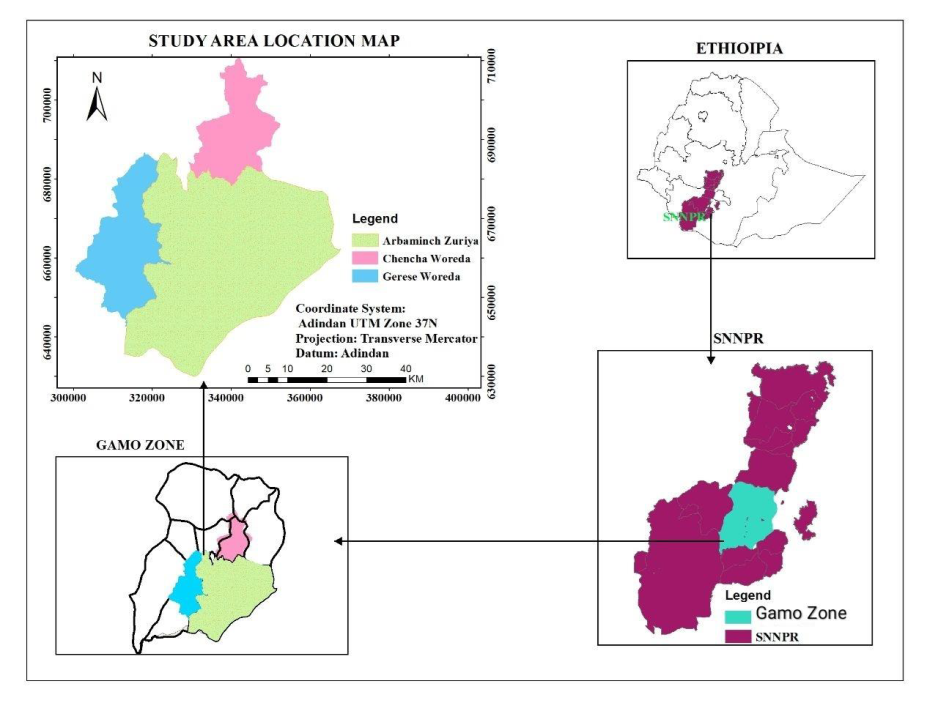
The study was conducted in the Gamo zone, in the Southern Ethiopian Regional State. The 2022 annual report of Gamo Zone indicates that the total area of Gamo Zone is 6460 km2, which is subdivided into 14 districts (Woredas) and four town administrations. The administrative center of the Gamo Zone is Arba Minch town, located 454 km south of Addis Ababa. Fig. 1
The study area's climate is characterized by a bimodal rainfall pattern. The main rainy season occurs from June to September, which is locally known as Badhessa, and the spring rainy season from February to April, that known as Balgo. The mean annual rainfall ranges from 500 mm in the lowlands to 1200 mm in the highlands, and the mean temperature varies from 10°C in the highlands to 25°C in the lowlands. The Gamo zone has various ecosystems ranging from afro-alpine vegetation on the high mountains like Guge with an elevation of 3400 meters above sea level to various dry and moist Afromontane forests in the altitudinal range of 1500-3000 meters above sea level (Daye, 2012). According to the 2022 annual report of Gamo Zone, the current forest coverage of the Gamo Zone is estimated at 305,013 hectares. From this, natural forest covers 118,140 hectares, and plantation forest covers 90,066 hectares. This implies that in the Gamo zone, natural forest covers more area than plantation forest. Currently, the total population of Gamo Zone is estimated to be about 1,597,767 with a population density of 80 inhabitants per square kilometer (Wallole, Gecho, and Tefera,2021).
Figure. 1 Location of the study area
2.2. Sampling and data collection
The study applied both probability and purposive sampling. Probability sampling was used to select sample households, while purposive sampling techniques were applied to select Zone, Woreda, and kebele (lower administrative unit in Ethiopia below district (woreda). Accordingly, Arba Minch Zuria Woreda, Chencha Woreda, and Geresse Woreda were selected. The criteria for selection of the three woredas were: - the Agro-ecological variations Dega (highland), Woinadega (mid-highland), and Kola (lowland), the endowment of forest resources (both natural and plantation), the community's dependence on forest resources for their livelihood, and the role of traditional institutions on resource management. Nine Kebeles were purposefully chosen from three Woredas because of their potential for forest endowment.
2.3. Sources of data
This study used a variety of data sources (key informant interviews, group discussions, household surveys, observations, and document reviews) to gather data on a particular topic to ensure the accuracy and consistency of the responses and narratives about Indigenous forest management practices and customary institutions.
Key Informants Interviews (KII)
The key informant interviews were conducted with individuals who possess extensive knowledge of natural resource management, such as forestry experts and community elders. The informants were selected based on their deep expertise, detailed understanding, and comprehensive knowledge of local histories, event sequences, and the forest resources of the area. Priority was given to elders, development agents (DAs) specializing in natural resource management (one per kebele), experts from the Woreda (one per Woreda), and representatives from the Zonal Forest Climate Change and Environmental Protection Office. A total of 31 key informants were interviewed. A checklist of open-ended questions was prepared and used to guide the interviews.
Focus Group Discussion (FGD)
Focus group discussions were conducted with community representatives from the selected kebeles. Participants in the (FGD)s were chosen from both genders and included social groups such as religious leaders, cultural leaders, elders, and women knowledgeable about forest management, as well as direct or indirect beneficiaries of forests. In each woreda, two FGDs were held, totaling six (6) FGDs.
Questionnaire survey
The survey gathered relevant qualitative and quantitative data from households. A structured and semi-structured questionnaire was administered to a sample of household heads from nine Kebeles. Four hundred households were chosen using a random sampling technique, and an equal population proportion sample size was drawn from each woreda.
Observation
Observation activities included trips to natural forest sites such as sacred groves, community woodlots, and state and local forests. Field notes and photos were used to collect important information about vegetation types, forest structure, how people interact with the environment, forest management, and conservation practices carried out at the household, kebele, and woreda levels.
2.3 Data analysis
In this study, the main research questions were addressed using a qualitative data analysis approach. That is, both thematic analysis and narrative analysis were employed. The narrative approach was chosen because it is often used to better understand the problem and the intended solution. Thematic analysis was also applied to analyze the data collected through interviews. Additionally, simple descriptive statistics, such as percentages, were used to examine survey results.
3. Results and Discussion
3.1. Contribution of Gamo Indigenous knowledge of forest management
Interviews with elders knowledgeable about Gamo culture and traditions reveal that the Gamo community has developed a broad system of intergenerationally transmitted knowledge for the sustainable use and management of natural resources. According to respondents, Indigenous knowledge of the Gamo people, combined with support from customary laws, spirituality, social norms, beliefs, and moral principles, has ensured forest management and conservation for centuries. Elders highlight the importance of knowledge transfer for preserving natural forests for future generations and the effective management of forests and natural resources through their ancestors' proverbs and storytelling. The study by Tizita (2016) confirms that a key component of the Gamo people's social capital is their indigenous knowledge, which plays a significant role in biodiversity conservation and is upheld by their local culture, spirituality, social norms, and ethical standards.
Furthermore, community elders emphasize that indigenous knowledge about forest management and conservation views humans and environmental elements as interconnected and mutually influential. This shows that the Gamo community depends on forests—either directly or indirectly—for almost every need, such as energy, food, shelter, and fodder, as well as for activities that generate income through the sale of forest resources and honey. Additionally, the interview respondents mentioned that protecting natural forests is a way for people to pray to the Supreme Natural Being, known locally as “Tossoo,” and to express their hopes. Similar findings have been reported by other researchers, such as Larson and Ram (2014) and Gabayo (2020), demonstrating that indigenous knowledge has played a key role in forest management in other parts of Ethiopia. In line with this study, Boafo et al. (2016) also confirmed that for indigenous people, using their indigenous knowledge is more practical, easier to do, and more effective for managing their forest resources sustainably.
3.2. The Indigenous practices that the Gamo community uses for forest management
Conserving forests in sacred places
According to the FGD and KII respondents, the practice of conserving forests in sacred areas is well-known and deeply rooted, and it is considered one of the Indigenous management practices in Gamo culture. In the area, there are historically designated sacred sites, including spiritual sites, sacred big trees, groves, places of assembly, and sacred forests. In these areas, remaining forest patches and lifelong trees are observed standing. According to Desissa (2007), the size of sacred forests in the study area ranges from 0.5 to 25 hectares. As the Gamo community's elders stated, these sacred natural forests serve as sites revered for prayer, deliverance to the creator God (Tossoo), and are culturally designated for ceremonial purposes. Additionally, all survey participants (100%) acknowledged that protecting trees in sacred sites is an indigenous practice they frequently use to manage natural forests.
In the Gamo area, sacred forest sites hold deep cultural, religious, and other significance for the local community. Religious sacrifice practices still occur in these sacred forests, such as in Dorze Ewurie village, where ceremonies of prayer and thanksgiving are performed to honor a supernatural being (Tossoo) for rain-bringing, stopping, and other communal purposes. Likewise, as noted by Bempong et al. (2023), sacred forests are important for reasons related to ecology, society, medicine, religion, and ecotourism.
The respondents indicate that traditional systems and values have largely maintained the existence of the communal forest in sacred sites. In this context, the main role of government officials is to support and train traditional leaders and the local community. The findings of (Bio & Dupras, 2023) show that religious and traditional leaders play a key role in managing communal resource areas. Similarly, in another part of Africa, sacred forests are either fully or partly protected by social, religious, or cultural systems. These forests are preserved by complex, long-standing institutions that often do not require government involvement.
Managing forests through the selective cutting practice
As mentioned in FGDs, the forest is vital for the Gamo community because it provides basic needs, livelihoods, food, medicine, shade, agricultural tools, and assets like household furniture. Although the Gamo community uses trees for various purposes, cutting down medicinal and culturally significant tree species, whether large or old, and young trees, is culturally forbidden. This is because the community believes that cutting young trees is like killing children, while cutting large trees is considered sacred and is given a status similar to Gamo elders. In Gamo culture, local elders publicly criticize residents who cut down large or small trees, and this criticism encourages others to refrain from cutting trees irresponsibly. However, cutting dead wood and branches is permitted. Likewise, twisted trees may be cut when forest resources are needed. Similarly, Tiwari, Tynsong, and Lynser (2010) reported that selective harvesting that does not impede forest regeneration is among the best practices for managing natural forests.
Elders claim that to preserve the forest's sustainability and prevent damage, the Gamo people have been using it for centuries. However, for several reasons, this practice is currently unable to continue properly. Nonetheless, there are still some places with dense forests. The forests are composed of a wide variety of indigenous trees. shrubs and grasses. Furthermore, the survey report indicates that 73% of participants have a perception of selectively cutting natural forests. This indicates that selective tree-cutting is a valued social custom and sound forest management practice in Gamo culture.
Protecting forests as a source of medicinal plants
The Gamo community has long used plants from forests for traditional medicine, mainly to treat humans and livestock, as shown by the KII and FGD responses. They recognize the importance of these plants in supporting life. Sacred groves, burial sites, and patches of community forests in this area are home to essential traditional medicinal plants. The respondents also highlight the importance of environmental sustainability, along with the management and conservation of forests in collecting medicinal plants. Similar studies indicate that other parts of Ethiopia also manage their forests for medicinal purposes. For example, Gabayo (2020) found that the Oromo people preserve forests specifically for medical uses. Additionally, as noted by Tesfaye and Bezabih (2017), the indigenous people of southern Ethiopia, who depend on the forest for medicinal, social, and economic purposes, have played a key role in forest conservation.
The current study reveals that a distinctive feature of the Gamo area is its practice of harvesting only the necessary parts of medicinal plants. For example, if the root has medicinal value, they extract only parts of the root without causing significant harm to other parts of the root or the plant. For some plants, only the leaves are used medicinally, and this method has also helped in conserving and managing forest resources over a long period.
Beekeeping in Forest for Forest Management
Respondents mentioned that beekeeping has been practiced in forests and around home gardens in the Gamo community for a very long time. Because trees and other flowering plants are used as bee feed, it is believed that preserving forests also indirectly supports bees. For the Gamo community, honey is used as food, medicine, a source of income, and a symbol of good fortune in Gamo. Gamo Zone's residents have long been engaged in beekeeping (Yemane and Taye, 2013). In the Gamo area, traditional beekeeping is common, with beehives hanging on trees with many branches (Anza, Yemane, and Bezabeh, 2021).
According to respondents, a beehive perched on a tree significantly contributes to forest management and conservation. When many beehives are placed in a specific forest area, the bees can serve as a safeguard against illegal tree-cutting activities. Additionally, others recognize that forest areas are the exclusive rights of beekeepers; therefore, outsiders are not allowed to use the forest or its products without permission from the beekeepers. Similarly, Minja and Nkumilwa (2016) note that one important and beneficial aspect of managing forest resources is beekeeping within forests. This is because, when beekeepers place their hives in the forest, they help prevent both bushfires and the felling of trees, poles, and other forest resources.
3.3. The Gamo Indigenous institutions that support forest management
There are multipurpose indigenous institutions in Gamo culture. In this community, political, cultural, religious, and environmental issues have long been addressed by these institutions (Freeman, 1999; Gebretsadik). In this regard, Dere woga (customary law), Dubusha (customary court or assemblies), and Gome (Misfortune) are the most well-liked institutions in the community. Thus, these institutions' role in forest management and conservation is the main focus of this study.
Dere Woga (customary law)
The respondents state that Dere Woga is a system of customary law widely used to regulate society. Dere and Woga, two separate words, combine to form Dere Woga. It is defined independently by some scholars. For instance, Freeman (1999) defined Dere as “people living in communities locally known as dere.” Gebretsadik (2022) defined Woga as Gamo’s political and conflict resolution institutions. The dere woga is a “customary law, which is the body of norms and a set of moral values that provide a broader framework for social interactions and human conduct across Gamo communities” (Mehari and Tadele, 2015). According to community elders, this institution has played a significant role in the political, social, economic, and environmental issues of the Gamo community. Furthermore, key informants and FGD participants have witnessed that since ancient times, the Gamo people have preserved their social cohesion through the customs established by Woga indigenous institutions. Similar to this, traditional institutions have been used by various communities in Ethiopia to manage their natural resources. For example, Tuma (2018) identified that the Oromo community, in collaboration with the Gada customary institution, effectively manages natural forest resources.
The Gamo’s dere Woga as an institution requires each individual to follow the customs that are orally passed down from their ancestors, guiding the moral behavior of entire communities. This strong community norm determines when and how to cut trees for personal use and the community's benefit from natural forest patches. For this purpose, communities have traditionally selected a custodian, known as “ekka” a dere senior or “Halka”, to oversee these activities. As noted in a previous study, the Gamo community council, which consists of the chief, elders, and religious leaders, punishes anyone who disobeys the customary law (Daye, 2012). The community elders confirmed that the current forests are remnants of once-dense natural forests, preserving old trees and supporting diverse biodiversity. The forest patches are protected through the enforcement of customary law (dere woga) and ancestral oral stories. This is similarly acknowledged by Berkes, Colding, and Folke (2009), who state that traditional knowledge, transmitted through oral storytelling and elder training, sustains communities' food security, health, and cultural traditions through various natural resource management practices rooted in local languages, values, and governance systems.
Additionally, government officials emphasized during the KII discussion that the best strategy for sustainably managing natural resources is working with customary law and traditional leaders. This is because people respect the woga more than the modern legal system. Therefore, it is crucial to prevent the increasing impact of deforestation and to implement government initiatives like afforestation and reforestation by strengthening dere Woga. Furthermore, officials noted that employing forest guards is less effective than a strong dere woga system. To effectively manage communal forests, the collaboration of traditional institutions and local government structures is essential (Akamani, 2023). The dere woga enforces customary laws that protect the forests and explicitly prohibit actions such as cutting down trees in natural forests, producing charcoal, and grazing animals in the forest. Such strong customary institutions are important and more effective for managing common resources. In line with this, Reynolds (2017) highlights that strong institutions play a significant role in communal forest management. A notable example is the Ethiopian Orthodox Church in Northern Ethiopia, which manages a collective spiritual commons forest.
Dubusha
Respondents in our KII and FGD discussions stated that dubusha is a significant customary institution in both the highlands and lowlands of the Gamo area. There is no single definition for dubusha; instead, the word "dubusha" can refer to three distinct concepts. Accordingly, dubusha is a customary court for conflict resolution, a community assembly for discussing communal issues, and the place where assemblies are held (Mehari & Tadele, 2015). According to FGD and KII respondents, dubusha is an institution used to manage and oversee communal natural resources or to handle social issues like disagreements, social and political decisions, punishing offenders, and conferring blessings and swearing. The respondents noted that the primary role of dubusha is conflict resolution within the Gamo community. Additionally, participants in our group discussion and key informants mentioned that dubusha sets rules and regulations that govern the use of communal resources, such as forests. The common property resources of the Gamo area have been governed by these institutional rules for centuries. According to the respondents, those who violate the rules and regulations governing these resources are either excluded or subject to severe sanctions.
Furthermore, the Gamo people used legends to help protect the natural forests at the Dubusha site. Dubusha places are usually owned and are connected to a large tree, known locally as a kasha. “Many Dubusha sites have big old trees growing there, and in general, they are seen as sacred spaces” (Freeman, 1999). During observation, most Dubusha sites feature large trees. The most common tree species on the Dubusha site include Arundinaria alpina, Juniperus procera, Hagenia abyssinica, Ficus vasta, and other tree species that are preserved for long periods (Desissa, 2007).
The FGDs shared stories about what happened to those who disobeyed traditional rules passed down by the Dubusha assemblies. Most stories described how natural forests posed a threat to people trying to enter them. The trees in the Dubusha area are protected from being cut because it is believed that anyone who cuts them will become sick or die. This storytelling highlights the consequences faced by those who ignored traditional rules, especially through legends that helped regulate the relationship between the natural forests and the community. One elder key informant said, "We have been following the rule of not cutting trees in the Dubusha area around the village for generations. Our parents taught us to obey this rule." Today, the decline of customs is mostly due to political, social, cultural, demographic, and economic changes, which gradually weaken and erode cultural taboos, leading to the breakdown of the cultural system. To address this issue, implementing new mechanisms of commons management is essential to integrate into modern institutions. In line with this, Bollig and Lesorogol (2016) stated that the relationship between more contemporary forms of commons management and traditional, established forms must also be addressed in new commons.
Gome (misfortune)
As stated by the FGD and KII participants in the Gamo community, gome refers to the strict social codes that regulate people's daily lives and activities, particularly viewed as having a spiritual connection. In addition, Mehari and Tadele (2015) define gome as a complex taboo institution that regulates human behavior. Regarding forest management, the role of this institution is especially to prevent illegal cutting and theft from forests. In this regard, a person who is suspected of stealing from the forest is brought before the council of elders and given a harsh warning for telling the truth; if the person doesn't, he/she possibly become a victim of gome.
Accordingly, any disobedience of the forest without permission from cultural or religious leaders might result in harm to the offenders. If someone fails to follow the gome, it is believed they will face misfortune. Desissa (2007) noted that in Gamo culture, gome is a traditional institution used not only for managing the forest but also for other purposes, such as preventing lying, stealing, boundary transgressions, digging up sacred sites, abusing women, and causing social embarrassment. The Gamo believe that breaking the gome could lead to misfortune, such as illness or death for the offender and their family, as well as issues like inefficiency, displacement, infertility (cows not giving milk, land becoming unproductive, a wife not giving birth), and loss of wealth (Zewdie, 2018; Gebretsadik, 2022).
Regarding this, one of the local elders stated that ‘gome is a highly significant misfortune custom code in our community. Destroying forests is prohibited and considered a crime. Because of this, those who destroy forests will be punished, and the community will isolate their generation. For example, due to gome, the “Arza” clan, who were inhabitants of this area, were cursed and displaced from the region as a result of destroying and clearing the forest. This is used as a valuable lesson for the people in our area because of their fear of this story, people taking care of the natural forest.’ (Geresse Woreda, a 70-year-old key informant). In this regard, the psychology of fear of the gome system discouraged people from destroying forests and misusing the environment. Thus, in the Gamo community, this system was used as a forest management tool for a long time. But lately, things have changed, with Gome becoming less respected in the community.
3.4. Indigenous Forest Management Knowledge Transfer
According to key informants, there are no written documents regarding indigenous forest management practices in the study area. Most of this knowledge is passed orally from one generation to the next. Additionally, survey respondents were asked whom they acquired indigenous knowledge (IK) from, and the majority (87.2%) stated they learned it from their parents. The remaining 10.5% and 2.3% reported learning it from community members around their neighbors and through self-teaching, respectively. This suggests that indigenous practices in this community are intergenerational. However, all (100%) of the respondents agreed that IK is not properly passed on to the younger generation compared to the previous one. Similarly, (Vázquez, 2020) notes that when knowledge is transmitted through oral tradition, there is a higher risk of losing institutional memory.
Furthermore, most interviewed elders stated that in the past, traditional beliefs and practices helped sustain natural forests; today, some of these traditions are no longer present in the study area, and others have lost their value. As a result, the younger generation shows little interest in practicing indigenous knowledge. In many African countries, traditional roles are mainly performed by elders (Sanga, 2022). Additionally, modernization, formal education, dominant religious influences, and the declining interest of the new generation in traditional practices and beliefs have greatly contributed to the decline in passing down indigenous knowledge in the study area.
In various parts of the world, Indigenous knowledge and practices are becoming more vulnerable, and only older generations largely retain this knowledge because they are not passing it on to younger people due to rapid social and economic changes (Su et al., 2020). Likewise, Asante, Ababio, and Boadu (2017) point out that traditional roles in natural forests in African countries like Ghana are being disrespected, which could result in a loss of authority and decreased interest among young people in the traditional functions that elders perform in natural forest conservation.
3.5. Reasons for the Weakening of Indigenous Practices in the Gamo Community
Respondents stated that the following driving factors discussed below threaten Gamo Indigenous knowledge, practices, and forest resources. Traditional institutions are crucial for successful natural resource management, but their weakening often leads to deforestation and degradation of forest resources. (Zegeye ,2017).
The conversion of traditional religion and beliefs
Gamo is one of the indigenous settlers of the Omotic tribe which is a part of the wider Omotic language family in southern Ethiopia. The archeological findings have also confirmed that the Omotic speakers of the Gamo community settlement, which has an age of about 6400 years (Weedman et al., 2010). (Freeman, 1999)also states that the Gamo community has traditional religious practices that they have worshiped and believed for centuries. Gamo elders claim that before Christianity arrived in the region, people there practiced traditional religious ceremonies and worshiped a supernatural force locally known as "Tossoo," or the sky God. In addition, they believe that “Tossoo’’ protects them from any external enemies, helping them with economic and environmental problems by praying to the creature God “Tossoo’’
Furthermore, in focus group discussions, participants mentioned that currently, people in the area are not fully engaging in traditional activities due to modernization and the influence of Christianity (both Orthodox and Protestant). During the discussion, some respondents stated that Christianity has weakened traditional practices and beliefs, such as worshipping in natural forests and making sacrifices for religious reasons. Today, almost the entire community worships in churches rather than in traditional ritual sites and rarely takes part in ritual ceremonies. According to Freeman (1999), despite the high number of conversions to Christianity, the level of opposition to traditional practices among the Gamo people varies between the two religious groups. Protestants were often required to abandon many of their traditions, which posed a serious threat to traditional sacrifice practices.
The survey results also showed that nearly all respondents follow Orthodox Christianity (46.3%) and Protestant Christianity (51%), while very few follow indigenous religions or beliefs (2.7%). Respondents stated that indigenous beliefs have gradually converted to Christianity, especially Orthodox and Protestant Christianity. This indicates that the dominance of the main faith has exerted pressure on traditional belief systems and ritual practices that have long served as forest conservation strategies. Most respondents confirmed that the performance of ritual ceremonies has been diminished and eroded by the influence of modern thinking among the youth. Studies conducted in other parts of Ethiopia have also shown that indigenous religions, beliefs, and practices are declining due to the dominance of Christianity and Islamic teachings (Zegeye, 2017; Maru et al., 2020; Ameneshewa et al., 2023).
Furthermore, a household survey revealed that 86% of respondents believe that indigenous knowledge (IK) is weakening due to religious dominance. Meanwhile, 14% of respondents reported that IK is still strongly practiced in managing natural forests. Consistent with this study, (Eneji et al., 2012) argued that most African societies are becoming increasingly assimilated, with the rise of Christianity and formal education having a particularly negative impact on indigenous religious belief systems. In many African regions, new faiths have replaced local customs and rituals, causing a decline in the value of traditional beliefs, environmental ethics, and indigenous knowledge systems. (Heto and Mino, 2023)
Dominance of Formal Institutions
Most respondents (96%) in the survey stated that the dominance of government institutions is a major reason for weakening indigenous forest management practices and their institutions. Compared to formal institutions, elders who were interviewed said that traditional institutions are less punitive and more subjective. Informants also noted that the traditional institution system has become less effective since the Derge regime, mainly due to policies that placed all natural resources under state control. Zewdie (2018) confirmed that traditional institutions, practices, and customary law in the Gamo region have declined in importance since the regime change in 1974 in Ethiopia. This aligns with Larson and Ram (2014), who found that most African traditional knowledge and informal institutions are neglected and weak in managing natural resources. Moreover, FGDs reveal that traditional leaders have only a customary system and lack a police or court system. In contrast, formal institutions have an administrative structure capable of punishing violators and holding them accountable. As formal institutional practices increase, the role of traditional institutions has diminished. Regarding forest management, traditional institutions are more flexible than modern ones and can punish offenders based on the severity and type of offense committed (Tiwari et al., 2010).
Population pressure and Poverty
According to interviewed respondents, population pressure in terms of agricultural expansion and high demand for fuel wood and construction materials are eroding factors for less respect for indigenous rules established by society to manage communal resources such as community forests and sacred sites. One of the key informants from the elders said that ‘’the demand for additional lands for farming activities because of population pressure is adversely affecting the indigenous beliefs and respect for social taboos. Nowadays, customary lawbreakers cut trees from natural forests and sacred places, and construct houses, selling firewood harvested from those places.’’
Additionally, respondents explained that due to high population density and low income, people are expanding agricultural lands and activities, opting for immediate livelihood solutions rather than long-term ones. This means that agricultural products can be produced in a shorter period, allowing for quicker income generation compared to forests and forest products, which take longer and are more focused on future generations rather than the present. Also, Engdawork and Bork (2014) point out that in the Gamo area, the growing population and land demand require expanding agricultural land at the expense of forests to increase production and meet the needs of the growing population. The demand for more arable land for farming becomes unavoidable due to rapid annual population growth, which worsens deforestation and land degradation (Debebe, 2010). Daye (2012) highlights the increasing threat to government-protected forests, community forests, and sacred forest ecosystems in Gamo caused by social, economic, and institutional changes, overgrazing, and increasing human populations.
Furthermore, participants in the FGD explained that, due to the current economic burden, illegal tree-cutting (theft) from natural forests, charcoal production, and the gathering and selling of firewood are the most accessible sources of livelihood. As a result, local communities focus on meeting basic needs and addressing financial burdens rather than adhering to indigenous knowledge and customary laws regarding the environment and the use of natural forest resources. Additionally, youth unemployment worsens the situation. This shows how heavily the community relies on agriculture and forests for their livelihoods.
4. Conclusions and Recommendations
Conclusion
Indigenous knowledge, practices, and institutions for managing and conserving forests have been developed by the Gamo community. For centuries, the community has utilized the forests for spiritual, social, economic, and environmental purposes. This knowledge, practices, and institutions have played a remarkable role in the sustainability of forest resources for a long time in the area. Nevertheless, the implementation of indigenous practices for forest conservation and management is declining as a result of the conversion of traditional religions and beliefs to Christianity, the modernization effect, and population pressure and poverty.
Recommendations
The study recommends the following: First, to preserve the natural forests, it is necessary to protect indigenous knowledge, practices, traditional rules, and institutions that people use to manage natural resources. Second, experts in natural resource management, the government, and communities should promote indigenous practices and knowledge used for conserving and managing natural resources. Third, the study suggests providing education to the new generation about the importance of indigenous cultural practices to foster a positive attitude and generate interest in their society's traditions. Finally, it is advisable to widely spread family planning education since population growth contributes to the destruction of forest resources in the study area.
Acknowledgments
We would like to thank the study area community, key informants, data collectors, field supervisors, and local area administrators for their assistance in locating and contacting household heads and stakeholders at the district and kebele levels. Experts and representatives from various institutions deserve recognition for their assistance and collaboration during the data collection process.
Disclosure statement
We wish to confirm that there are no known conflicts of interest associated with this publication.
Funding
This work was supported by Addis Ababa University and Arba Minch University. We express our thanks to both institutions for providing funding for our study.

Open Access By Aditum Open Access Journals id licensed under Creative Commons Attribution 4.0 International License. Based On a Work at aditum.org